.png)


Sellers always face the dilemma of choosing between wholesale and retail when starting their Amazon business. While people have their own preferences, choosing the wrong strategy that does not align with their specific needs can be detrimental.
Although it is quite obvious that the right way to solve this retail vs. wholesale puzzle is to put all the pieces of relevant information together, most aspiring sellers don’t have a clear idea of what that information includes.
Whether you’re considering starting your business on Amazon or looking to scale an existing one, you have to choose between either strategy. This post provides the essential differences between retail arbitrage and wholesaling on Amazon and compares the key advantages and disadvantages of both strategies.
What is Wholesale and Retail Arbitrage?
Before discussing the pros and cons of wholesale and retail arbitrage models, let’s try to understand what each basically means.
Retail arbitrage: In this business model, you buy products in retail and sell them online. For Amazon sellers, this model depends on buying products at a lower price from superstores, liquidation shops, clearance aisles, or sales events and selling them at a higher price on Amazon. Essentially, you take advantage of the price discrepancy between the retail stores and Amazon.
For example, you’re looking to buy cotton T-shirts on Amazon and come across a T-shirt that costs $35. After checking out the details, you realize that you have seen the exact T-shirt at a local store but at a lower price of $20, and you have that sudden ‘aha’ moment. You buy the T-shirts from the store and start selling them on Amazon for profit–you’ve started your own retail arbitrage business on Amazon.
Wholesale: This model involves buying products in bulk directly from a supplier, distributor, or manufacturer at a wholesale price and selling them at a retail price on Amazon. This model depends on the difference between wholesale and retail product prices, as wholesale per-unit prices are lower than retail prices.
Wholesaling on Amazon requires acquiring products from reliable suppliers at competitive prices, as you can’t have a steady profit margin without it.
Wholesale vs. Retail Arbitrage: Key Differences
-(2).png)
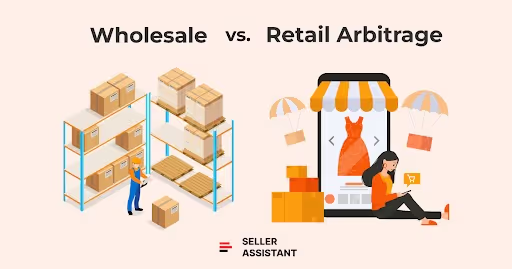
Wholesale vs. Retail Arbitrage
Both models can be viable options for you as an Amazon seller; however, the two models differ in certain critical business aspects, including:
- Inventory and Stock Availability
Retail Arbitrage: Facing Inventory Constraints
Retail arbitrage heavily depends on the availability of products in retail stores. Retailers often impose restrictions on bulk purchases or limit access to certain items, making inventory acquisition challenging. Also, with limited stock purchased on a small scale, you may quickly run out of popular products, restricting growth and scalability.
Wholesale: Stability Through Supplier Networks
In contrast, wholesale allows you to source products directly from various suppliers, lowering inventory risks. This diversity in sourcing from large-scale suppliers ensures a consistent product supply, enabling a more stable and scalable business model.
- Product Sourcing Process
Retail Arbitrage: A Time-Intensive Effort
The process of searching for deals in retail arbitrage is often time-consuming and unpredictable. Unlike wholesale, where successful products can be reordered in bulk, each item in retail arbitrage requires individual sourcing efforts.
Wholesale: Consistency and Opportunities
In wholesale, you can benefit from a steady product supply by building strong relationships with suppliers. These partnerships often unlock exclusive deals, discounts, or early access to products, providing a competitive edge.
- Profit Margins and Returns
Retail Arbitrage: Faster Returns but Variable Margins
Retail arbitrage offers the potential for quick turnover, especially for trending or seasonal items. However, profit margins can fluctuate significantly depending on the discounts obtained and market demand.
Wholesale: Predictable Profits and Long-Term Gains
Due to bulk purchasing, the wholesale model usually provides more stable profit margins. While returns on investment may take longer to show results, the model offers better opportunities for long-term profitability and growth.
- Operational Costs and Storage Needs
Retail Arbitrage: Low Overheads and Flexible Investments
Retail arbitrage is more accessible due to its lower initial costs. You can start with minimal investment and scale based on their financial capacity. Storage and logistical expenses remain low, especially when using Fulfillment by Amazon (FBA).
Wholesale: Higher Upfront Costs for Long-Term Revenue
Entering the wholesale market requires significant initial capital for bulk orders, ranging from a few thousand to tens of thousands of dollars. However, the gradual growth in ROI balances out these costs over time. You may have to bear additional expenses for warehousing and supplier management, but these investments often lead to better profitability.
- Growth and Expansion Potential
Retail Arbitrage: A Limited Growth Model
The scalability of retail arbitrage is limited by its reliance on discounted products and the effort required to source them. Managing inventory and scaling operations can become difficult, making it challenging to sustain long-term growth.
Wholesale: Potential for Expansion
Wholesale offers you a scalable business model based on the ability to streamline operations through supplier relationships and large-scale purchases. With dependable suppliers and consistent product lines, you can focus on expanding your inventory and upgrading processes for sustainable growth.
- Risks and Challenges
Retail Arbitrage: Low-Capital Risk with Market Uncertainty
While retail arbitrage carries smaller financial risk due to its low initial investment, it has its own challenges. These include unpredictable inventory availability, market saturation, and brand restrictions that can lead to legal issues.
Wholesale: Balancing High-Capital Risk and Growth Potential
Wholesale requires a considerable upfront investment, which can pose financial risks if products fail to sell. Moreover, acquiring products from unreliable suppliers can create risks related to quality control and supply chain disruptions, alongside the pressures of a competitive market.
- Long-Term Business Sustainability
Retail Arbitrage: A Short-Term Strategy
Retail arbitrage is best suited for those looking for short-term or supplementary income. However, its reliance on fluctuating market trends and intensive sourcing efforts limits its viability as a sustainable business model.
Wholesale: A Long-Term Strategy
Wholesale offers a sustainable approach, with opportunities for brand building and private labeling. This enhances business credibility and customer loyalty, making it a better option if you are seeking a consistent and reliable income stream.
Final Thoughts: Choosing the Right Model
The choice between retail arbitrage and wholesale depends on your resources, goals, and risk tolerance capacity. Retail arbitrage is ideal for beginners with limited capital seeking or those looking for quick entry into the Amazon marketplace. Meanwhile, wholesale offers greater scalability, stability, and long-term growth potential, although with a higher upfront investment.