

Amazon remains the largest marketplace for product resellers, but the numbers behind it are changing fast. In 2025, fewer sellers joined the platform while overall sales, traffic, and million-dollar businesses continued to grow.
For wholesale, online arbitrage, and dropshipping sellers, understanding these shifts is essential for making smarter sourcing, pricing, and expansion decisions.
In this post, we break down the most important Amazon statistics and trends for 2026 based primarily on Marketplace Pulse data, along with other recent industry reports. These figures reveal how big the opportunity really is, how competition is evolving, and what today’s Amazon marketplace means for resellers.
Amazon Marketplace Size and Growth
Amazon continues to dominate global ecommerce and remains the largest marketplace for independent sellers. In 2025, Amazon generated approximately $440 billion in U.S. ecommerce sales, accounting for 35.7% of the total U.S. online retail market.
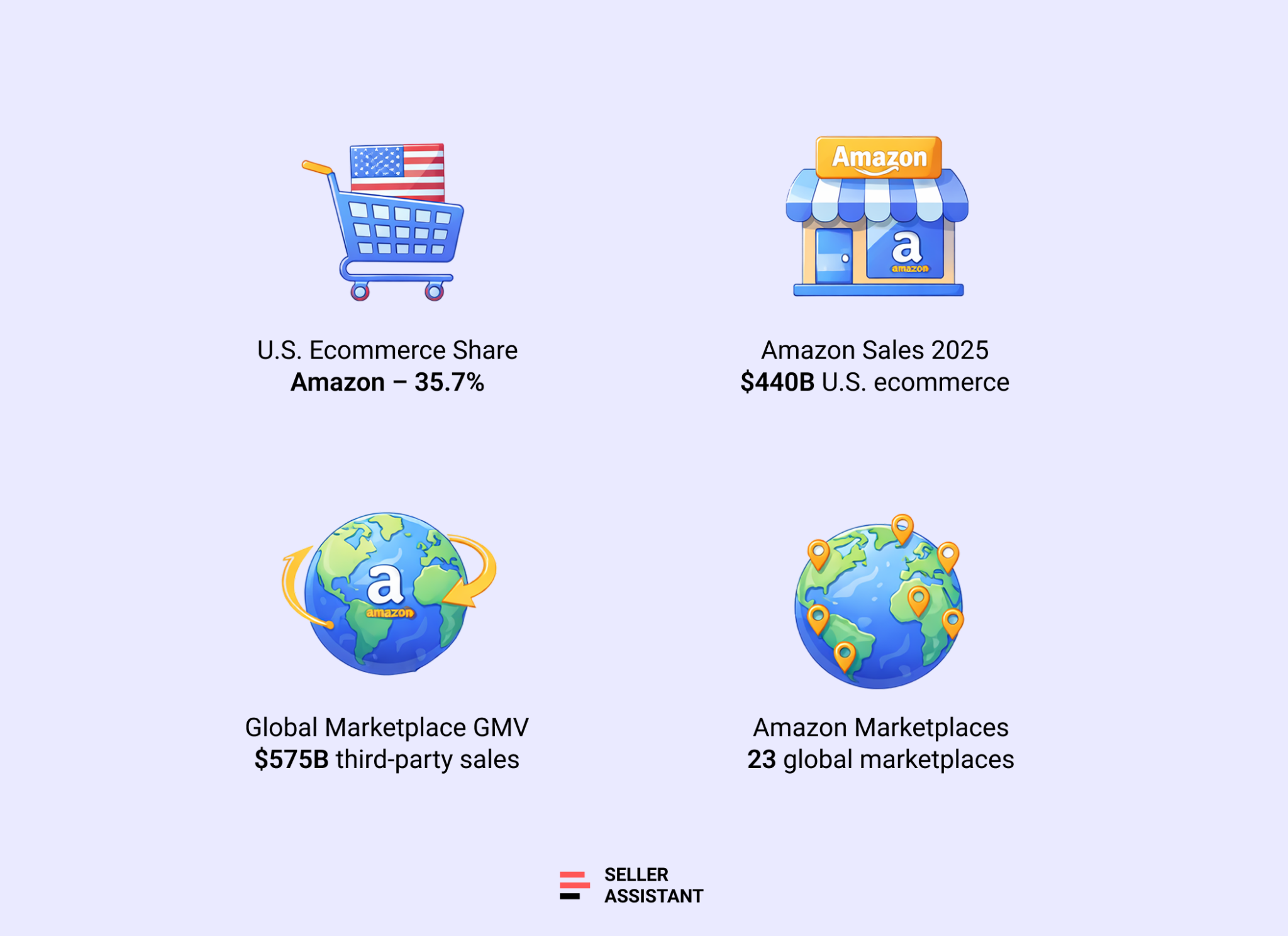
Together with Shopify – which holds around 14% of U.S. ecommerce – the two platforms now power nearly half of all U.S. online sales (49.7%). This concentration shows how much modern ecommerce relies on these two infrastructures.
Amazon’s marketplace is also the largest third-party ecommerce ecosystem in the world. According to Marketplace Pulse, third-party sellers generated about $575 billion in global gross merchandise value (GMV) in 2025. In the United States alone, third-party GMV reached approximately $305 billion.
Largest Amazon Marketplaces
| Marketplace | Estimated GMV |
|---|---|
| United States | $305B |
| United Kingdom | $54B |
| Germany | $51B |
| France | $38B |
| Italy | $30B |
For wholesale, online arbitrage, and dropshipping sellers, this scale represents massive demand. Millions of shoppers search Amazon daily, making it the primary sales channel for resellers across thousands of product categories.
Amazon Seller Statistics
Understanding how many sellers operate on Amazon – and how that number is changing – helps resellers evaluate the real level of competition on the platform. While Amazon still hosts millions of sellers worldwide, recent data shows that the marketplace is becoming less crowded in terms of new entrants but more competitive in terms of execution.
The number of new sellers joining Amazon declined significantly in 2025, while the number of high-performing sellers continued to grow. This shift signals a major transition – Amazon is evolving from a platform where anyone could experiment with ecommerce to one where long-term, well-run operations dominate.
Below are some of the most important Amazon seller statistics that illustrate how the marketplace is changing.
Active Amazon sellers
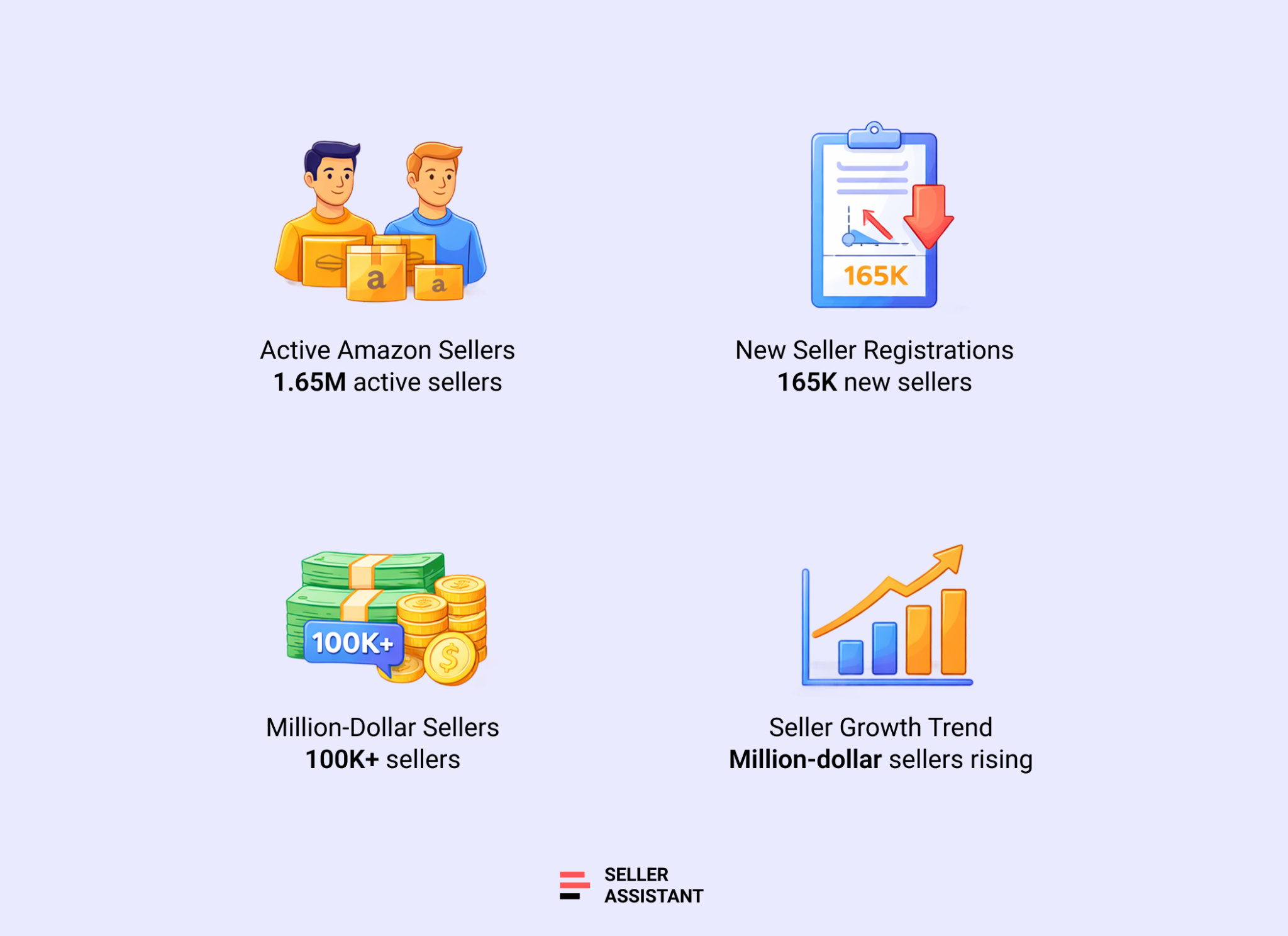
Amazon currently has about 1.65 million active sellers worldwide. Active sellers are defined as accounts that received at least one customer feedback rating in the past year, indicating that they generated sales.
Although this is still a massive seller base, the number has declined compared to previous years. In 2021, Amazon had around 2.4 million active sellers, meaning the marketplace has become more consolidated as weaker or inactive sellers leave the platform.
New seller registrations
Amazon registered approximately 165,000 new sellers in 2025, the lowest annual number recorded in the past decade. This represents a 44% decline compared to 2024.
The drop reflects increasing barriers to entry. Rising advertising costs, higher platform fees, and stronger competition make launching a profitable Amazon business more challenging than it was several years ago.
Million-dollar Amazon sellers
Despite fewer sellers entering the marketplace, the number of successful businesses continues to grow. More than 100,000 Amazon sellers now generate over $1 million in annual revenue, nearly doubling from around 60,000 sellers in 2021.
This trend highlights what analysts call the “competition paradox” – fewer sellers overall, but a growing number of large and highly optimized businesses capturing significant market share.
Amazon Revenue Distribution Among Sellers
Not all Amazon sellers earn the same revenue. In fact, sales on the marketplace follow a power-law distribution, where a relatively small group of sellers generates a large share of total revenue. Understanding how sales are distributed helps wholesale, online arbitrage, and dropshipping sellers set realistic expectations and identify where opportunities exist.
While millions of sellers operate on Amazon, a much smaller group reaches high revenue levels. At the same time, the number of large sellers continues to grow as experienced businesses scale their operations and capture more demand.
Million-dollar sellers
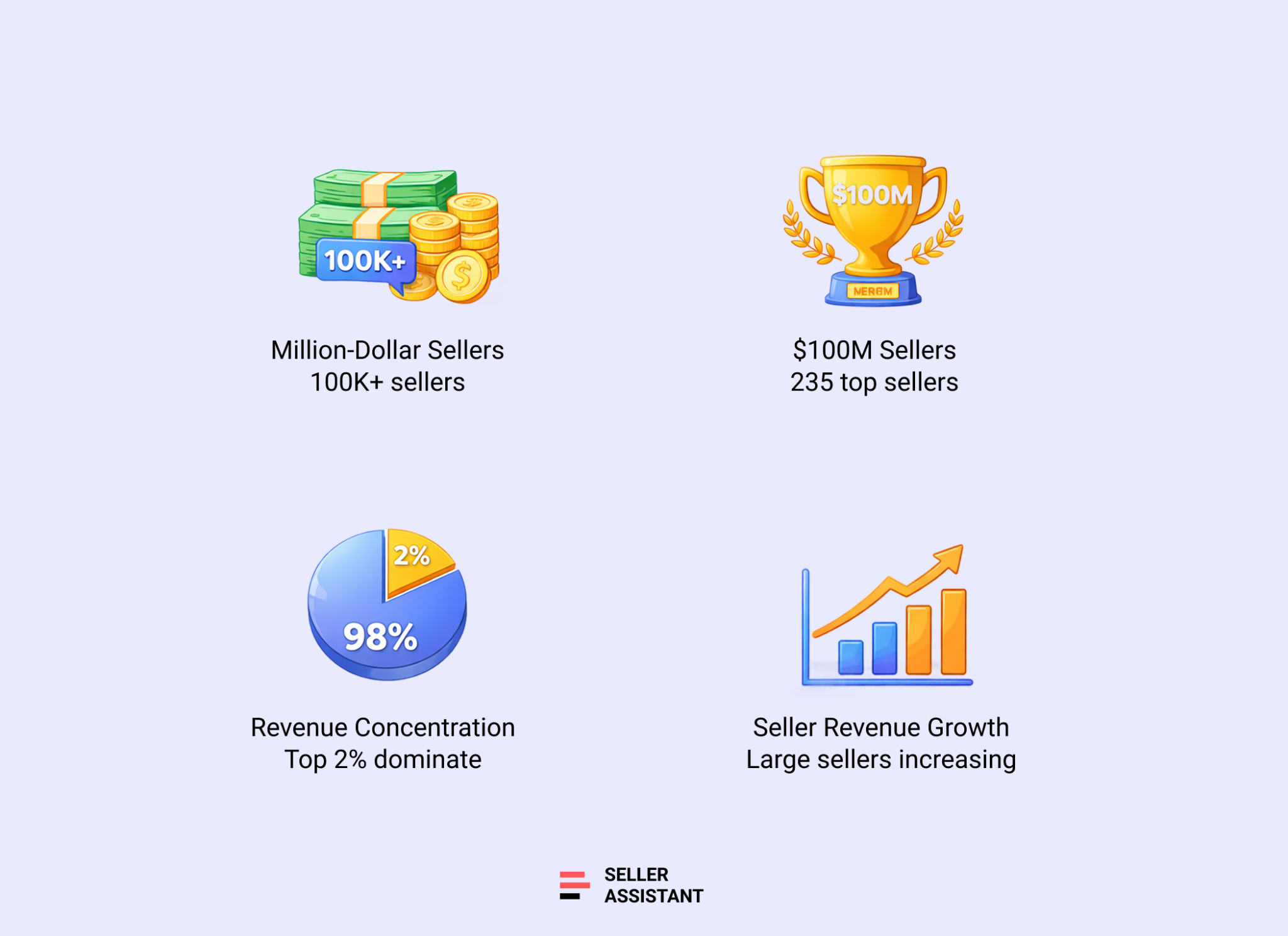
Amazon now has more than 100,000 sellers generating over $1 million in annual revenue. Just a few years ago, that number was closer to 60,000 sellers, which shows how quickly successful Amazon businesses are scaling.
This growth reflects the increasing professionalization of the marketplace. Many of these businesses operate sophisticated sourcing, pricing, and advertising strategies that allow them to expand product catalogs and capture larger portions of marketplace demand.
$100 million sellers
At the very top of the marketplace, a small group of sellers generates extremely large revenue. Around 235 Amazon sellers now generate more than $100 million per year, compared to roughly 50 sellers only a few years ago.
These companies often operate as large ecommerce brands or major retail operations with extensive supply chains and advanced logistics.
Revenue concentration
Amazon sales are heavily concentrated among top-performing sellers. In the United States marketplace, approximately 2% of sellers generate more than 50% of total marketplace revenue.
This means that while the marketplace is highly competitive, there is still significant room for growth for sellers who build efficient sourcing and operational strategies.
Amazon Traffic and Customer Demand
Amazon’s massive customer traffic is one of the main reasons the marketplace remains attractive for wholesale, online arbitrage, and dropshipping sellers. Millions of shoppers visit Amazon every day looking for products across thousands of categories. This constant demand allows resellers to reach large audiences without building their own ecommerce traffic.
According to estimates, Amazon.com receives about 2.69 billion monthly visits, making it one of the most visited retail websites in the world. This enormous traffic volume creates significant sales potential for sellers who can compete effectively in their categories.
Another important trend is that traffic per seller has increased in recent years. Since 2021, traffic available per active seller has grown by roughly 31% as the total number of sellers declined while overall marketplace demand continued to expand.
For resellers, this means that although Amazon remains competitive, the platform still offers strong customer demand and consistent purchasing activity.
Amazon traffic statistics
| Metric | Value |
|---|---|
| Monthly Amazon traffic | 2.69B monthly visits |
| Traffic per seller growth | +31% since 2021 |
| U.S. traffic density | 4,900 visits per seller |
| Customer search demand | Billions of product searches |
Traffic per seller
Marketplace Pulse analysis shows that the U.S. marketplace generates about 4,900 visits per active seller on average each month. This high traffic density helps explain why the United States remains the most attractive marketplace for product resellers.
Large traffic volumes also allow sellers to operate in specialized niches where even relatively small search demand can support a profitable product.
Amazon Seller Success Rates
Launching a successful Amazon business depends on many factors – product selection, pricing, sourcing strategy, and operational execution. However, marketplace data shows that a significant share of new sellers still manage to generate their first sale within the first year.
The United States remains the easiest marketplace for new sellers to gain initial traction. The large customer base and extremely high search volume allow even niche products to find buyers.
At the same time, success rates vary widely across different Amazon marketplaces. Smaller markets typically have lower search demand, which makes it harder for new listings to gain visibility and generate early sales.
For wholesale, online arbitrage, and dropshipping sellers, this means that starting in the U.S. marketplace often provides the best opportunity to test new products and validate demand.

First-year seller success rates
Marketplace Pulse data shows that around 60% of new sellers in the United States make their first sale within the first year. In comparison, success rates are significantly lower in some other major marketplaces.
For example, roughly 42% of new sellers in Germany and 33% in the United Kingdom generate their first sale within the first year after registering.
These differences highlight the importance of marketplace selection when launching or expanding an Amazon business.
Why sellers start in the U.S.
| Factor | Advantage |
|---|---|
| Marketplace size | Largest Amazon marketplace |
| Customer demand | Highest search volume |
| Product niches | More micro-niche opportunities |
| Sales validation | Faster product testing |
Amazon Fees and Marketplace Economics
Selling on Amazon provides access to enormous customer demand, but it also involves a complex cost structure that directly affects seller profitability. Over time, Amazon has expanded the number of services that sellers rely on – including fulfillment, advertising, logistics, and data tools. As a result, the economics of selling on Amazon have shifted significantly over the past decade.
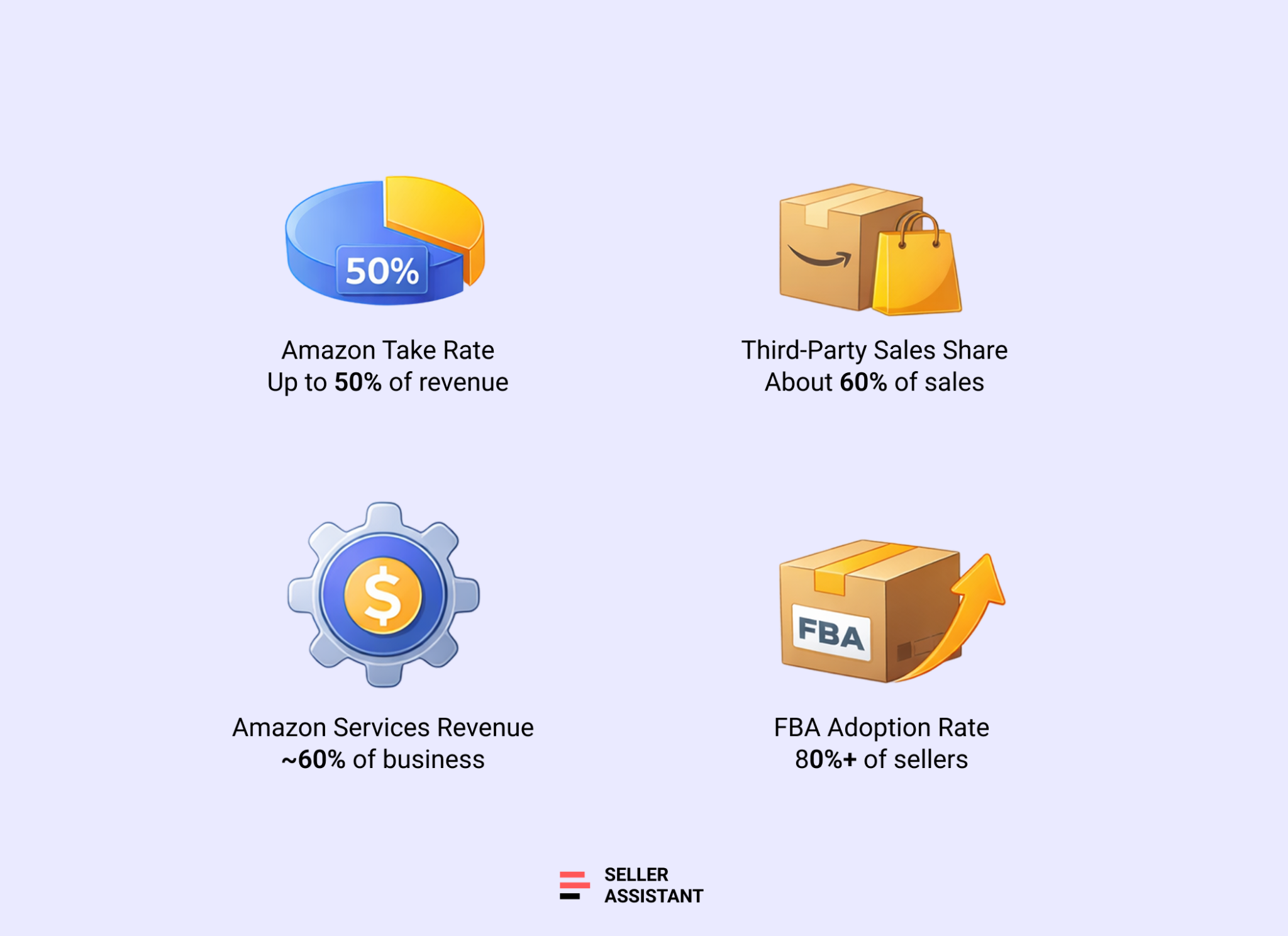
Amazon’s effective take rate can exceed 50% of a product’s revenue once all major seller expenses are included. These costs typically combine referral fees, Fulfillment by Amazon (FBA) fees, advertising spend, and other operational services required to remain competitive on the platform.
For wholesale, online arbitrage, and dropshipping sellers, this means profitability depends heavily on accurate sourcing, careful cost analysis, and efficient operations.
Amazon’s services-driven business model
Amazon has long generated a large share of its revenue from services provided to sellers, including advertising, logistics, fulfillment, and seller subscriptions. According to Marketplace Pulse analysis, around 60% of Amazon’s business now comes from services, while about 40% comes from retail operations.
These services – particularly Fulfillment by Amazon (FBA) and Amazon’s advertising platform – form the core infrastructure that supports millions of marketplace sellers. Through this system, independent sellers supply much of the product selection, while Amazon provides the marketplace, logistics network, and customer traffic that power the ecosystem.
Third-party sellers dominate Amazon sales
Independent sellers play a central role in Amazon’s marketplace ecosystem. In recent years, third-party sellers have consistently accounted for about 60% of all products sold on Amazon.
This share has steadily increased over time as Amazon expanded its marketplace model and encouraged independent sellers to provide more product selection.
For resellers, this statistic confirms that the majority of products purchased on Amazon are supplied by businesses like wholesale distributors, online arbitrage sellers, and dropshippers rather than Amazon itself.
Fulfillment by Amazon adoption
Fulfillment by Amazon has become the standard logistics solution for many sellers. Industry estimates suggest that more than 80% of Amazon sellers use FBA for at least part of their inventory.
Using FBA allows sellers to offer Prime shipping, improve Buy Box eligibility, and simplify order fulfillment. However, it also introduces additional fulfillment and storage costs that sellers must factor into their pricing strategy.
Global Competition and International Expansion
Amazon is a global marketplace, but most sellers still operate in only one region. At the same time, international competition continues to grow as sellers from different countries expand into new marketplaces.
69% of Amazon sellers operate in only one marketplace, while only a small share of sellers expand into multiple international regions. This hesitation to expand globally creates opportunities for sellers who are willing to navigate logistics, compliance requirements, and localization challenges.
However, the global Amazon ecosystem has also become more competitive, particularly due to the rapid growth of Chinese sellers across international marketplaces.
Global Amazon seller statistics
| Metric | Value |
|---|---|
| Single-marketplace sellers | 69% sell in one marketplace |
| Chinese seller share | 50%+ of sellers |
| New Chinese sellers | 59.9% of registrations |
| Amazon marketplaces | 23 global marketplaces |
Chinese sellers on Amazon
Chinese merchants now represent a major portion of the global Amazon seller base. Chinese sellers account for more than 50% of active Amazon sellers worldwide.
Chinese businesses also dominate new seller registrations. In 2025, about 59.9% of new Amazon seller accounts were registered by Chinese sellers, while U.S. sellers accounted for roughly 16.3%.
One reason for this strong presence is supply chain proximity. Many Chinese sellers work directly with manufacturers or operate as manufacturers themselves, which allows them to control production costs and launch products quickly.
Despite this competitive advantage, U.S.-based sellers often generate higher average revenue. Marketplace Pulse estimates that the average U.S. Amazon seller generates about $884,000 in revenue, compared with around $393,000 for Chinese sellers.
International marketplace opportunities
Amazon currently operates 23 marketplaces worldwide, but most sales remain concentrated in a handful of major regions such as the United States, the United Kingdom, and Germany.
Because many sellers remain focused on a single marketplace, expanding into international markets can provide additional growth opportunities. Sellers who understand regional regulations, logistics, and customer preferences may face less direct competition compared to highly saturated marketplaces.
For wholesale, online arbitrage, and dropshipping sellers, international expansion can also provide access to new product demand and pricing opportunities across different markets.
What These Amazon Statistics Mean for Sellers
Competition is becoming more professional
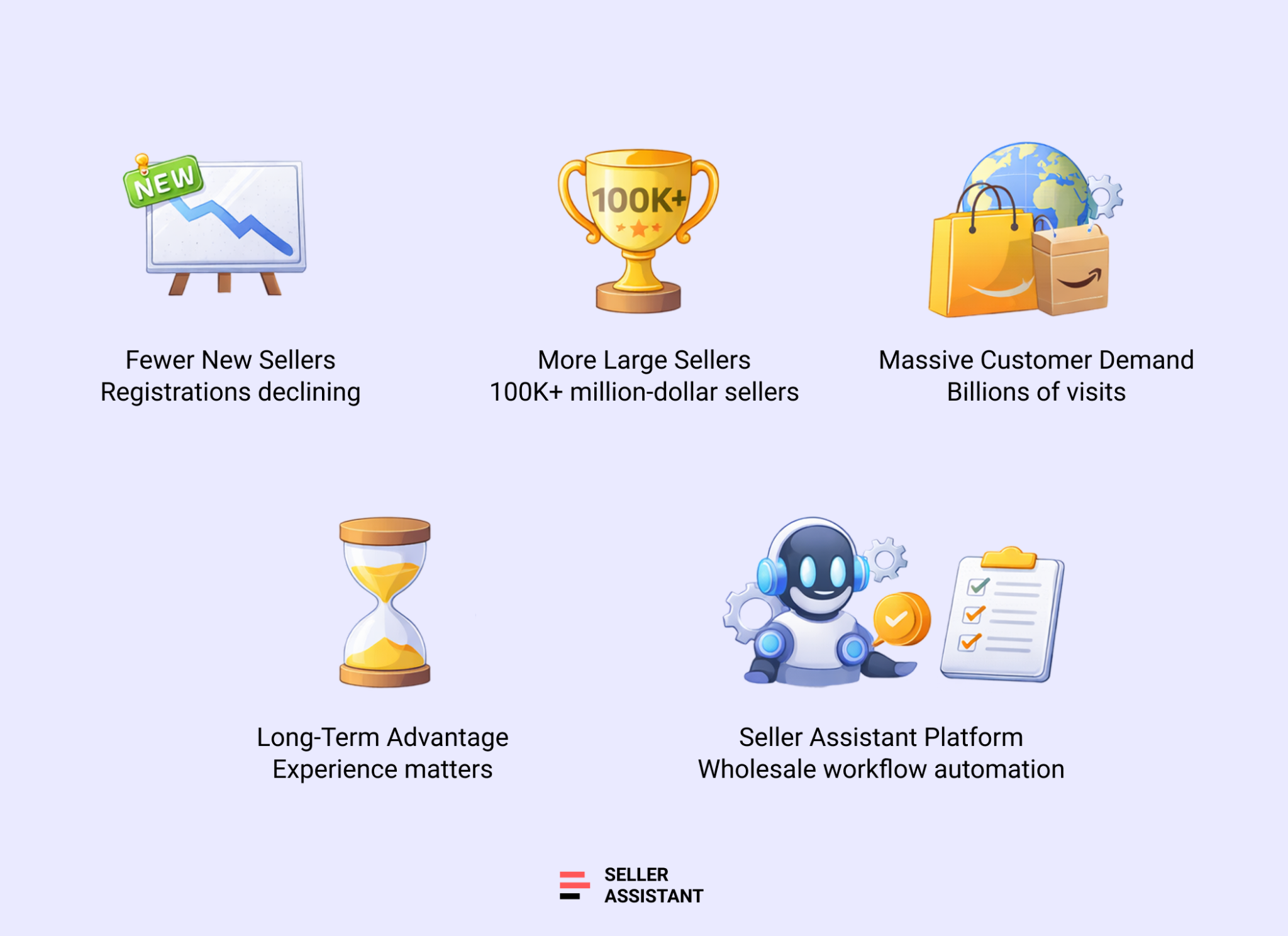
Amazon’s marketplace continues to grow, but the data shows that the environment for sellers is changing. Fewer new sellers are entering the platform, while established businesses are scaling faster and capturing a larger share of revenue. For wholesale, online arbitrage, and dropshipping sellers, these trends highlight the importance of operating efficiently and making data-driven decisions.
Established sellers are scaling faster
One clear takeaway is that competition on Amazon is becoming more professional. While the number of active sellers has declined in recent years, the number of million-dollar sellers continues to rise. This means success increasingly depends on strong product sourcing, pricing strategies, and operational efficiency rather than simply listing products.
Automation tools are becoming essential
As Amazon competition grows more sophisticated, many sellers rely on automation tools to manage key tasks such as product sourcing, competitor analysis, Buy Box monitoring, and profitability calculations. These tools help sellers evaluate large product catalogs and make faster, data-driven decisions in a marketplace where pricing and demand change constantly.
Platforms like Seller Assistant provide an end-to-end workflow system designed for wholesale and arbitrage sellers. The platform combines sourcing automation, bulk research tools, and browser extensions that help sellers analyze products, evaluate supplier price lists, check restrictions, and manage suppliers and purchase orders within one connected workflow.

Customer demand remains massive
Another key insight is that Amazon still offers enormous demand. Billions of monthly visits and strong first-sale success rates show that the marketplace continues to provide significant opportunities for sellers who can identify profitable products and manage their costs effectively.
Long-term strategy creates advantages
Finally, the data suggests that long-term strategy matters more than quick experimentation. Many of the most successful sellers have been operating on the platform for years, building reviews, supplier relationships, and optimized operations that allow them to scale over time.
FAQ
How many sellers are currently active on Amazon?
Amazon has about 1.65 million active sellers worldwide, according to Marketplace Pulse estimates. Active sellers are accounts that received at least one customer feedback rating in the past year.
How many new sellers join Amazon each year?
In 2025, about 165,000 new sellers registered on Amazon, the lowest number recorded in the past decade. This decline reflects increasing competition and higher operational requirements for new sellers.
What percentage of Amazon sales come from third-party sellers?
Independent sellers generate roughly 60% of all products sold on Amazon. This shows how central third-party sellers are to the marketplace ecosystem.
How much traffic does Amazon receive each month?
Amazon.com receives around 2.69 billion monthly visits, making it one of the largest ecommerce websites in the world. This massive traffic creates strong demand for products sold by marketplace sellers.
Why do many Amazon sellers use automation tools?
Automation tools help sellers analyze products, track competitors, and calculate profitability more efficiently. These tools allow wholesale and arbitrage sellers to evaluate large product catalogs and make faster sourcing decisions.
Final Thoughts
Amazon remains the largest marketplace for independent sellers, but the numbers show that the platform is evolving. While fewer new sellers are joining, overall sales, traffic, and the number of million-dollar businesses continue to grow. This means the opportunity on Amazon is still significant, but success increasingly depends on strong sourcing strategies, efficient operations, and data-driven decision-making.
For wholesale, online arbitrage, and dropshipping sellers, understanding marketplace statistics helps reveal where opportunities still exist and how competition is changing. Sellers who leverage automation tools like Seller Assistant, analyze market data, and focus on long-term growth are better positioned to build sustainable Amazon businesses in an increasingly sophisticated marketplace.