

Finding products for Amazon wholesale is easy. Turning a wholesale brand into consistent, profitable deals is where the real challenge begins.
Sellers often spend hours contacting suppliers, opening accounts, and reviewing huge product catalogs, only to discover weak margins, heavy competition, or products that carry unnecessary risk. The difference between random sourcing and scalable sourcing is having a process.
In this post, we’ll show how Seller Assistant helps connect every stage of the workflow – from validating a wholesale brand and finding suppliers to analyzing catalogs and uncovering profitable, lower-risk opportunities – so you can move from brand research to best deals faster.
Note. Seller Assistant is an end-to-end Amazon workflow management platform that integrates 15+ wholesale-focused solutions into one connected system. It combines sourcing workflow automation, bulk research and intelligence tools, and integrated Chrome extensions – giving you everything you need to streamline finding deals, managing suppliers, and creating purchase orders.

With Seller Assistant, every step of your Amazon wholesale and arbitrage workflow is automated and connected.
How Wholesale Brands Become Profitable Amazon Deals
Turning a wholesale brand into profitable Amazon deals is the process sellers use to identify strong brand opportunities, find legitimate suppliers, organize supplier relationships, and analyze products before investing in inventory. Instead of searching for random products, sellers build a structured sourcing pipeline that helps them consistently discover products that fit their profitability and risk criteria.
How the process works
In a typical Amazon wholesale workflow, sellers begin by researching a brand to determine if it is worth selling. After validating demand, competition, catalog depth, and reseller viability, they look for manufacturers, distributors, or wholesalers connected to that brand. Once suppliers are identified, sellers organize supplier information and manage outreach, then analyze supplier catalogs to uncover profitable, high-demand, lower-risk products before making purchasing decisions.
Why this process matters for Amazon sellers
Building a reliable sourcing process directly affects profitability, inventory consistency, and long-term growth. Choosing weak brands, working with the wrong suppliers, or missing risks hidden inside supplier catalogs can quickly lead to wasted time, lower margins, and expensive sourcing mistakes.
Why wholesale sourcing must be a connected workflow
As Amazon businesses grow, sourcing becomes harder to manage through spreadsheets, browser tabs, and disconnected tools. Brand research, supplier discovery, supplier management, and product analysis need to remain connected throughout the process. Seller Assistant helps Amazon wholesale sellers, online arbitrage sellers, and dropshippers organize these stages into one workflow and move from brand research to profitable deals faster.
Why Amazon Sellers Need a Brand-to-Deal Workflow
Finding products for Amazon wholesale may seem straightforward when you’re working with a few suppliers or testing a small number of brands. But as your business grows, brand research, supplier discovery, price lists, and product analysis become much harder to manage manually. More brands, larger supplier catalogs, and increasing product opportunities create too many moving parts to track across spreadsheets, browser tabs, and scattered notes.
What starts as a simple sourcing process often turns into disconnected research, inconsistent decisions, and missed opportunities that directly affect profitability and growth.
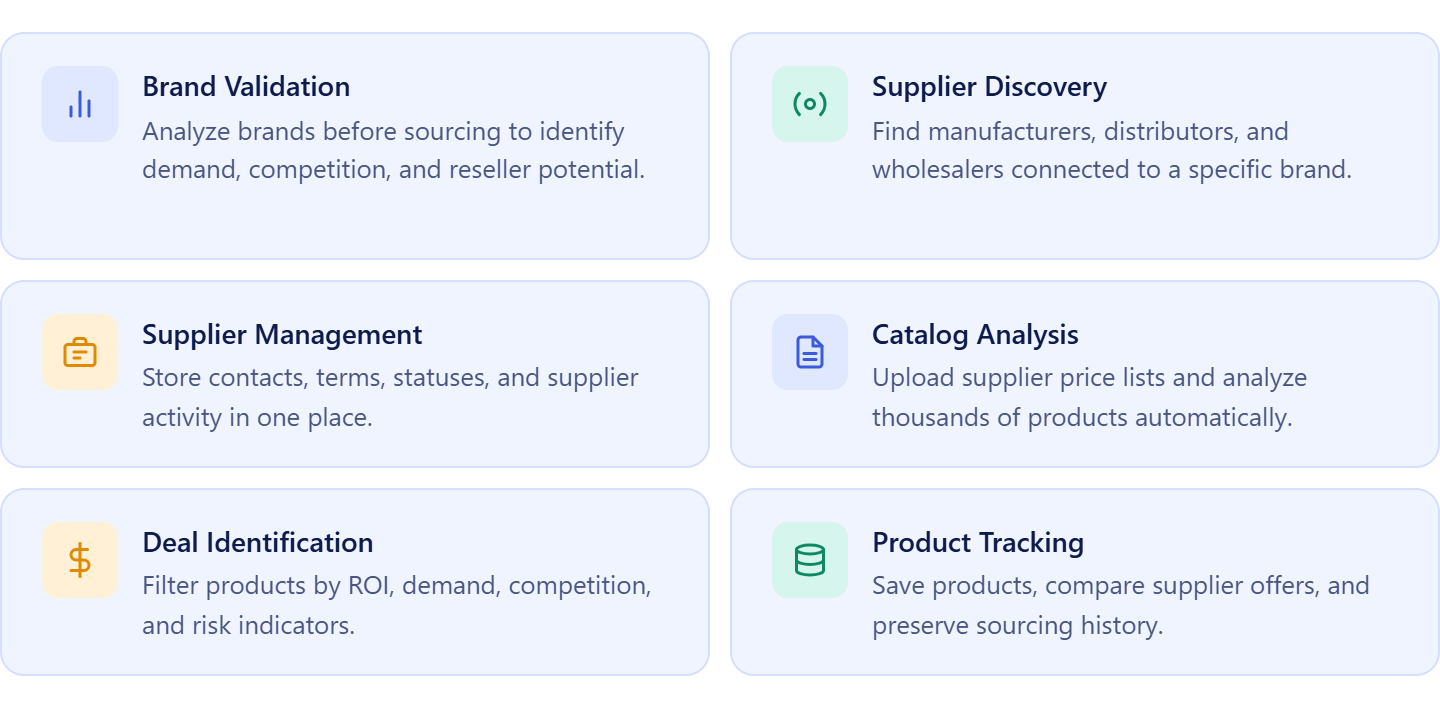
Brand selection becomes guesswork
Many sellers jump into product research or contact suppliers before understanding whether the brand itself is worth selling. This often leads to wasted time opening accounts for brands with low demand, heavy Amazon competition, or limited long-term potential.
Supplier discovery becomes slow and inconsistent
Manual searches often produce marketplaces, retail websites, and irrelevant results. Sellers can spend hours filtering websites and trying to determine which businesses actually support wholesale relationships.
Supplier information becomes difficult to manage
As the number of suppliers grows, contacts, payment terms, outreach history, and supplier catalogs quickly become scattered across emails and spreadsheets. This makes supplier relationships harder to maintain and increases the chance of missing important information.
Large catalogs create sourcing bottlenecks
Supplier price lists can contain hundreds or thousands of products. Reviewing products one by one, calculating profitability, checking Buy Box conditions, and identifying risks manually slows sourcing and limits how many opportunities sellers can evaluate.
Product decisions become harder to track
The same ASIN may appear from multiple suppliers with different costs and conditions. Without a structured system, sellers can lose pricing history, repeat research, or miss better buying opportunities.
Sourcing needs a connected workflow
As sourcing becomes more complex, it must function as a structured process rather than disconnected tasks. Brand validation, supplier discovery, supplier management, and product analysis need to stay connected so sellers can move from wholesale brands to profitable Amazon deals faster and with fewer mistakes.
Building a Connected Brand-to-Deal Workflow with Seller Assistant
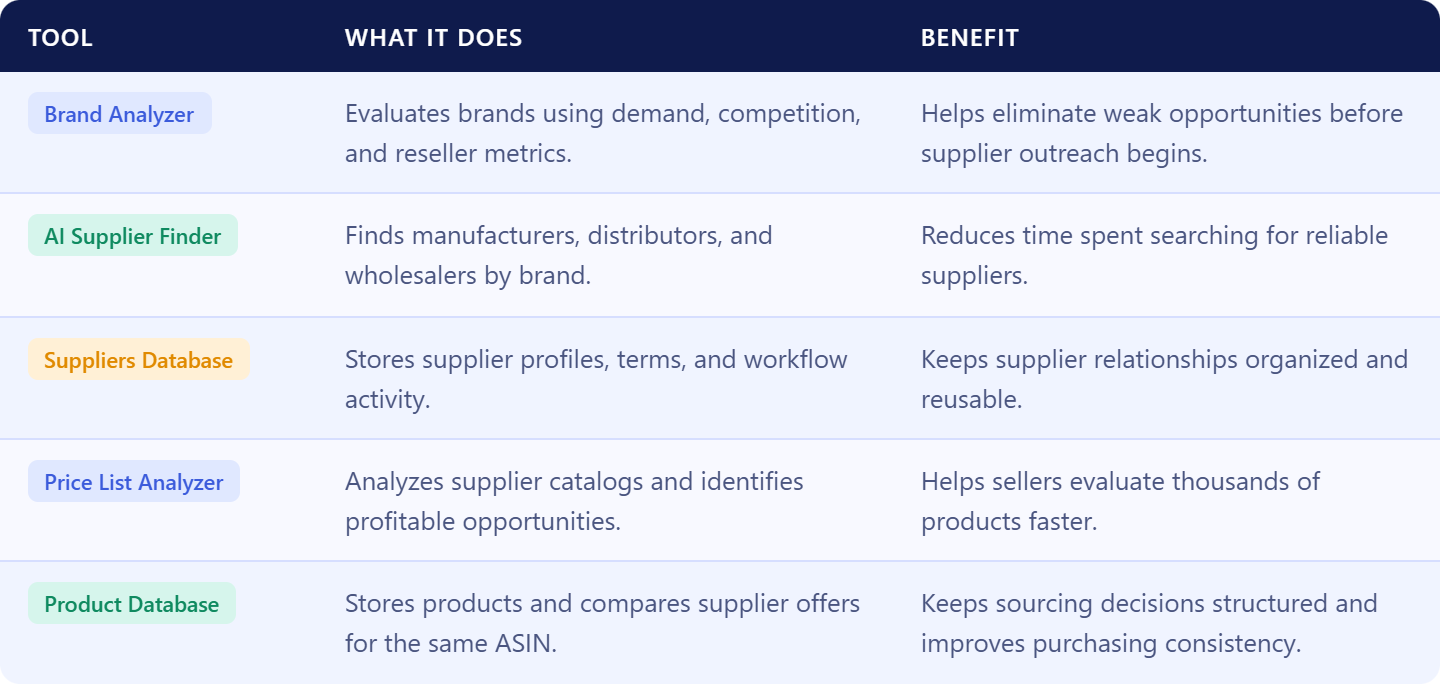
A typical Amazon wholesale workflow starts with Brand Analyzer, where sellers determine if a brand is actually worth pursuing based on demand, competition, Amazon presence, and catalog depth.
Once a brand meets sourcing criteria, AI Supplier Finder helps locate manufacturers, distributors, and wholesalers connected to that brand. Suppliers can then be added to Suppliers Database, where contacts, terms, and workflow activity stay organized.
When suppliers send catalogs, Price List Analyzer automatically evaluates large product lists and highlights profitable, high-demand, lower-risk opportunities. Products are then automatically saved to Product Database, where sellers can compare supplier offers, preserve sourcing history, and continue into purchasing workflows.
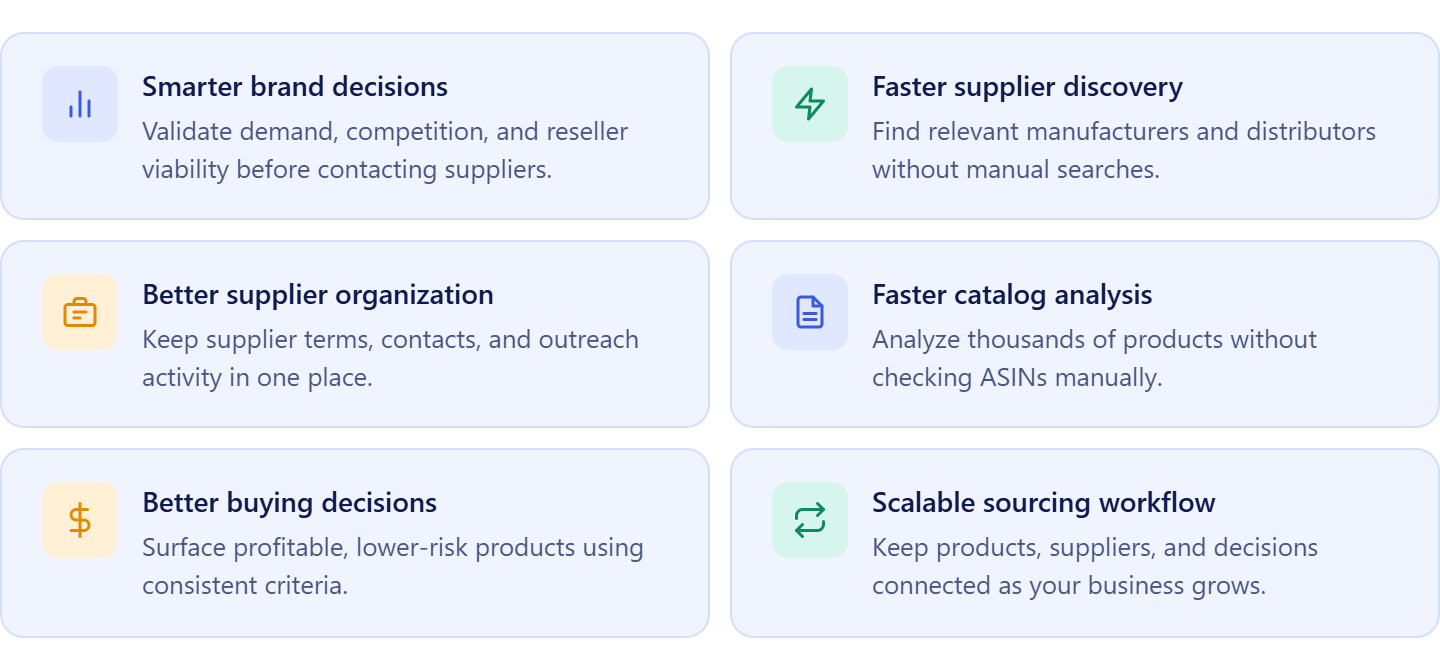
Benefits of a connected brand-to-deal workflow
What Seller Assistant tools support the brand-to-deal workflow
How Seller Assistant Turns Wholesale Brands into Profitable Deals
Finding profitable products starts long before you upload a supplier catalog or place a purchase order. Amazon wholesale sellers first need to identify brands worth selling, find legitimate suppliers, organize supplier relationships, and analyze products before investing in inventory. Without a structured process, sourcing quickly turns into disconnected research, repeated work, and missed opportunities.
Seller Assistant connects these stages into one workflow, helping sellers move from brand research to profitable deals without rebuilding information at every step.
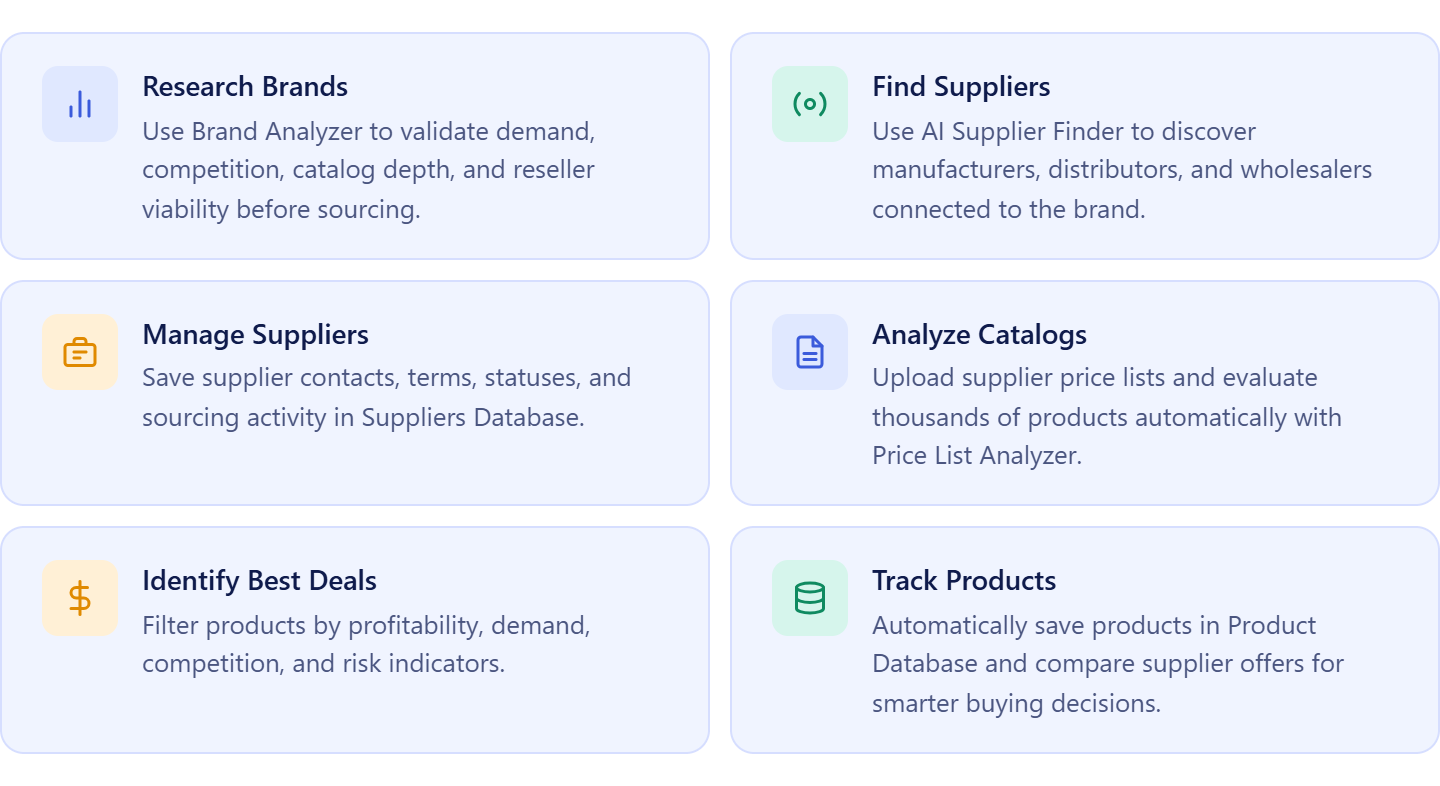
Sellers begin with Brand Analyzer, where they evaluate demand, competition, Amazon presence, catalog size, and reseller viability before spending time contacting suppliers. Instead of analyzing products one by one or opening accounts blindly, they can quickly eliminate brands with weak demand, strong Amazon Retail competition, or limited long-term potential.
Once a brand meets sourcing criteria, AI Supplier Finder helps identify manufacturers, distributors, and wholesalers connected to that brand. This removes much of the manual work involved in supplier discovery and helps sellers focus on supplier opportunities that support wholesale relationships.
After identifying potential partners, suppliers can be saved directly into Suppliers Database, where contact details, statuses, payment terms, minimum order values (MOV), lead times, and other operational information stay organized in one place. This creates a structured sourcing pipeline instead of relying on spreadsheets and scattered notes.
When suppliers send catalogs, sellers upload them into Price List Analyzer , where products are automatically matched with Amazon listings and enriched with profitability, demand, competition, and risk data. Sellers can quickly filter out restricted products, weak opportunities, and high-risk ASINs while surfacing products that match their sourcing criteria.
Products are automatically stored in Product Database, where supplier offers, cost data, notes, and sourcing decisions remain connected. Sellers can compare multiple offers for the same ASIN, choose the most profitable supplier, and continue directly into purchasing workflows.
This connected workflow allows Amazon wholesale sellers, online arbitrage sellers, and dropshippers to move from wholesale brand research to profitable deals through one consistent and scalable sourcing process.
What Is Brand Analyzer?
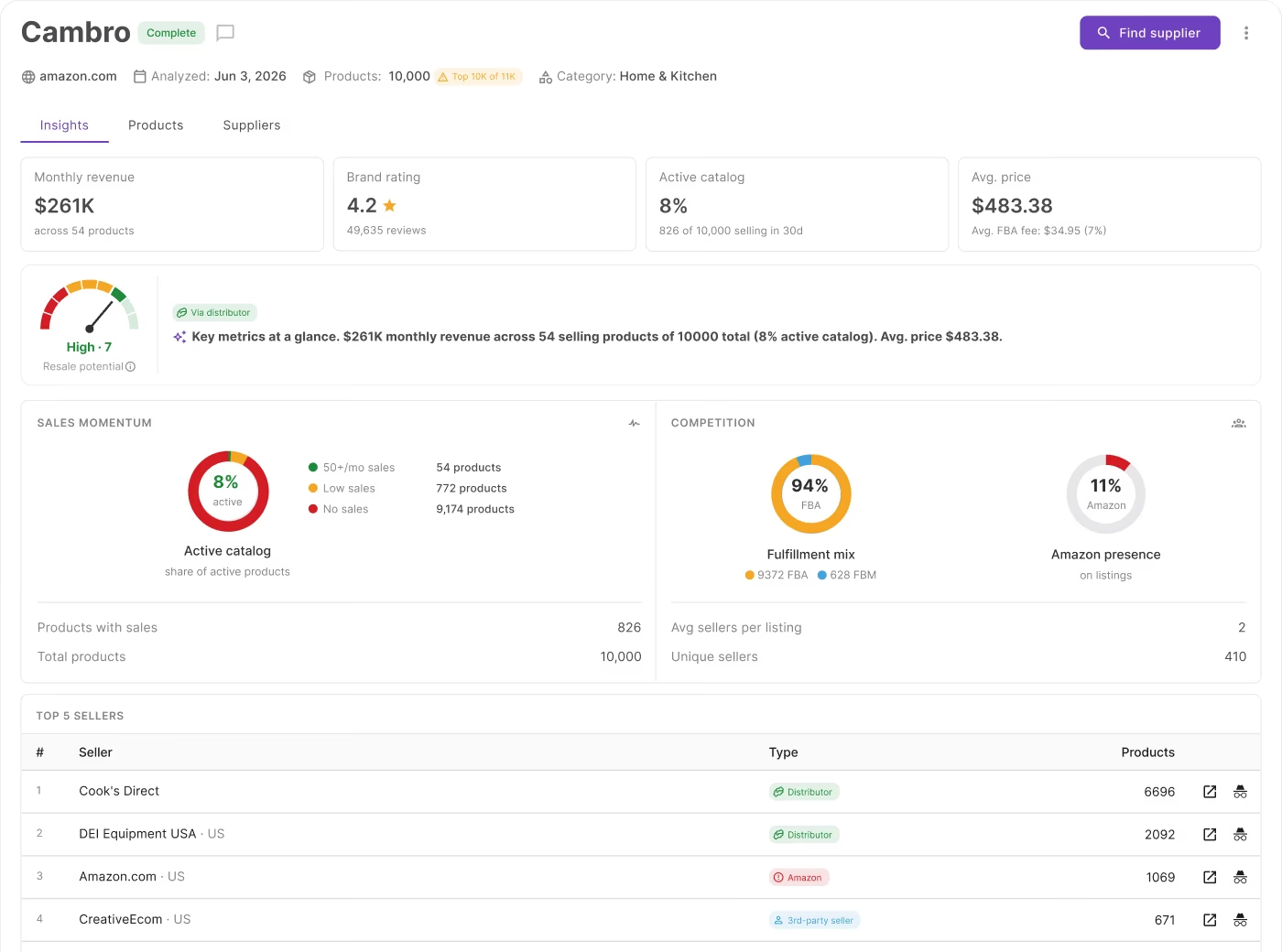
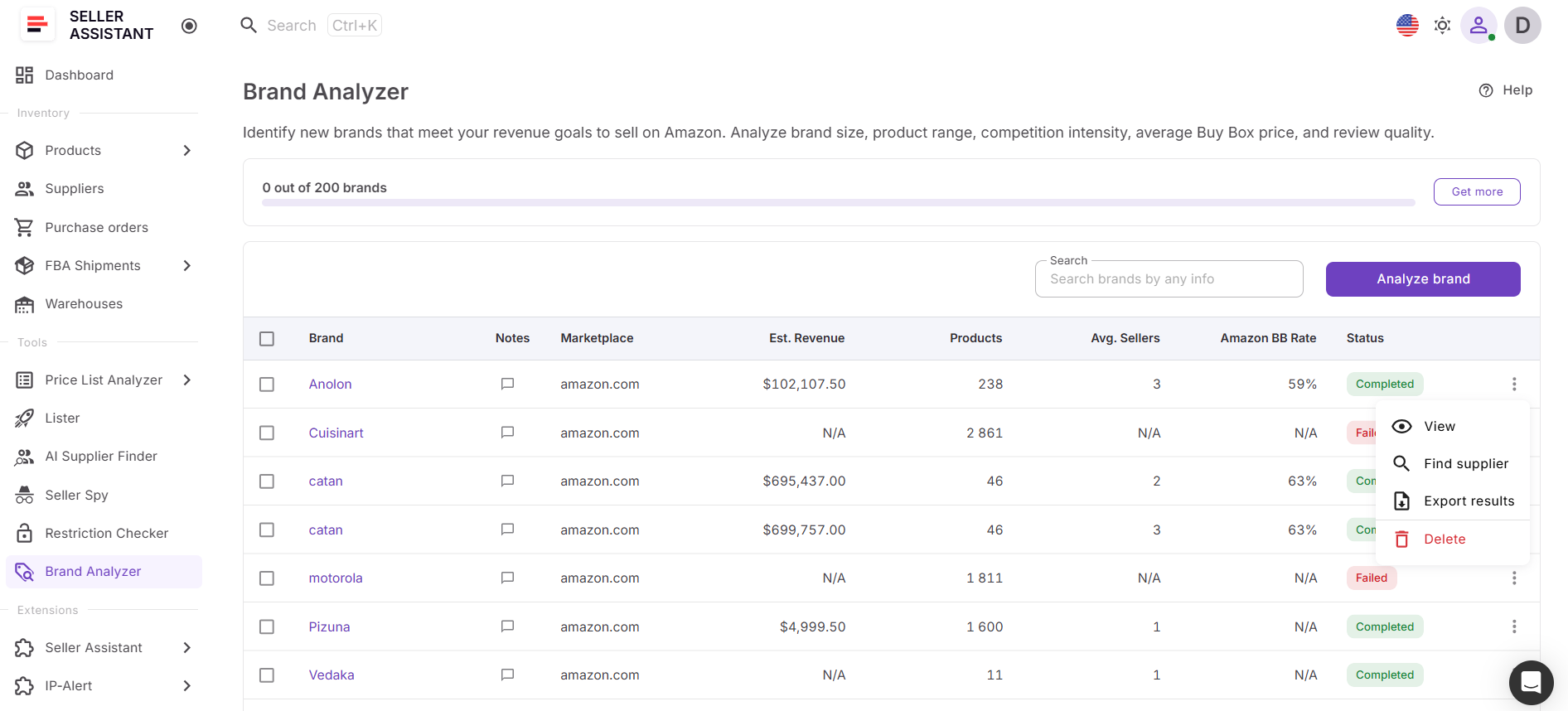
Brand Analyzer is Seller Assistant’s brand research and qualification tool designed for Amazon wholesale sellers, online arbitrage sellers, and dropshippers who want to identify profitable sourcing opportunities before investing time in suppliers or inventory.
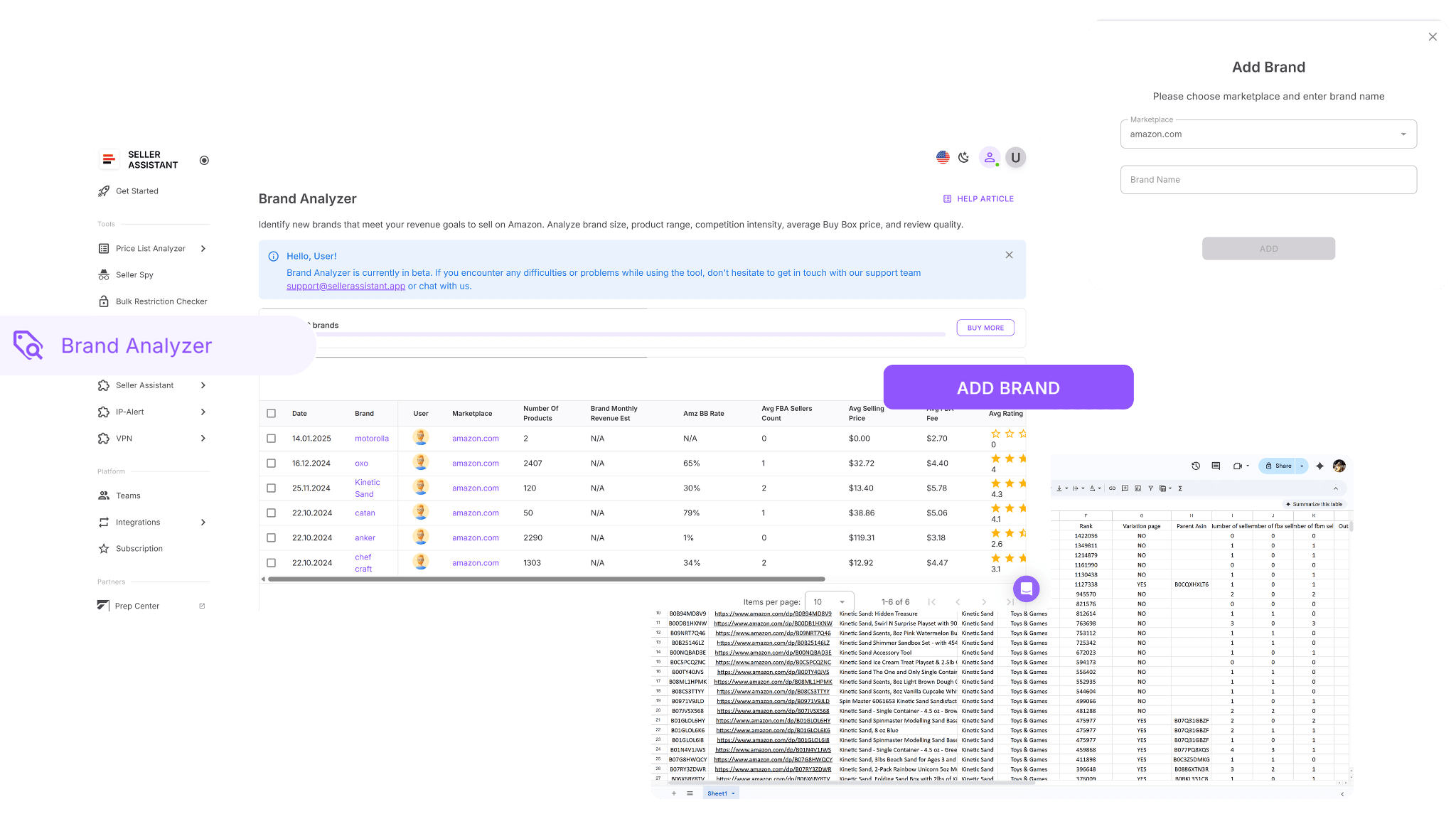
Instead of analyzing individual products one by one, Brand Analyzer evaluates an entire brand and brings together key metrics such as demand, competition, revenue potential, pricing behavior, catalog size, and reseller viability in one place. This helps sellers understand whether a brand is worth pursuing before moving into supplier search and product-level analysis.
What Brand Analyzer does
Brand Analyzer helps sellers quickly qualify or eliminate brands using structured brand-level data instead of manual product research.
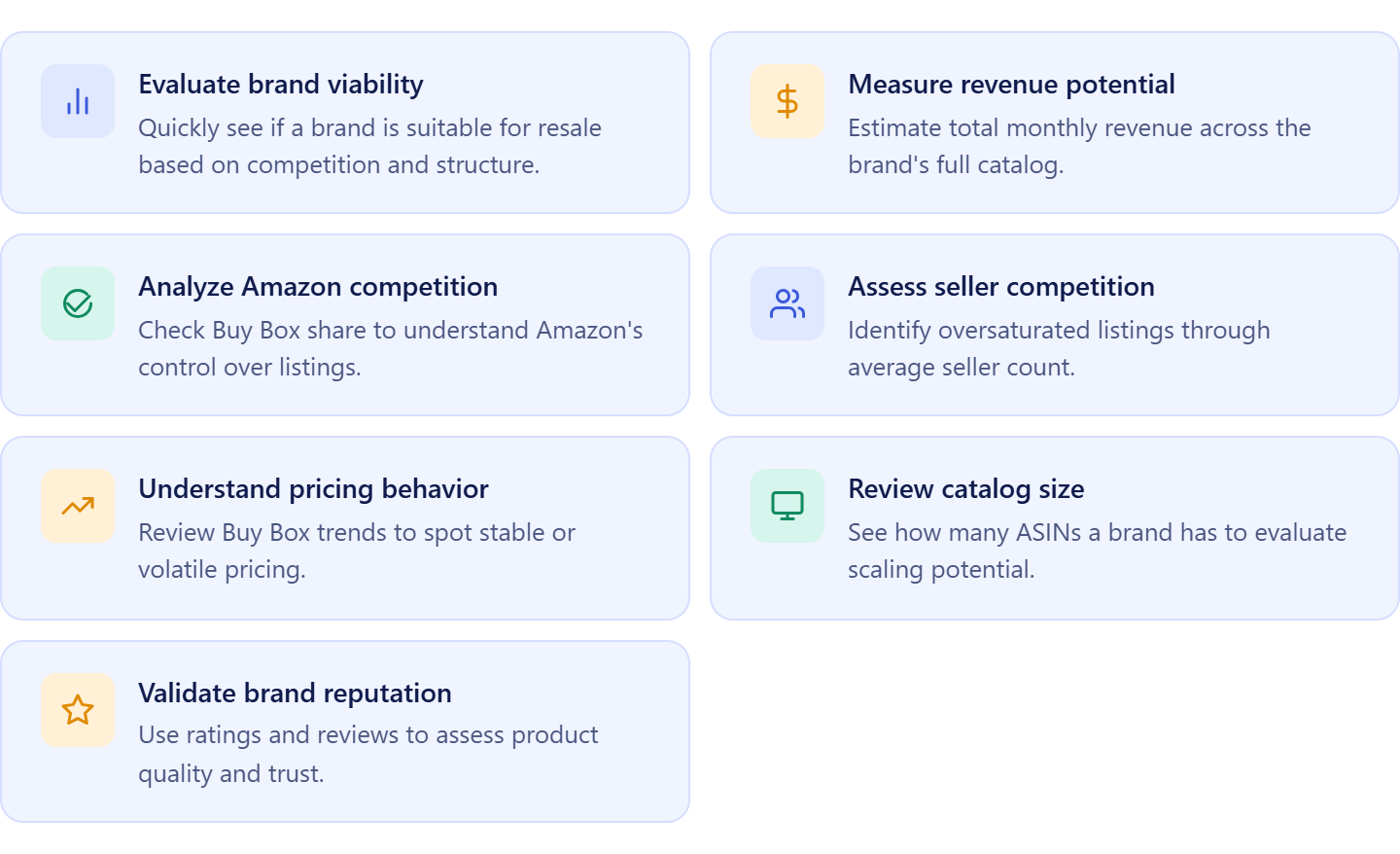
It allows sellers to:
- Evaluate reseller viability by analyzing Amazon presence, competition levels, and catalog structure;
- Measure estimated revenue potential across an entire brand portfolio;
- Analyze Amazon Buy Box share to identify Amazon Retail competition;
- Review average seller counts to detect oversaturated or highly competitive brands;
- Analyze Buy Box pricing and historical trends to understand pricing stability and margin potential;
- Assess catalog depth by reviewing the total number of products and ASINs;
- Check brand ratings and review volume to evaluate reputation and customer trust;
- Access brand-level and product-level insights in one place before contacting suppliers;
- Quickly eliminate weak opportunities before moving into supplier discovery and product sourcing.
How Brand Analyzer turns brands into best deals
Brand Analyzer acts as the starting point of the sourcing workflow by helping sellers focus only on brands that fit their business criteria. Instead of opening accounts and contacting suppliers blindly, sellers can quickly eliminate brands with weak demand, heavy Amazon competition, or limited growth potential.
Once a brand qualifies, sellers can move directly into AI Supplier Finder to locate manufacturers, distributors, and wholesalers connected to that opportunity. By connecting brand validation with supplier discovery, Brand Analyzer turns random product research into a structured path toward profitable Amazon deals.
What Is AI Supplier Finder?
AI Supplier Finder is Seller Assistant’s supplier discovery tool designed for Amazon wholesale sellers, online arbitrage sellers, and dropshippers who need to find reliable sourcing partners by brand. Instead of manually searching websites, filtering out retail stores, and trying to determine which businesses are legitimate suppliers, the tool analyzes brand information and generates a structured list of manufacturers, distributors, and wholesalers connected to that brand.
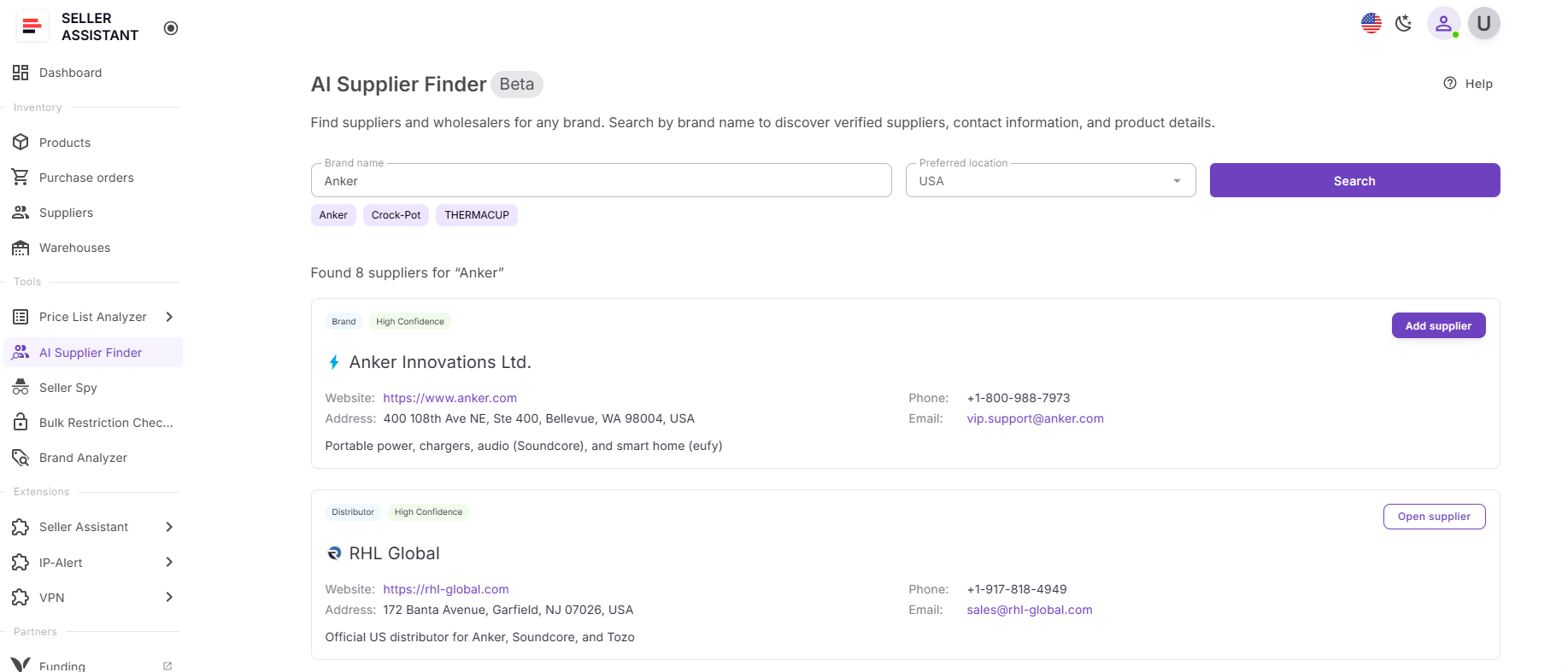
It helps sellers move from a validated brand opportunity to real supplier relationships faster and with less manual research.
What AI Supplier Finder does
AI Supplier Finder helps sellers simplify supplier discovery by delivering structured supplier data and prioritizing the best sourcing opportunities.
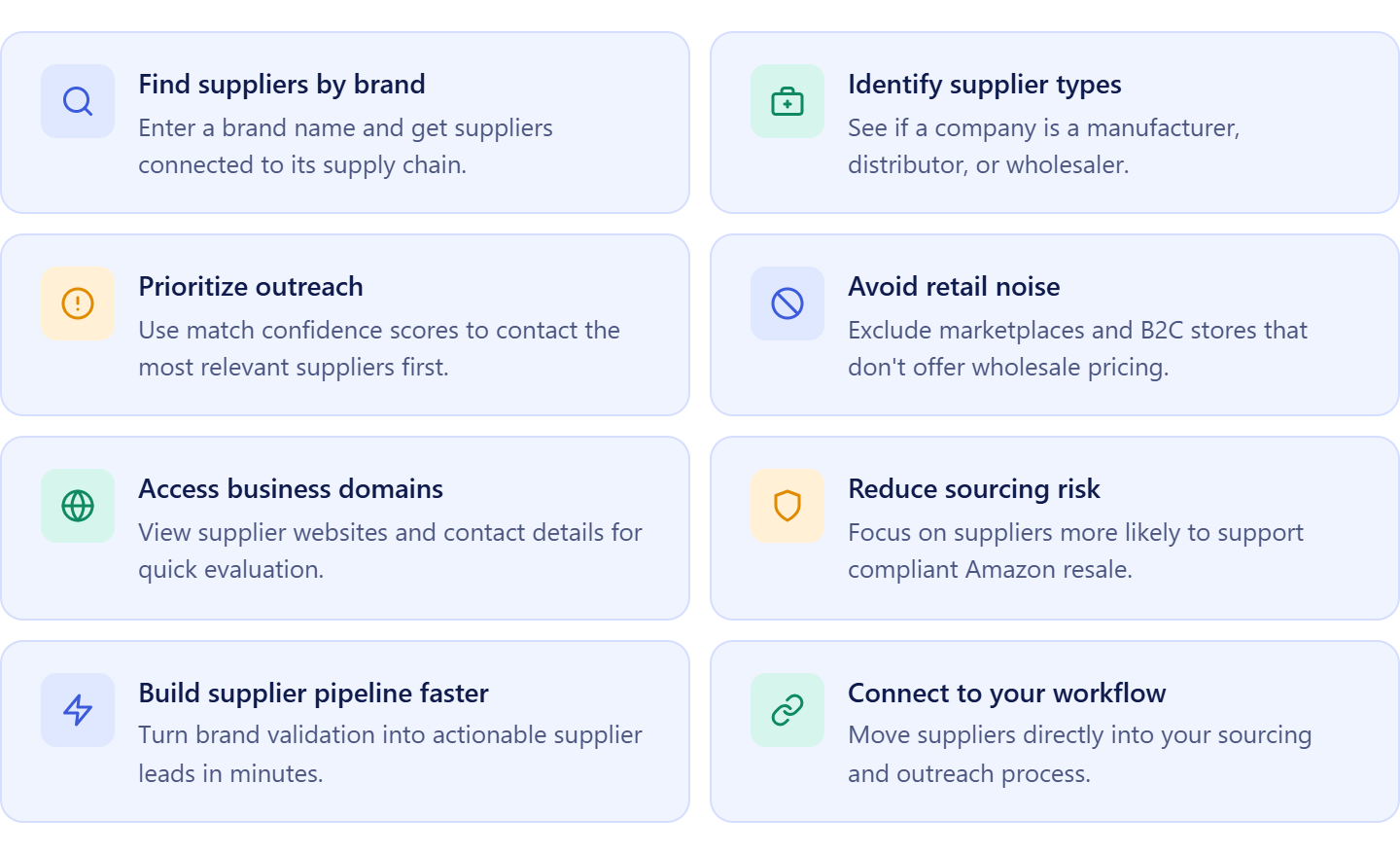
It allows sellers to:
- Find manufacturers, distributors, wholesalers, and alternative suppliers connected to a specific brand;
- Distinguish between supplier types to identify the most suitable sourcing path;
- Prioritize outreach opportunities using confidence levels;
- Filter out marketplaces, retail stores, and irrelevant B2C websites;
- Access supplier websites and available contact information in one place;
- Focus on suppliers more likely to support Amazon resale and provide proper business documentation;
- Reduce manual research and eliminate unreliable search results;
- Turn validated brands into organized supplier opportunities within minutes.
How AI Supplier Finder turns brands into best deals
AI Supplier Finder helps transform validated brand opportunities into actionable sourcing relationships. Instead of spending hours searching for distributors and verifying supplier websites manually, sellers can move directly from Brand Analyzer into supplier discovery within the same workflow.
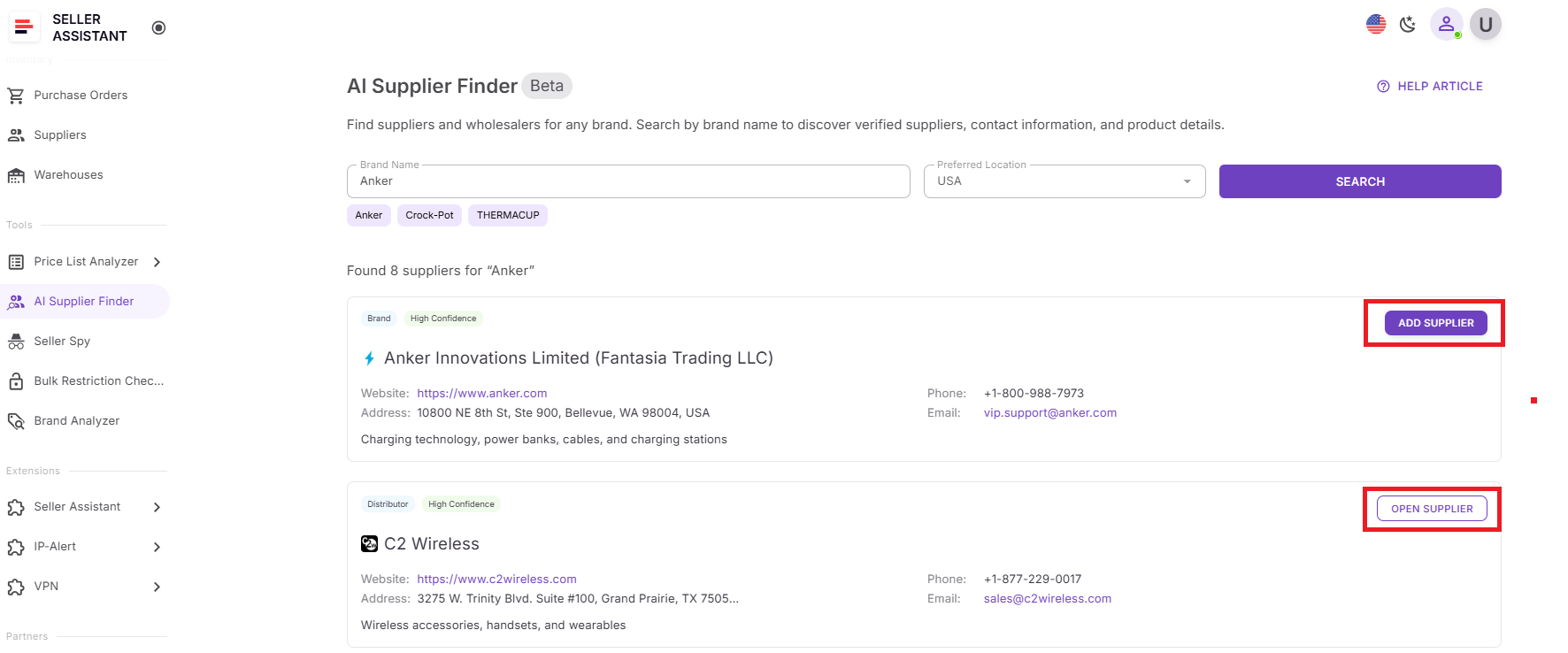
Once suppliers are identified, they can be added directly to Suppliers Database, where contact information, supplier terms, statuses, and sourcing activity remain connected throughout the process. By connecting brand research with supplier discovery and management, AI Supplier Finder helps sellers build stronger supplier networks and move closer to profitable Amazon deals faster.
What Is Suppliers Database?
Suppliers Database is Seller Assistant’s supplier management tool designed for Amazon wholesale sellers, online arbitrage sellers, and dropshippers who work with multiple suppliers and need to keep sourcing operations organized. It centralizes supplier profiles, business terms, contact information, and operational settings in one connected workspace, making supplier management easier as supplier networks grow.
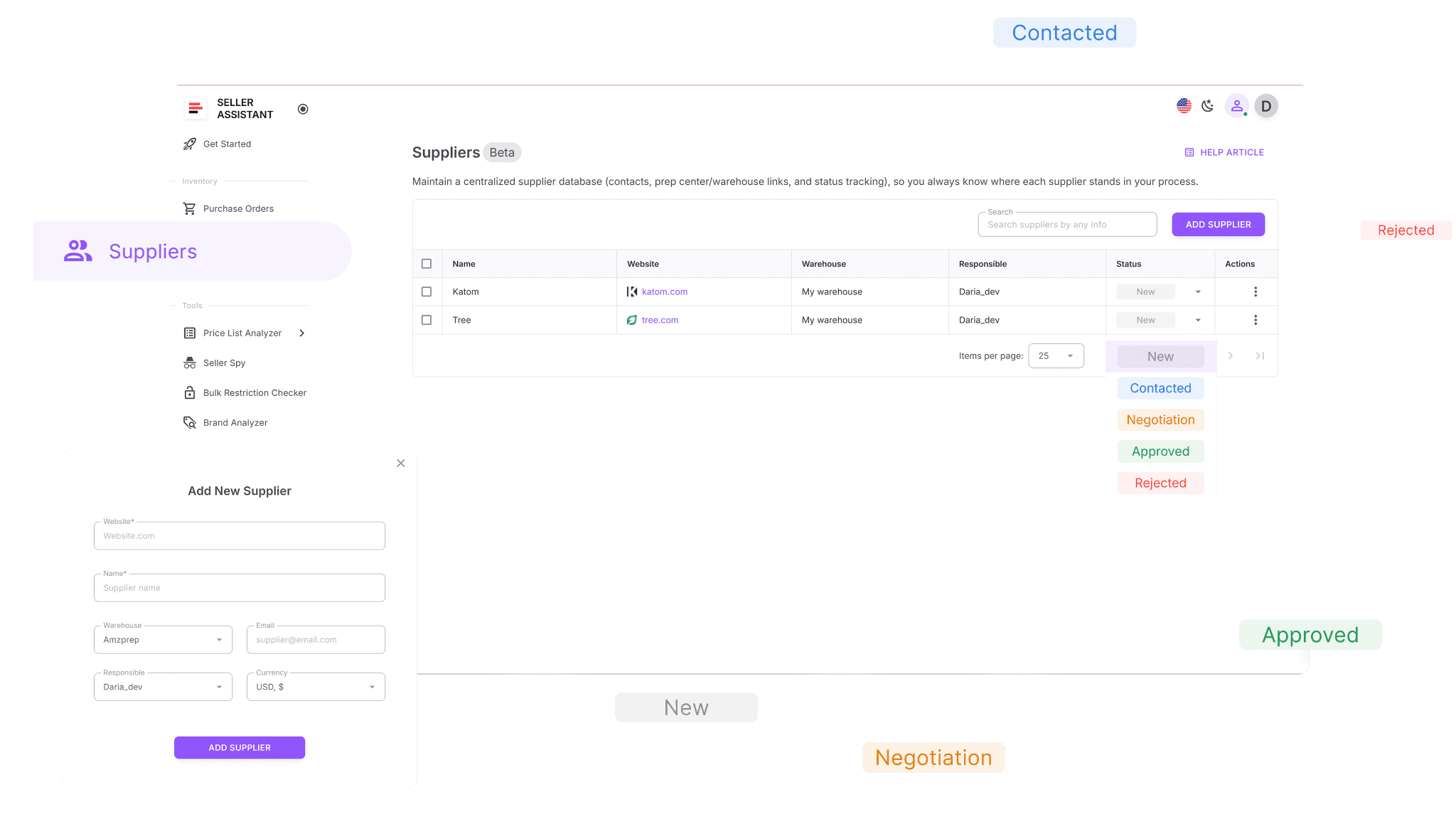
Instead of relying on spreadsheets, emails, and scattered notes, sellers manage suppliers through unified profiles that stay connected to sourcing, catalog analysis, and purchasing workflows. This keeps supplier information accurate, reusable, and accessible throughout the process of turning brands into profitable deals.
What Suppliers Database does
Suppliers Database helps sellers organize supplier relationships and turn supplier information into a structured part of the sourcing workflow.
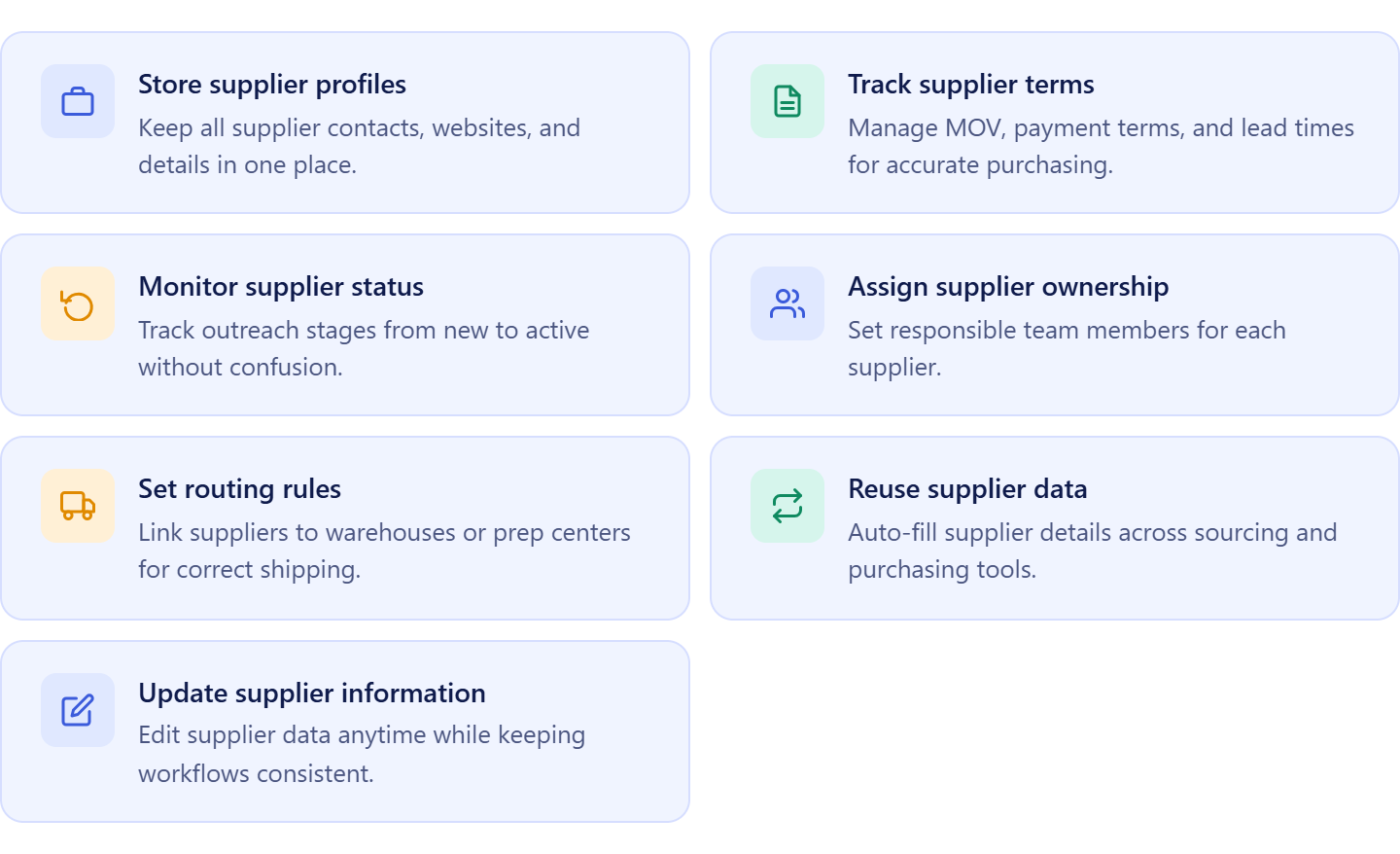
It allows sellers to:
- Store supplier profiles, websites, contact details, and notes in one place;
- Manage supplier terms such as minimum order values (MOV), payment terms, lead times, and shipping requirements;
- Track supplier relationship stages, including New, Contacted, Negotiation, Approved, Active, and Rejected;
- Assign suppliers to sourcing team members or virtual assistants;
- Upload and connect supplier catalogs directly to supplier profiles;
- Keep supplier details attached while analyzing catalogs and sourcing products;
- Reuse supplier information across sourcing and purchasing workflows;
- Update supplier information without breaking workflow connections.
How Suppliers Database turns brands into best deals
Suppliers Database turns supplier information into reusable workflow data instead of disconnected records. Once suppliers are discovered through AI Supplier Finder, they can be added directly into the database with available details already populated.
As supplier relationships develop, statuses, terms, notes, and sourcing activity remain connected throughout the workflow. When suppliers send catalogs, those price lists stay linked to the correct supplier in Price List Analyzer, while products and supplier offers continue into Product Database.
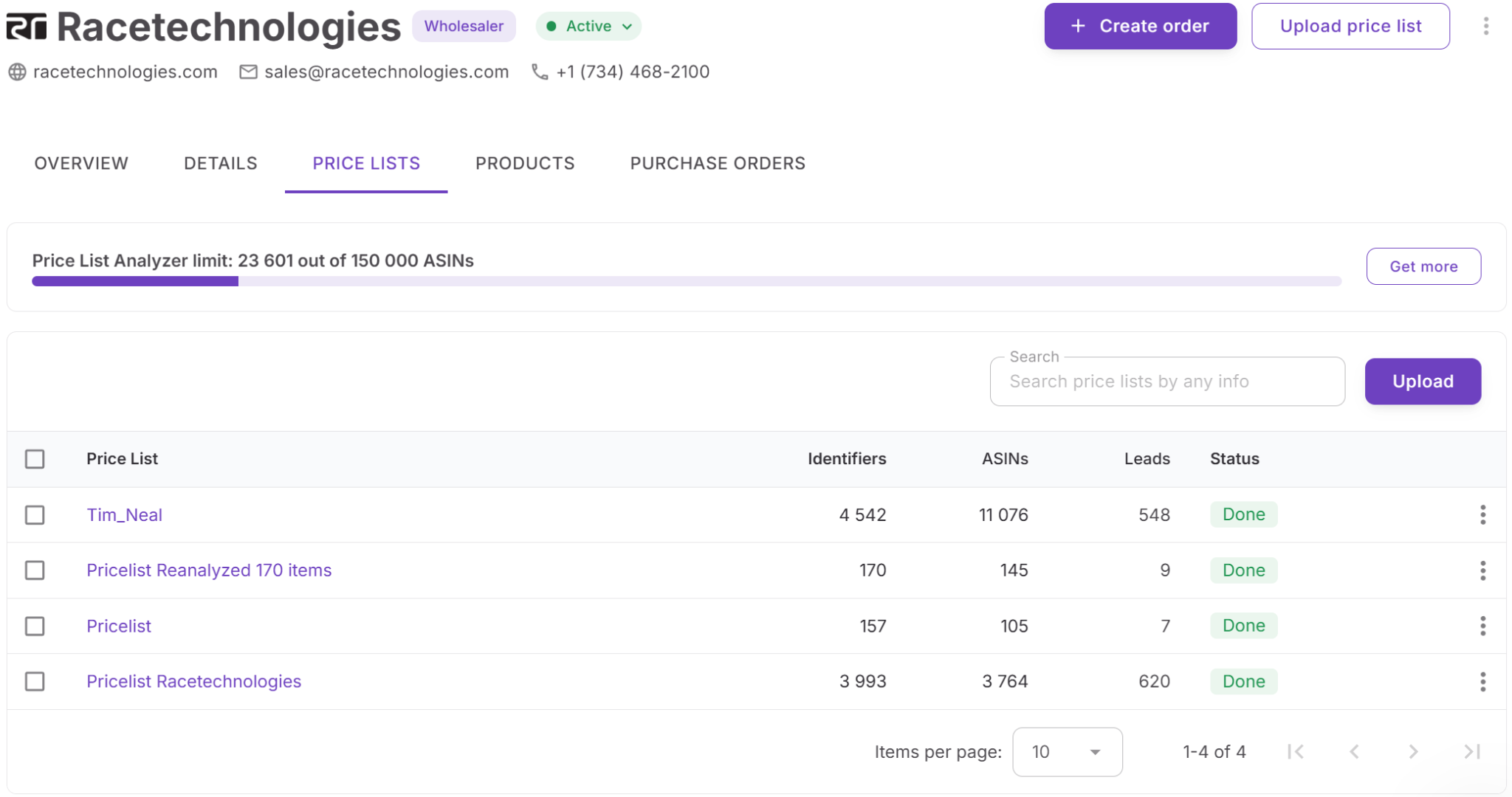
By keeping supplier records connected across tools, Suppliers Database helps sellers eliminate repeated work, maintain cleaner sourcing pipelines, and move from brand opportunities to profitable Amazon deals in a more organized and scalable way.
What Is Price List Analyzer?
Price List Analyzer is Seller Assistant’ss bulk product research and catalog analysis tool designed for Amazon wholesale sellers, online arbitrage sellers, and dropshippers who work with large supplier catalogs. It transforms raw supplier price lists into structured Amazon product data, helping sellers evaluate profitability, demand, competition, and product risks across hundreds or thousands of products at once.
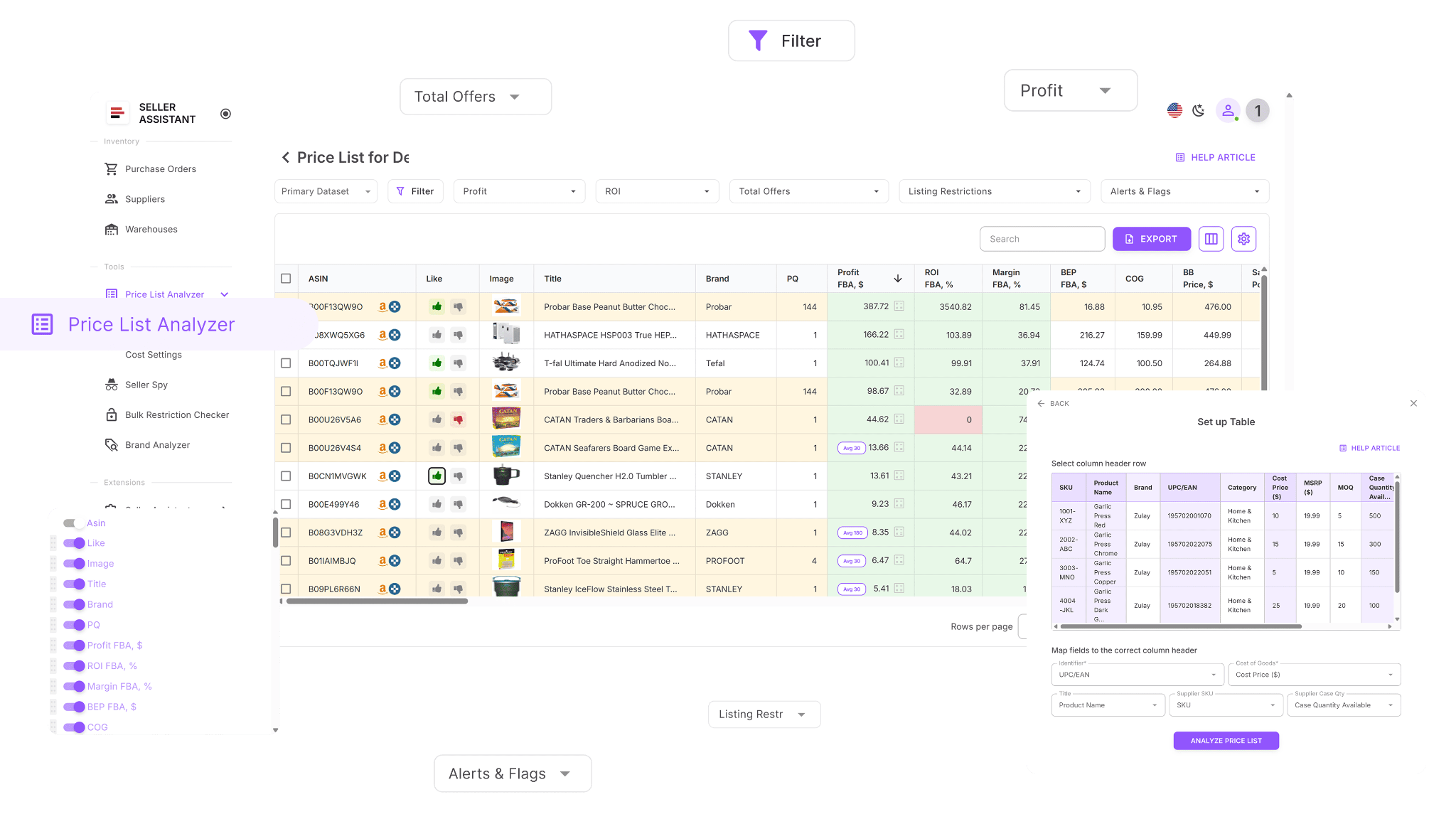
Instead of manually researching products one by one, sellers can upload supplier catalogs directly into their workflow, keep them connected to supplier records, and quickly identify products that fit their sourcing criteria.
What Price List Analyzer does
Price List Analyzer helps sellers convert large supplier catalogs into structured buying decisions while keeping sourcing data connected throughout the workflow.
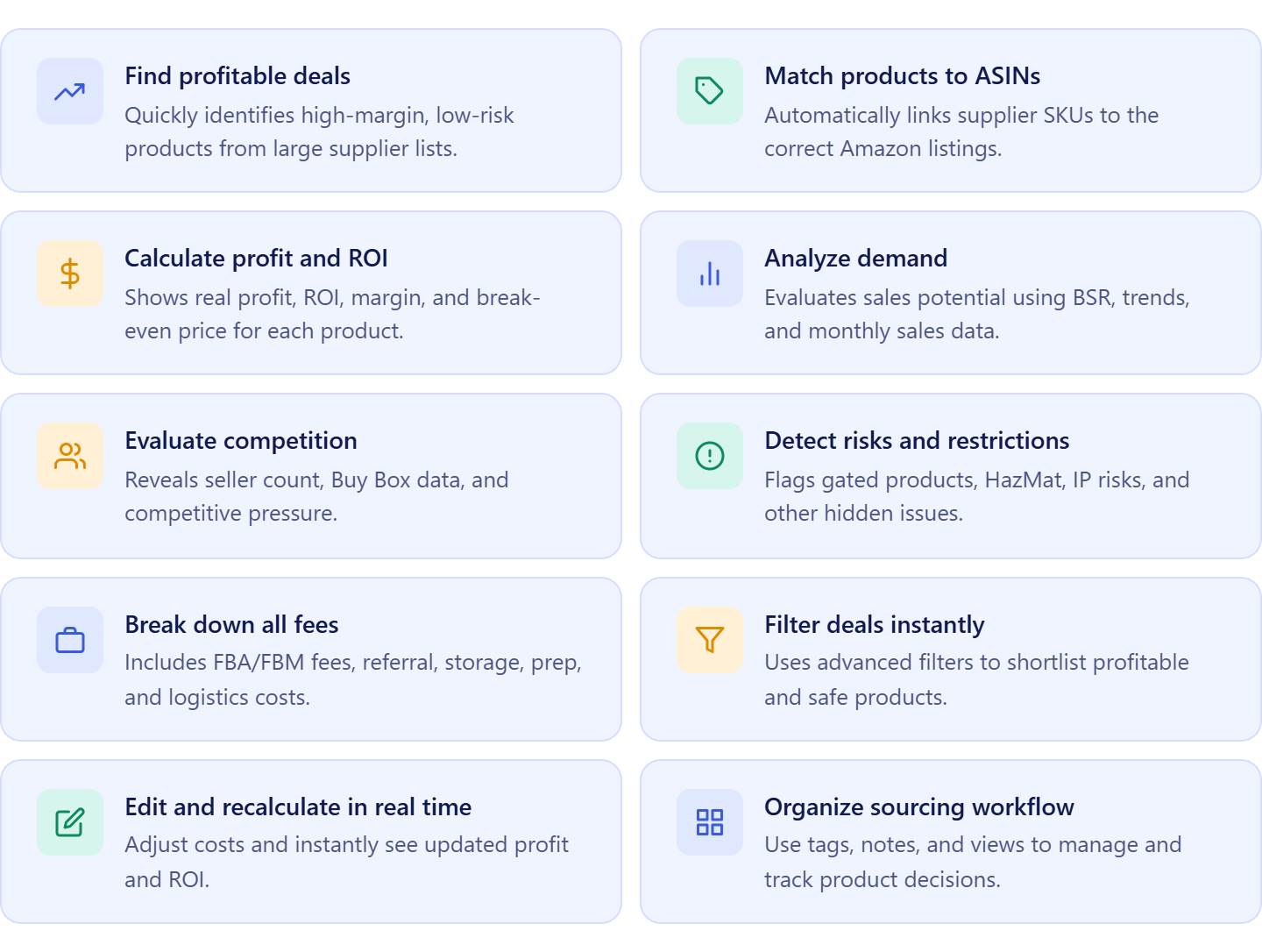
It allows sellers to:
- Analyze hundreds or thousands of supplier products in minutes instead of checking ASINs manually;
- Automatically match supplier identifiers such as SKUs, UPCs, and EANs with Amazon listings;
- Calculate ROI, profit, margins, break-even prices, and maximum COG automatically;
- Validate demand using BSR history, sales estimates, and sales trends;
- Analyze competition through seller counts, Amazon presence, and Buy Box conditions;
- Detect restrictions and sourcing risks such as gated products, HazMat items, meltable products, and IP risks;
- Filter products by profitability, demand, competition, and risk criteria;
- Adjust COG, shipping costs, prep fees, taxes, and package quantities with instant recalculation;
- Organize sourcing decisions using notes, tags, likes, and saved views.
How Price List Analyzer turns brands into best deals
Price List Analyzer automates one of the most time-consuming stages of wholesale sourcing – turning supplier catalogs into profitable buying opportunities. Once suppliers send catalogs, sellers can upload them directly from Suppliers Database, keeping supplier information and sourcing history attached automatically throughout the workflow.
Instead of manually reviewing thousands of products, sellers can quickly identify profitable, high-demand, lower-risk opportunities using consistent sourcing criteria. Products and supplier offers are automatically saved to Product Database, where sourcing decisions, supplier comparisons, and purchasing activity remain connected.
By linking supplier catalogs with supplier records and product management, Price List Analyzer helps sellers move from validated brands to profitable Amazon deals faster and with less manual work.
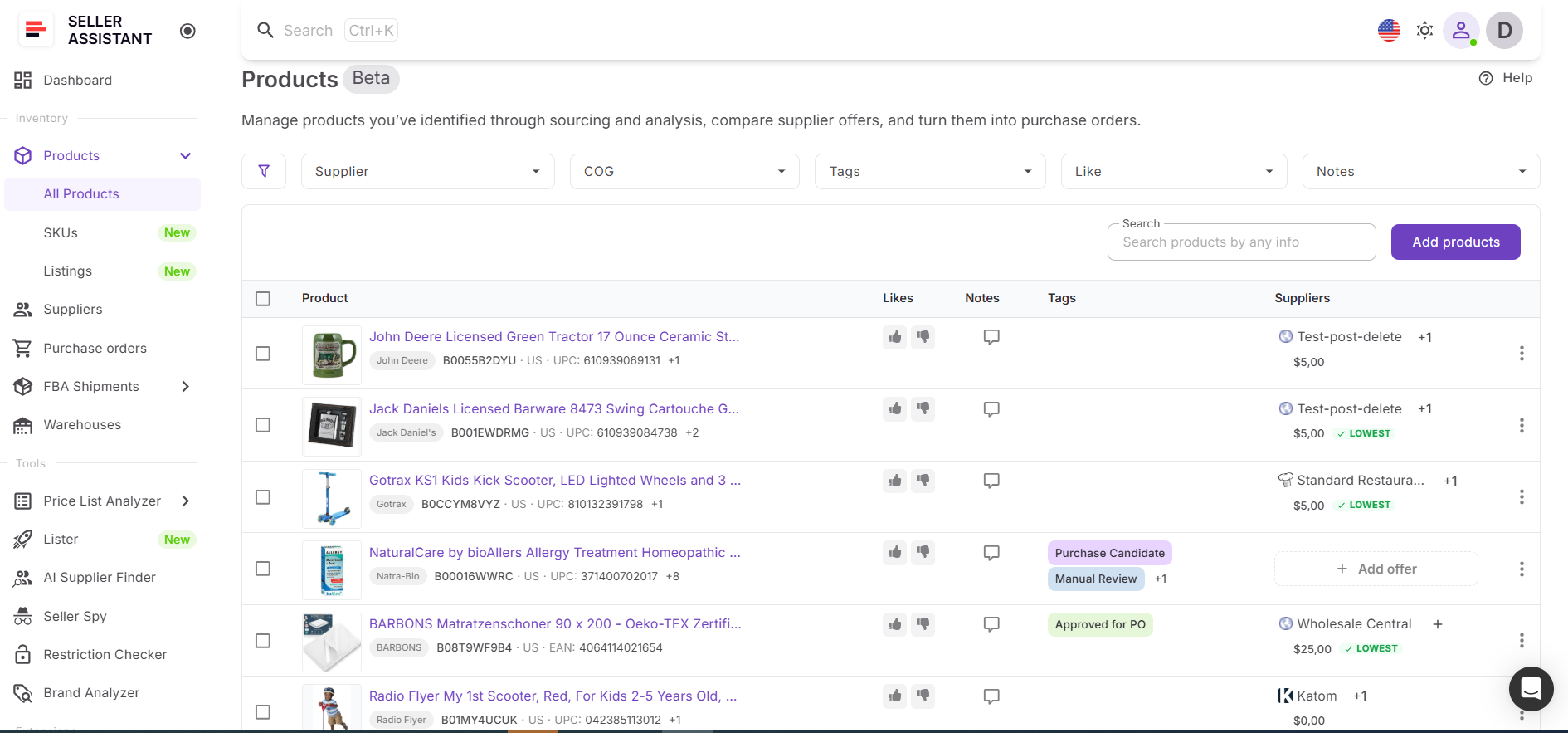
What Is Product Database?
Product Database is Seller Assistant’s product management and sourcing workspace designed for Amazon wholesale sellers, online arbitrage sellers, and dropshippers who need to organize products and make consistent buying decisions. It centralizes sourced products, supplier offers, cost information, and sourcing activity in one place, allowing sellers to compare opportunities and continue workflows without losing data.
Instead of managing products across spreadsheets and disconnected tools, sellers work with structured product records that remain connected to suppliers, purchasing, and listing workflows.
What Product Database does
Product Database helps sellers organize sourcing decisions and turn product opportunities into actionable buying workflows.
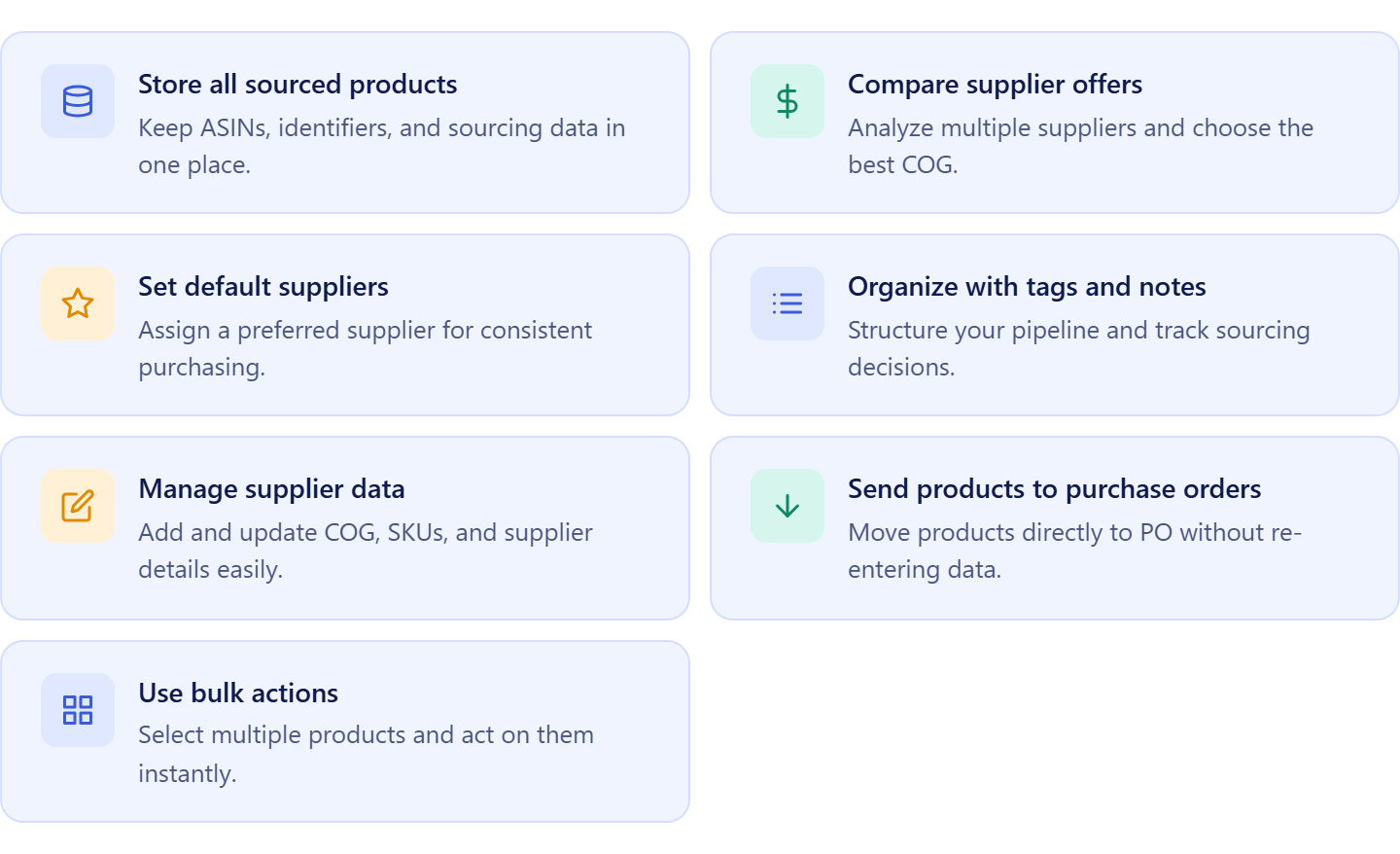
It allows sellers to:
- Store sourced products with ASINs, identifiers, marketplaces, and sourcing information in one place;
- Compare multiple supplier offers for the same product and identify the most profitable option;
- Select a default supplier to maintain consistent purchasing decisions;
- Organize products using notes, tags, and likes to manage sourcing activity;
- Add, edit, and manage supplier offers, including COG, SKUs, identifiers, and links;
- Move products directly into purchase orders without re-entering data;
- Apply bulk actions to multiple products at once to reduce manual work;
- Re-analyze products in Price List Analyzer without uploading data again;
- Create Amazon listings while keeping product and supplier information connected;
- Track SKUs, listing status, and product activity across the workflow;
- Maintain product history and sourcing records for better visibility and team collaboration.
How Product Database turns brands into best deals
Product Database becomes the decision layer where sourcing opportunities turn into purchasing actions. After products are identified in Price List Analyzer, they are automatically saved into Product Database together with supplier offers and sourcing information.
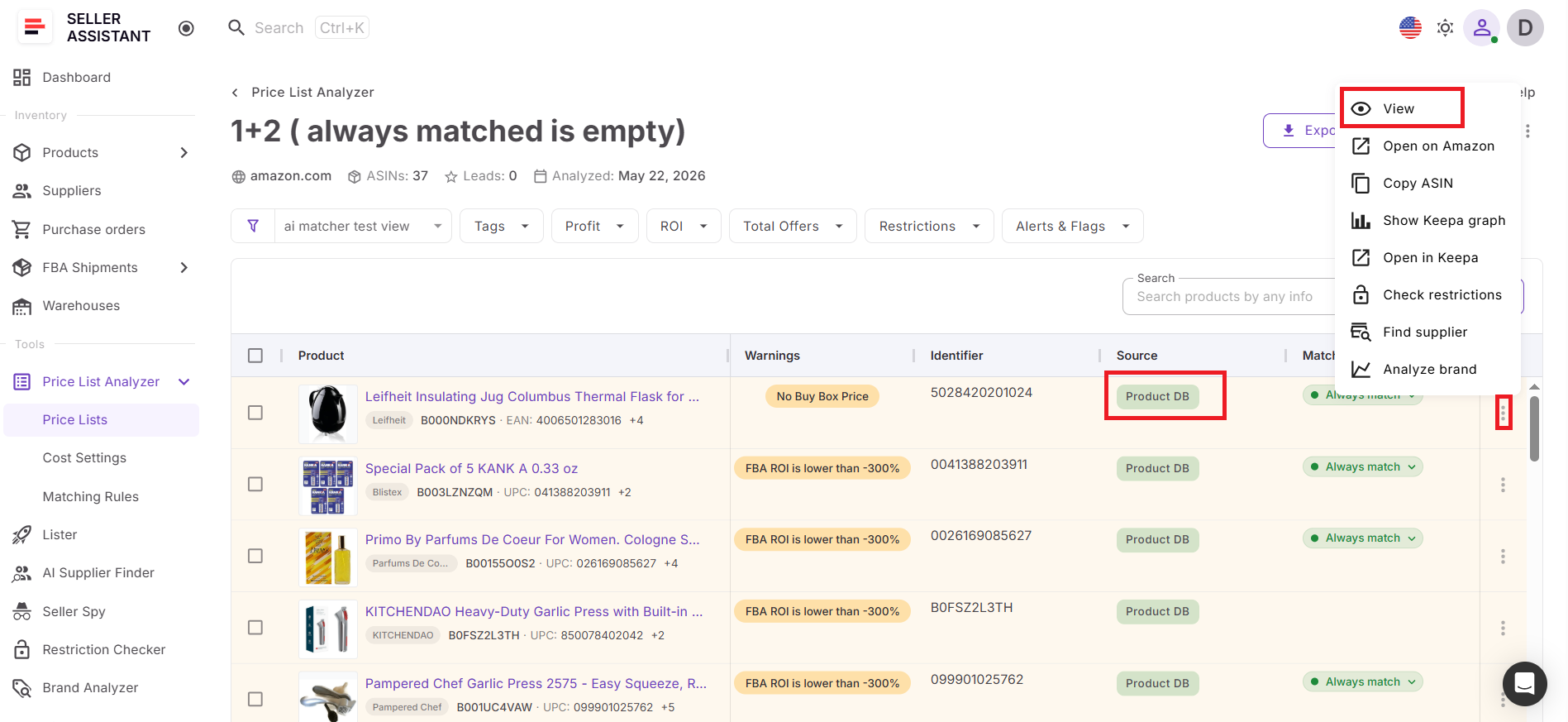
Instead of repeatedly reviewing the same products or losing pricing information across sourcing sessions, sellers can compare multiple offers for the same ASIN, identify the lowest COG, preserve sourcing history, and select the best supplier for purchasing.
By keeping products, supplier data, and sourcing decisions connected, Product Database helps sellers turn analyzed opportunities into profitable Amazon deals and maintain a repeatable sourcing workflow as their business grows.
Step-by-step: Turn a Wholesale Brand Into Profitable Amazon Deals
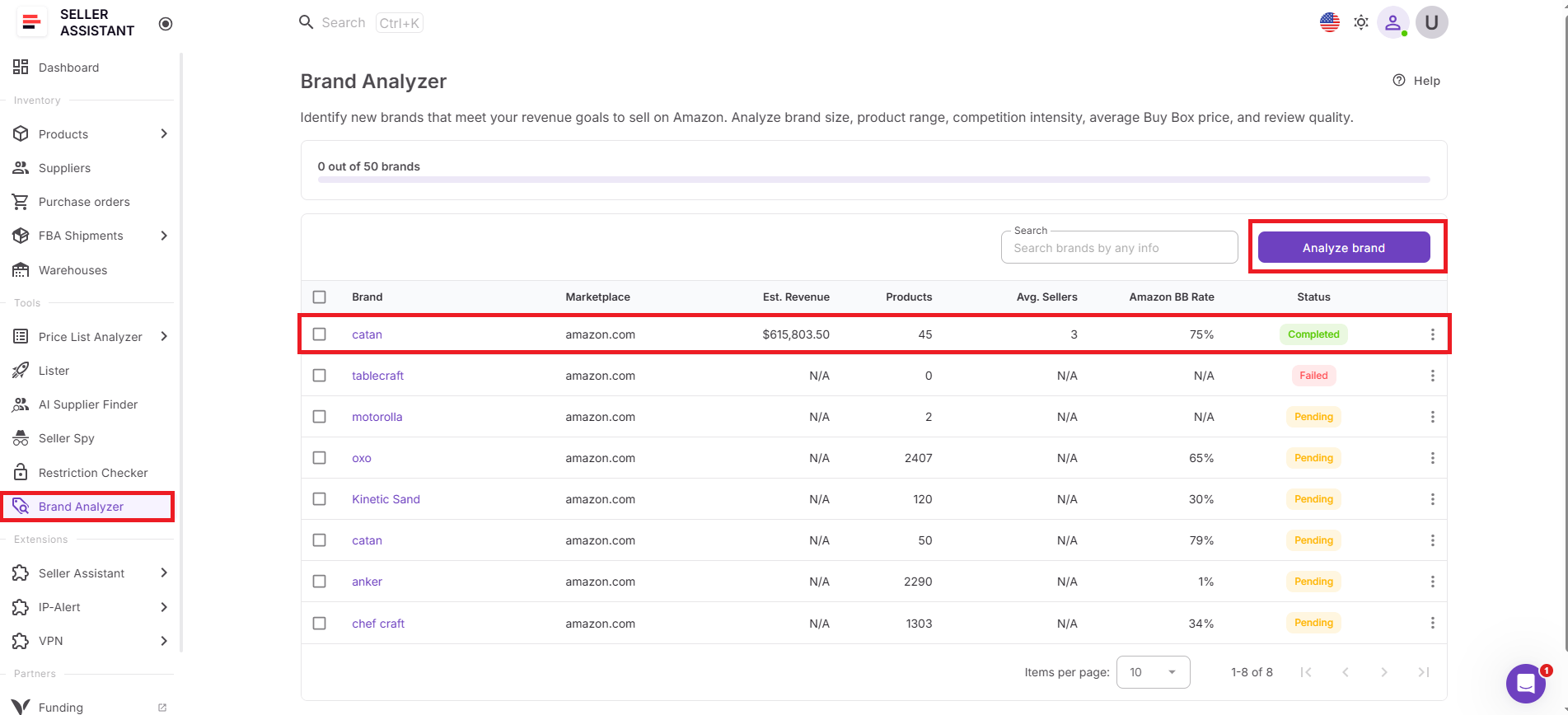
Step 1. Validate the brand with Brand Analyzer
Start by evaluating the brand with Brand Analyzer before reaching out to suppliers. Review demand, catalog depth, Amazon presence, seller competition, pricing trends, and overall reseller viability to determine whether the opportunity fits your sourcing criteria.
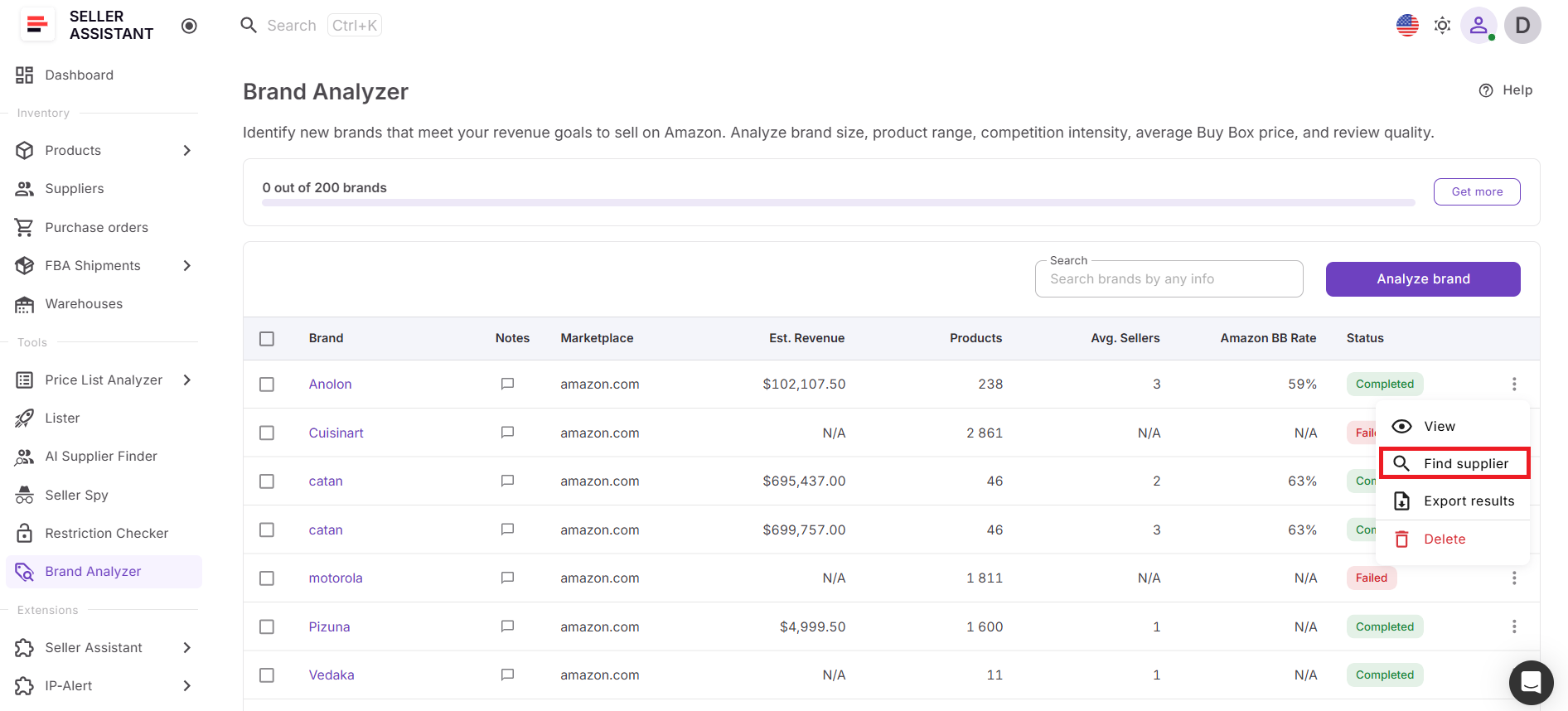
Step 2. Find sourcing partners with AI Supplier Finder
After identifying a promising brand, use AI Supplier Finder to locate manufacturers, distributors, and wholesalers connected to it. Focus on high-confidence supplier matches and avoid retail or irrelevant sources.
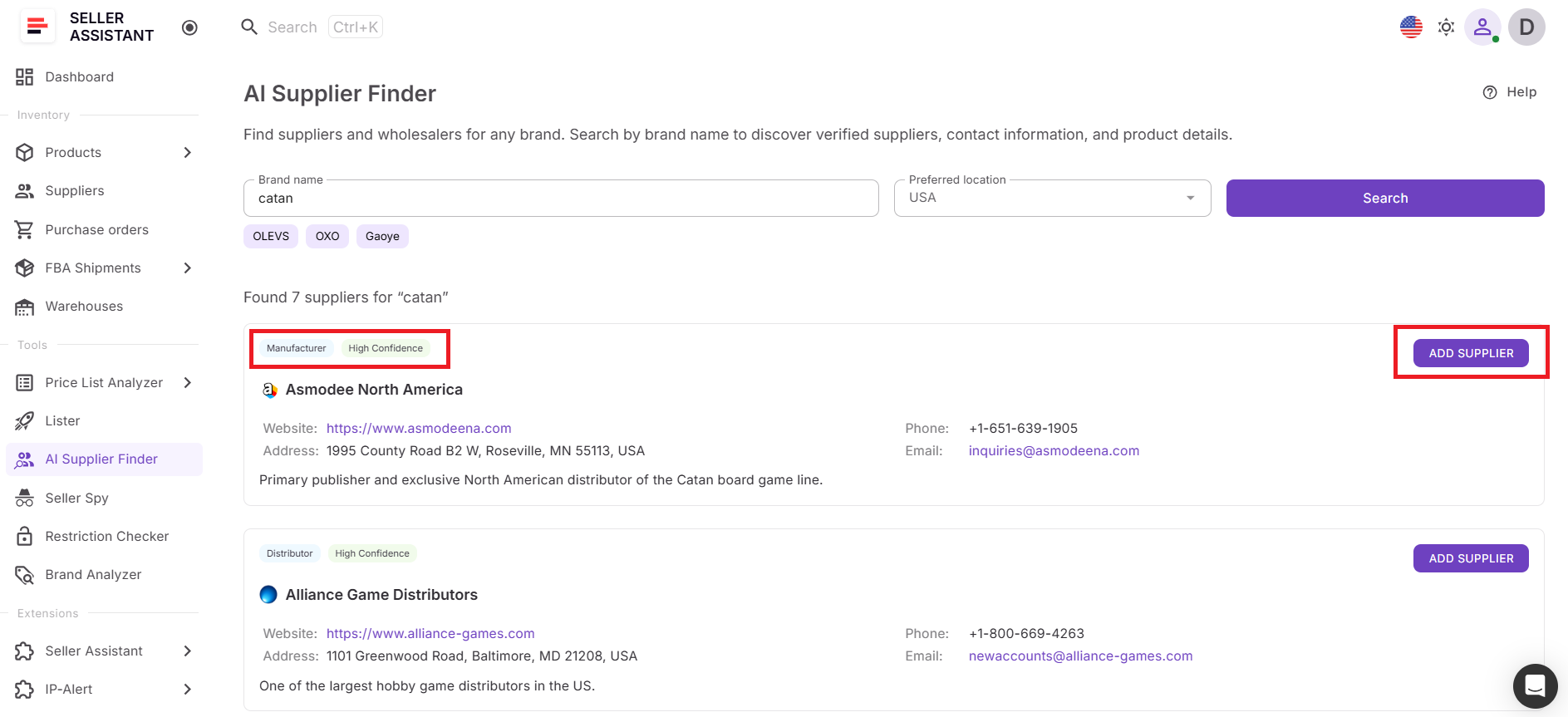
Step 3. Build your supplier pipeline with Suppliers Database
Save qualified suppliers into Suppliers Database and organize important information such as contact details, payment terms, minimum order values (MOV), lead times, and operational settings.
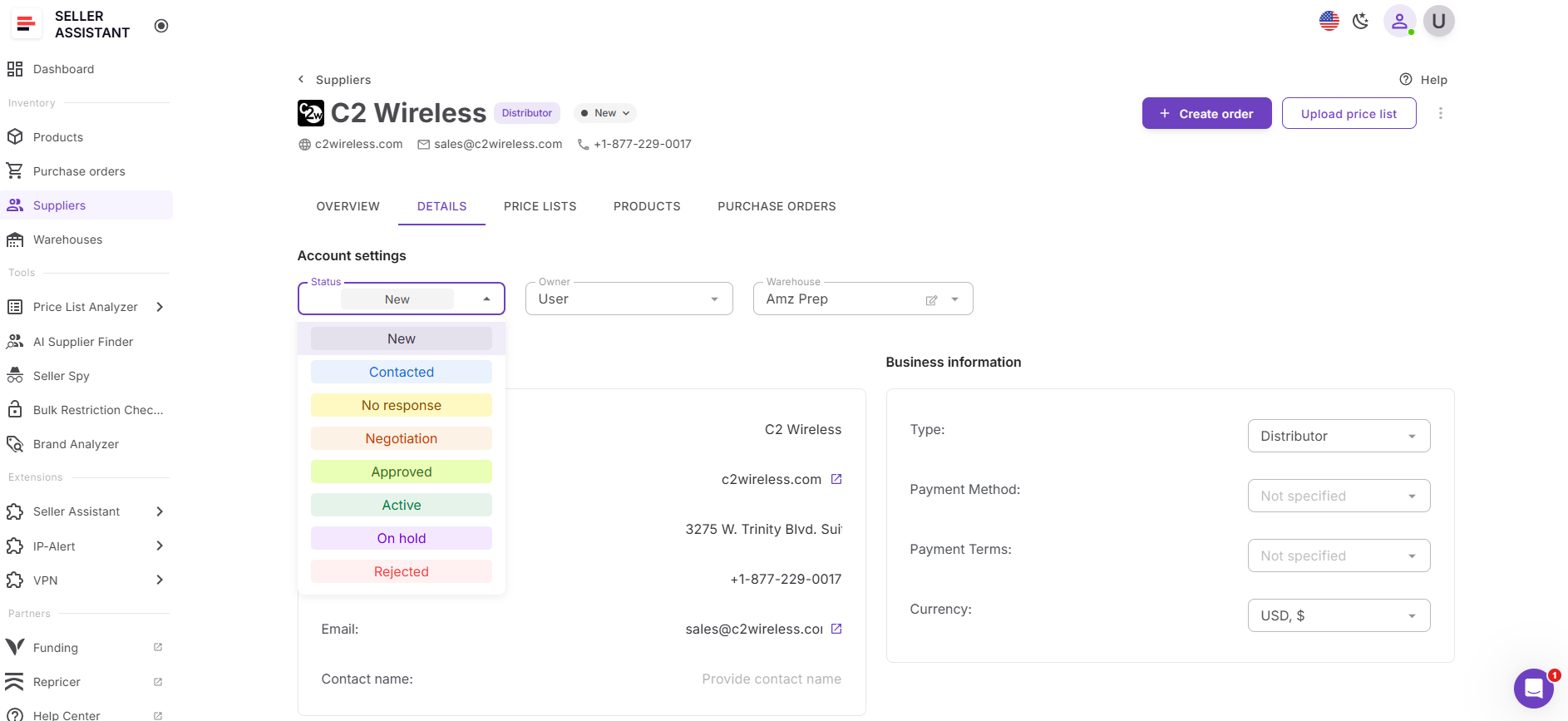
Step 4. Organize supplier activity and relationships
Track supplier progress as relationships evolve by updating statuses such as New, Contacted, Negotiation, Approved, or Active. This helps keep outreach organized and prevents repeated communication.
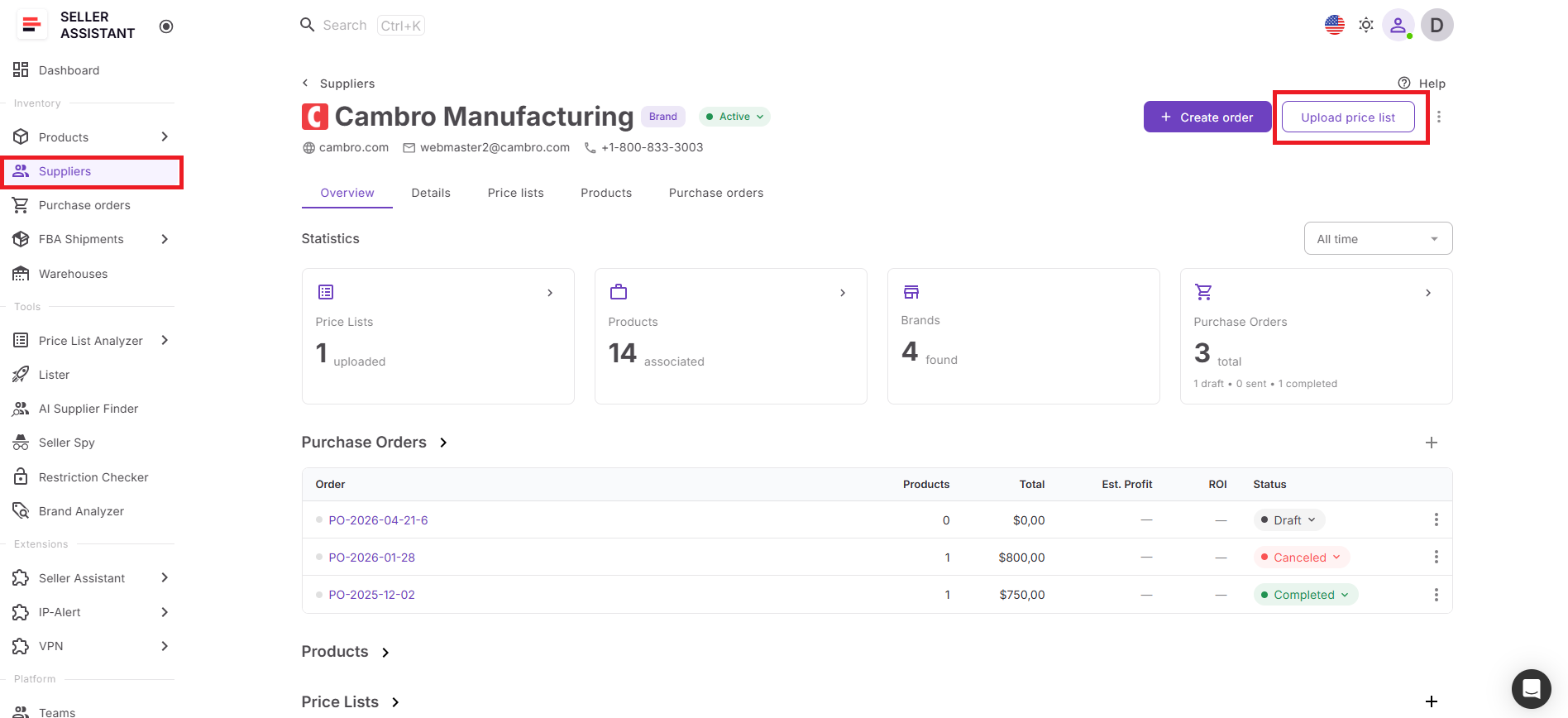
Step 5. Upload supplier catalogs into Price List Analyzer
Once suppliers provide product catalogs, upload them directly into Price List Analyzer. Supplier information stays connected automatically throughout the workflow.
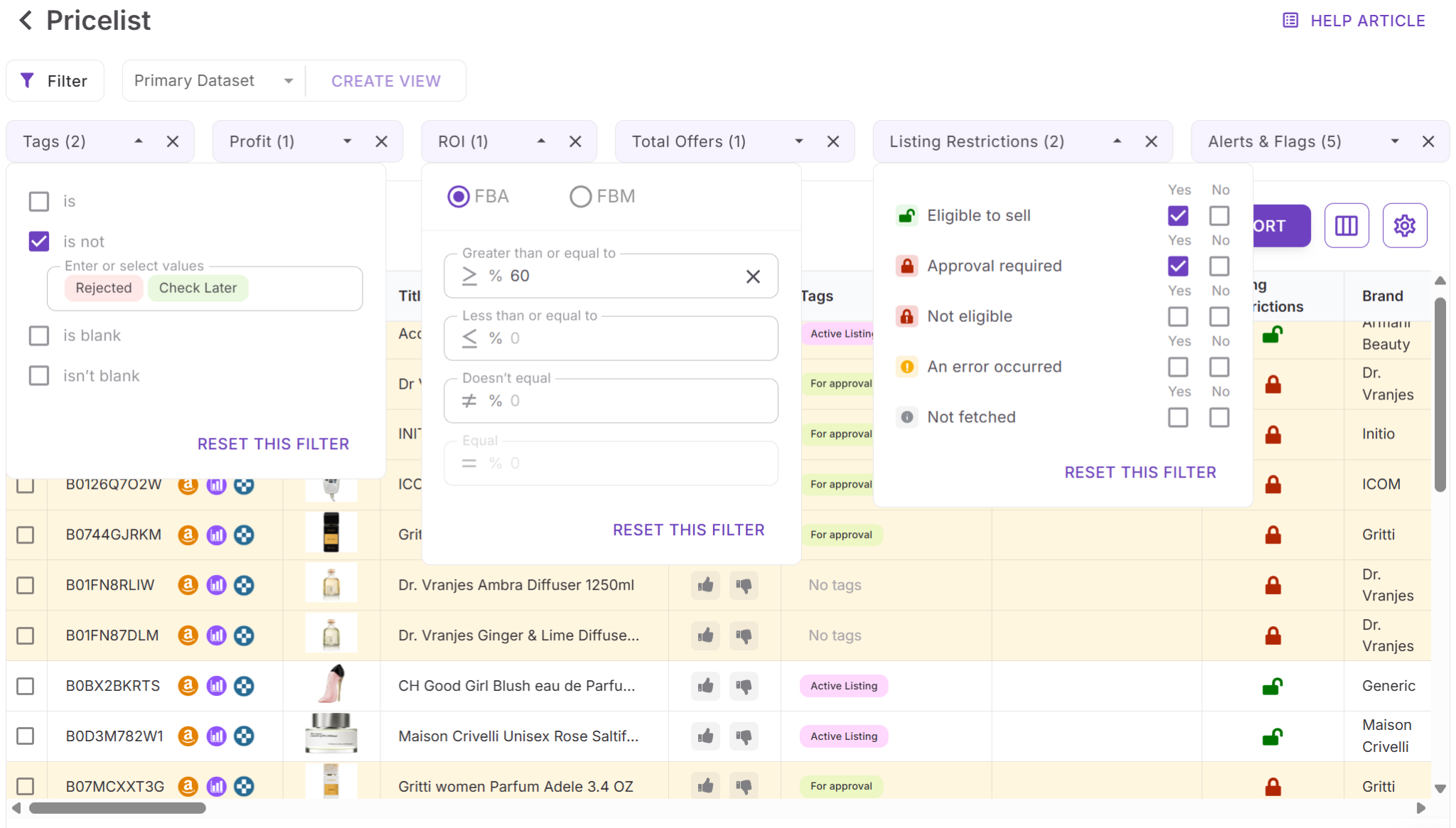
Step 6. Identify profitable product opportunities
Review profitability, ROI, demand, seller competition, Buy Box conditions, and product risks. Filter out weak, restricted, or high-risk products and focus on opportunities that meet your business goals.
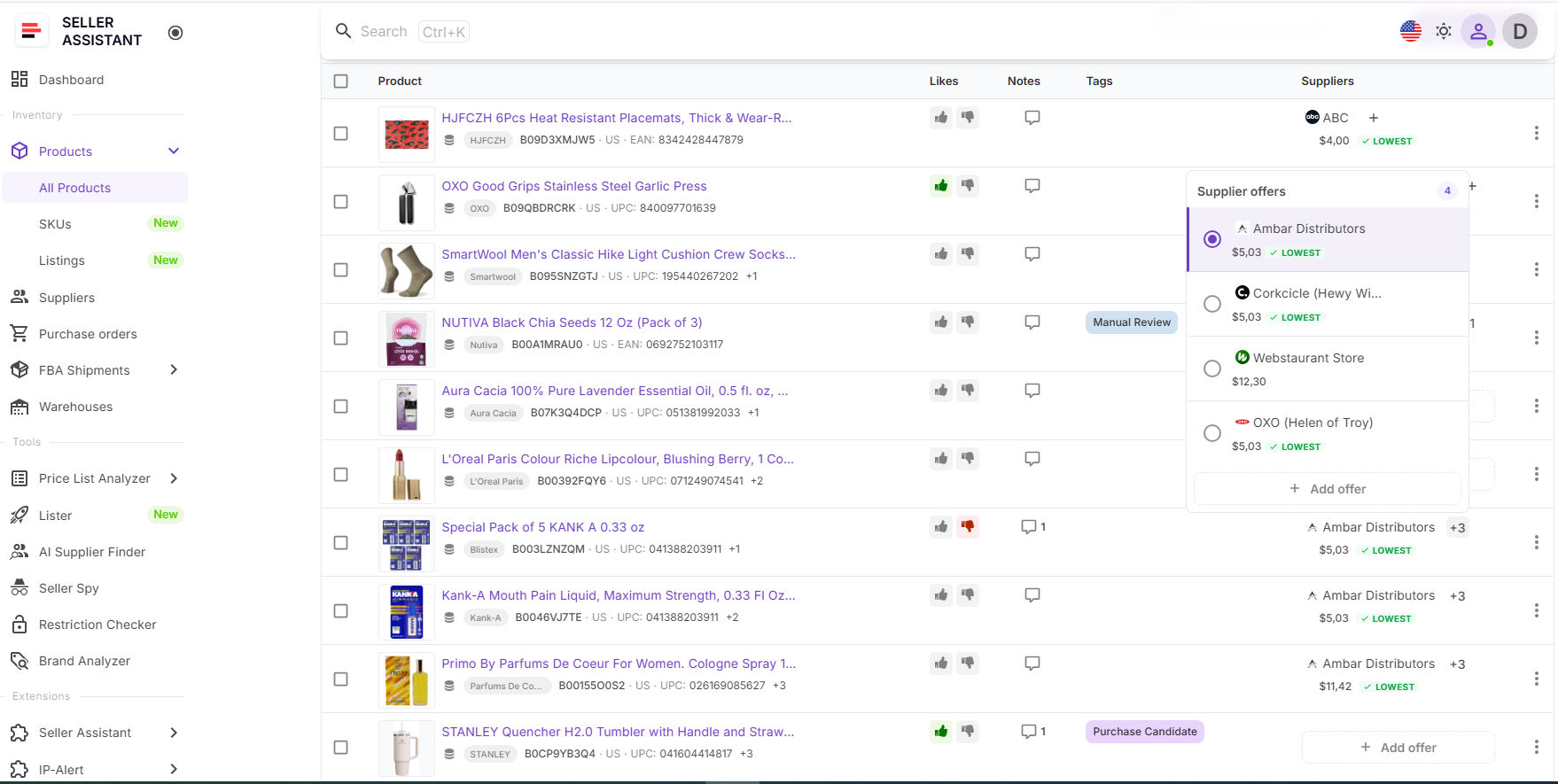
Step 7. Save products and compare supplier offers
Products are automatically stored in Product Database, where supplier offers, COG, sourcing notes, and product decisions stay connected. Compare multiple offers and identify the best buying option for each ASIN.
Step 8. Repeat and scale your sourcing workflow
Apply the same process across additional brands and suppliers to create a repeatable sourcing system that helps consistently turn wholesale opportunities into profitable Amazon deals.
FAQ
Can I use a wholesale brand to best deals workflow if I sell through online arbitrage or dropshipping?
Yes. While the workflow is designed for Amazon wholesale sellers, online arbitrage sellers and dropshippers can also use it to research brands, organize suppliers, and evaluate product opportunities. The process helps create more structured sourcing regardless of the business model.
Why should I analyze a brand before contacting suppliers?
A profitable product does not always mean the brand is a strong sourcing opportunity. Brand analysis helps identify issues such as heavy Amazon competition, weak demand, limited catalog depth, or low reseller potential before spending time on outreach.
How does AI Supplier Finder help reduce sourcing time?
Instead of manually searching websites and filtering out retail stores, AI Supplier Finder surfaces manufacturers, distributors, and wholesalers connected to a specific brand. This allows sellers to focus on outreach instead of spending hours validating search results.
What happens after I upload a supplier catalog?
After uploading a catalog into Price List Analyzer, products are automatically matched with Amazon listings and enriched with profitability, competition, demand, and risk data. The analyzed products are then automatically saved into Product Database for future sourcing and purchasing workflows.
Why is Product Database important in the sourcing process?
Product Database helps sellers keep supplier offers, sourcing notes, and product decisions connected in one place. It also allows comparison of multiple supplier offers for the same ASIN so sellers can consistently choose the best buying option.
Final Thoughts
Finding profitable products on Amazon is only one part of building a successful sourcing operation. The real challenge is creating a process that consistently turns brand opportunities into profitable inventory decisions. Without structure, sellers often waste time researching weak brands, searching for unreliable suppliers, managing scattered information, and manually reviewing large product catalogs.
Seller Assistant helps connect every stage of that process into one workflow. With Brand Analyzer, AI Supplier Finder, Suppliers Database, Price List Analyzer, and Product Database, sellers can move from brand validation to supplier discovery, catalog analysis, and buying decisions without rebuilding information at every step.