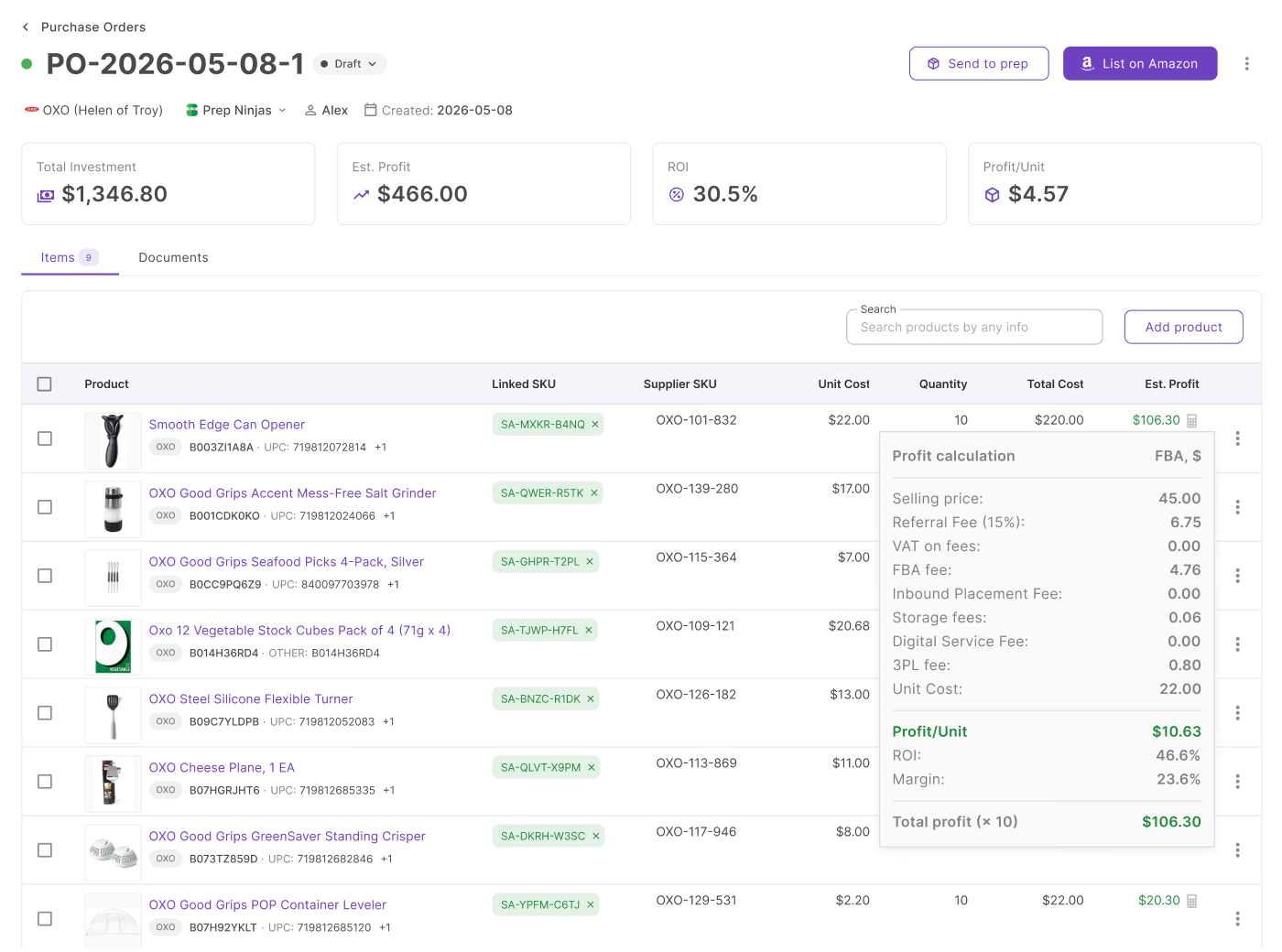


Finding a supplier is only the beginning of the wholesale sourcing process. To turn supplier catalogs into profitable Amazon inventory, sellers must manage supplier relationships, analyze product opportunities, organize purchasing data, assign fulfillment destinations, and create accurate purchase orders.
When these tasks are handled in separate spreadsheets and tools, the process becomes slow, repetitive, and prone to costly mistakes.
Seller Assistant connects every stage of this workflow into one system. In this post, we’ll show how Amazon wholesale sellers, online arbitrage sellers, and dropshippers can move from supplier discovery to purchase order creation using a connected workflow that keeps supplier, product, warehouse, and purchasing data synchronized.
Note. Seller Assistant is an end-to-end Amazon workflow management platform that integrates 15+ wholesale-focused solutions into one connected system. It combines sourcing workflow automation, bulk research and intelligence tools, and integrated Chrome extensions – giving you everything you need to streamline finding deals, managing suppliers, and creating purchase orders.

With Seller Assistant, every step of your Amazon wholesale and arbitrage workflow is automated and connected.
From Supplier to Purchase Order: The Best Way to Manage Wholesale POs
Managing wholesale supplier purchase orders is not just about creating an order and sending it to a supplier. For Amazon wholesale sellers, online arbitrage sellers, and dropshippers, purchasing begins much earlier – with finding reliable suppliers, evaluating supplier catalogs, selecting profitable products, planning inventory routing, and preparing accurate supplier orders.
The journey from supplier to purchase order
A successful purchasing process starts with identifying a brand and finding suppliers that offer wholesale access to its products. After connecting with a supplier and receiving a product catalog, sellers analyze the available products to determine which ones meet their profitability, demand, and risk requirements.
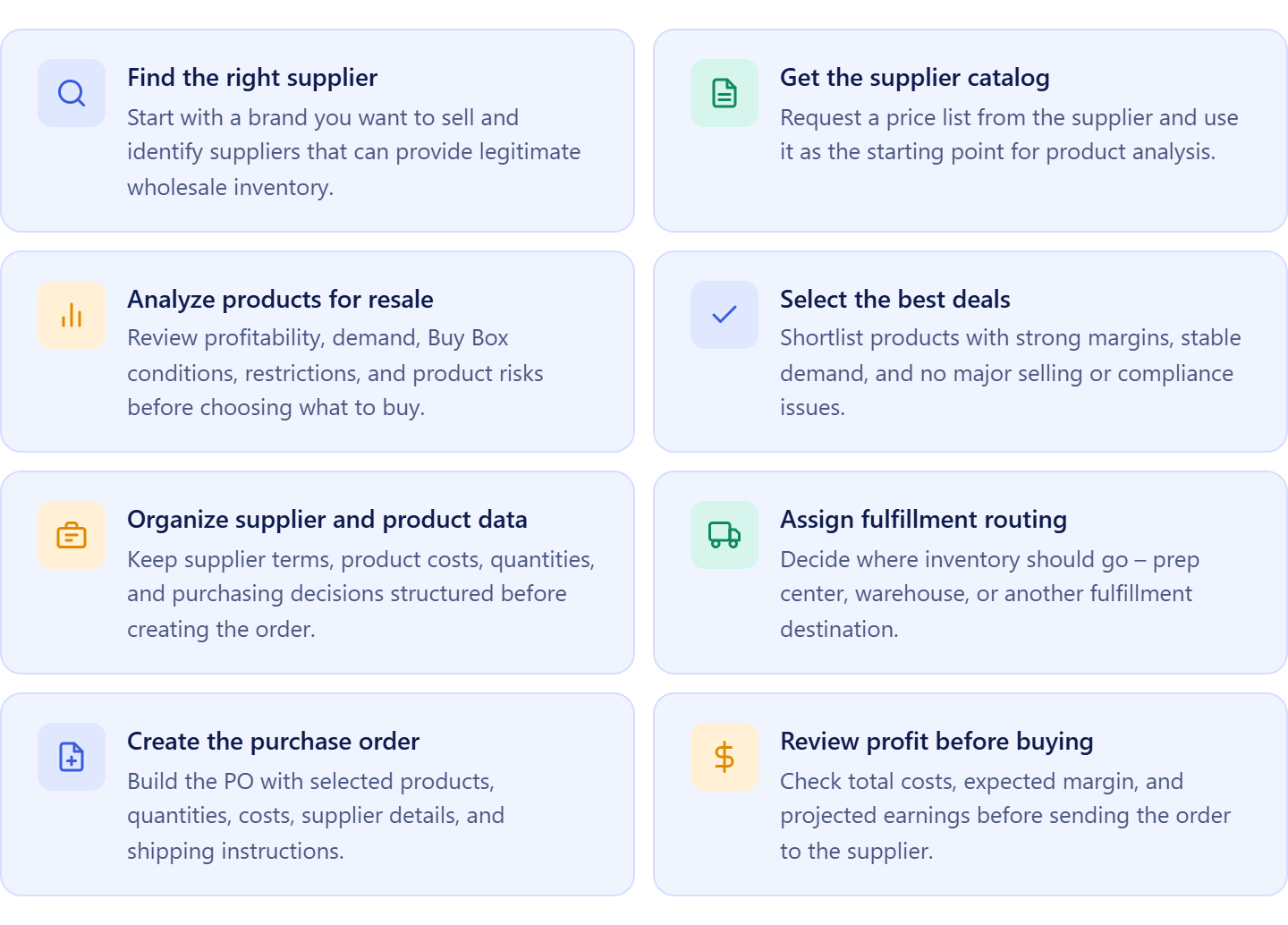
Once purchasing opportunities are identified, supplier information, product data, costs, and shipping destinations are organized before creating a supplier order. The final step is reviewing the order’s projected performance and sending it to the supplier for fulfillment.
Why every purchasing decision matters
Each decision made during the purchasing process affects the outcome of the order. Choosing the wrong supplier, buying low-performing products, overlooking restrictions, or using inaccurate costs can reduce profitability and create inventory challenges.
Careful purchasing helps sellers protect margins, maintain inventory availability, and invest capital in products that support long-term business growth.
Why wholesale purchasing works best as a workflow
As businesses expand, sellers often manage multiple suppliers, thousands of products, several warehouses, and ongoing replenishment cycles. Handling these activities separately creates duplicate work, inconsistent data, and operational bottlenecks.
A workflow-based approach keeps supplier discovery, product evaluation, purchasing decisions, inventory routing, and order creation connected. This makes wholesale supplier purchase orders easier to manage, improves accuracy across the entire process, and allows sellers to scale purchasing operations more efficiently.
Why Supplier Purchasing Needs a Connected Workflow?
Managing wholesale supplier POs requires sellers to coordinate multiple activities at the same time – finding suppliers, evaluating supplier catalogs, selecting products, organizing supplier information, assigning fulfillment destinations, and creating purchase orders. When these processes are handled separately, information becomes scattered, manual work increases, and purchasing mistakes become more common.
A connected workflow brings every stage of supplier purchasing together. Instead of switching between spreadsheets, emails, and disconnected tools, sellers can manage suppliers, products, warehouses, and orders within one system. This helps Amazon wholesale sellers, online arbitrage sellers, and dropshippers work more efficiently while maintaining control as purchasing operations grow.
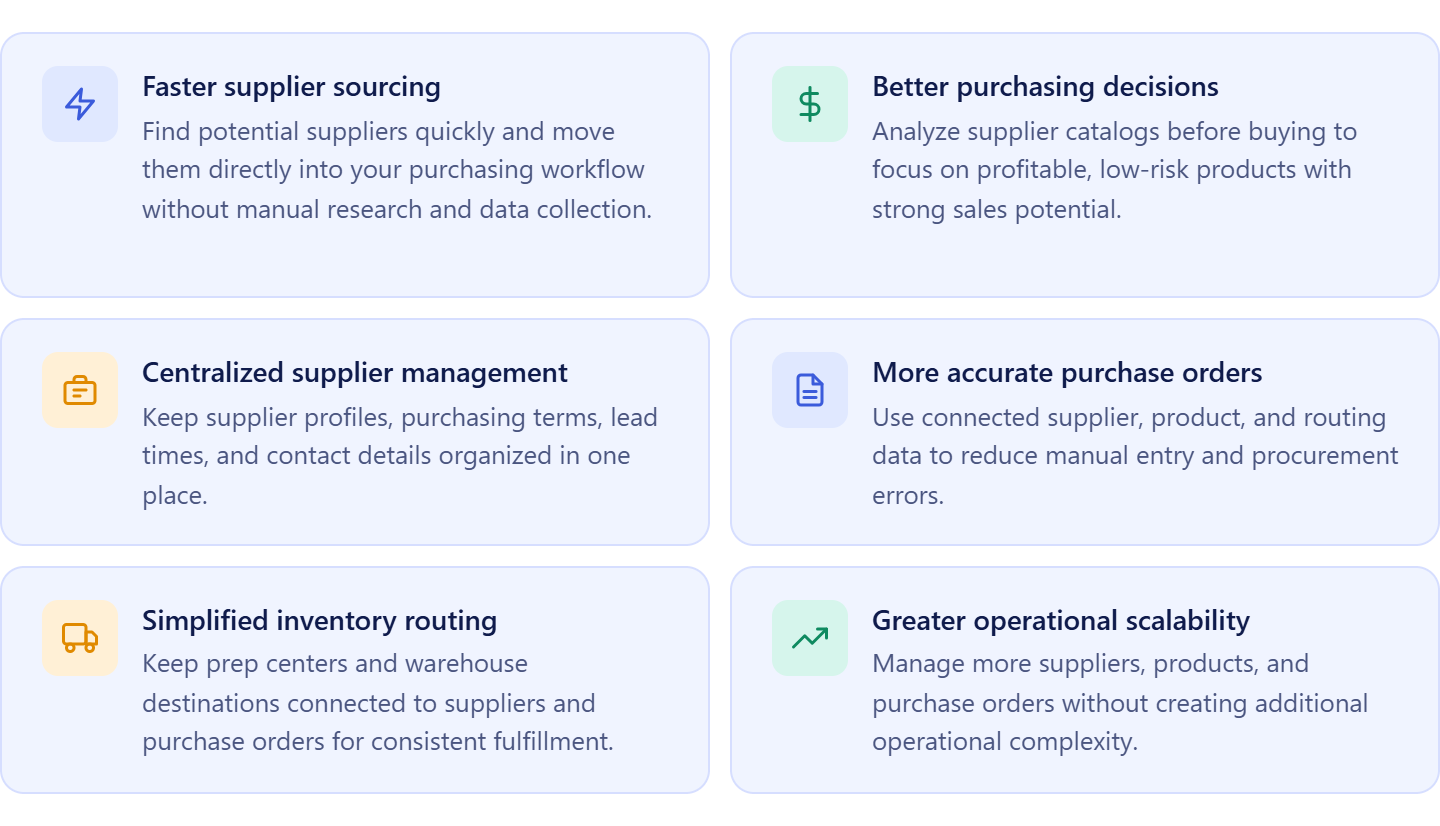
Faster supplier discovery
Finding manufacturers, distributors, and wholesalers becomes easier when supplier research is connected directly to the purchasing process. Sellers can move from identifying a supplier to building a purchasing relationship without unnecessary manual work.
Smarter product selection
Evaluating supplier catalogs before purchasing helps sellers identify products with strong profit potential while avoiding restrictions, low-demand items, and other sourcing risks.
Better supplier organization
Keeping supplier contact information, purchasing terms, lead times, and relationship details in one place makes supplier management more consistent and easier to maintain over time.
More efficient order creation
When supplier records, product data, and fulfillment destinations are already connected, creating wholesale supplier POs requires less manual input and fewer repetitive tasks.
More accurate inventory routing
Keeping warehouse and prep center information connected to suppliers and orders helps ensure inventory is shipped to the correct destination and reduces fulfillment issues.
Easier business growth
As supplier networks, product catalogs, and order volumes increase, a connected workflow helps sellers manage purchasing operations more efficiently without creating additional complexity.
How Seller Assistant Connects Every Stage of Supplier Purchasing
Managing supplier purchases involves much more than creating purchase orders. Amazon sellers must find suppliers, evaluate supplier catalogs, organize supplier information, select profitable products, assign fulfillment destinations, and review profitability before committing capital. When these activities are handled separately, data becomes fragmented and purchasing becomes harder to manage.
Seller Assistant connects the entire process into one workflow where information flows automatically from one stage to the next. Instead of manually transferring supplier, product, and purchasing data between spreadsheets and tools, sellers can manage the complete journey from supplier discovery to purchase order creation inside one system.
How the workflow works
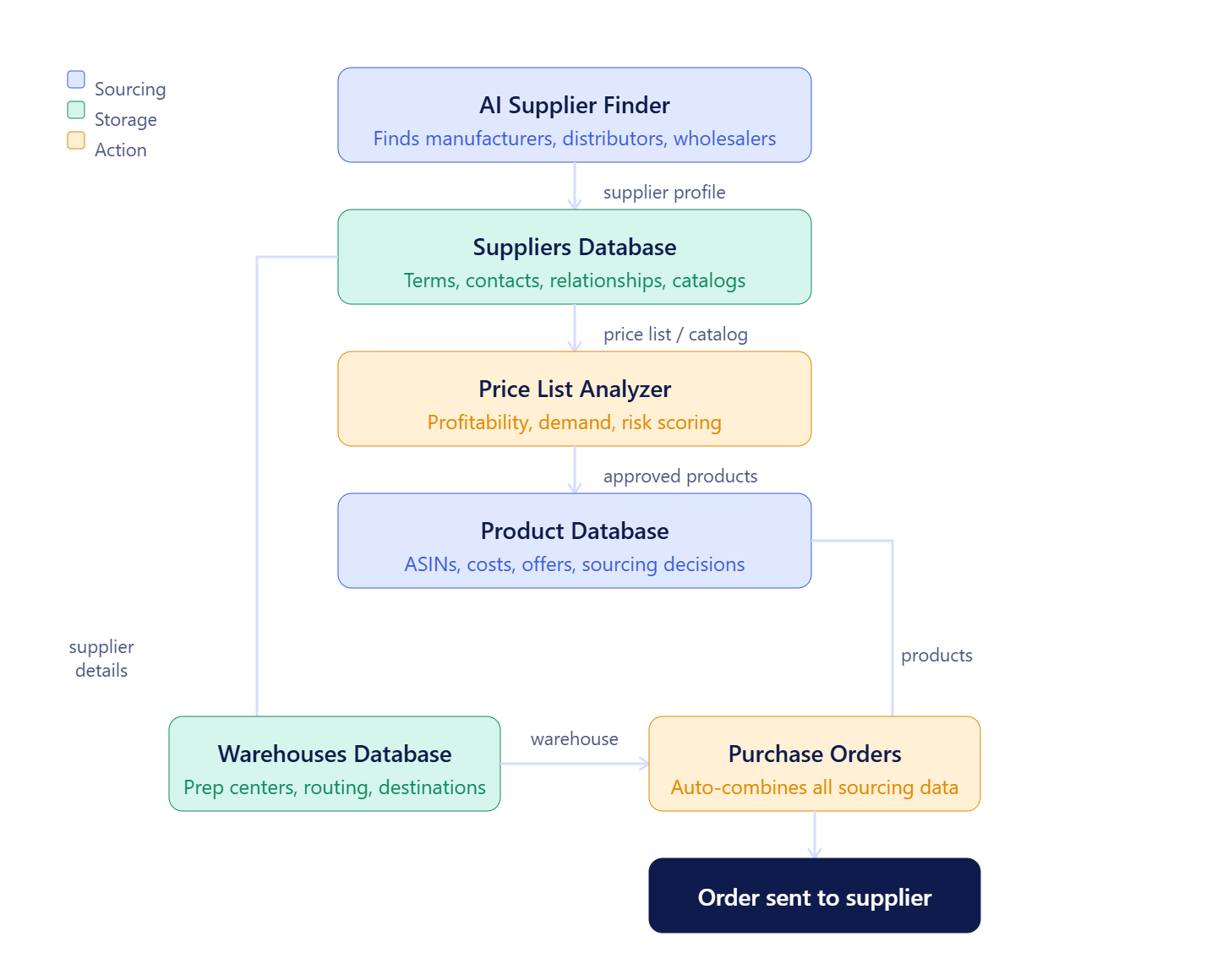
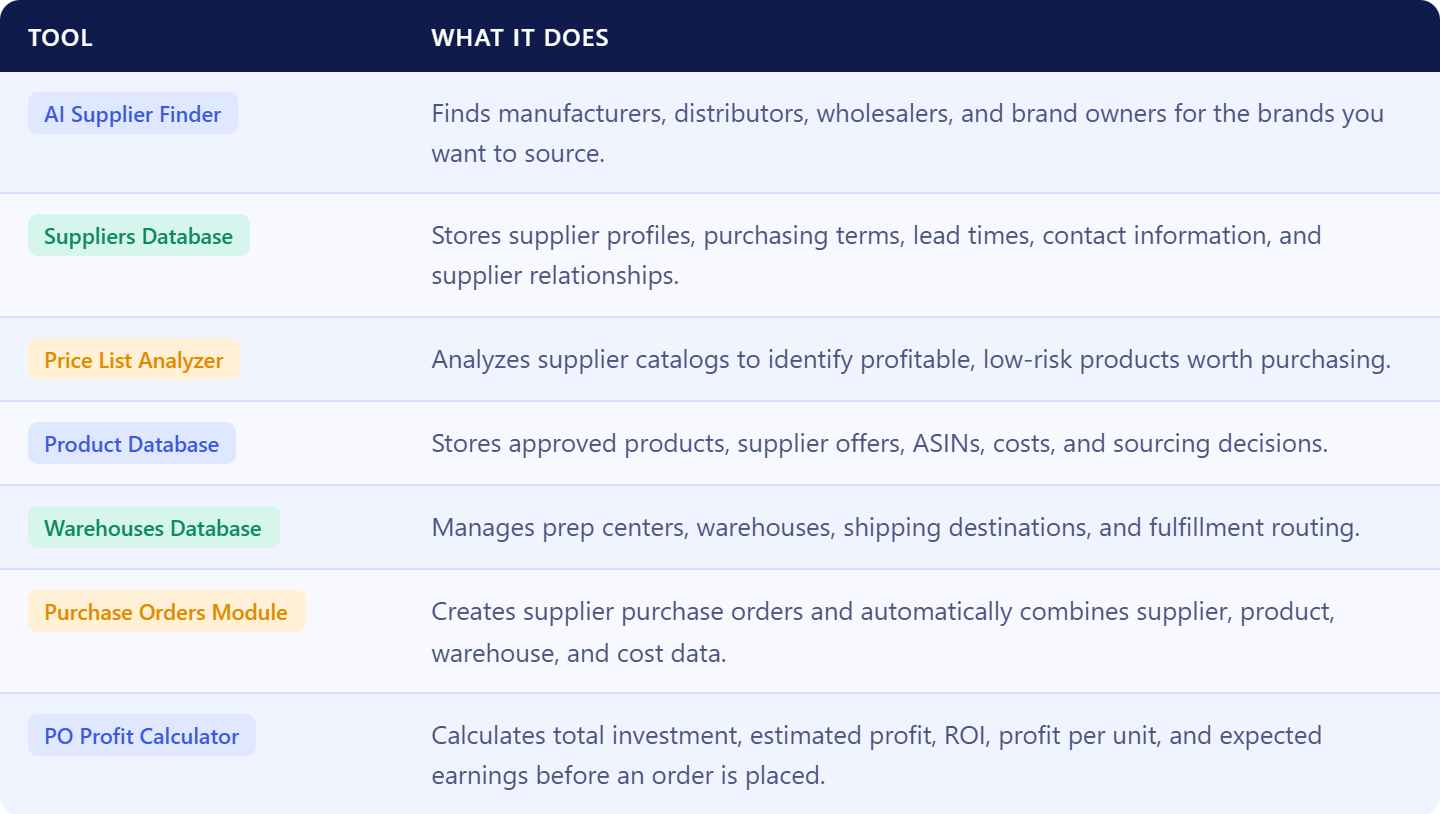
The process starts when a seller selects a brand and uses AI Supplier Finder to identify manufacturers, distributors, wholesalers, or brand owners. Once a supplier is selected, it is saved in Suppliers Database, where supplier information, purchasing terms, and relationship details are managed.
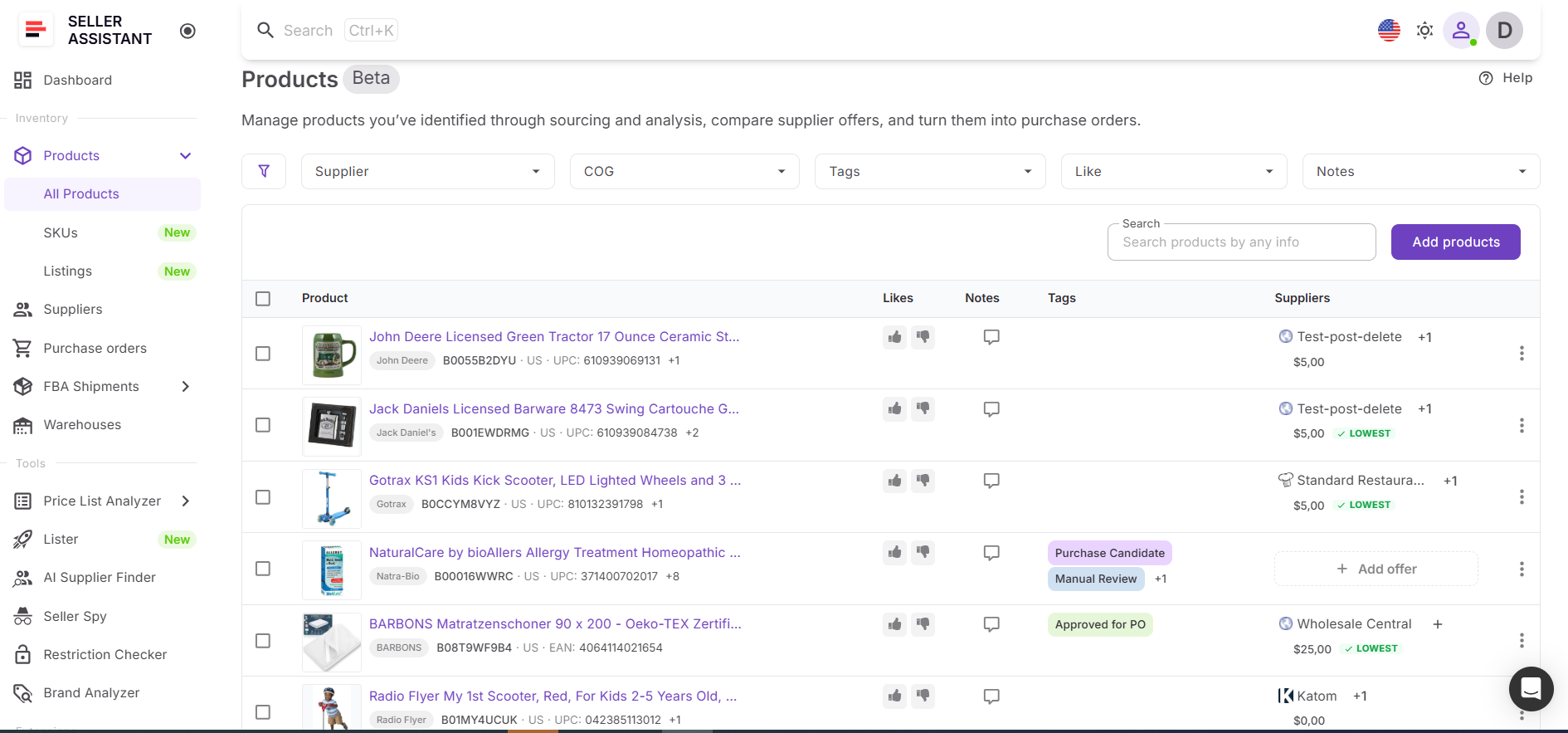
After receiving a supplier catalog, the seller uploads it for analysis to Price List Analyzer to identify profitable products, evaluate risks, and shortlist the best opportunities. All products and supplier offers are automatically stored in Product Database, creating a centralized sourcing record.
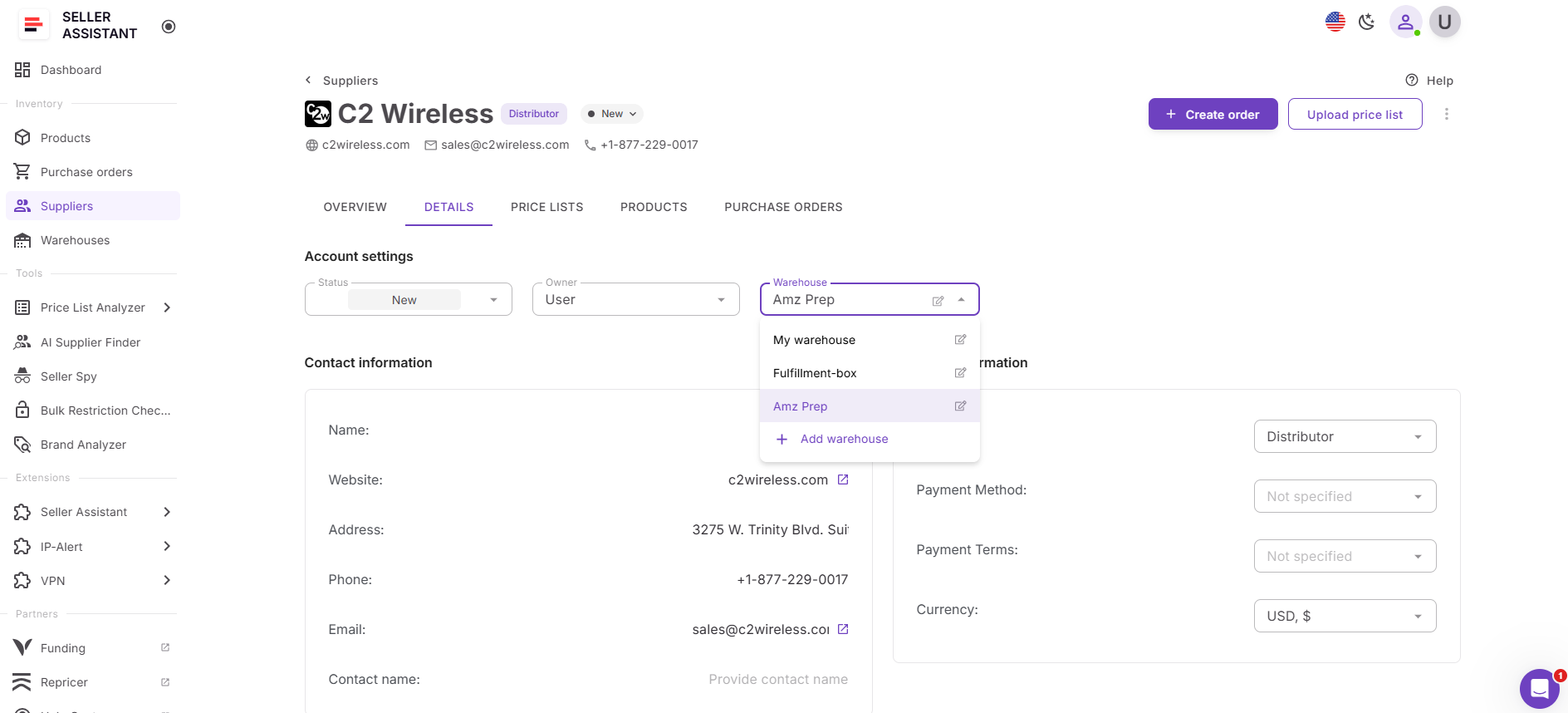
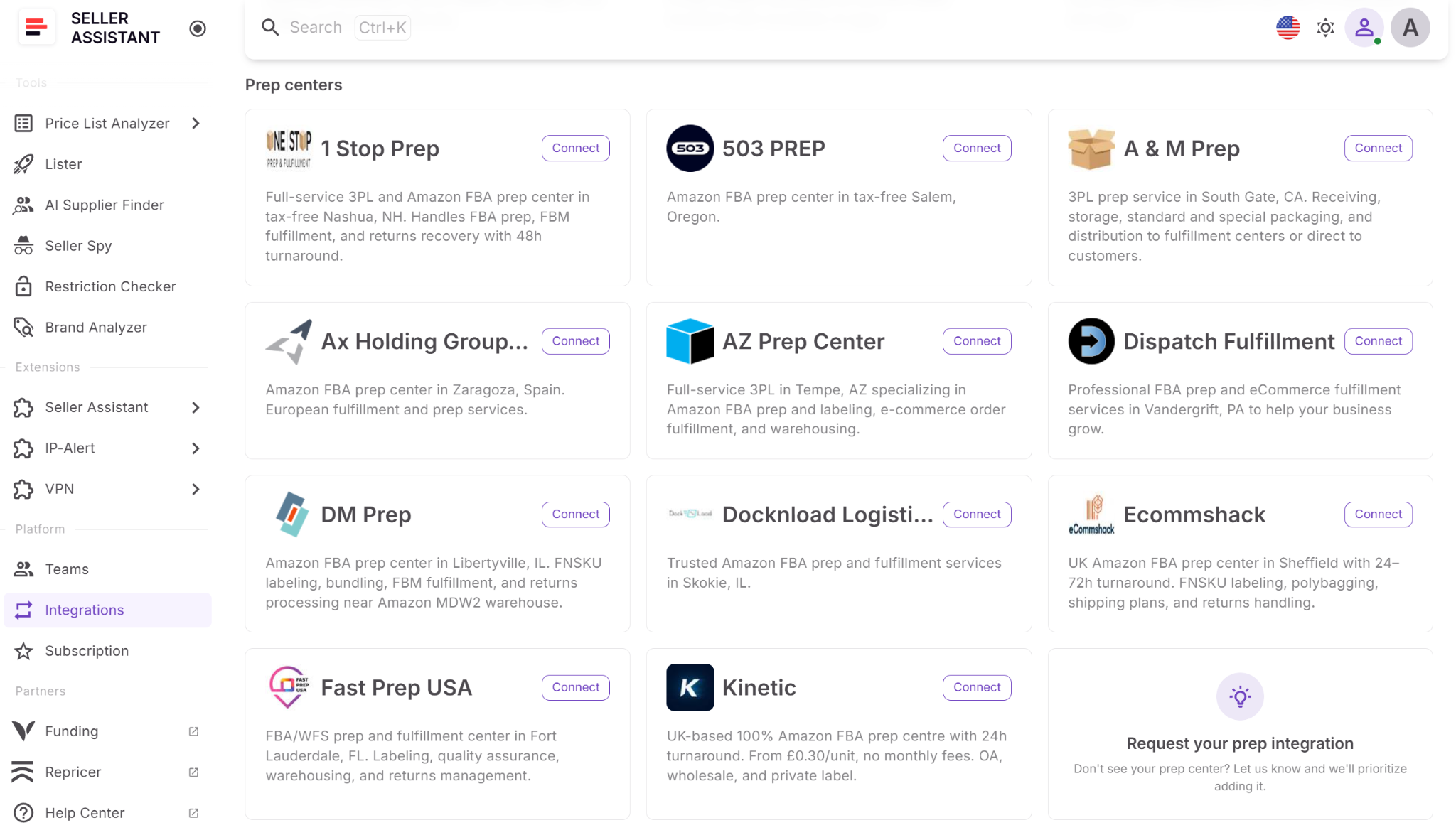
Next, the seller assigns a prep center or warehouse destination with Warehouses Database. Existing fulfillment locations can be reused, or new warehouses can be added as needed. Seller Assistant also supports direct integration with prep centers, making inventory routing part of the purchasing workflow.
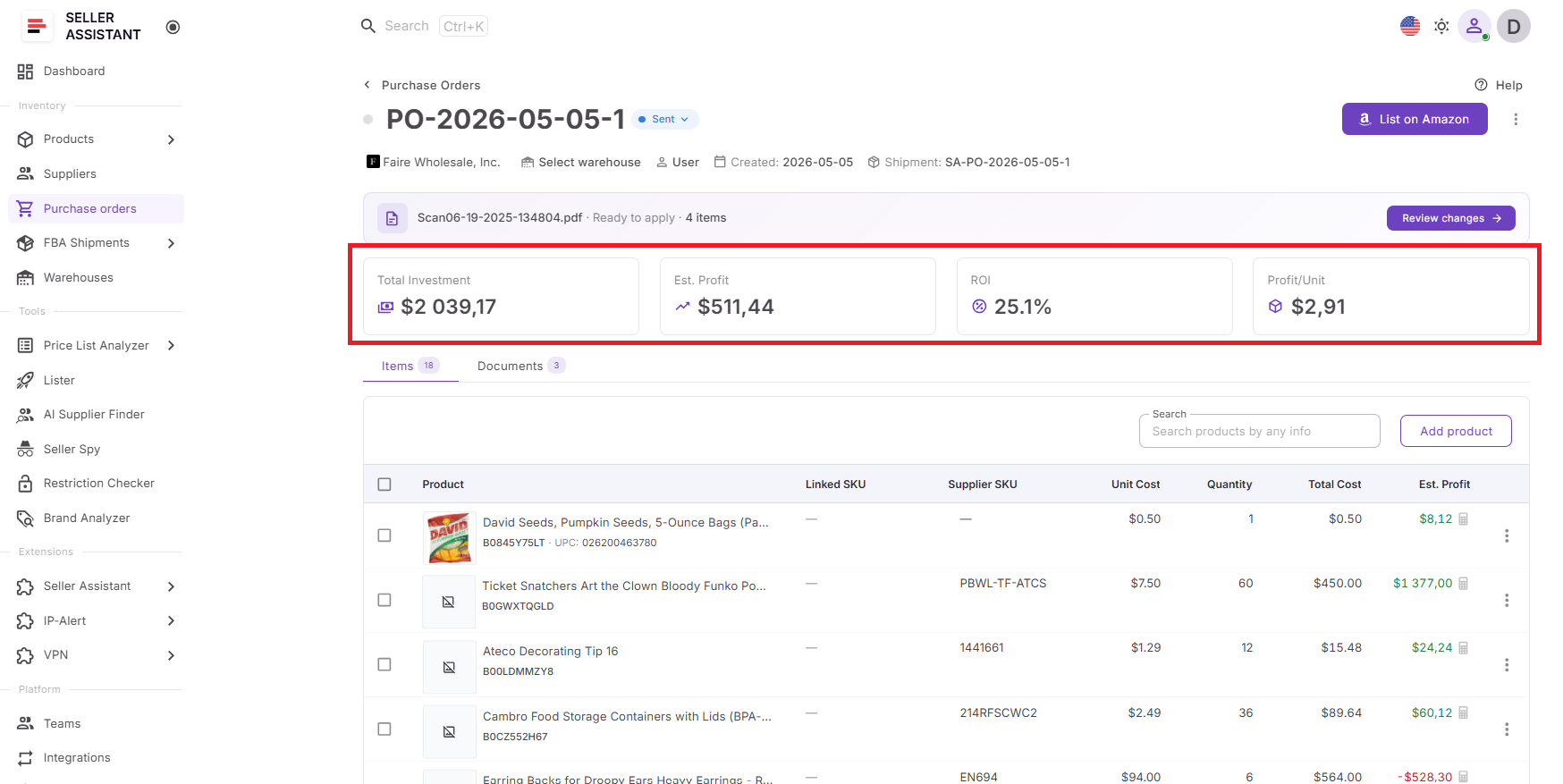
Finally, selected products are moved into Purchase Orders Module, where supplier details, warehouse information, and product data are filled automatically. Before sending the order, the seller can review purchase order profitability, including total investment, estimated profit, ROI, and expected earnings.
Seller Assistant tools used in the workflow
What AI Supplier Finder Is
AI Supplier Finder is Seller Assistant’s supplier sourcing tool designed for Amazon wholesale sellers, online arbitrage sellers, and dropshippers. It helps sellers quickly discover potential suppliers for a specific brand, including manufacturers, distributors, wholesalers, and brand owners that support wholesale purchasing.
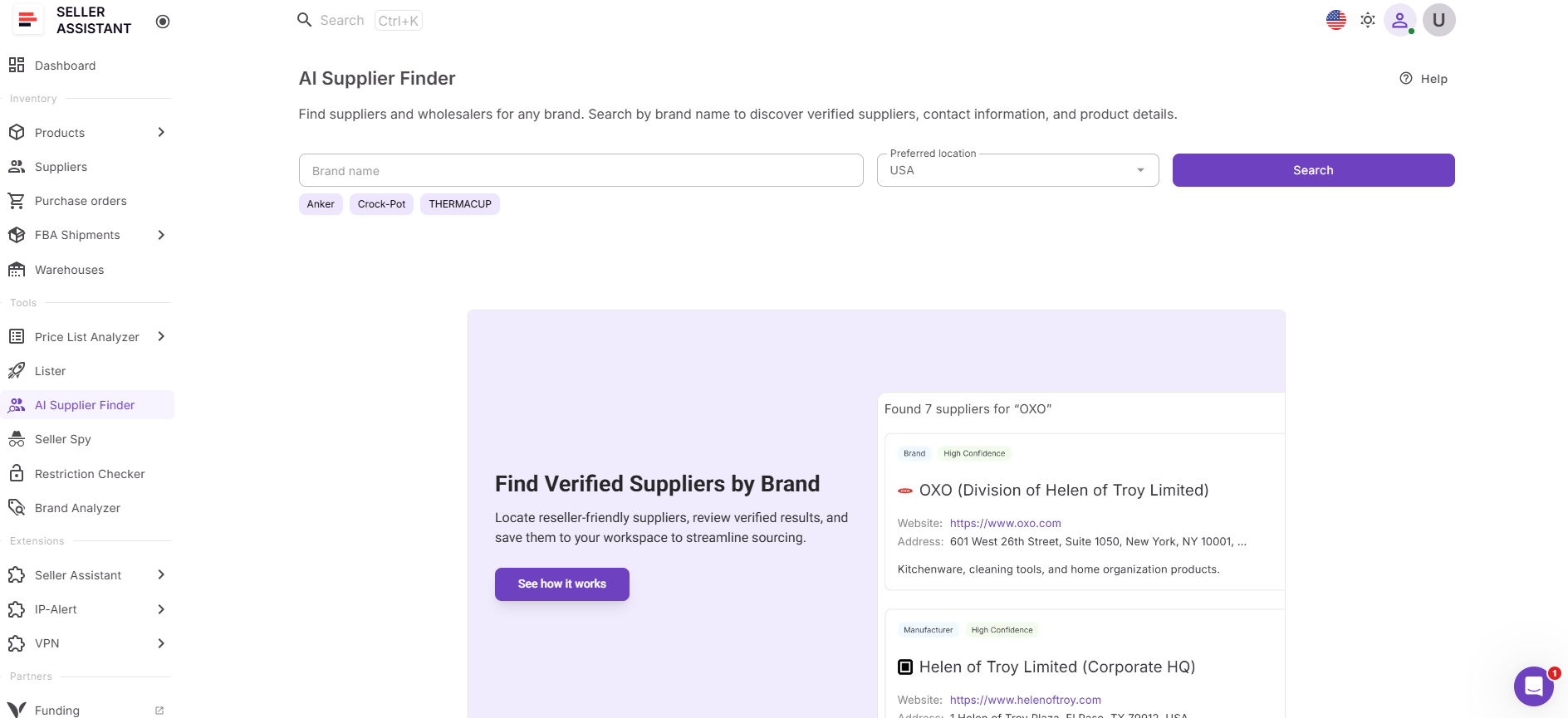
Instead of manually researching suppliers across search engines and business directories, sellers receive a structured list of supplier opportunities tailored to wholesale sourcing and Amazon resale.
What AI Supplier Finder does
AI Supplier Finder helps sellers identify and evaluate suppliers before starting the purchasing process.
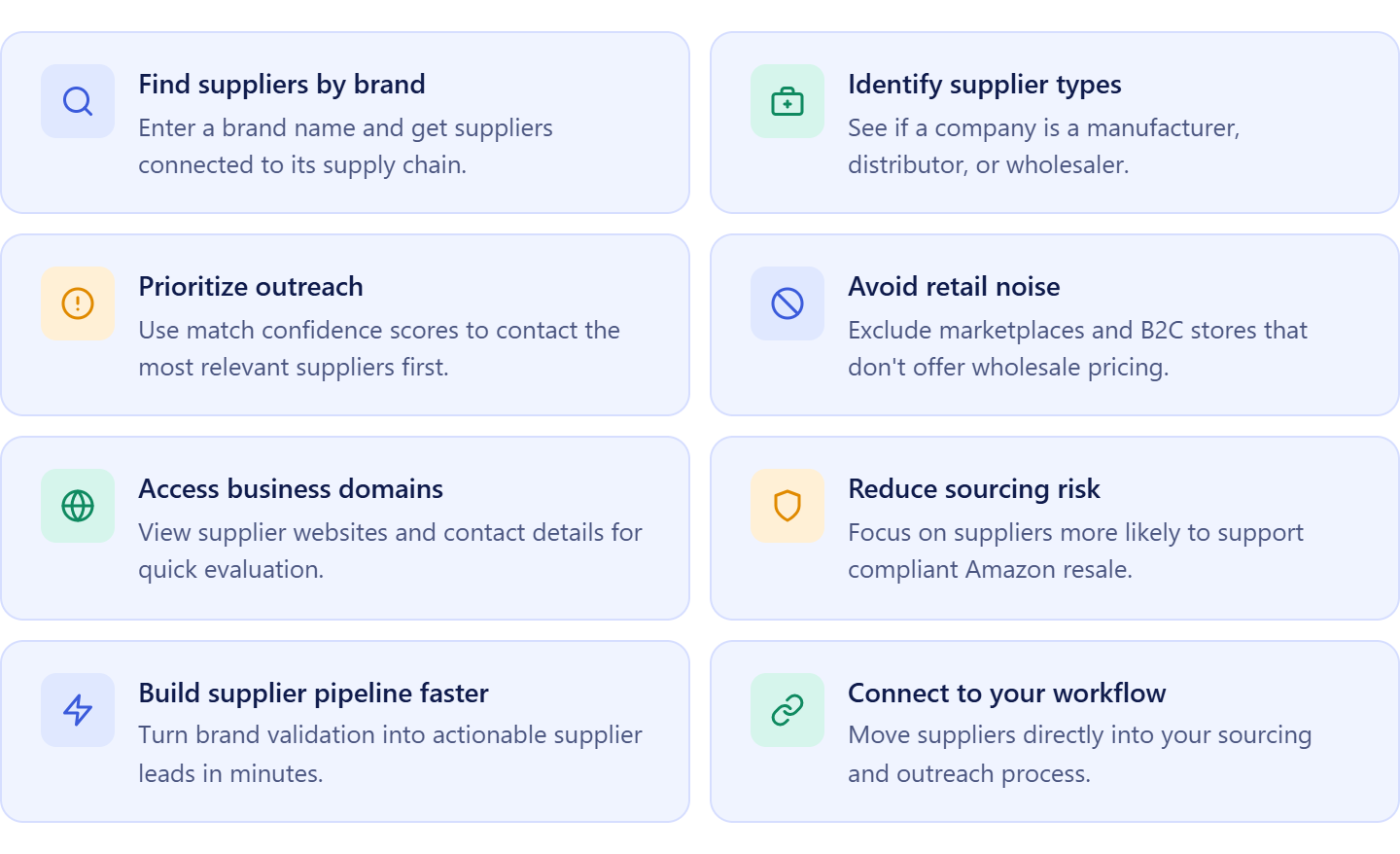
It allows sellers to:
- Search for suppliers by brand;
- Discover manufacturers, distributors, wholesalers, and brand representatives;
- Prioritize suppliers most suitable for wholesale sourcing;
- Access supplier websites and business contact information;
- Review supplier relevance using confidence scores;
- Exclude retail stores, marketplaces, and consumer-focused websites;
- Launch supplier searches directly from sourcing activities;
- Add suppliers directly into supplier management workflows.
How AI Supplier Finder supports supplier purchasing workflows
AI Supplier Finder supports supplier purchasing workflows by helping sellers quickly find sourcing partners for the brands they want to sell. Instead of spending time researching suppliers manually, sellers can move directly from brand selection to supplier outreach and relationship building.
Once a supplier is identified, it can be added to the workflow where supplier information, purchasing terms, product catalogs, warehouse assignments, and future supplier orders remain connected. This creates a smooth transition from supplier discovery to product sourcing and ultimately to purchase order creation.
What Suppliers Database Is
Suppliers Database is Seller Assistant’s supplier management tool built for Amazon wholesale sellers, online arbitrage sellers, and dropshippers. It provides a centralized place to manage supplier profiles, purchasing requirements, contact information, lead times, and supplier relationships throughout the sourcing and purchasing process.
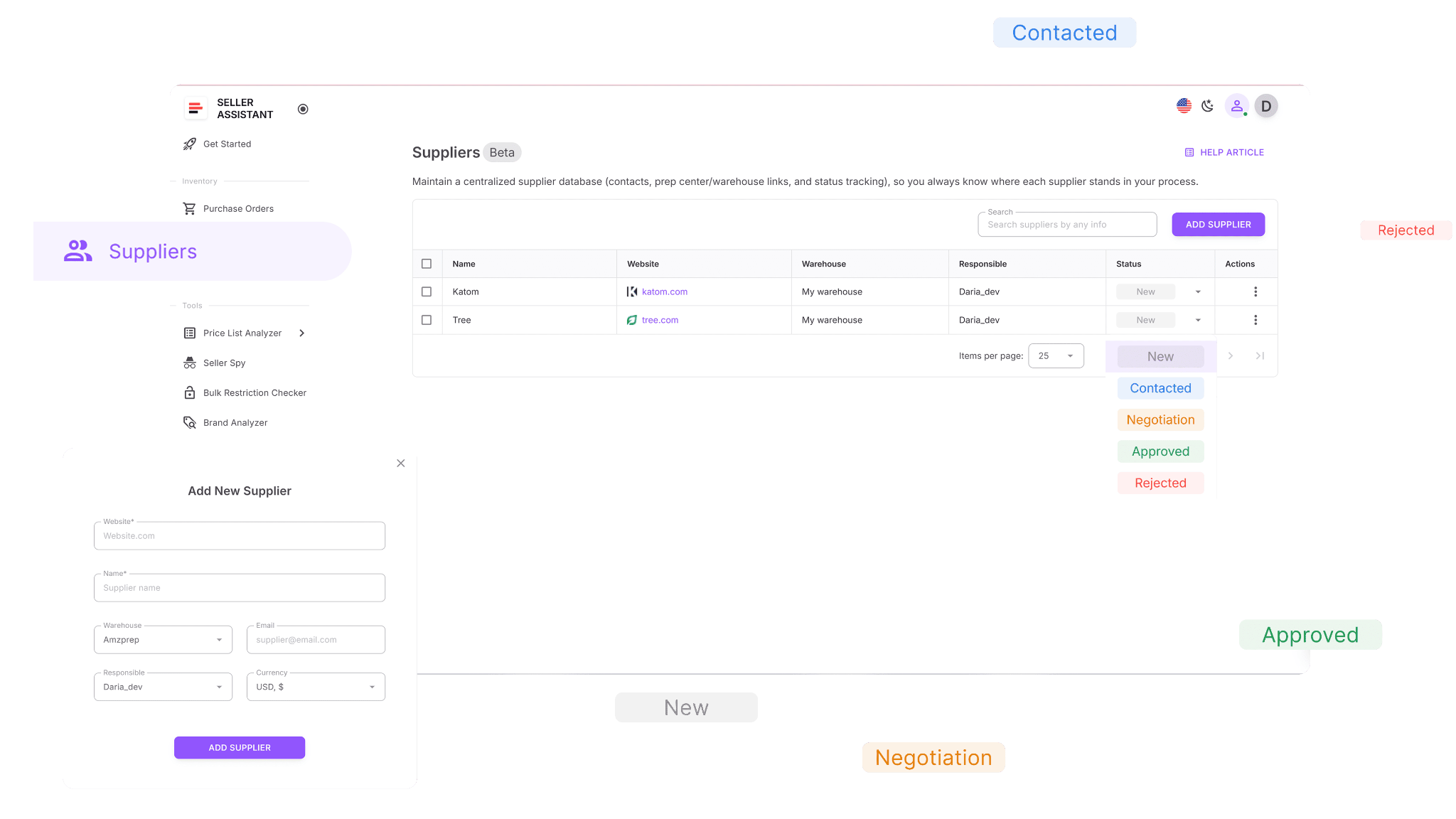
Instead of tracking supplier information across spreadsheets, emails, and notes, sellers can maintain complete supplier records in one organized system that supports ongoing purchasing activities.
What Suppliers Database does
Suppliers Database helps sellers manage supplier relationships and keep supplier information organized throughout the purchasing workflow.
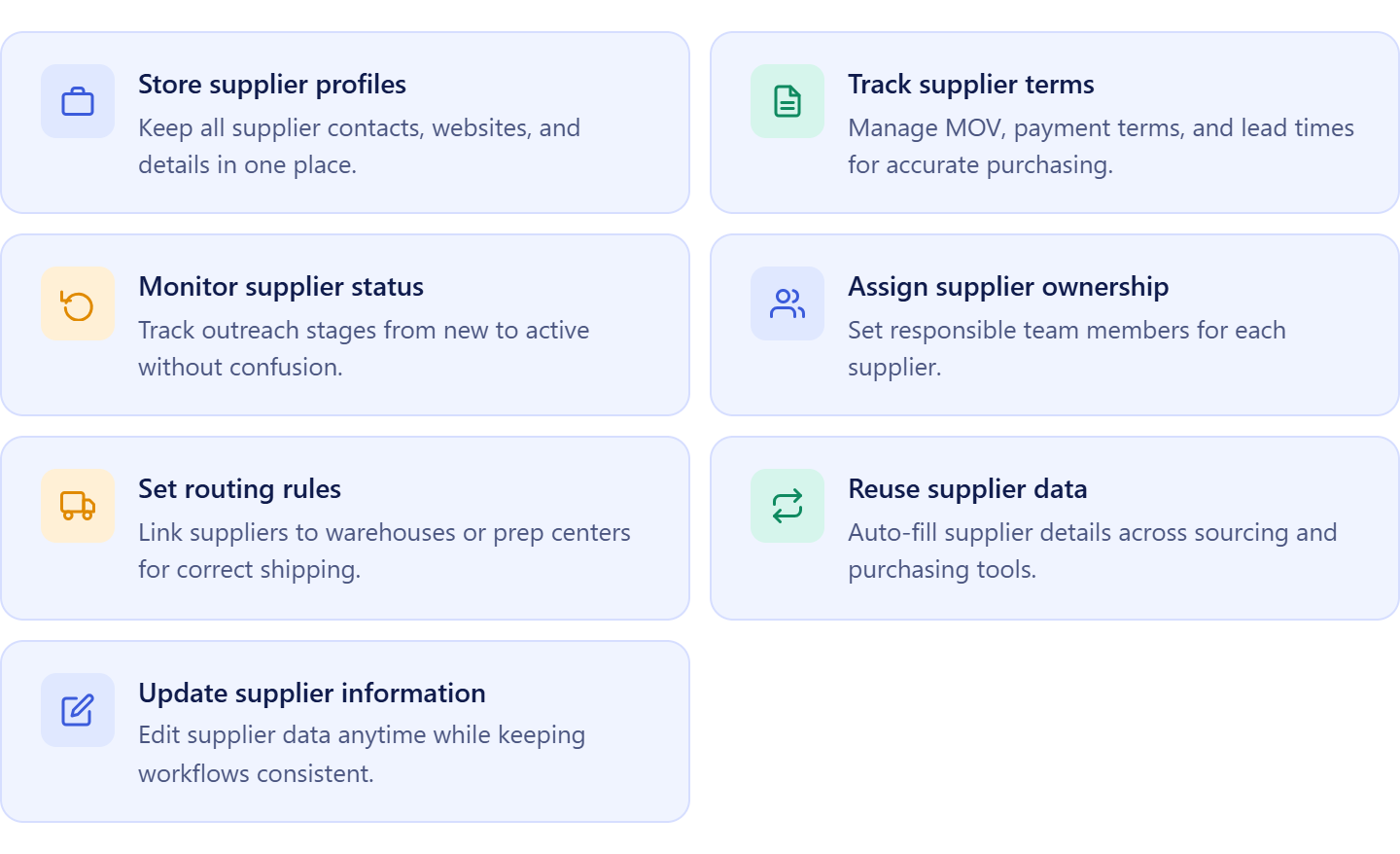
It allows sellers to:
- Save supplier profiles and business contact information;
- Manage purchasing terms such as MOQ, payment terms, lead times, and shipping requirements;
- Track supplier outreach and relationship status;
- Assign suppliers to buyers, sourcing specialists, or virtual assistants;
- Link suppliers to prep centers and warehouse destinations;
- Reuse supplier information when creating supplier orders;
- Update supplier records as supplier relationships evolve.
How Suppliers Database supports supplier purchasing workflows
Suppliers Database supports supplier purchasing workflows by making supplier information available throughout the journey from supplier discovery to purchase order creation. Instead of repeatedly searching for supplier contacts, purchasing requirements, shipping instructions, and payment terms, sellers can access everything from a centralized supplier profile.
Because supplier records remain connected to products, warehouses, and supplier orders, purchasing becomes more consistent and efficient. This helps sellers reduce administrative work, improve supplier communication, avoid purchasing mistakes, and manage growing supplier networks more effectively.
What Price List Analyzer Is
Price List Analyzer is Seller Assistant’s supplier catalog evaluation tool designed for Amazon wholesale sellers, online arbitrage sellers, and dropshippers. It helps sellers analyze supplier price lists in bulk and identify products with the strongest sales potential before committing to a purchase.
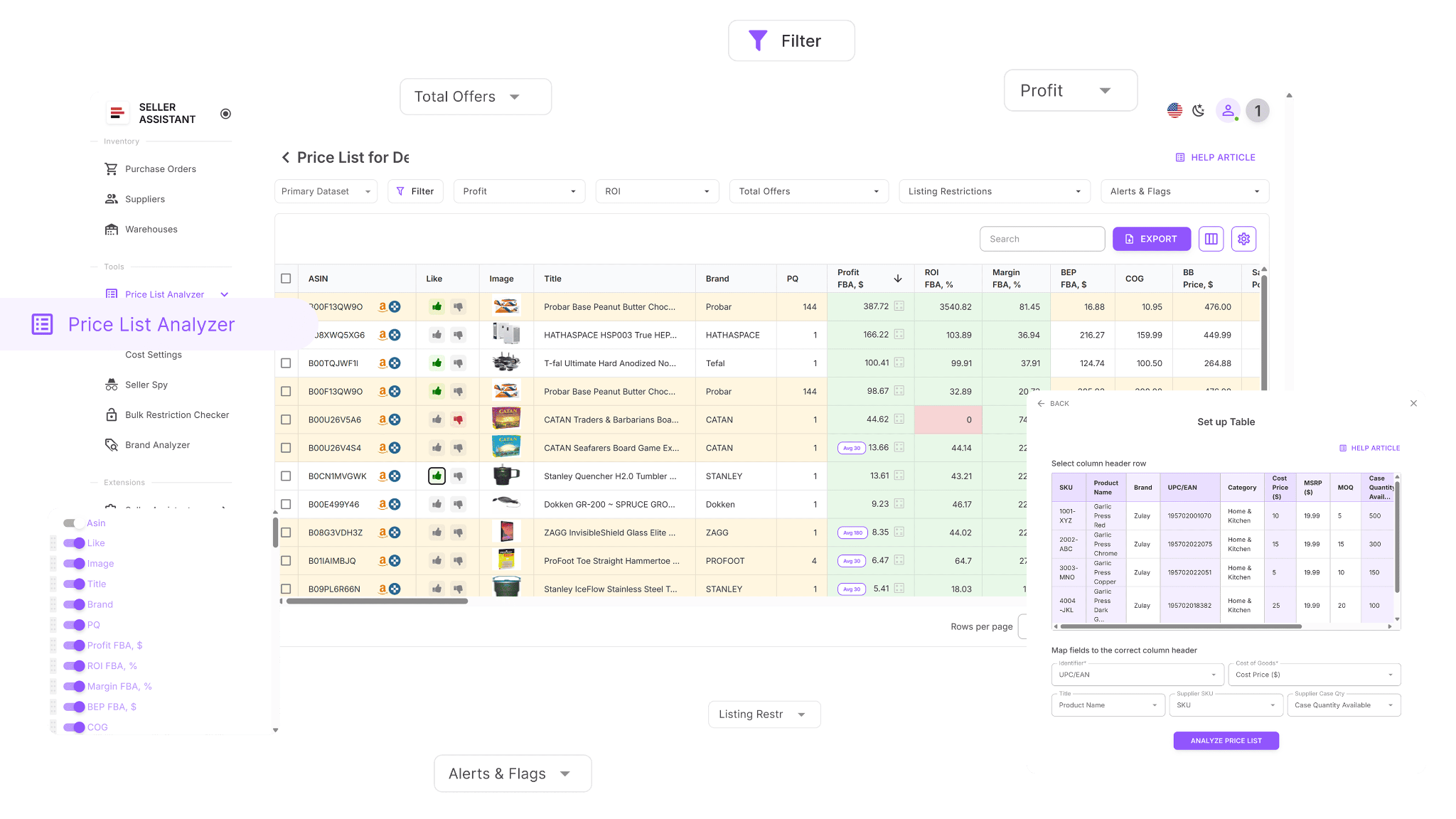
Instead of manually checking products one at a time, sellers can upload entire supplier catalogs and quickly determine which items are profitable, in demand, and suitable for resale on Amazon.
What Price List Analyzer does
Price List Analyzer helps sellers turn supplier catalogs into informed purchasing opportunities.
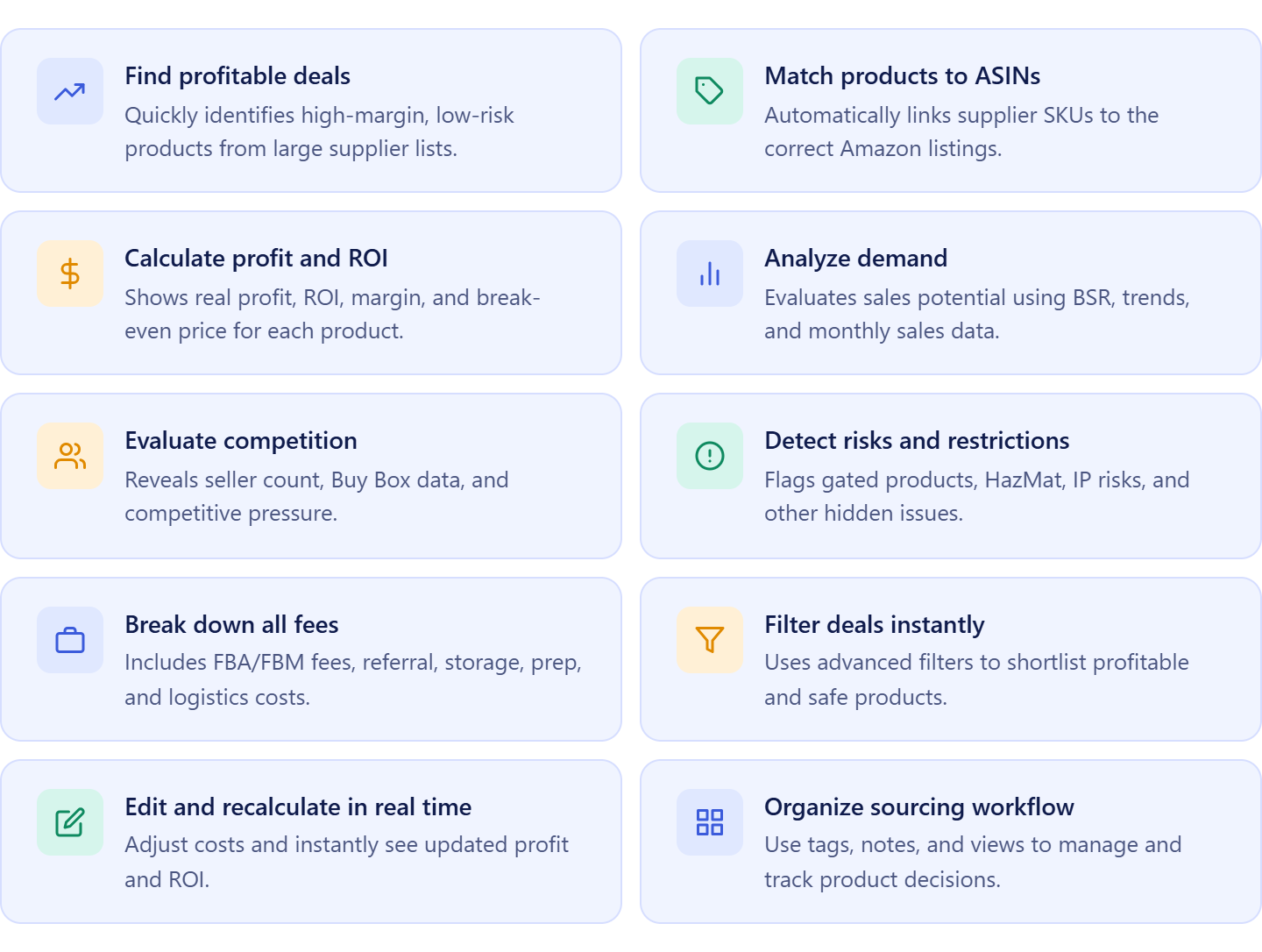
It allows sellers to:
- Analyze large supplier catalogs in bulk;
- Match supplier products to Amazon ASINs automatically;
- Calculate ROI, margin, profit, and break-even pricing;
- Evaluate demand using sales estimates and BSR history;
- Review competition, Buy Box conditions, and Amazon participation;
- Identify restrictions, HazMat products, IP risks, and other sourcing issues;
- Filter products by profitability, competition, demand, and risk;
- Adjust COG, shipping, prep, and logistics costs dynamically;
- Organize product evaluations with tags, notes, and custom views;
- Move approved products into the next stage of the workflow.
How Price List Analyzer supports supplier purchasing workflows
Price List Analyzer supports supplier purchasing workflows by helping sellers determine which products from a supplier’s catalog are worth buying. Rather than making purchasing decisions based on incomplete research, sellers can evaluate hundreds or thousands of products using real Amazon marketplace data.
Once profitable products are identified, supplier offers, costs, and sourcing decisions remain connected throughout the workflow. This allows sellers to build supplier orders using validated product data, reduce purchasing risk, and focus their investment on products with the highest potential returns.
What Product Database Is
Product Database is Seller Assistant’s product management tool designed for Amazon wholesale sellers, online arbitrage sellers, and dropshippers. It serves as a centralized workspace where sellers can store products they have sourced, supplier offers, ASINs, costs, and purchasing decisions throughout the buying process.
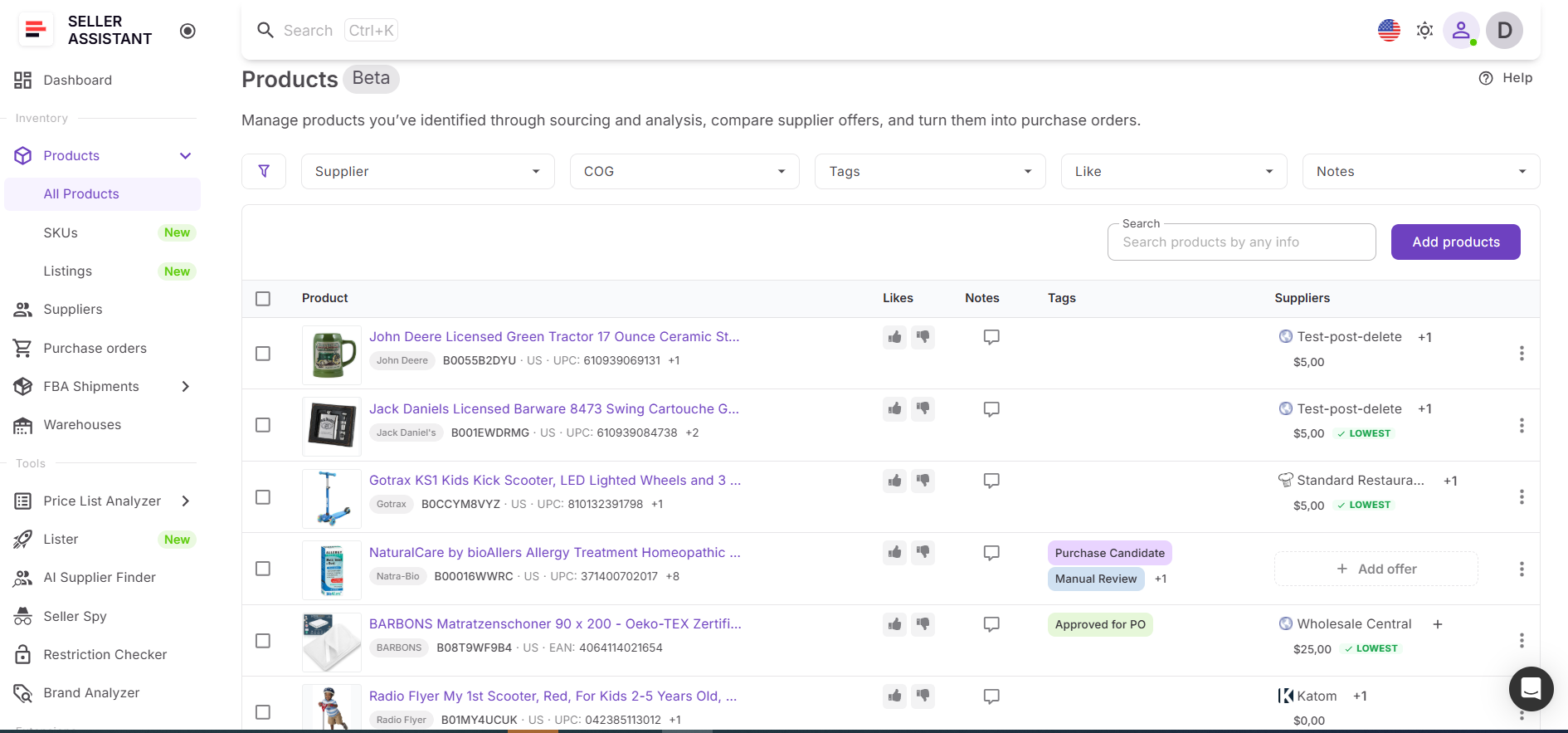
Instead of managing product information across spreadsheets, supplier catalogs, and separate sourcing tools, sellers can keep all product-related data organized in one place and ready for future purchasing activities.
What Product Database does
Product Database helps sellers organize sourcing results and maintain a structured product pipeline.
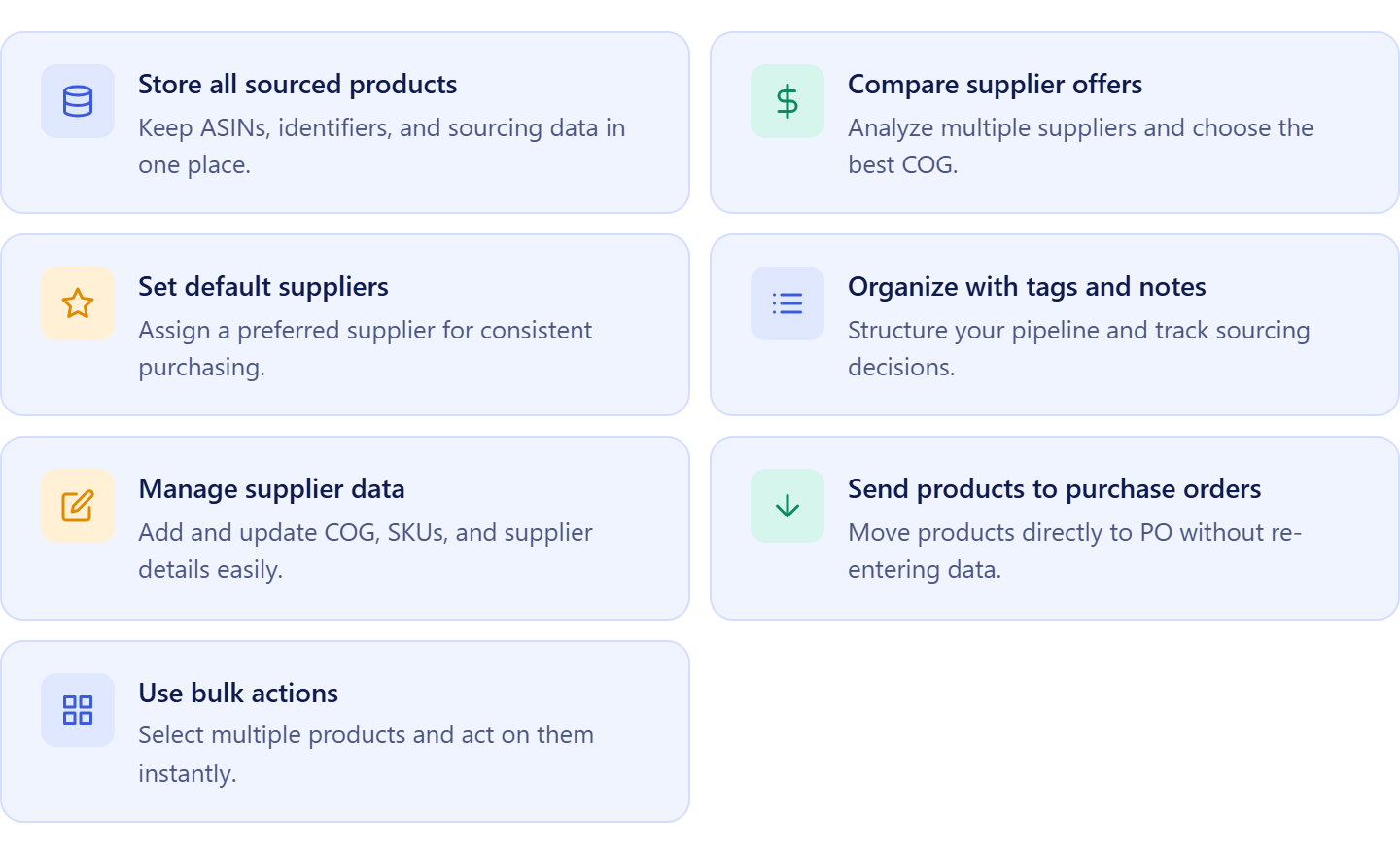
It allows sellers to:
- Store sourced products and ASIN data in one location;
- Compare multiple supplier offers for the same product;
- Assign preferred suppliers to products;
- Organize sourcing decisions using tags, notes, and likes;
- Manage supplier costs and product identifiers;
- Add selected products directly to supplier orders;
- Perform bulk actions across multiple products.
How Product Database supports supplier purchasing workflows
Product Database supports supplier purchasing workflows by keeping approved products, supplier offers, and buying decisions connected throughout the journey from supplier catalog analysis to purchase order creation. Instead of repeatedly searching for product costs, supplier offers, and sourcing notes, sellers can access all relevant information from a centralized product record.
When it’s time to place an order, products can be moved directly into the purchasing workflow with supplier and cost information already attached. This reduces manual work, improves purchasing consistency, and helps sellers manage larger product catalogs and supplier networks more efficiently.
What Warehouses Database Is
Warehouses Database is Seller Assistant’s warehouse and prep center management tool designed for Amazon wholesale sellers, online arbitrage sellers, and dropshippers. It provides a centralized place to manage warehouses, prep centers, shipping destinations, and inventory routing information used throughout the purchasing process.
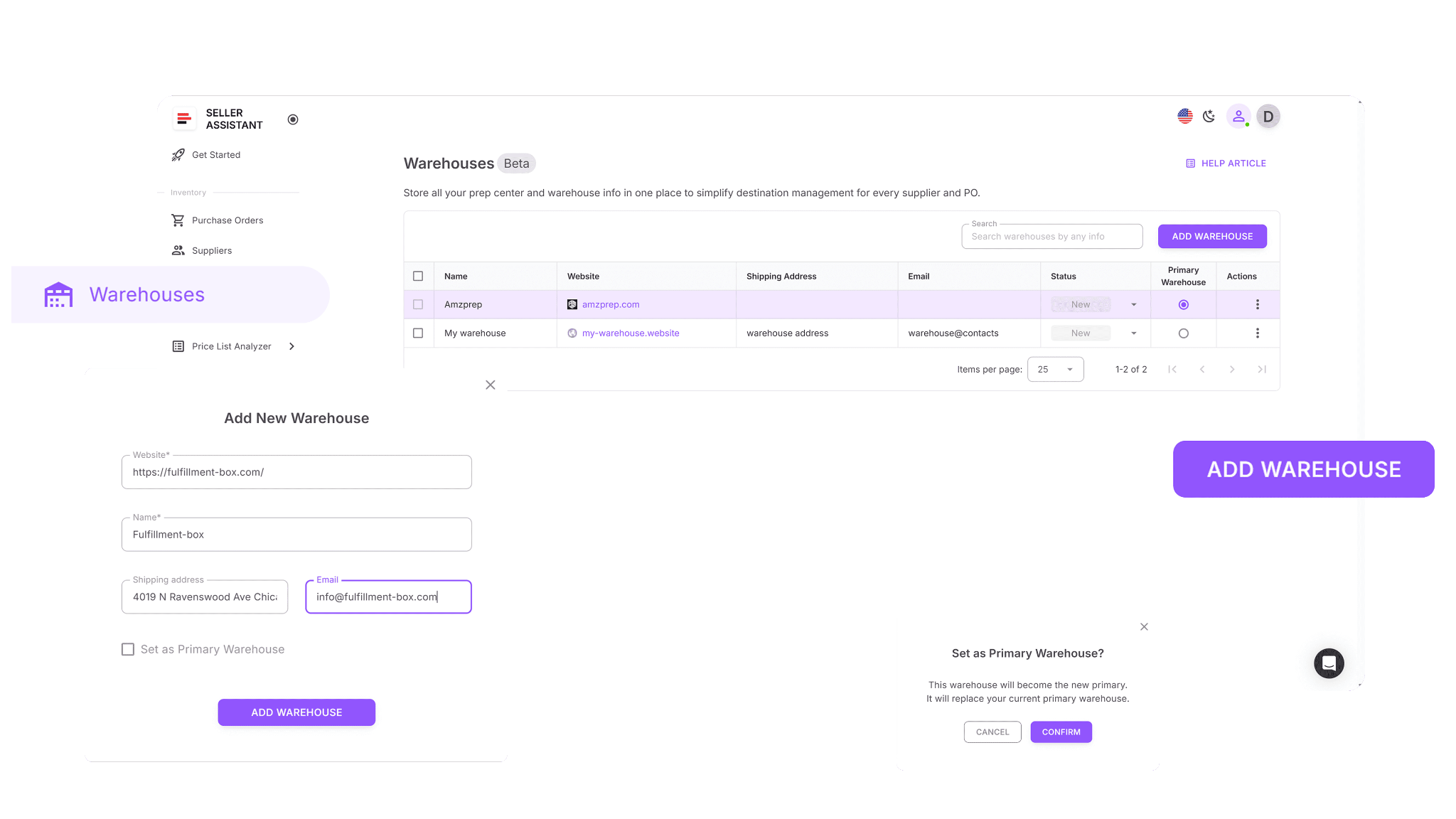
Instead of storing fulfillment details across spreadsheets, emails, and documents, sellers can keep all routing information organized in one system and reuse it across supplier orders and inventory shipments.
What Warehouses Database does
Warehouses Database helps sellers organize inventory routing and maintain accurate shipping destinations.
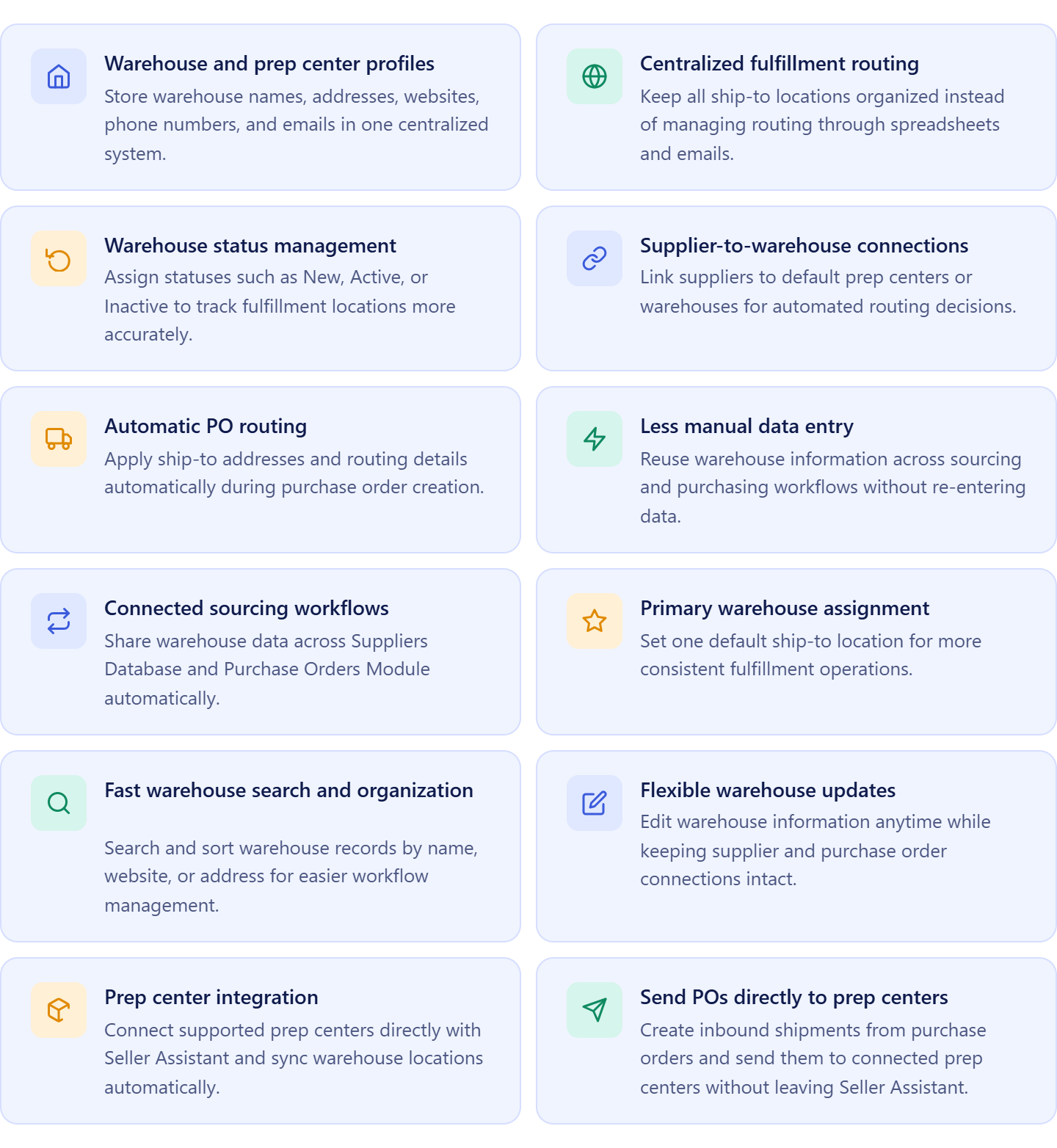
It allows sellers to:
- Create warehouse and prep center profiles;
- Store shipping addresses and contact information;
- Manage active fulfillment locations;
- Assign default warehouses to suppliers;
- Reuse ship-to destinations across supplier orders;
- Connect and sync supported prep centers directly with Seller Assistant;
- Search, organize, and update warehouse records easily;
- Keep routing information connected to suppliers and purchasing workflows.
How Warehouses Database supports supplier purchasing workflows
Warehouses Database supports supplier purchasing workflows by keeping fulfillment destinations connected to supplier and purchasing data. Instead of manually entering shipping addresses every time inventory is ordered, sellers can assign suppliers to specific warehouses or prep centers and automatically apply that routing information to future orders.
For sellers using integrated prep centers, synced warehouse locations become available directly in the workflow, and purchase orders can be sent to prep centers as inbound shipments without leaving Seller Assistant. This reduces routing errors, improves fulfillment accuracy, and makes inventory movement from supplier to prep center easier to manage as operations grow.
What Purchase Orders Module Is
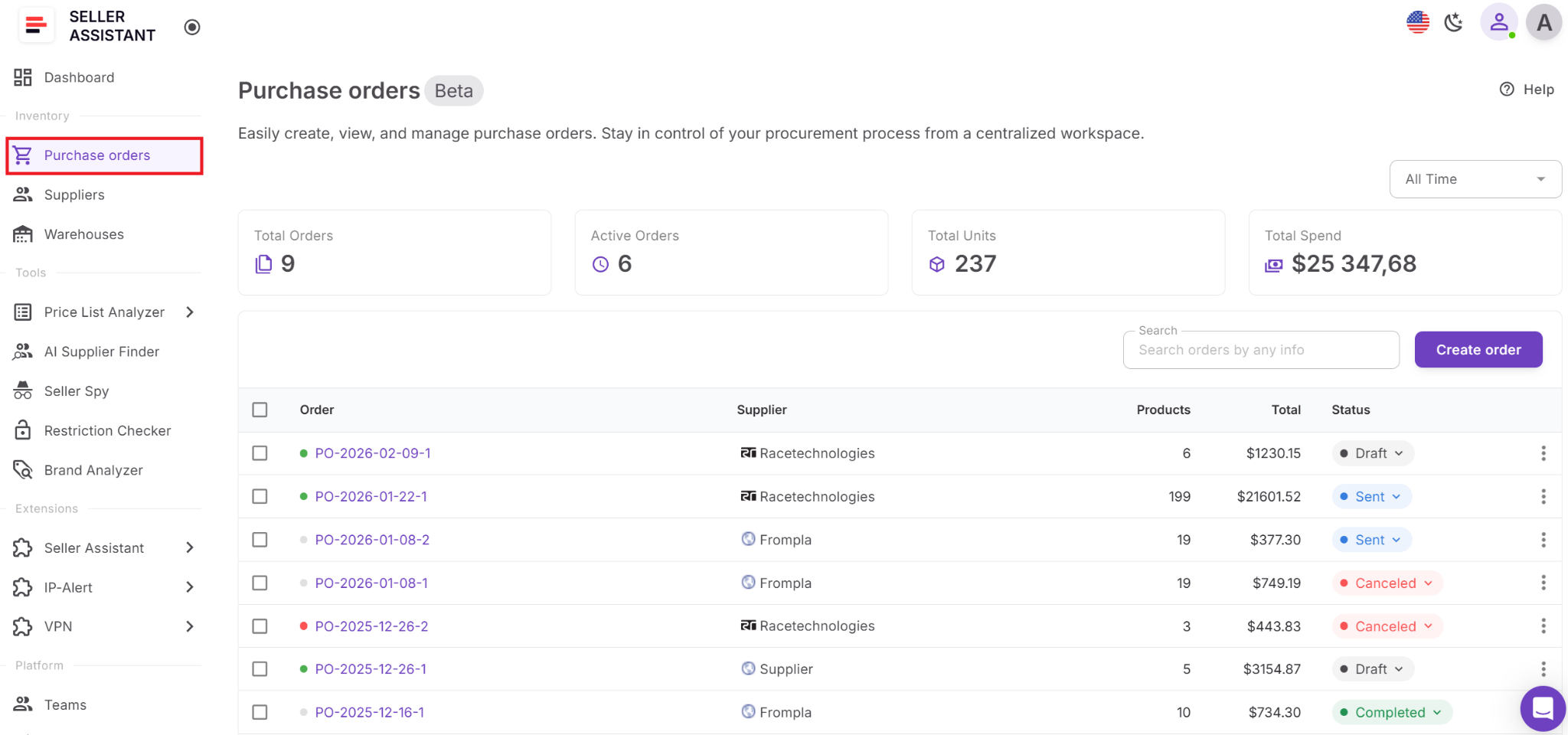
Purchase Orders Module is Seller Assistant’s supplier order management tool designed for Amazon wholesale sellers, online arbitrage sellers, and dropshippers. It provides a centralized workspace for creating, organizing, tracking, and managing supplier orders using connected supplier, product, and warehouse data.
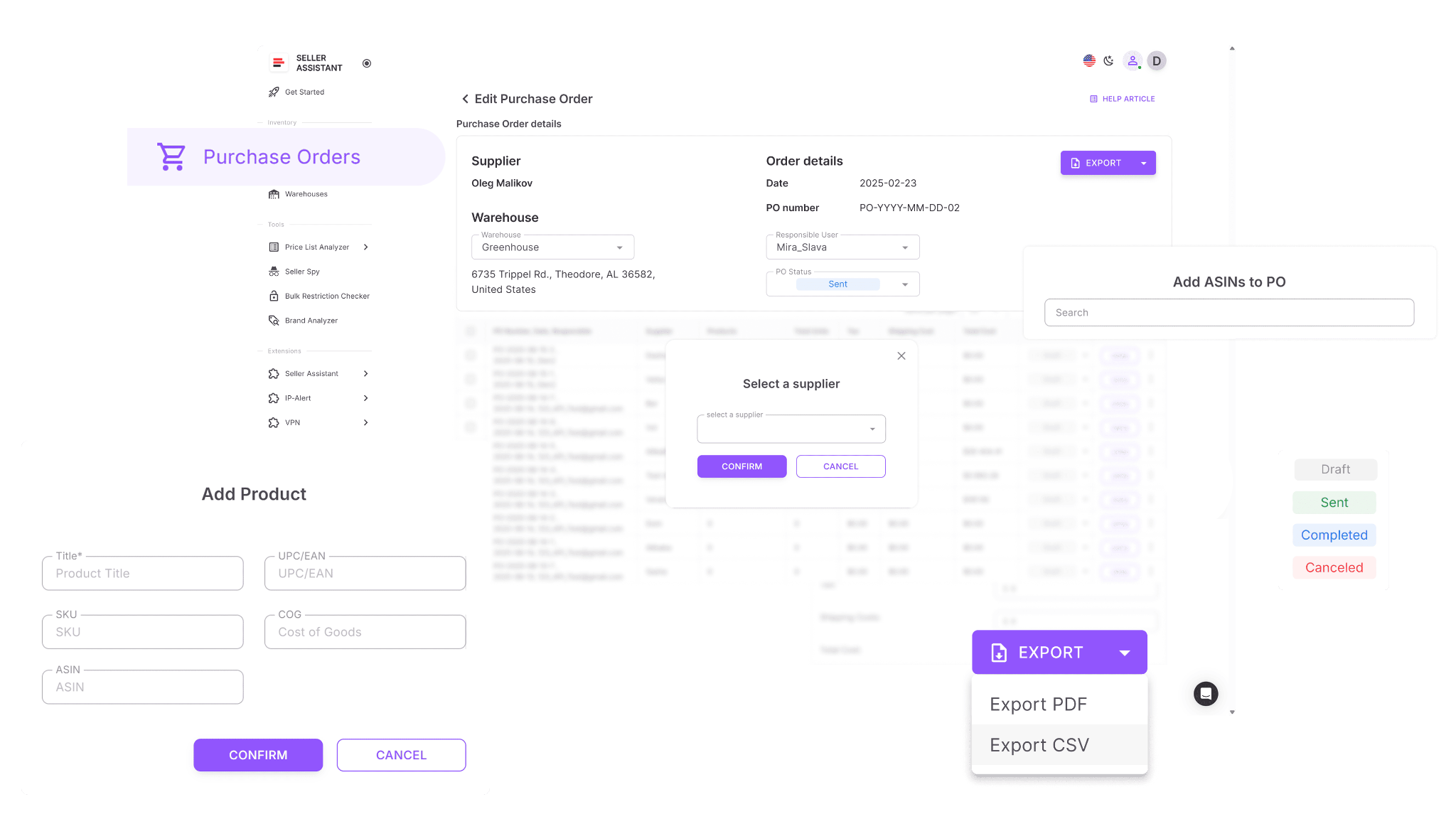
Instead of building orders manually in spreadsheets or disconnected templates, sellers can generate structured purchase orders using information already collected throughout the sourcing and purchasing workflow.
What Purchase Orders Module does
Purchase Orders Module helps sellers organize supplier purchasing and maintain a consistent ordering process.
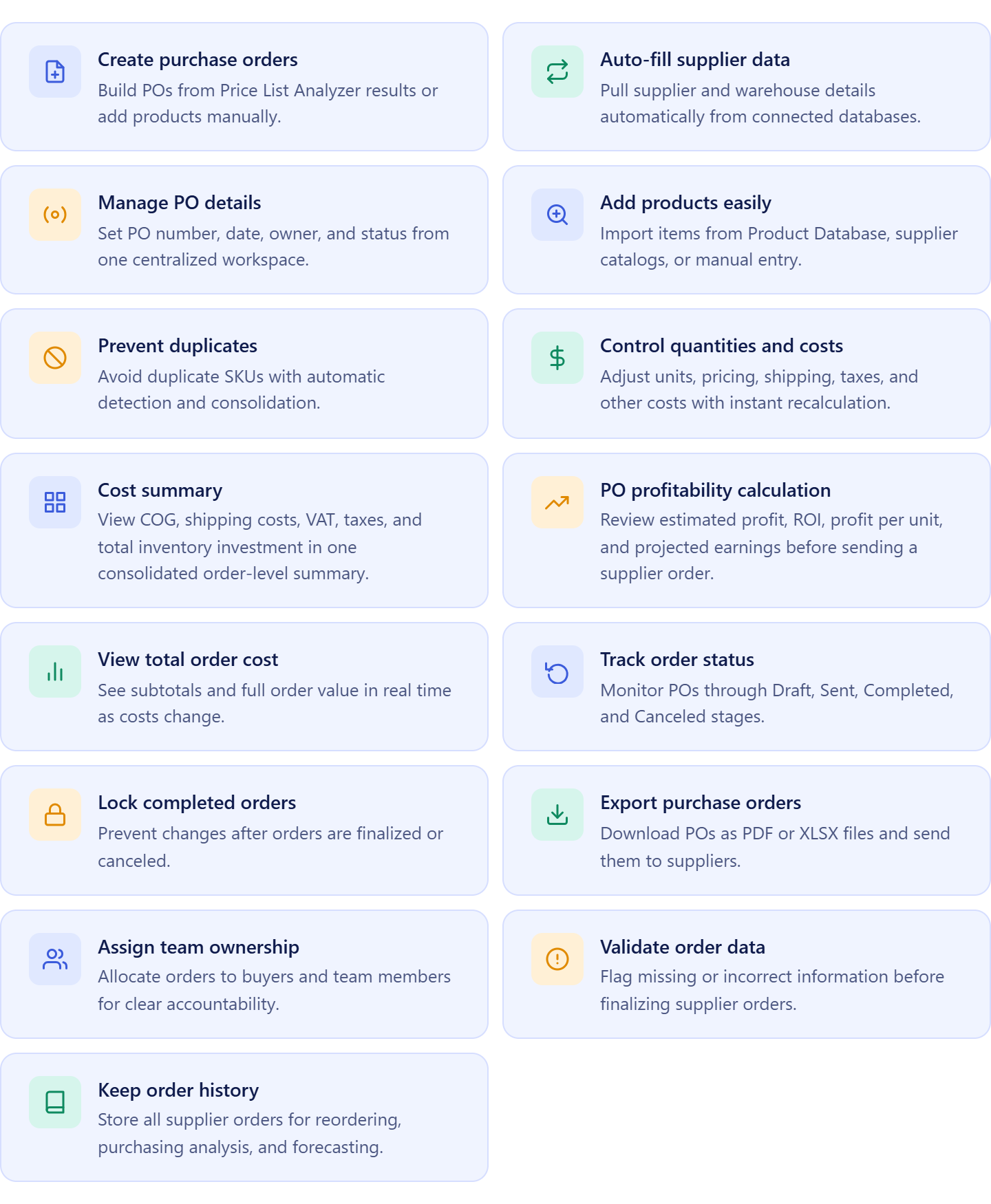
It allows sellers to:
- Create supplier orders from approved products;
- Automatically apply supplier and warehouse information stored in the workflow;
- Manage order numbers, ownership, dates, and statuses;
- Add products from Product Database, supplier catalogs, or manual entry;
- Prevent duplicate products within the same order;
- Adjust quantities, pricing, shipping, taxes, and other purchasing costs;
- View a consolidated cost summary with COG, VAT, taxes, shipping, and total inventory cost;
- Calculate estimated order profitability before placing a supplier order;
- Track supplier orders through different order stages;
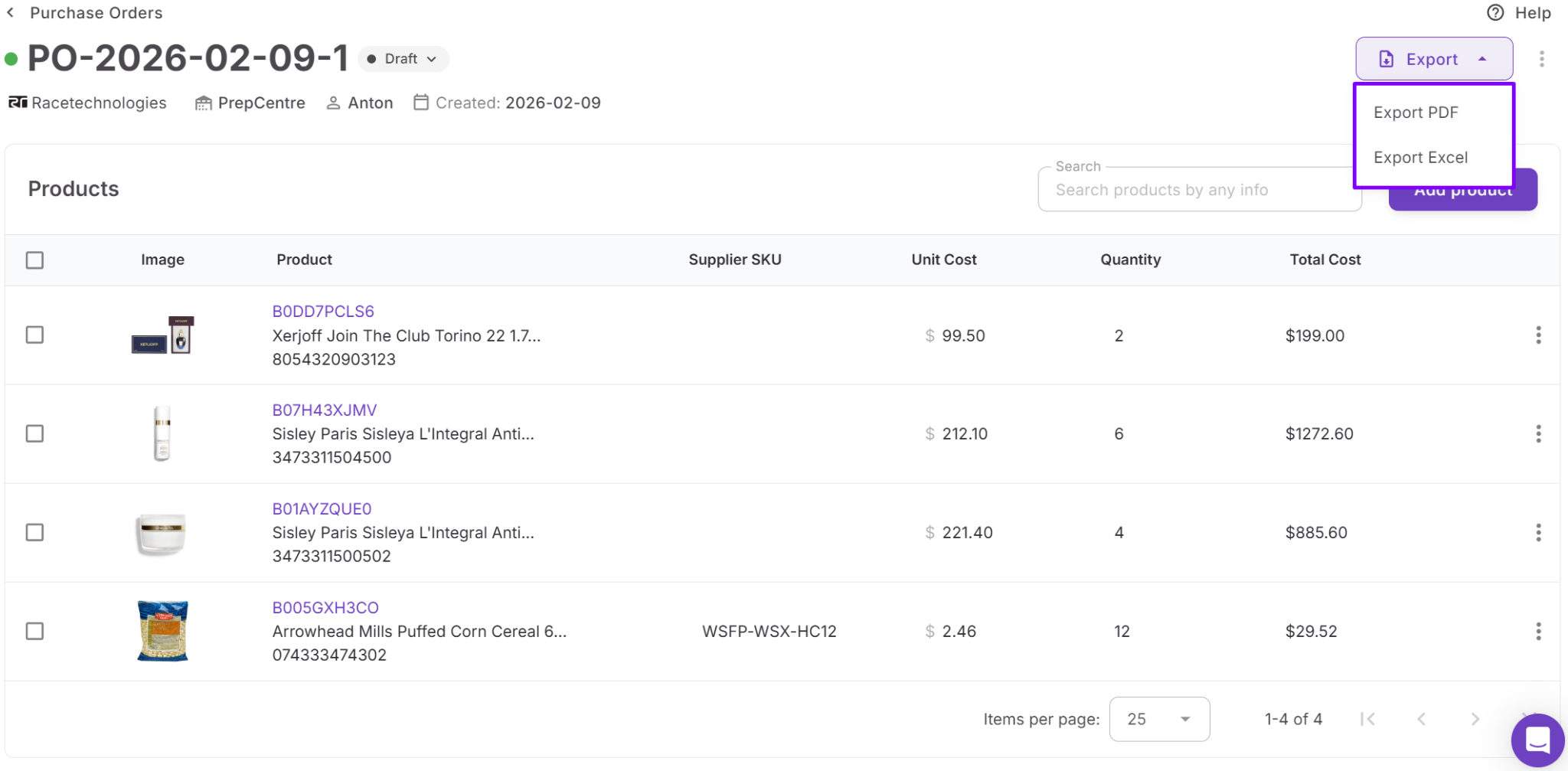
- Export supplier orders as PDF or XLSX files;
- Assign orders to buyers and team members;
- Review incomplete order information before sending;
- Maintain a complete history of supplier purchases.
How Purchase Orders Module supports supplier purchasing workflows
Purchase Orders Module supports supplier purchasing workflows by bringing together all supplier, product, warehouse, and cost data required to create a supplier order. Once products are approved and routed to the correct fulfillment destination, sellers can generate purchase orders without manually rebuilding order information.
The module also helps sellers evaluate orders before committing capital. A built-in cost summary consolidates product costs, VAT, taxes, shipping expenses, and other purchasing costs to show the total inventory investment at the order level. At the same time, profitability calculations provide visibility into expected profit, ROI, and projected earnings.
This allows sellers to make purchasing decisions using complete financial data rather than estimates, while keeping supplier orders organized, accurate, and connected to the rest of the workflow.
How to Go from Supplier to Purchase Order Step by Step
Moving from supplier discovery to a completed purchase order requires more than simply placing an order.
Amazon sellers must validate suppliers, evaluate product opportunities, organize purchasing data, assign fulfillment destinations, and confirm profitability before investing in inventory. A connected workflow helps keep every stage organized and reduces costly purchasing mistakes.
Step 1. Choose a brand and find suppliers
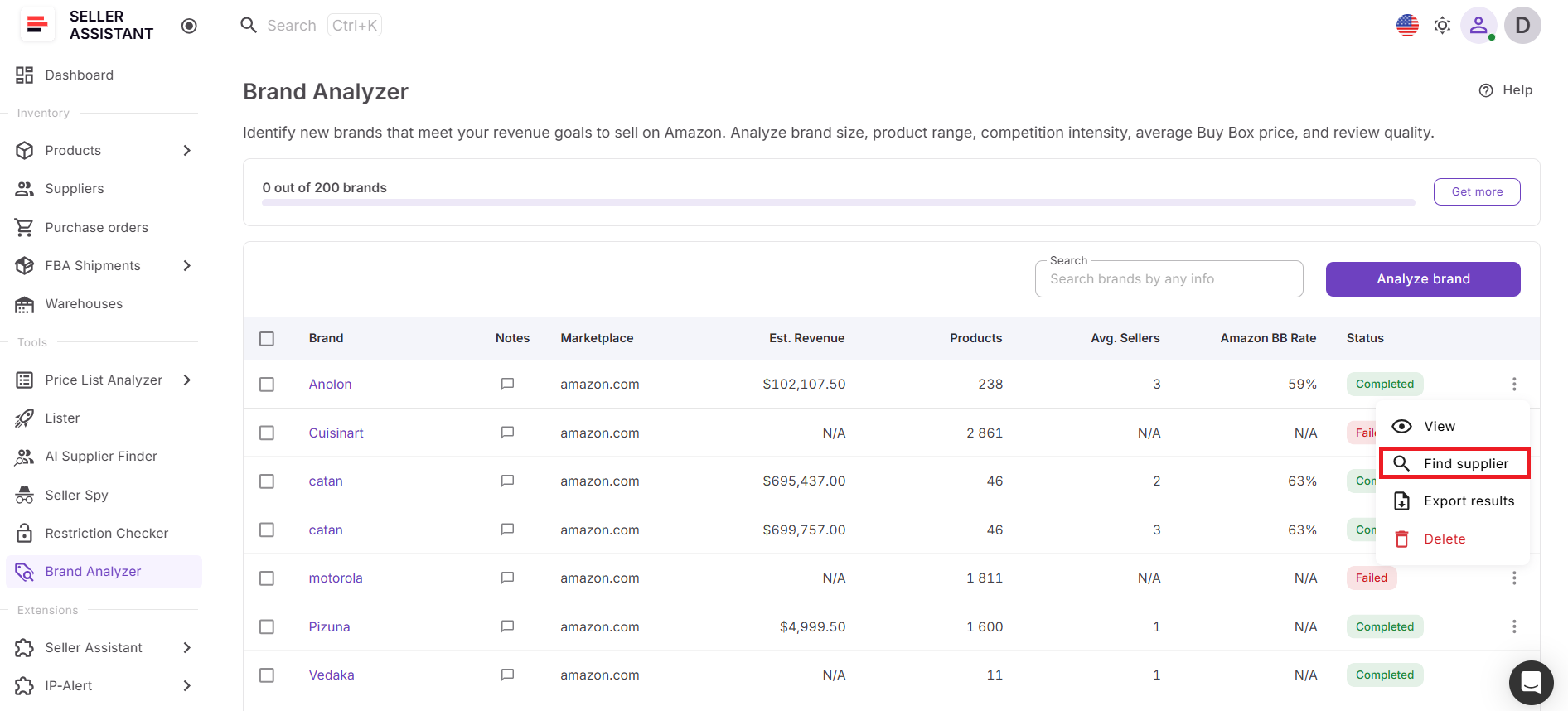
Start by selecting a brand you want to source. Use Seller Assistant’s Brand Analyzer to evaluate the brand and AI Supplier Finder to locate manufacturers, distributors, wholesalers, and brand owners that offer wholesale purchasing opportunities.
Step 2. Organize supplier information
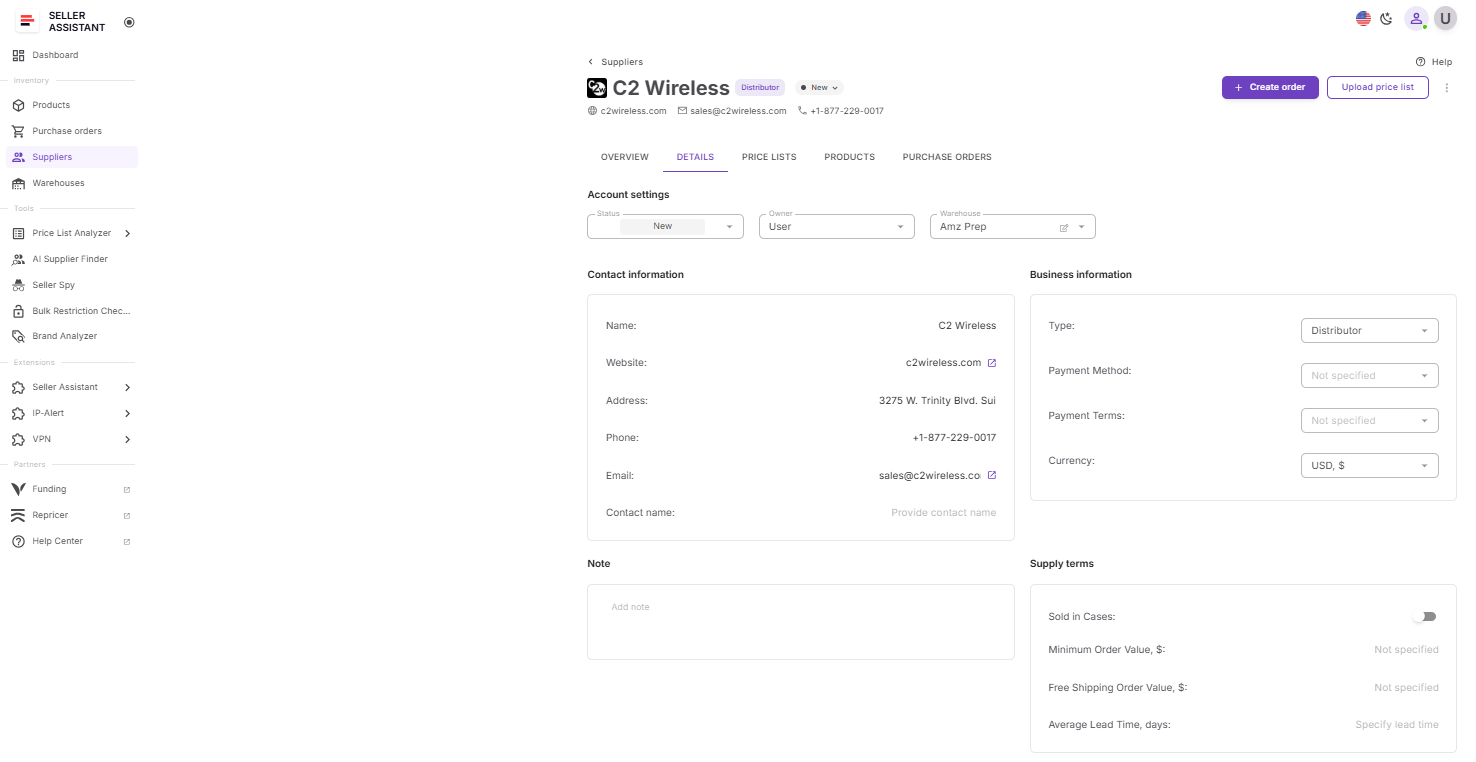
After selecting a supplier, save key details such as contact information, payment terms, MOQ requirements, lead times, and relationship status. Keeping supplier records organized makes future purchasing faster and more consistent.
Step 3. Request and analyze the supplier catalog
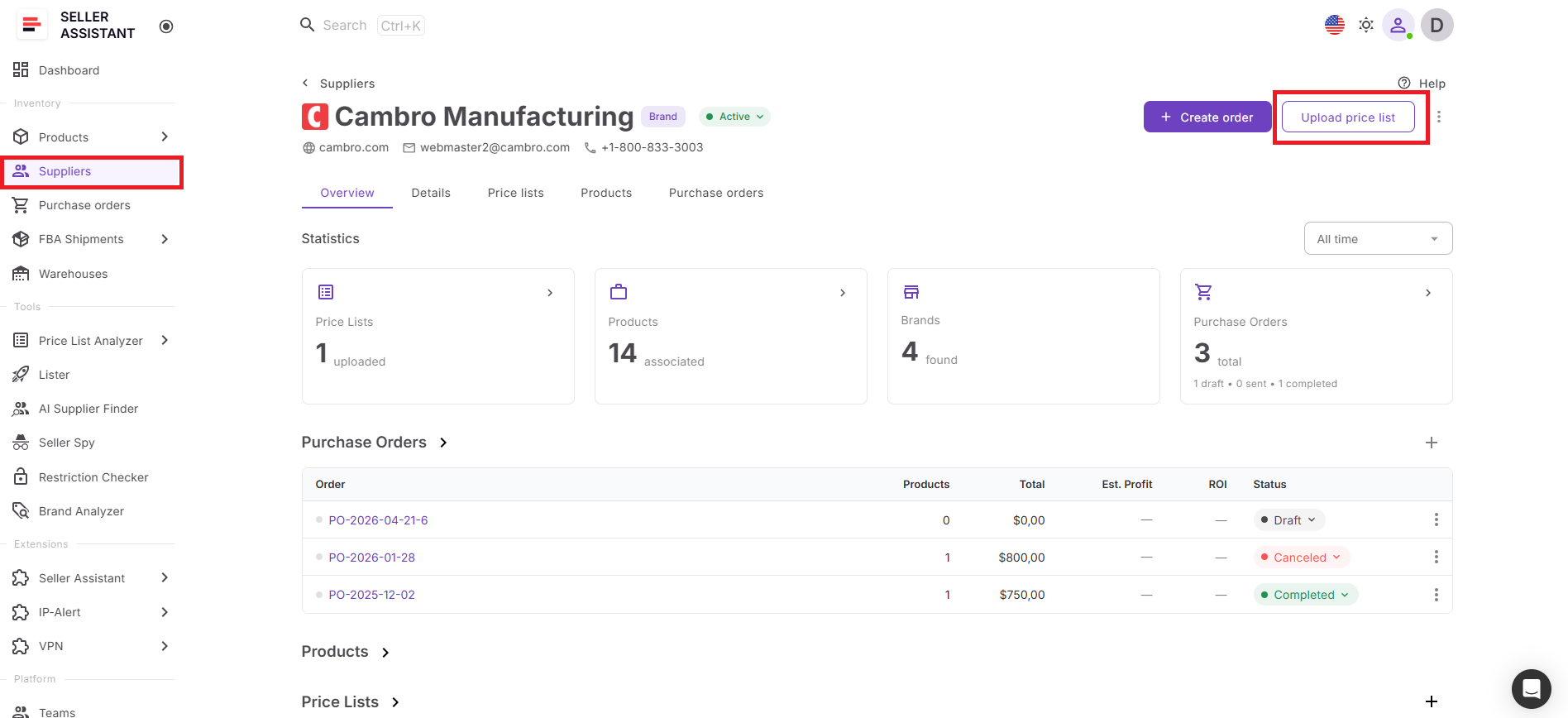
Obtain a price list from the supplier and analyze it with Price List Analyzer. Review profitability, demand, competition, Buy Box conditions, restrictions, IP risks, HazMat status, and other factors to identify products worth purchasing.
Step 4. Build your product pipeline
Approved products and supplier offers are automatically stored in the Product Database. This creates a centralized sourcing record that includes ASINs, costs, supplier offers, notes, and purchasing history for future use.
Step 5. Select a warehouse or prep center
Assign inventory to the correct warehouse or prep center before creating the order with Warehouse Database.
- Existing fulfillment locations can be reused.
- New destinations can be added, and supported prep centers can be connected directly to Seller Assistant for streamlined inventory routing.
Step 6. Create the purchase order
Move selected products into Purchase Orders Module to generate a supplier order. Product details, supplier information, and warehouse routing data are filled automatically from the connected workflow, reducing manual work and data-entry errors.
Step 7. Review costs and profitability
Before sending the order, analyze the complete cost summary and projected financial performance. Review COG, shipping expenses, VAT, taxes, total inventory investment, estimated profit, ROI, and profit per unit to confirm the order meets your purchasing goals.
Step 8. Send the order and route inventory
Export the purchase order as a PDF or XLSX file and send it to the supplier. If you’re using a connected prep center, you can also create and send an inbound shipment directly from the purchase order, keeping inventory routing connected to the purchasing workflow.
Step 9. Track and reuse purchasing data
Keep purchase orders stored for order tracking, replenishment planning, forecasting, supplier negotiations, and future reorders. Because supplier, product, warehouse, and order data remain connected, the next purchasing cycle becomes faster and easier to manage.
FAQ
What is a wholesale supplier purchase order?
A wholesale supplier purchase order is a document that tells a supplier which products you want to buy, in what quantities, at what prices, and where the inventory should be shipped. It serves as a formal purchasing agreement between the seller and the supplier.
Why should Amazon sellers analyze supplier catalogs before creating a purchase order?
Not every product in a supplier catalog is profitable or suitable for resale on Amazon. Analyzing catalogs helps sellers identify products with strong margins, stable demand, manageable competition, and fewer sourcing risks before committing capital.
How can sellers avoid mistakes when creating supplier purchase orders?
Keeping supplier information, product data, and warehouse routing connected in one workflow reduces manual entry and helps prevent errors. This minimizes issues such as incorrect pricing, outdated supplier terms, duplicate products, and shipping inventory to the wrong location.
Why is purchase order profitability important?
Purchase order profitability shows whether an order is likely to generate enough profit to justify the investment. Reviewing ROI, estimated profit, shipping costs, taxes, and total inventory cost before placing an order helps sellers make more informed purchasing decisions.
Can purchase orders be connected directly to prep centers?
Yes. Seller Assistant supports direct integrations with supported prep centers, allowing sellers to sync warehouse locations and create inbound shipments from purchase orders. This simplifies inventory routing and helps move products from suppliers to prep centers more efficiently.
Final Thoughts
Managing supplier purchases successfully requires more than creating and sending orders. Amazon sellers must find reliable suppliers, evaluate supplier catalogs, select profitable products, organize supplier information, route inventory correctly, and verify profitability before placing an order.
Seller Assistant connects all of these activities into one workflow. From supplier discovery with AI Supplier Finder to catalog analysis, product management, warehouse routing, purchase order creation, profitability review, and prep center integration, every step remains connected and organized.