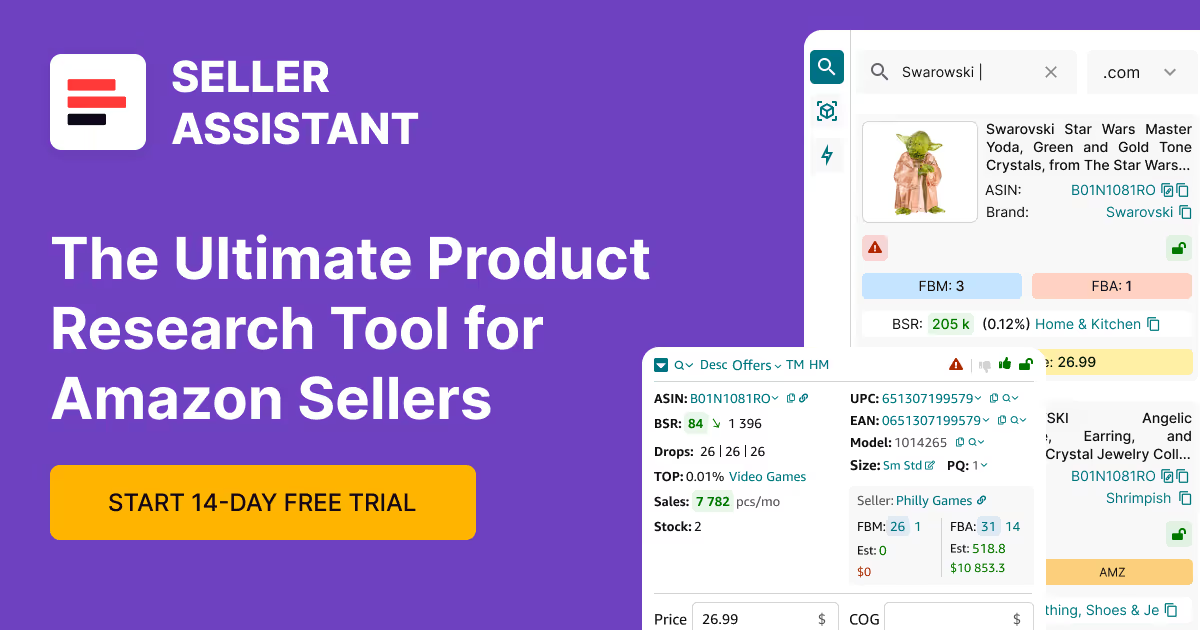



Accurate product matching is one of the most overlooked parts of Amazon sourcing. When a supplier UPC links to the wrong ASIN, every metric you rely on – price, demand, competition, and ROI – becomes unreliable.
These errors don’t stay small, especially when you analyze large price lists at scale. A few mismatches can quickly turn into bad buying decisions and lost profit. To source confidently, you need control over how products are matched.
This post shows how to use Seller Assistant’s Matching Rules tool to improve data accuracy, prevent repeated errors, and build a more reliable sourcing workflow.
Why Accurate ASIN–UPC Matching Matters in Amazon Sourcing
Accurate ASIN–UPC matching is the foundation of every sourcing decision you make. When a supplier product is linked to the wrong ASIN, all the data you rely on – price, demand, competition, and ROI – becomes misleading. What looks like a profitable deal may actually be a completely different product.
For Amazon wholesale sellers working with bulk price lists, even small matching errors can scale into consistent losses. Ensuring correct matches allows you to trust your data, avoid costly mistakes, and build a sourcing process that stays reliable as your business grows.
Wrong match leads to wrong product
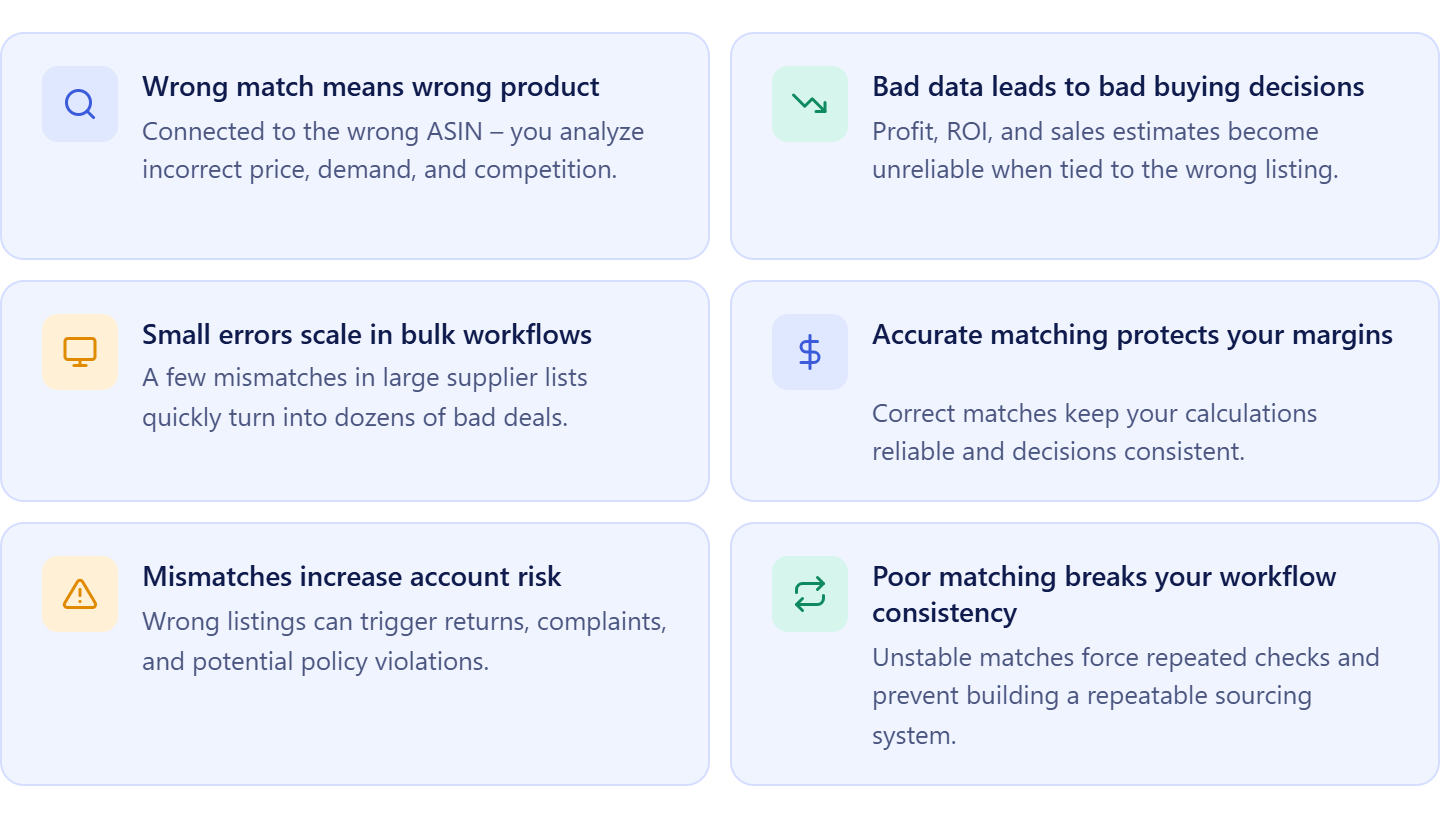
A mismatched UPC can connect your supplier item to a different listing, leading you to analyze and potentially buy the wrong product.
Unreliable data breaks decision making
Profit, ROI, and sales estimates only make sense when tied to the correct ASIN, otherwise your analysis becomes inaccurate.
Errors multiply at scale
In bulk sourcing, even a small percentage of mismatches can affect dozens or hundreds of products, increasing overall risk.
Accurate matching protects your margins
Correct matches ensure you base decisions on real data, helping you avoid unprofitable deals and hidden risks.
Matching mistakes increase account risk
Listing the wrong product under an ASIN can lead to returns, complaints, or policy violations that impact account health.
Consistent matching enables scalable sourcing
When your matching logic is reliable, your entire workflow becomes repeatable, faster, and easier to scale.
What Is Seller Assistant’s Matching Rules Tool?
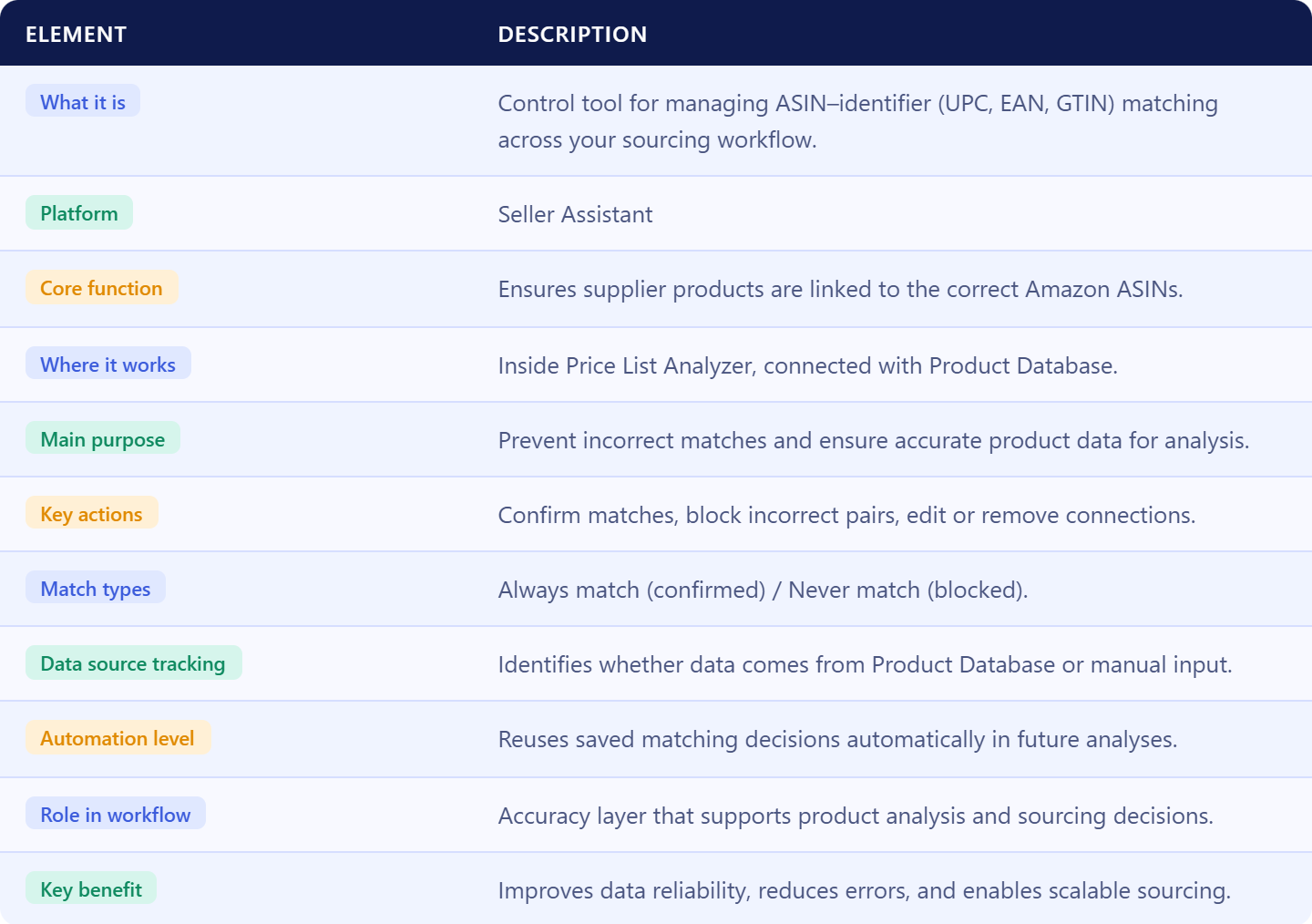
Seller Assistant’s Matching Rules tool is a control system that manages how product identifiers (UPC, EAN, GTIN) are linked to Amazon ASINs across your sourcing workflow. It ensures that each supplier product is connected to the correct Amazon listing and that these decisions are stored and reused automatically.
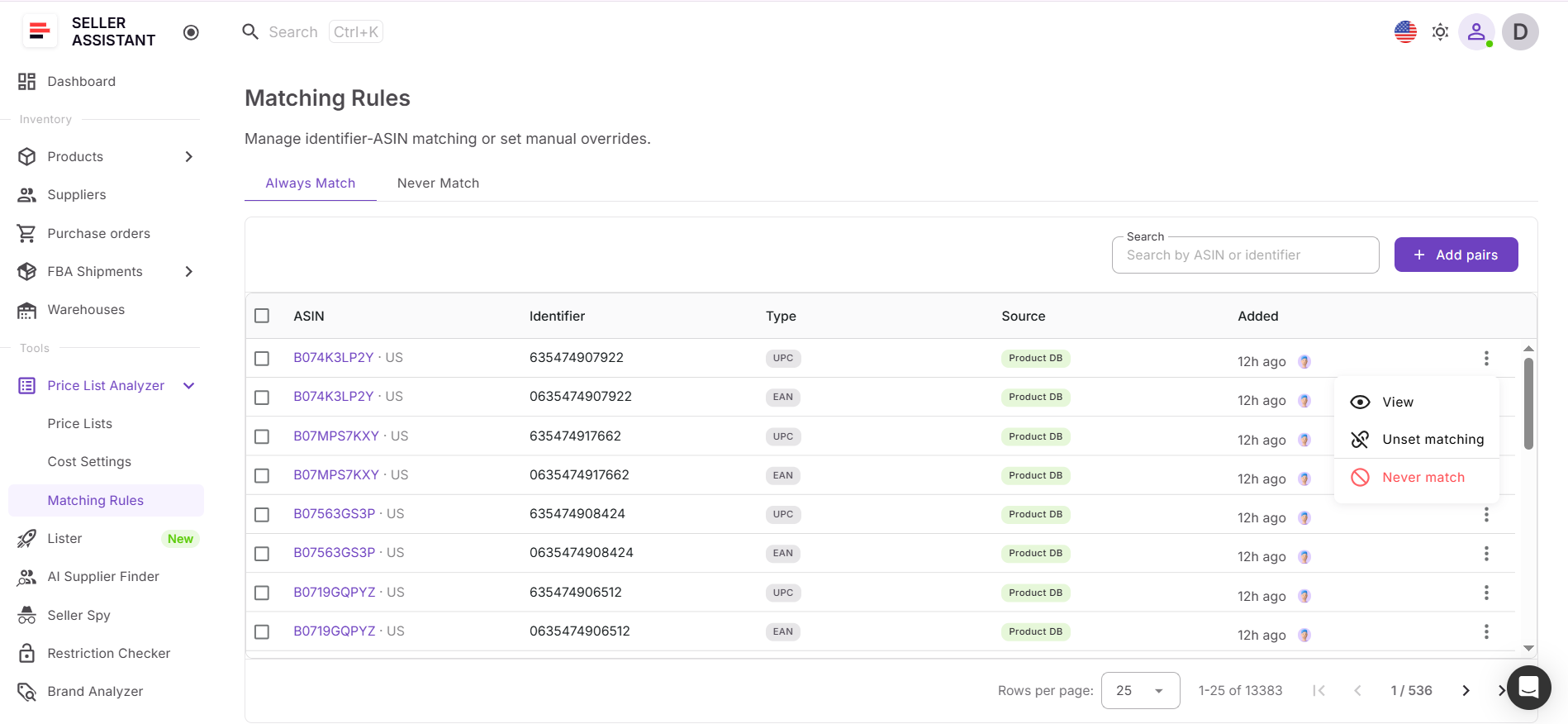
Instead of relying only on automatic matching, you define which ASIN–identifier pairs are valid and which should be ignored. This turns matching into a structured, repeatable process that improves accuracy over time.
Matching Rules gives you control over one of the most critical parts of Amazon sourcing – product accuracy. By managing how identifiers connect to ASINs and reusing those decisions, you create a system where your data stays reliable, your analysis stays consistent, and your sourcing becomes scalable.
Matching Rules tool summary
How matching rules connects your data and analysis workflow
Matching Rules creates value when it’s connected to where your data lives and where decisions are made. That’s why it works directly with Product Database and Price List Analyzer – one stores your matching logic, the other applies it at scale during sourcing.
Product Database
Product Database is where all matching decisions are stored and managed.
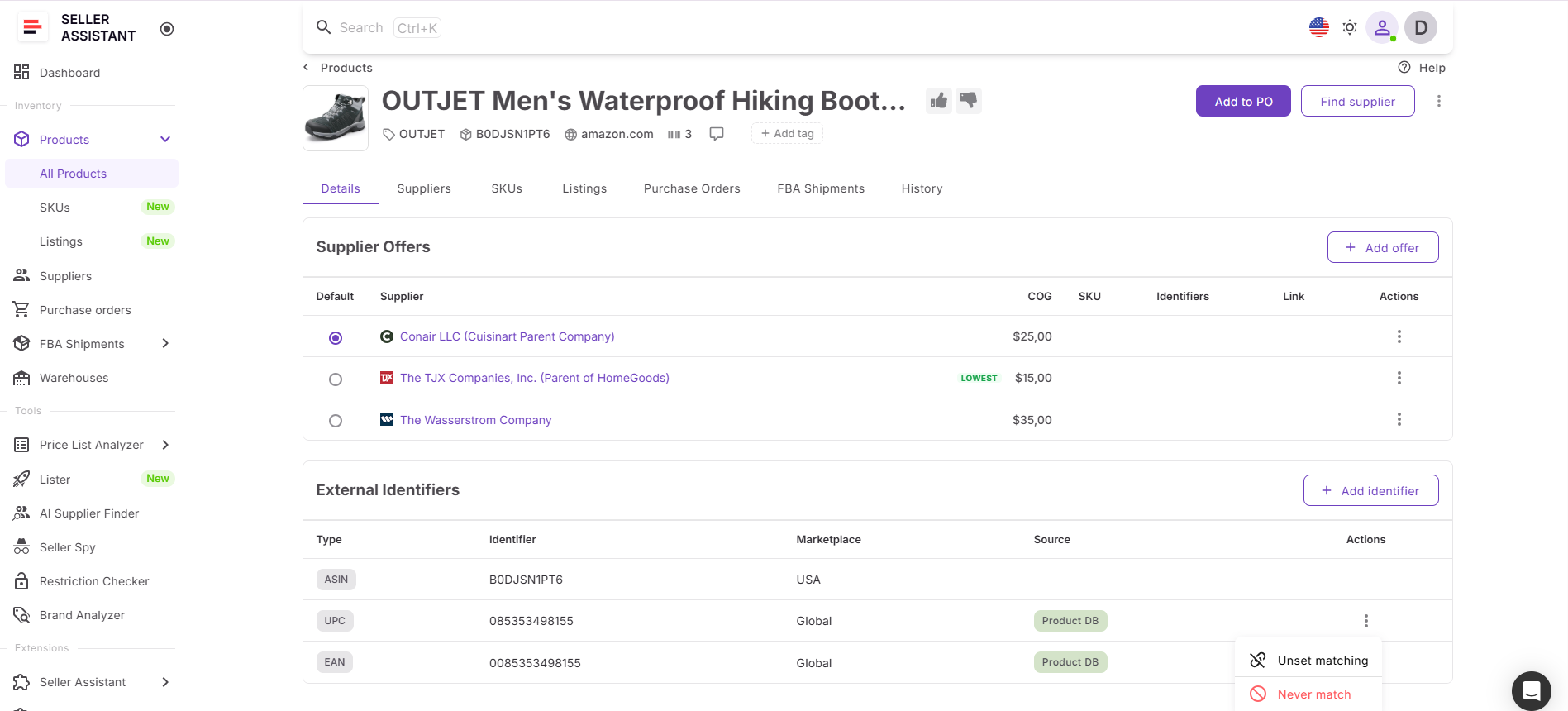
It shows:
- ASIN–identifier (UPC, EAN, GTIN) pairs
- Match type (Always match / Never match)
- Data source (automatic or manual)
- Editable product identifiers
Here you can add missing identifiers, correct errors, and define which matches should be reused or blocked.
This gives you a persistent matching system where every validated decision is saved and reused automatically.
Price List Analyzer
Price List Analyzer is where matching rules are applied during bulk product analysis.
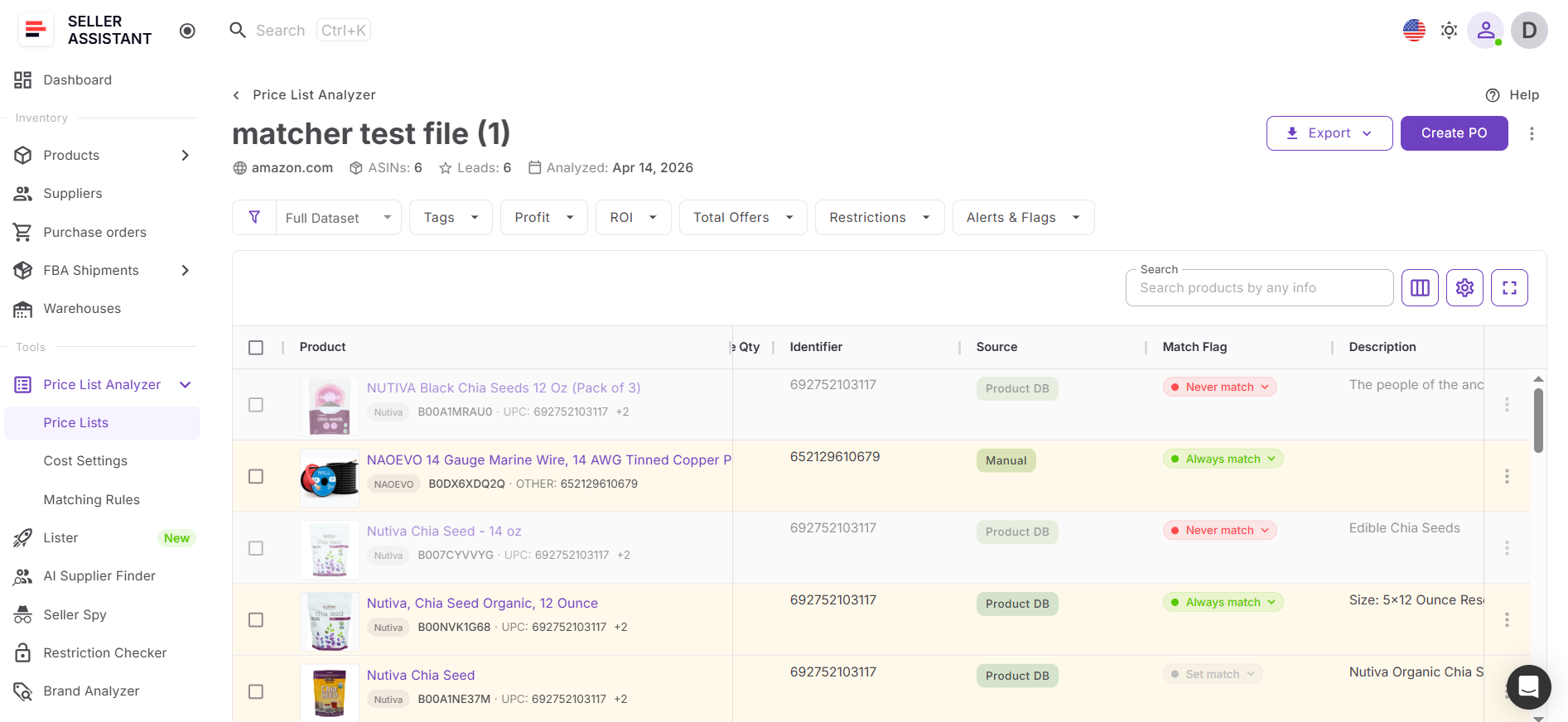
It shows:
- How each supplier product is matched to an ASIN
- Which identifiers are skipped (Never match)
- Suggested matches when no rule exists
- Live matching results inside the analysis table
You can review and adjust matches directly while analyzing products.
This ensures all profitability, demand, and competition data is based on the correct product before you make sourcing decisions.
How Matching Rules relates to match flag system
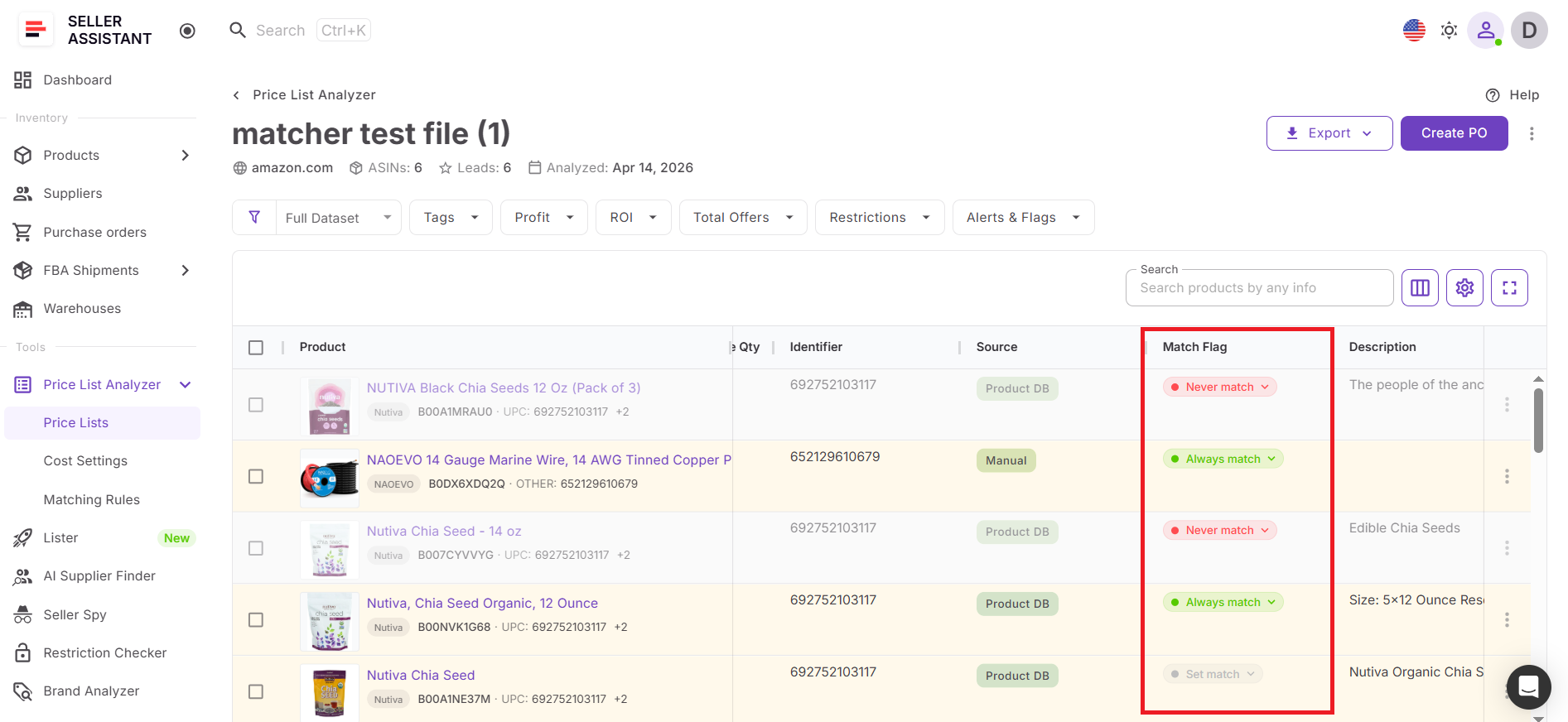
The Matching Rules tool operates on top of the Match Flag System, which defines how each ASIN–identifier pair behaves.
- Always match – confirms a correct connection and reuses it
- Never match – blocks incorrect matches from appearing again
These flags are stored in Product Database and applied automatically in Price List Analyzer, making your matching decisions consistent across all workflows.
Role in Seller Assistant workflow automation
Matching Rules is not a standalone feature – it is part of Seller Assistant’s connected wholesale workflow automation.
It works as the accuracy layer across the system:
- Matching Rules → controls product matching
- Price List Analyzer → analyzes products in bulk
- Product Database → stores and reuses data
- Supplier and purchasing tools → execute sourcing decisions
Because all tools are connected, matching decisions flow automatically through your workflow. This eliminates repeated validation, reduces errors, and ensures that every sourcing decision is based on correct product data.
Note. Seller Assistant is an end-to-end Amazon workflow management platform that integrates 15+ wholesale-focused solutions into one connected system. It combines sourcing workflow automation, bulk research and intelligence tools, and integrated Chrome extensions – giving you everything you need to streamline finding deals, managing suppliers, and creating purchase orders.

The platform aggregates: workflow management tools – Purchase Orders Module, Suppliers Database, Product DB, Warehouses Database, FBA Shipments to organize, automate, and scale every step of your wholesale and arbitrage operations; bulk research & sourcing tools – Price List Analyzer, Bulk Restriction Checker, AI Supplier Finder, Brand Analyzer, Seller Spy to evaluate supplier price lists, verify selling eligibility and restrictions, open new brands, and discover winning product ideas from competitors to expand your product catalog; Chrome extensions – Seller Assistant Browser Extension, IP-Alert Extension, and built-in VPN by Seller Assistant to deep-research products, check IP claims and compliance, and access geoblocked supplier sites directly within your browser; and integrations & team access features – seamless API connectivity and integrations with Zapier, Airtable, and Make, plus Virtual Assistant Accounts for secure, scalable team collaboration.
With Seller Assistant, every step of your Amazon wholesale and arbitrage workflow is automated and connected.
How Matching Rules Gives You Control Over Product Data
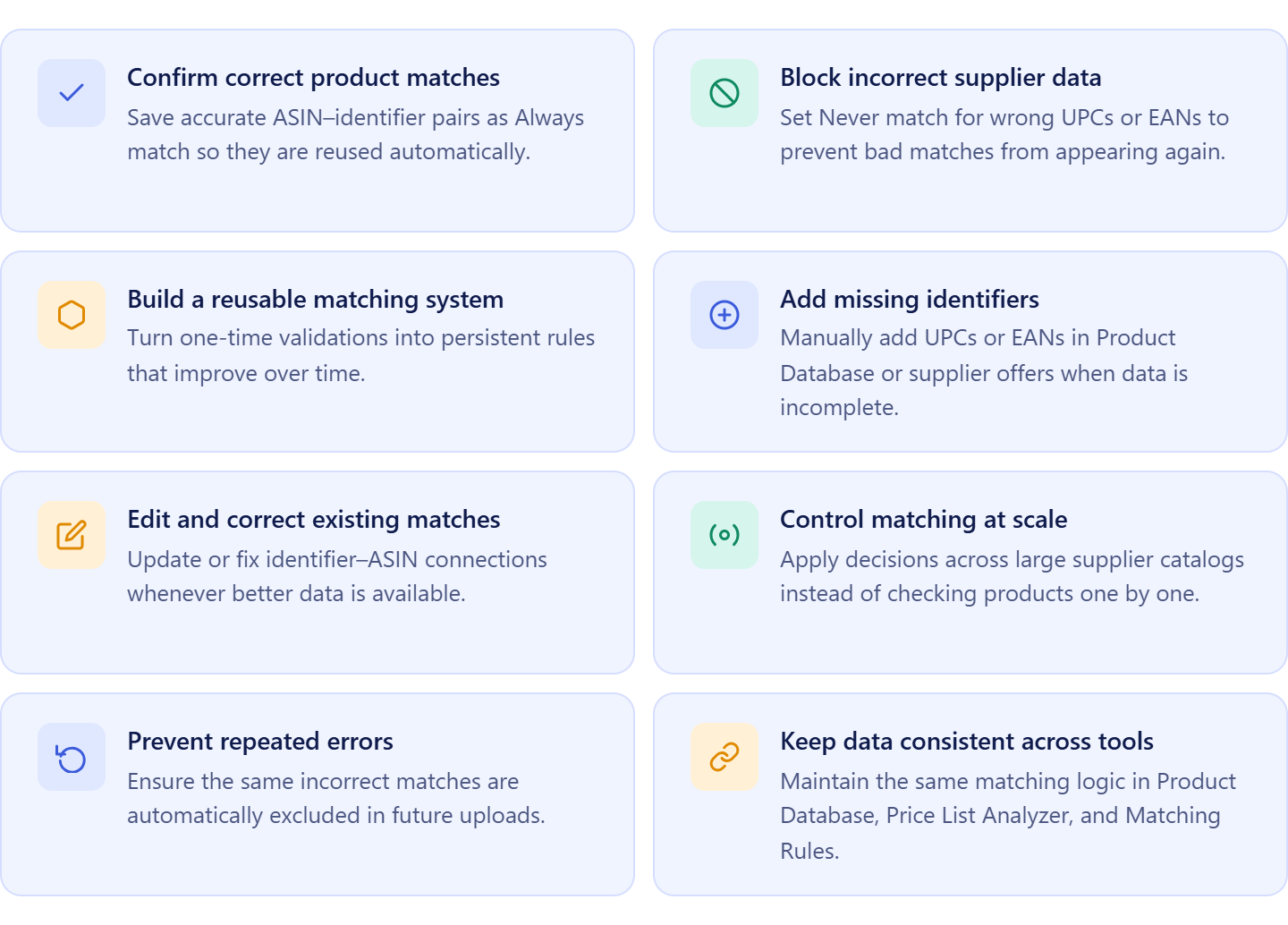
Matching Rules is more than a tool for fixing incorrect matches. It gives you full control over how product data behaves across your sourcing workflow. Instead of rechecking identifiers every time, you create a system that stores your decisions and applies them automatically as you scale.
Lock in correct product matches
Save verified ASIN–identifier pairs as Always match so they are reused without repeated validation.
Exclude incorrect supplier identifiers
Mark invalid UPCs or EANs as Never match to remove them from future analysis.
Create a rule-based matching system
Turn one-time checks into reusable rules that improve accuracy over time.
Fill in missing product data
Add identifiers manually when supplier information is incomplete or inconsistent.
Refine matches as data evolves
Adjust existing connections whenever you find updated or more accurate information.
Apply decisions across bulk data
Scale your matching logic across large product sets without manual rechecking.
Eliminate recurring matching issues
Prevent the same incorrect matches from appearing again in new supplier files.
Maintain consistency across tools
Keep matching logic aligned across Product Database, Price List Analyzer, and Matching Rules.
How Matching Rules Tool Works
Matching Rules controls how your products are connected to Amazon listings – and ensures those connections stay accurate as you scale.
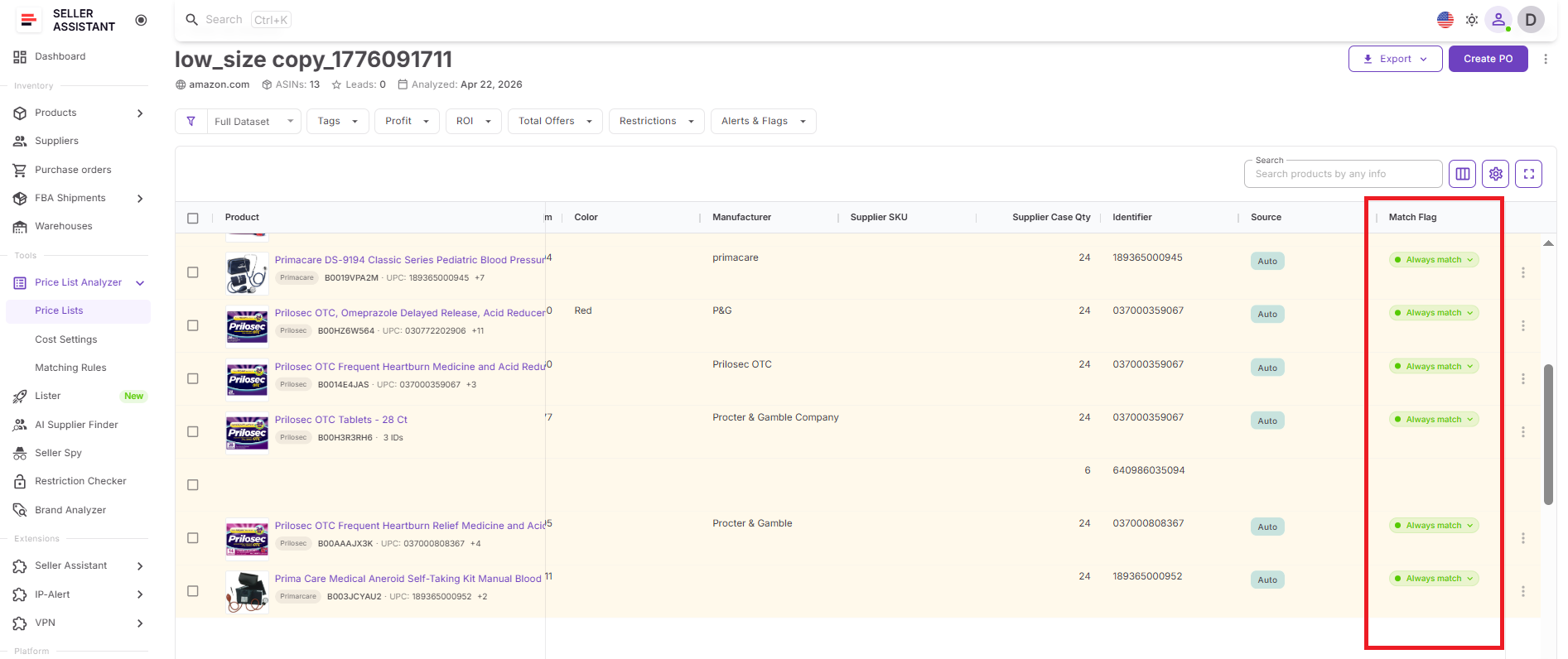
In practice, the workflow is simple:
- You add them to Product Database or analyze products in Price List Analyzer
- The system matches identifiers (UPC, EAN) to ASINs
- You review these matches and decide which are correct or incorrect
- Your decisions are saved and automatically applied in future analyses
This is powered by the Match Flag System, which lets you confirm, block, and manage ASIN–identifier relationships. Instead of rechecking data every time, you build a system that remembers your decisions and improves over time.
How match flag system works
When you analyze supplier products, each item includes an identifier like a UPC or EAN. To evaluate it on Amazon, that identifier must be connected to the correct ASIN.
The Match Flag System controls this connection. It allows you to:
- confirm correct matches
- block incorrect ones
- reuse these decisions automatically in future workflows
This ensures your sourcing is always based on accurate product data.
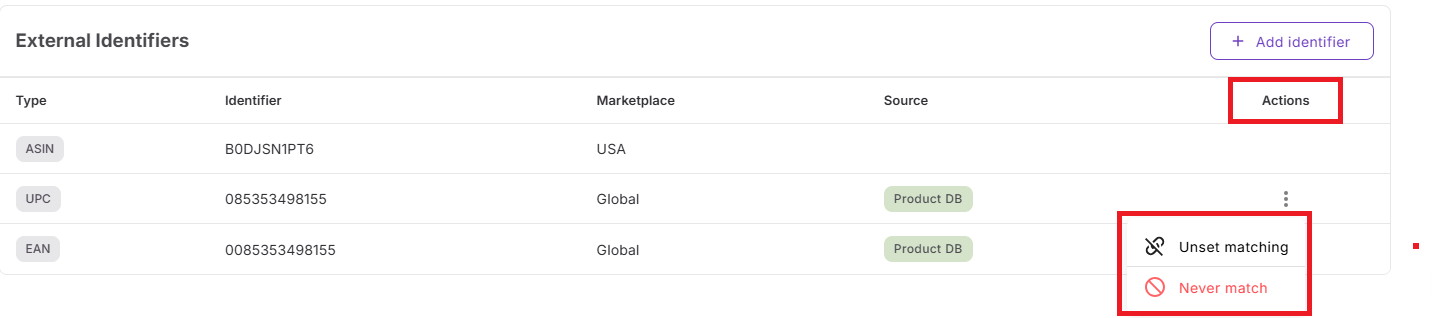
How ASIN–identifier connections are created
Every match starts with a connection between an ASIN and an identifier (UPC, EAN, GTIN).
These connections are created when:
- products are added to Product Database from supplier files
- items are analyzed in Price List Analyzer
identifiers are added manually from other sources
By default:
- all identifiers in Product Database are set to Always match
- their source is marked as Product DB
- manually added identifiers are marked as Manual
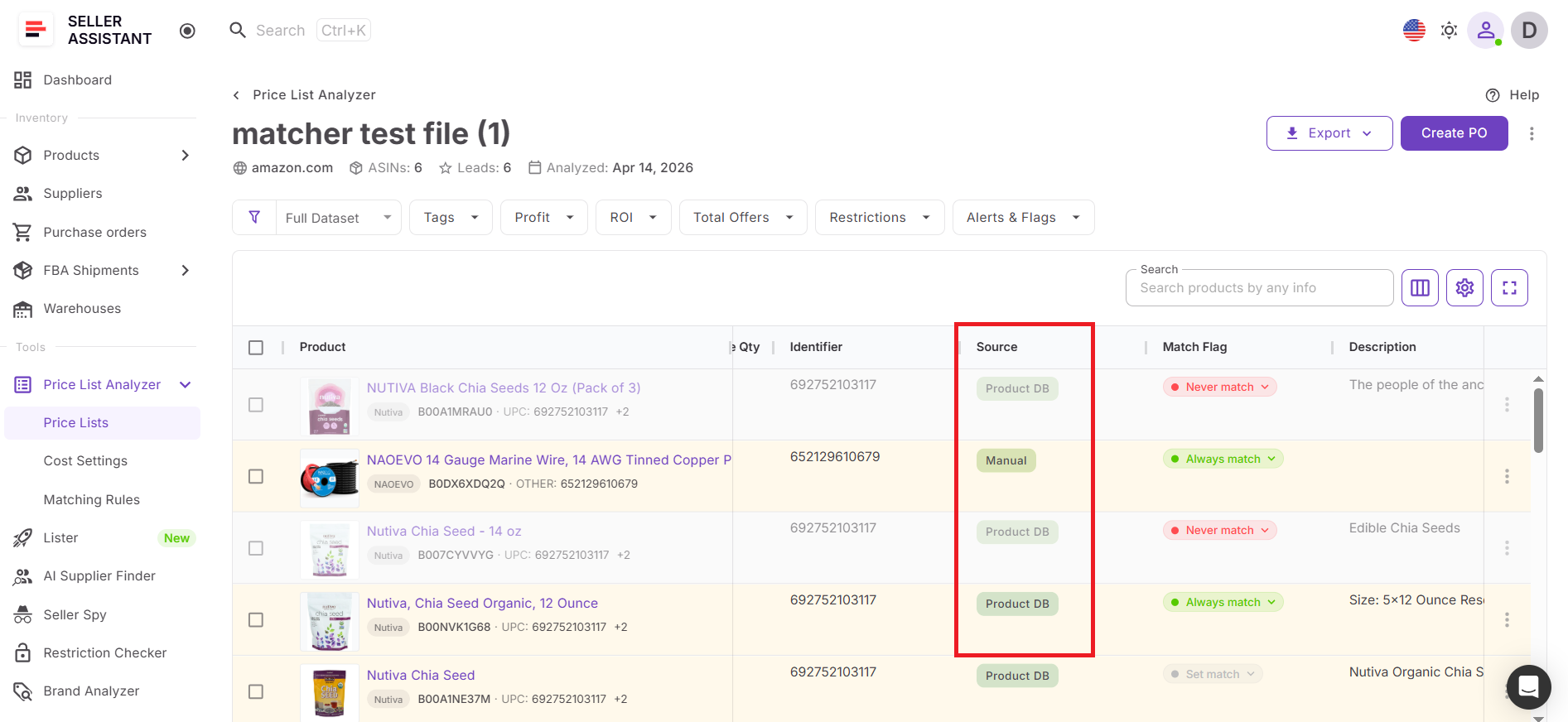
You can also:
- add new identifiers
- edit existing ones
- change match status at any time
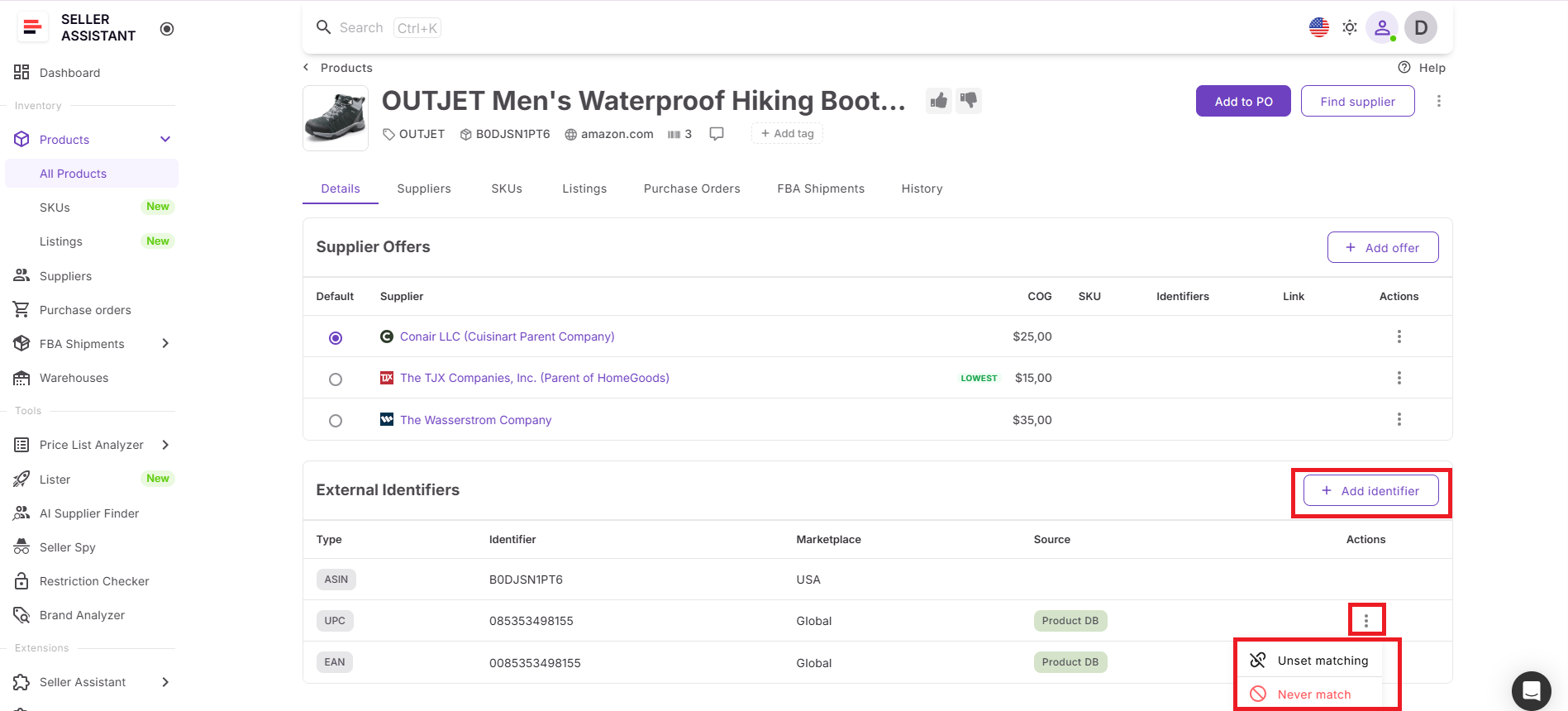
How matching works during analysis
When you run analysis in Price List Analyzer, the system applies your existing matching rules automatically.
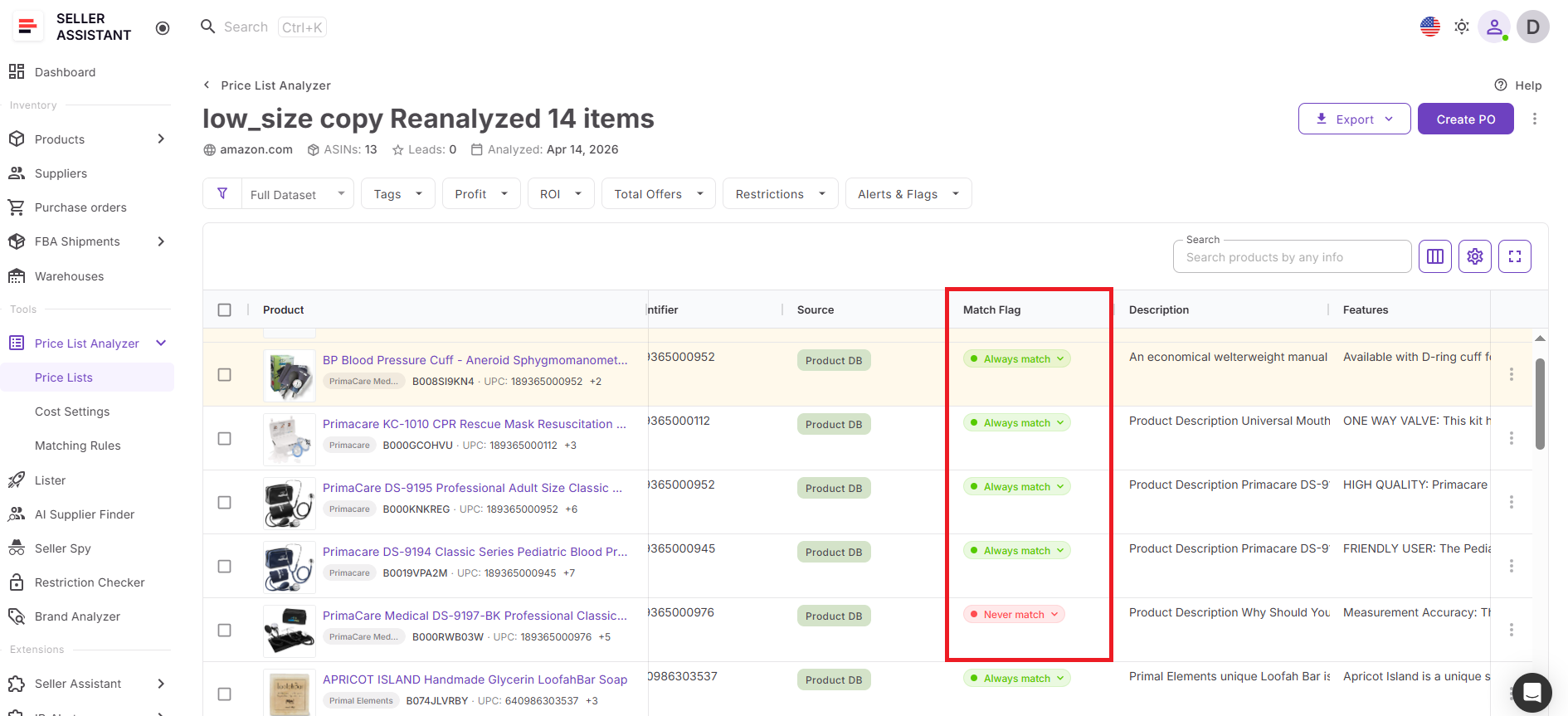
This means:
- confirmed ASIN–identifier pairs are reused instantly
- new matches may be suggested if no rule exists
- you can review and adjust matches directly in the table
If a pair is set to Never match, it is completely excluded from analysis.
Why matching rules are needed
Automatic matching is fast, but not always accurate. Supplier data often contains:
incorrect or reused UPCs
- inconsistent identifiers
- overlapping product data
At the same time, Amazon’s catalog can link similar identifiers to multiple listings.
This leads to:
- correct-looking but wrong matches
- inaccurate profitability calculations
- poor sourcing decisions
Matching Rules solves this by giving you full control over which connections are valid.
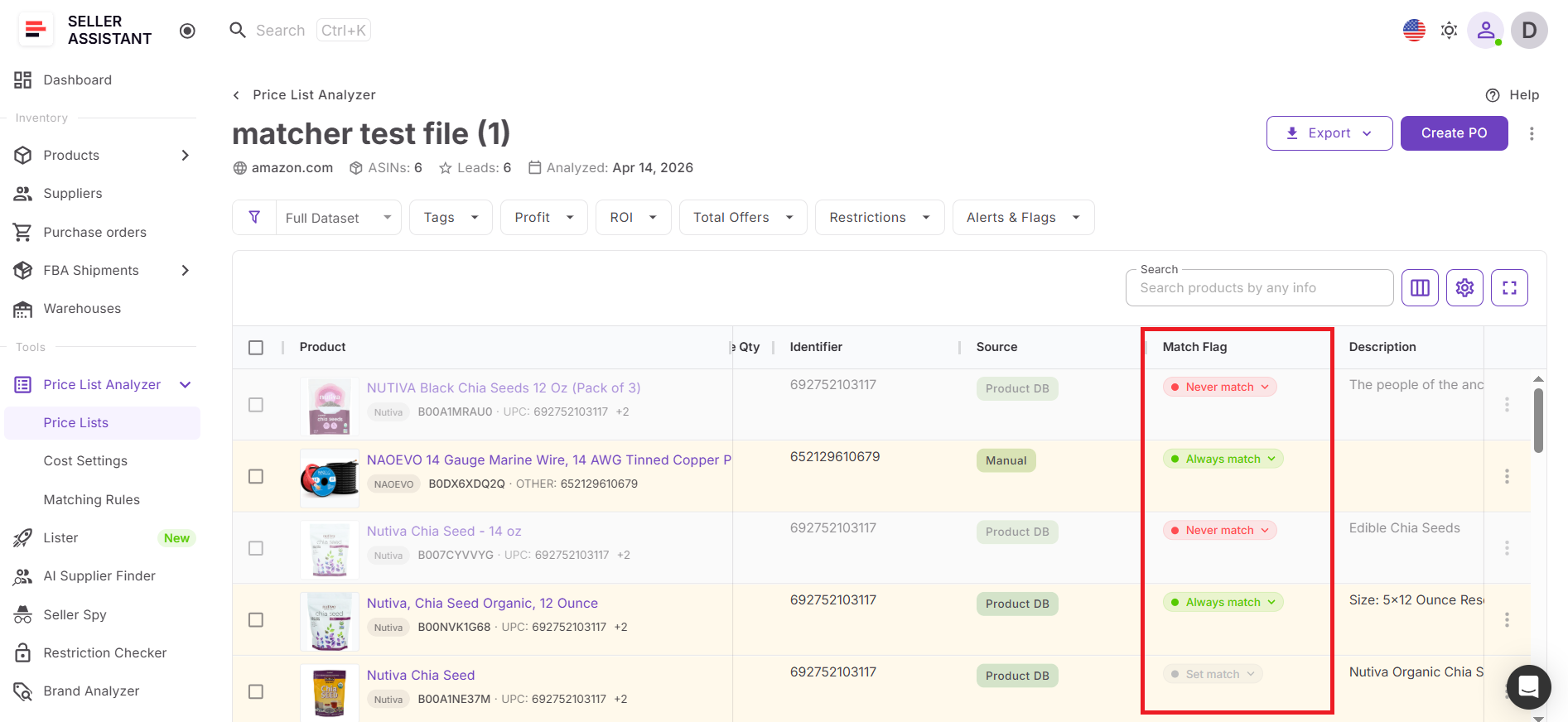
How match decisions work
Each ASIN–identifier pair can have one of two match types:
Always match – confirm the connection
Use this when the identifier correctly matches the product. It is saved in the Product Database and reused automatically.
Never match – block the connection
Use this when the identifier leads to the wrong ASIN. It is excluded from analysis and prevents repeated errors.
How you manage matching rules
Matching Rules is a dedicated interface inside Price List Analyzer where you can review and control all matches in one place.
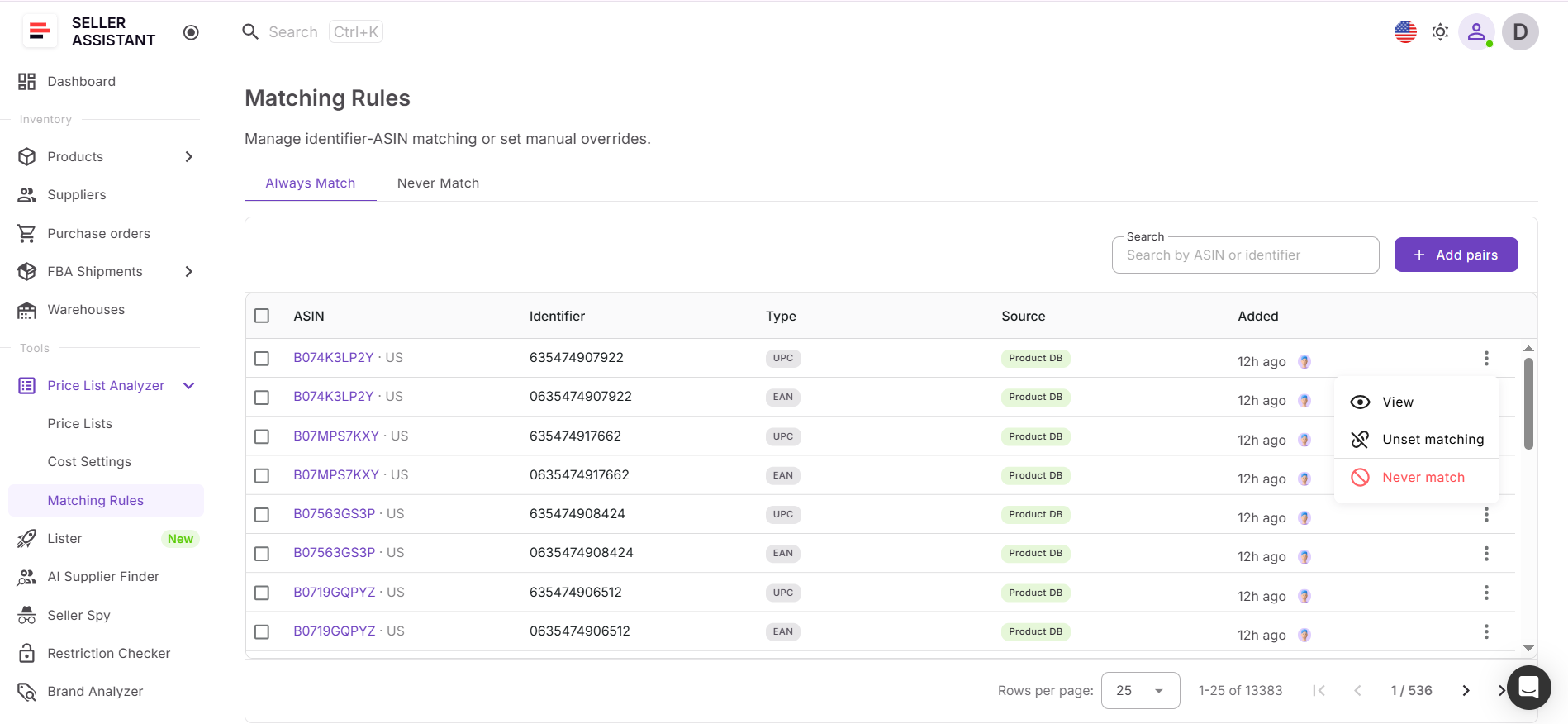
For each ASIN–identifier pair, it shows:
- ASIN
- identifier
- identifier type
- source (Product DB or Manual)
- date added
- match type
From here, you can:
- switch between Always match and Never match
- remove or reset matches
- review all connections across your workflow
You can also update match decisions directly from Product Database or supplier offers.
How to Apply Matching Rules Step By Step
Using Matching Rules means controlling how product identifiers connect to ASINs and deciding which matches should be trusted or ignored. This process runs across Product Database, supplier offers, Price List Analyzer, and Matching Rules, creating a consistent system for accurate sourcing.
Step 1. Add products to your database
Start by adding products to the Product Database from Price List Analyzer, supplier files, or manual input.
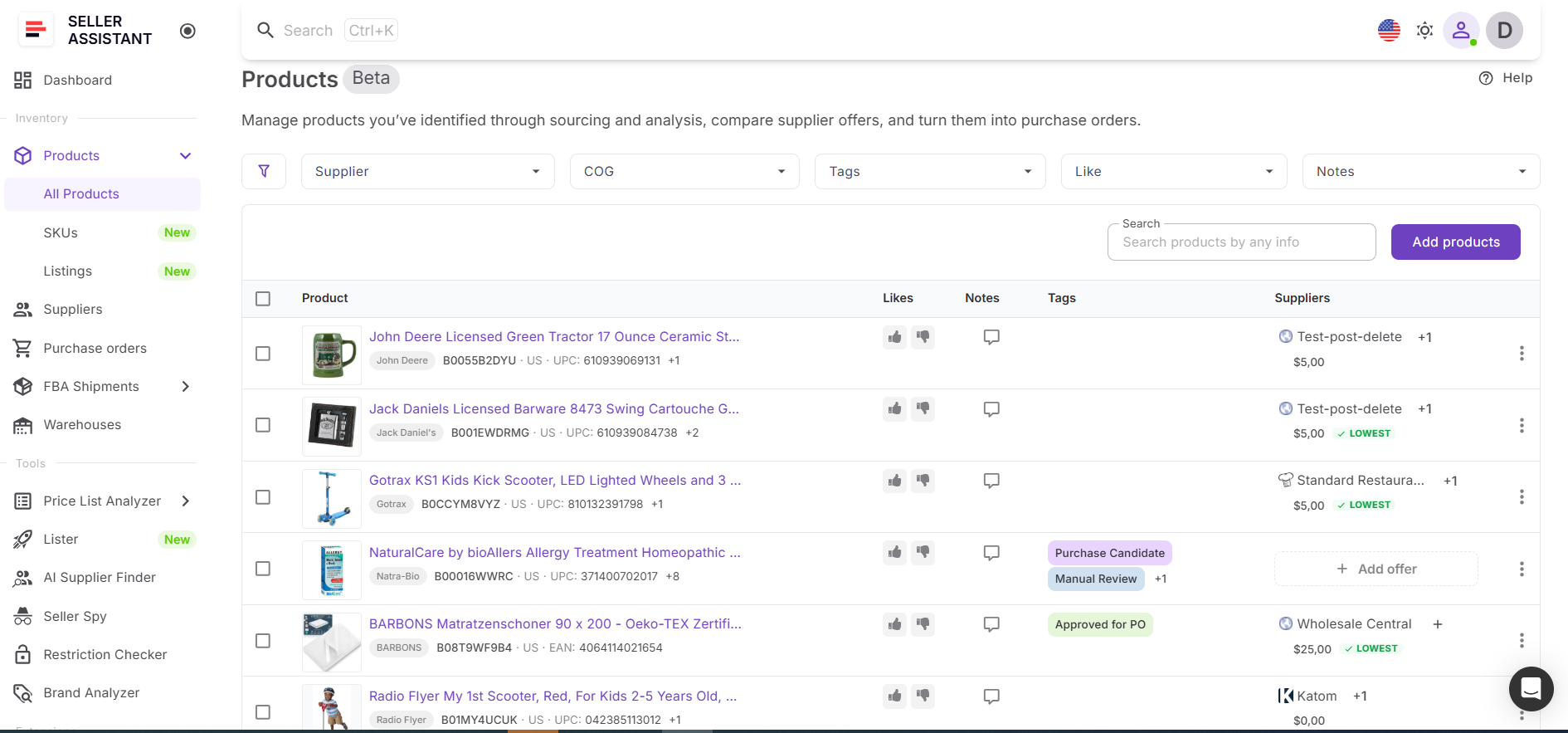
Each product automatically stores its identifiers and sets them to Always match by default, with the source labeled as Product DB unless added manually.
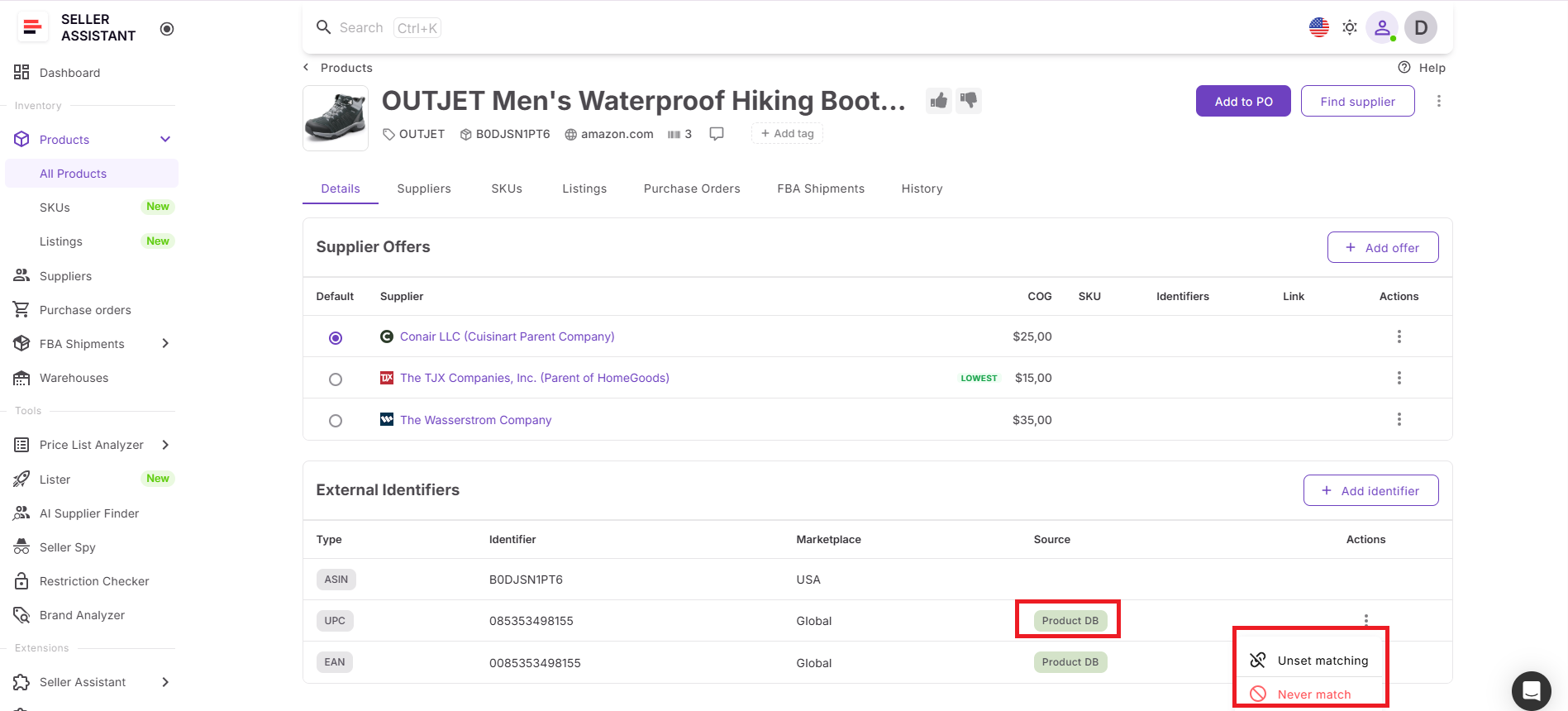
Step 2. Check product identifiers
Open the product and review its identifiers (UPC, EAN, GTIN). Confirm they match the correct ASIN.
This helps catch supplier data issues early, before they affect bulk analysis.
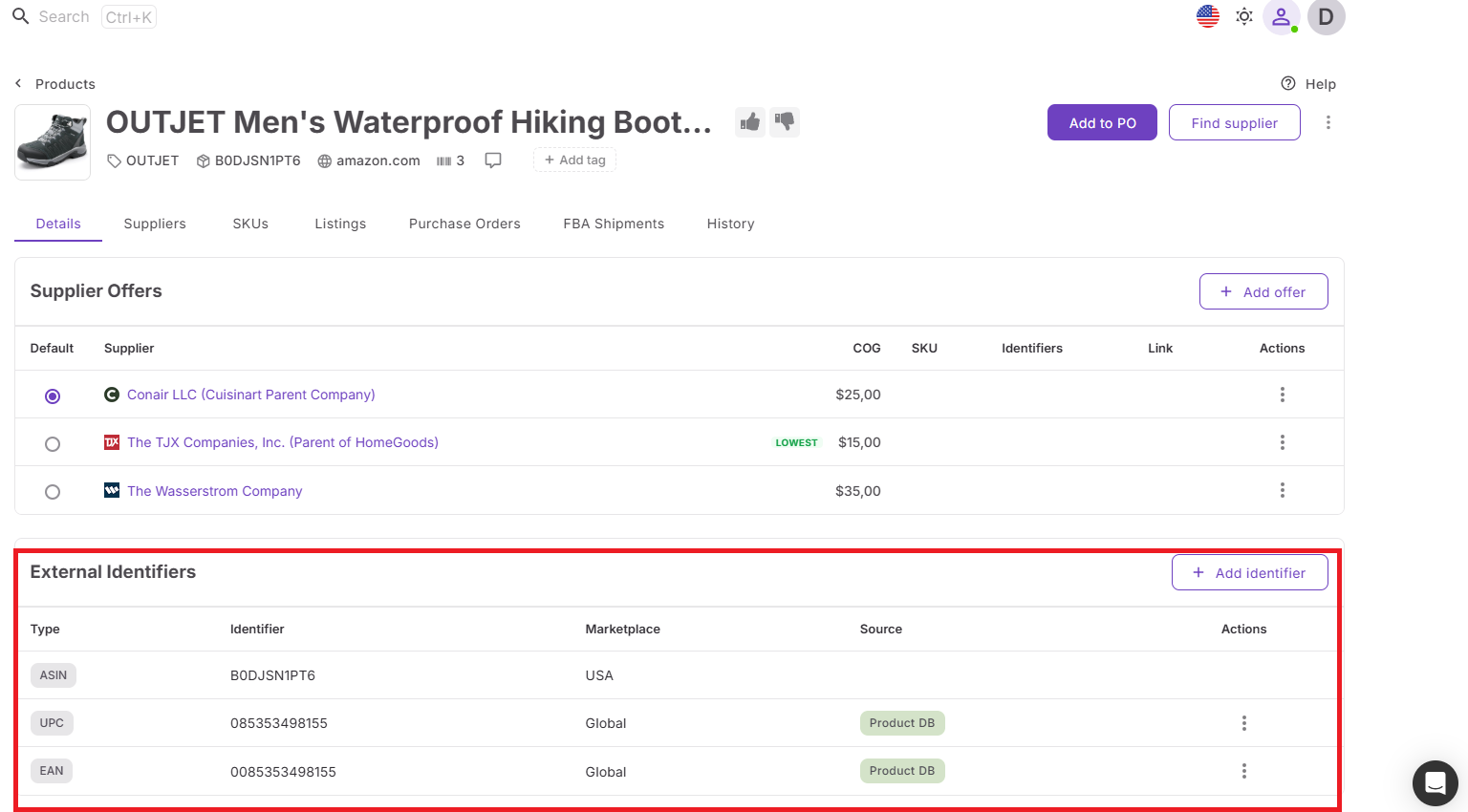
Step 3. Add missing identifier data
If identifiers are incomplete, add them manually in the Product Database or supplier offers.
Manually added data is labeled as Manual source, making it easy to track what was entered versus imported.
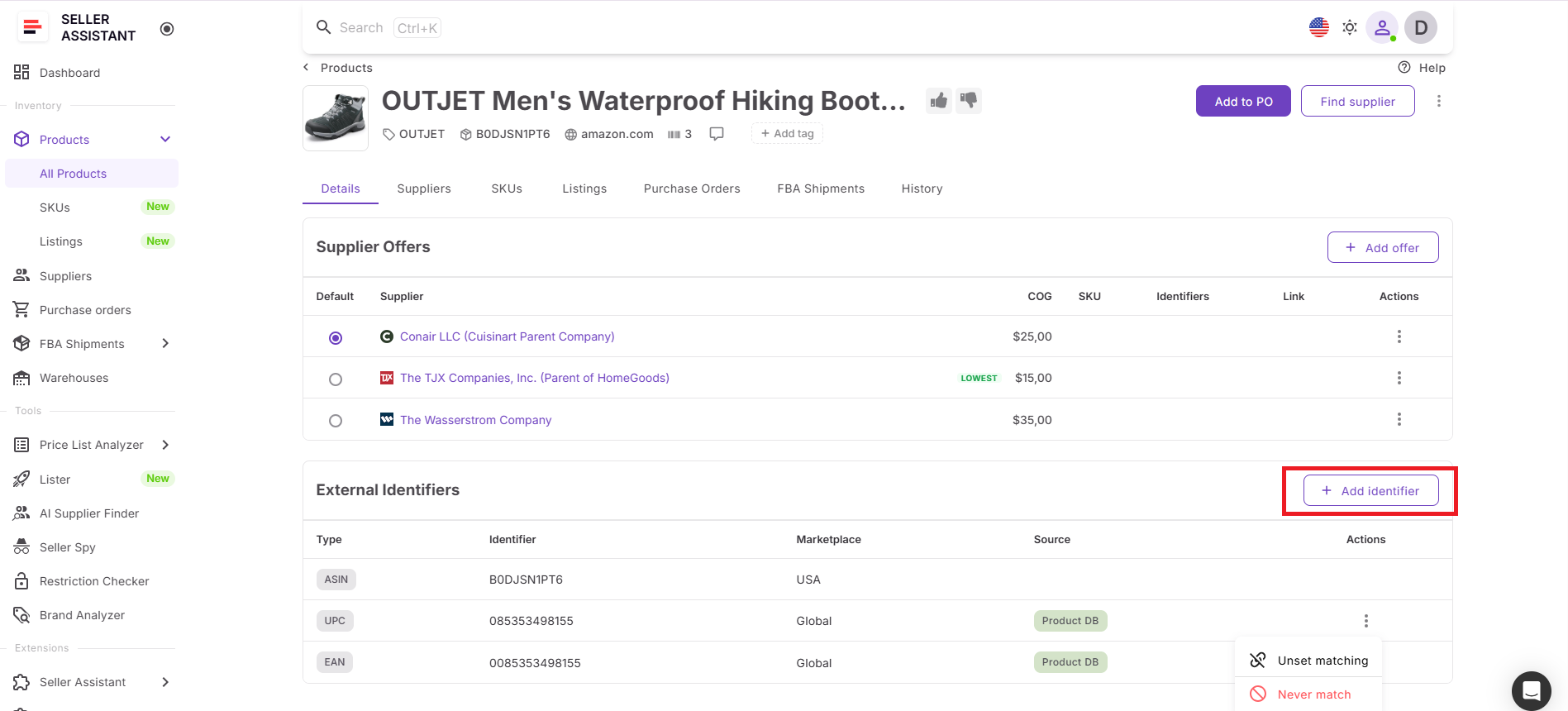
Step 4. Confirm valid matches
When an identifier correctly matches the ASIN, keep it as Always match.
This saves the connection and ensures it’s reused automatically in future workflows.
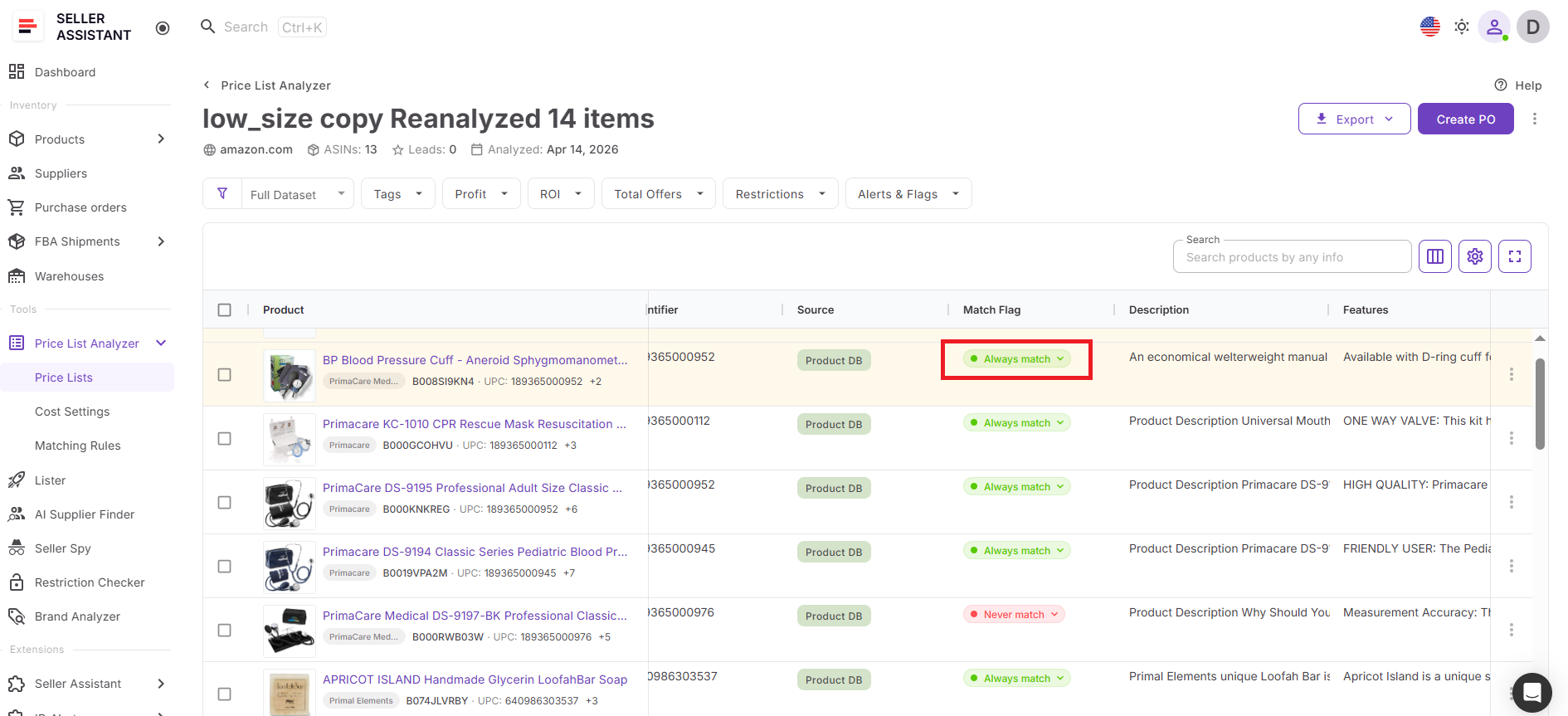
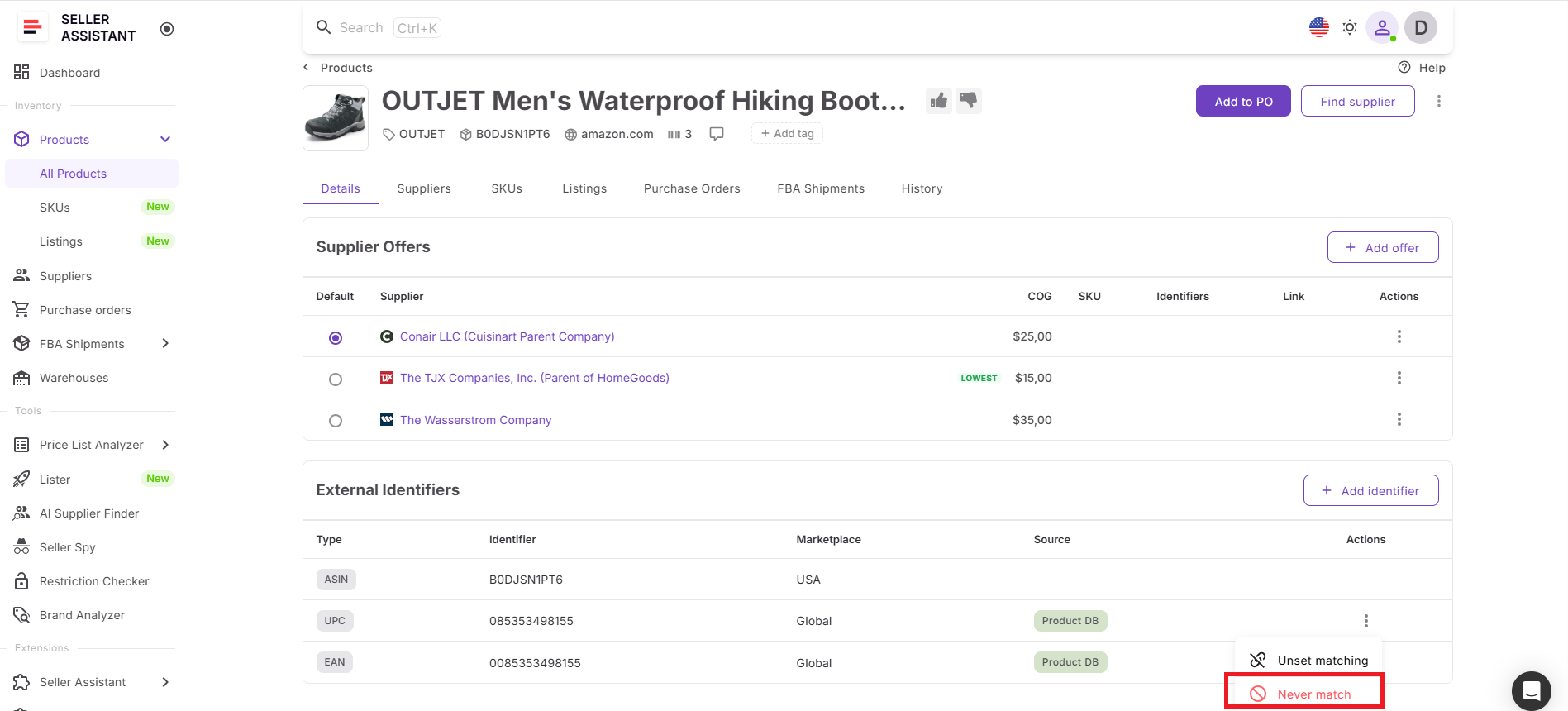
Step 5. Block incorrect matches
If an identifier links to the wrong ASIN, switch it to Never match.
This prevents the pair from being used again and removes it from future analysis.
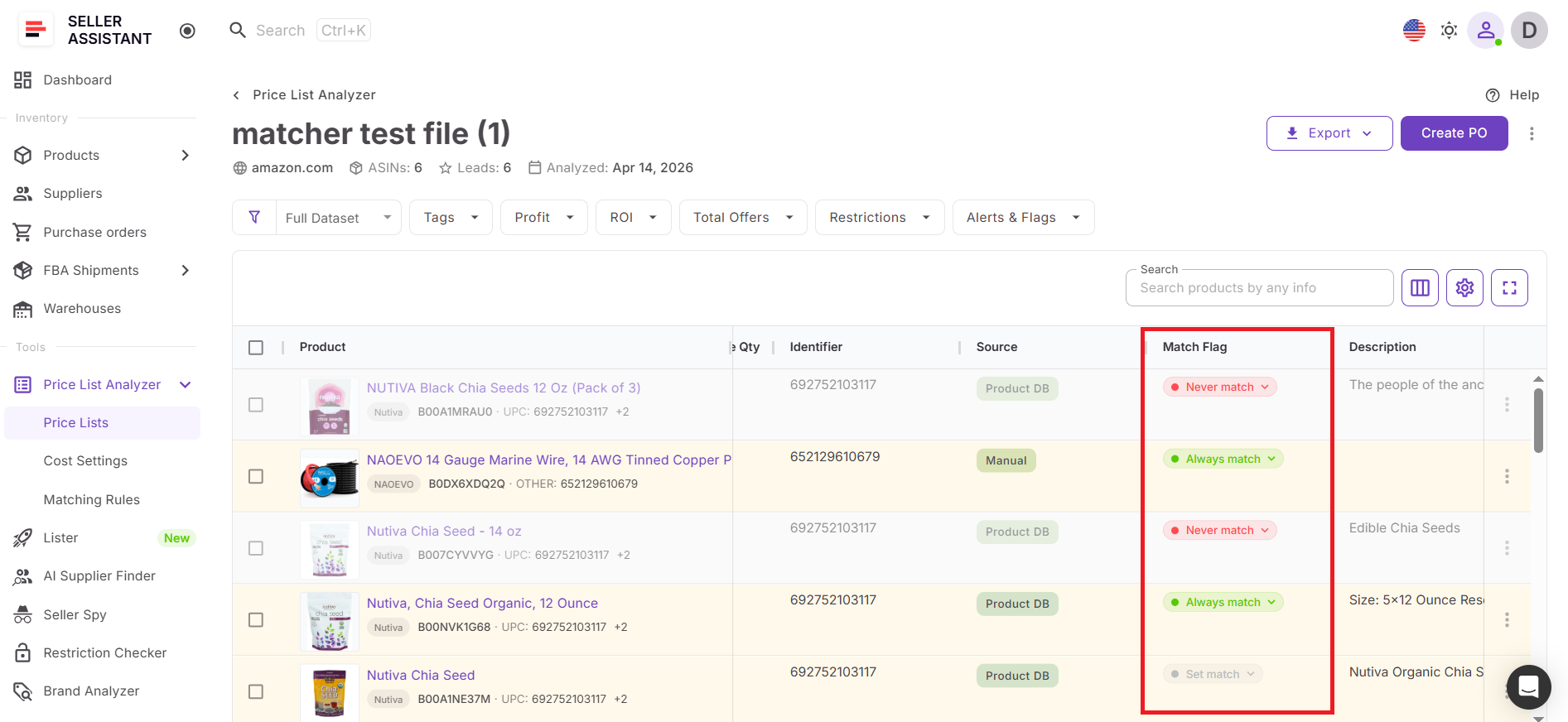
Step 6. Validate matches during analysis
While working in Price List Analyzer, review how each product is matched.
Make sure the ASIN, identifier, and product details align before relying on profit, ROI, demand, or competition data.
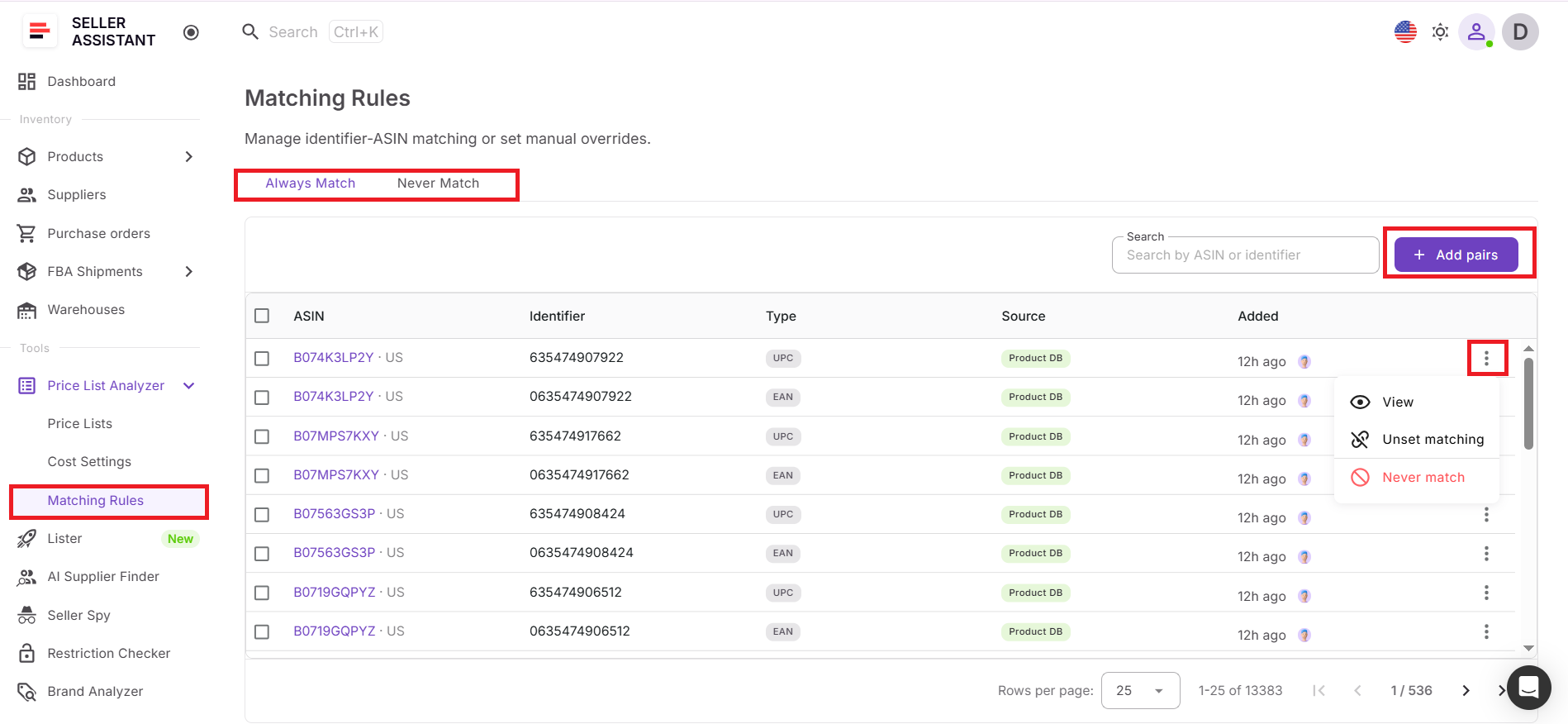
Step 7. Control matches in matching rules
Open Matching Rules inside Price List Analyzer to manage all ASIN–identifier pairs in one place.
You can:
- view full match details (ASIN, identifier, type, source, date)
- switch between match types
- remove or reset incorrect connections
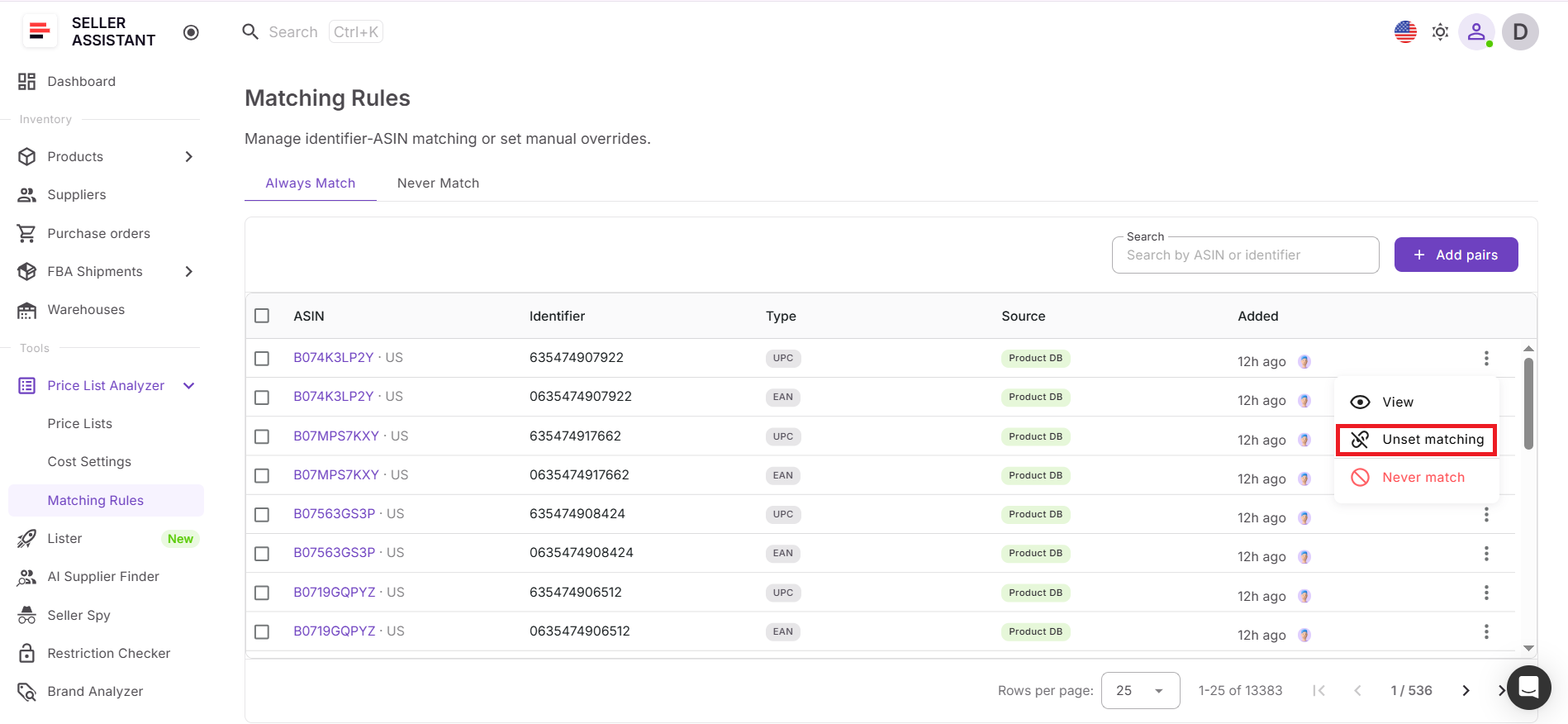
Step 8. Keep matches updated over time
As supplier data changes or better matches appear, update your rules.
You can modify match types, add new pairs, or remove outdated ones to keep your data accurate as your catalog grows.
FAQ
What is the difference between Always match and Never match?
Always match confirms that an identifier correctly belongs to an ASIN and will be reused automatically. Never match blocks incorrect pairs so they are excluded from future analysis.
Do I need to review matches every time I analyze a price list?
No, once you validate matches, the system saves and reapplies them automatically. You only need to review new or uncertain matches when they appear.
Can I fix incorrect matches after analysis?
Yes, you can update match types at any time in Product Database, Price List Analyzer, or Matching Rules. Changes apply immediately and affect future analyses.
What happens if I don’t use Matching Rules?
You rely entirely on automatic matching, which can lead to incorrect product data. This increases the risk of wrong calculations, bad purchases, and repeated errors.
Is Matching Rules useful for scaling a sourcing business?
Yes, it helps standardize how products are matched across large catalogs. This reduces manual work and keeps your data accurate as your operation grows.
Final Thoughts
Accurate product matching is not a minor technical detail – it’s the foundation of every sourcing decision you make. When your ASIN–identifier connections are correct, your profitability calculations, demand analysis, and buying decisions all become reliable. When they’re wrong, everything downstream is affected.
Seller Assistant’s Matching Rules tool gives you control over this process. Instead of relying on automatic matching, you build a system that confirms correct data, blocks errors, and improves with every supplier file you analyze.
Seller Assistant automates and connects every stage of your Amazon wholesale and arbitrage workflow. It brings together in one platform: workflow management tools – Product Database, Purchase Orders Module, Suppliers Database, Warehouses Database, FBA Shipments, bulk research & sourcing tools – Price List Analyzer, Bulk Restriction Checker, Sourcing AI, Brand Analyzer, Seller Spy, Chrome extensions – Seller Assistant Browser Extension, IP-Alert Extension, and built-in VPN by Seller Assistant, and integrations & team access features – seamless API connectivity, integrations with Zapier, Airtable, and Make, and Virtual Assistant Accounts.