


Listing Amazon products after creating purchase orders is where many resellers lose speed. You’ve already sourced products, confirmed margins, and placed orders – but now you’re back in Seller Central, rebuilding listings one by one.
This step slows down your workflow and delays getting inventory live. Seller Assistant removes this gap by connecting purchase orders directly to listing. Instead of treating listing as a separate task, you can move from sourcing to active offers in one flow.
In this post, you’ll learn how to list products faster, keep SKUs consistent, and scale without switching tools.
Why Listing Breaks If Not Connected to Purchase Orders
In a structured wholesale workflow, everything moves in sequence – sourcing, product validation, and purchase orders. But listing often sits outside this system. After placing a purchase order, you switch to Seller Central, search for each ASIN again, recreate SKUs, and re-enter the same data. This disconnect slows down your operations and introduces errors right before products go live.
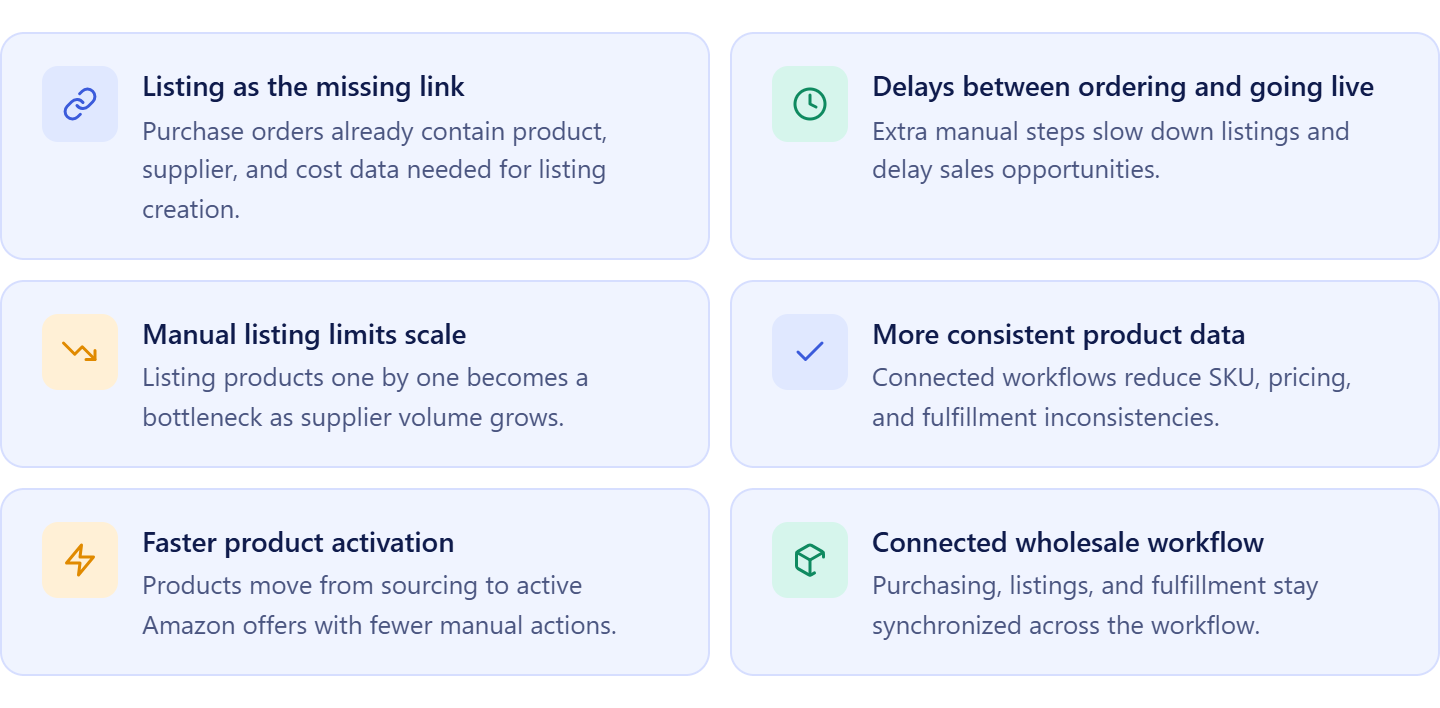
Listing as the missing link
Purchase orders already contain the data you need – products, quantities, costs, and supplier details. When listing isn’t connected to this step, you duplicate work and risk inconsistencies across SKUs, pricing, and fulfillment settings.
Delays between ordering and going live
Every extra step between purchase order and listing delays time to market. Until a product is listed, it can’t compete for the Buy Box or start generating sales.
Manual listing limits scale
Listing one product at a time may work at low volume, but it doesn’t hold up when you manage multiple suppliers and large catalogs. A disconnected process creates bottlenecks that slow down growth.
Why connecting purchase orders to listing matters
When listing is built into your purchase order workflow, products move directly from sourcing to active offers. This keeps your data consistent, reduces manual work, and helps you scale faster without breaking your process.
What Seller Assistant’s Tools Help List from POs?
Listing products after purchasing inventory is often fragmented – you move between spreadsheets, Seller Central, and notes to match SKUs, costs, and supplier data. Seller Assistant simplifies this by letting you list products directly from purchase orders inside one connected workflow. Instead of re-entering data, you move from buying to listing in a few clicks, keeping everything accurate and consistent.
This process is powered by two core tools: Seller Assistant’s Purchase Orders Module and Seller Assistant’s Lister.
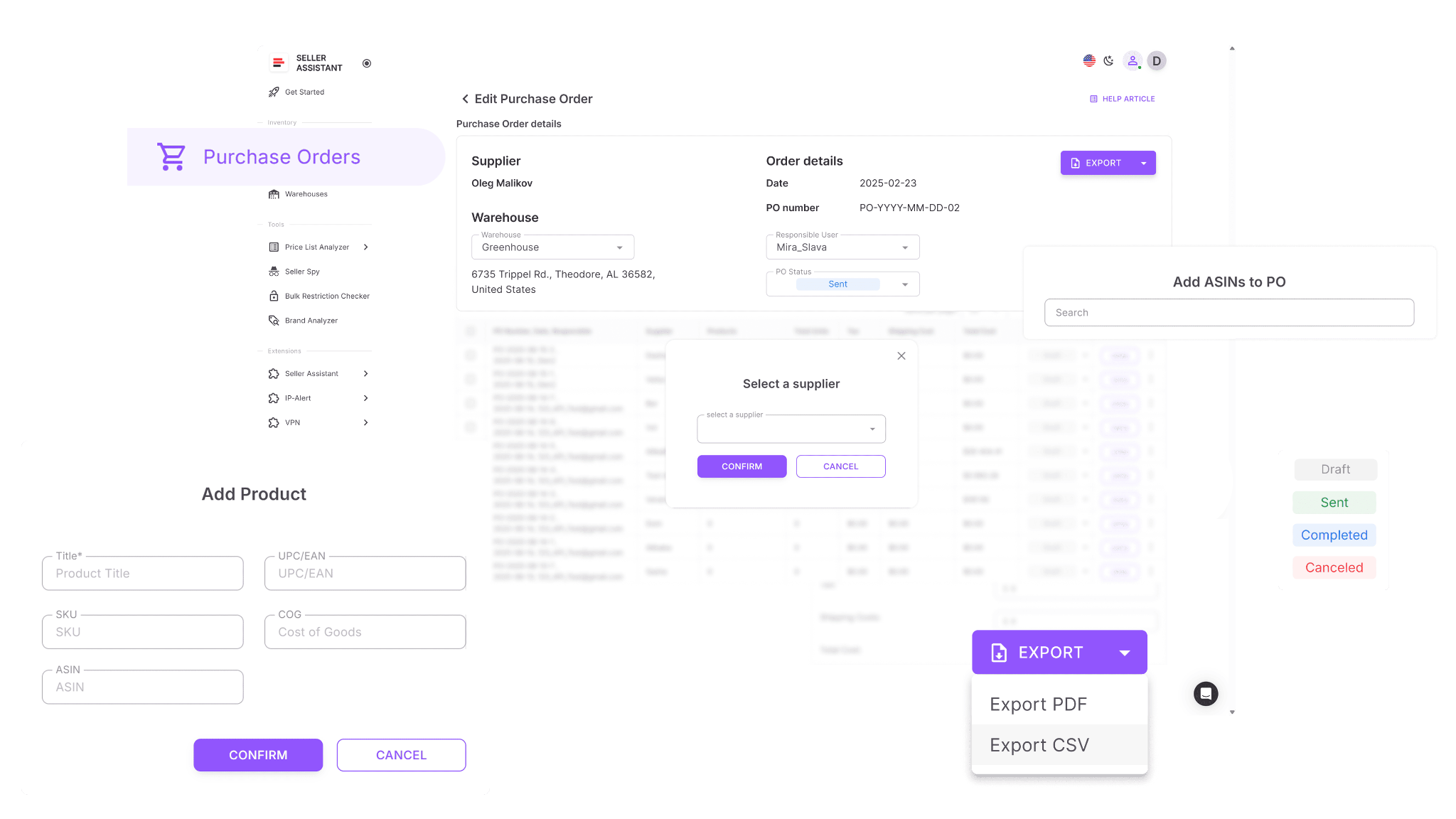
Purchase Orders Module
Purchase Orders Module is where your buying decisions are structured and stored. It contains all ordered products, quantities, supplier details, and costs in one place. Because this data is already organized, it becomes the foundation for listing – you don’t need to recheck suppliers, SKUs, or pricing before creating listings.
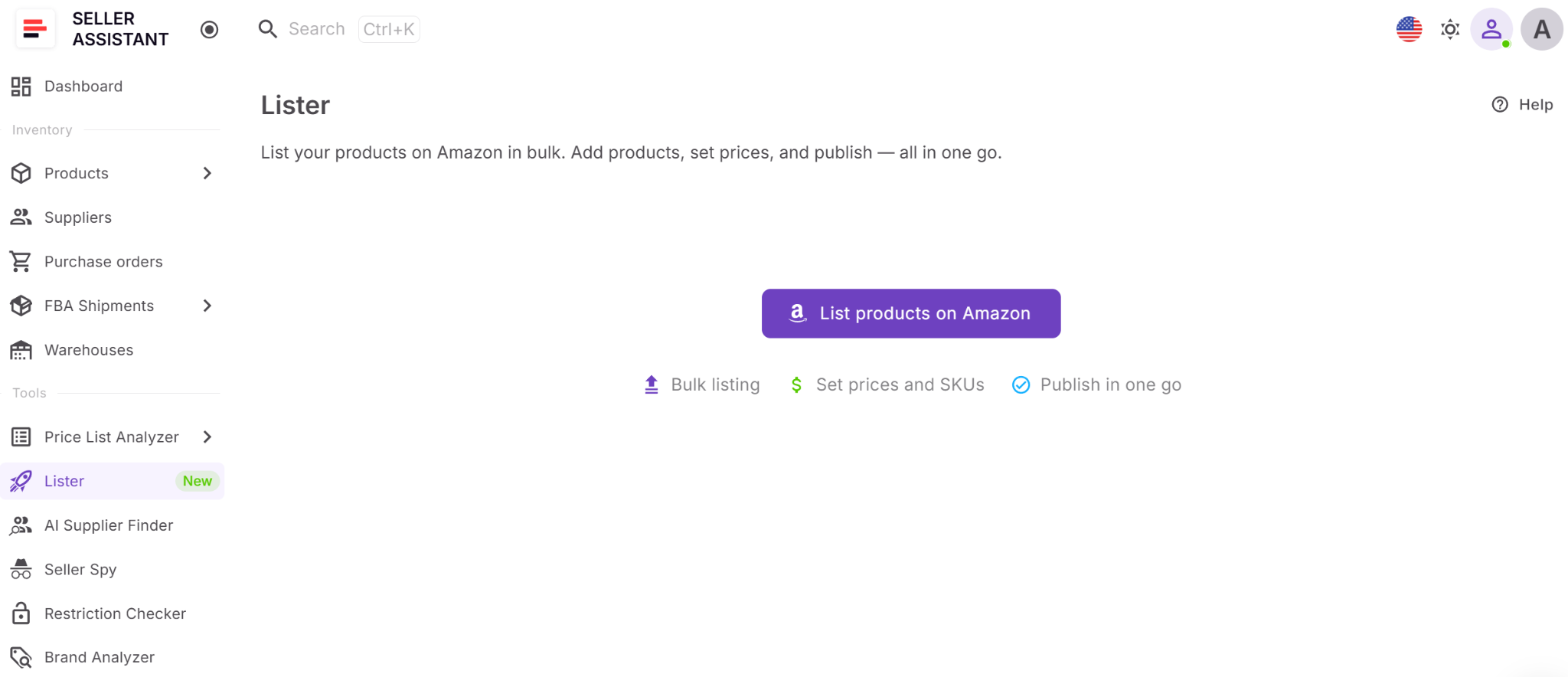
Lister
Lister is the tool that creates your Amazon listings based on product and purchase order data. It pulls in key details such as ASIN, SKU, and cost structure, allowing you to generate listings quickly without manual entry. This reduces errors and speeds up the process of making inventory available for sale.
How it works together
Once a purchase order is created, you can take products directly from it and send them to Lister. The system uses existing product and supplier data to prefill listing details, so you only need to review and publish. This creates a smooth transition from purchasing to selling without breaking your workflow.
How listing from POs fits into your workflow
Listing from POs is part of Seller Assistant’s connected wholesale workflow. After sourcing products, validating suppliers, and placing orders, you move directly into listing and fulfillment. Each step is linked, so data flows automatically from product research to purchase orders to listings, keeping your operations fast, accurate, and scalable.
Note. Seller Assistant is an end-to-end Amazon workflow management platform that integrates 15+ wholesale-focused solutions into one connected system. It combines sourcing workflow automation, bulk research and intelligence tools, and integrated Chrome extensions – giving you everything you need to streamline finding deals, managing suppliers, and creating purchase orders.

The platform aggregates: workflow management tools – Purchase Orders Module, Suppliers Database, Product DB, Warehouses Database, FBA Shipments to organize, automate, and scale every step of your wholesale and arbitrage operations; bulk research & sourcing tools – Price List Analyzer, Bulk Restriction Checker, AI Supplier Finder, Brand Analyzer, Seller Spy to evaluate supplier price lists, verify selling eligibility and restrictions, open new brands, and discover winning product ideas from competitors to expand your product catalog; Chrome extensions – Seller Assistant Browser Extension, IP-Alert Extension, and built-in VPN by Seller Assistant to deep-research products, check IP claims and compliance, and access geoblocked supplier sites directly within your browser; and integrations & team access features – seamless API connectivity and integrations with Zapier, Airtable, and Make, plus Virtual Assistant Accounts for secure, scalable team collaboration.
With Seller Assistant, every step of your Amazon wholesale and arbitrage workflow is automated and connected.
What Is Lister
Lister is Seller Assistant’s listing tool that lets you create Amazon listings directly from your product and purchase order data. Instead of manually entering ASINs, SKUs, and costs in Seller Central, Lister pulls this information from your workflow and prepares listings faster and with fewer errors. It’s designed to turn purchased inventory into active listings without breaking your process or duplicating work.
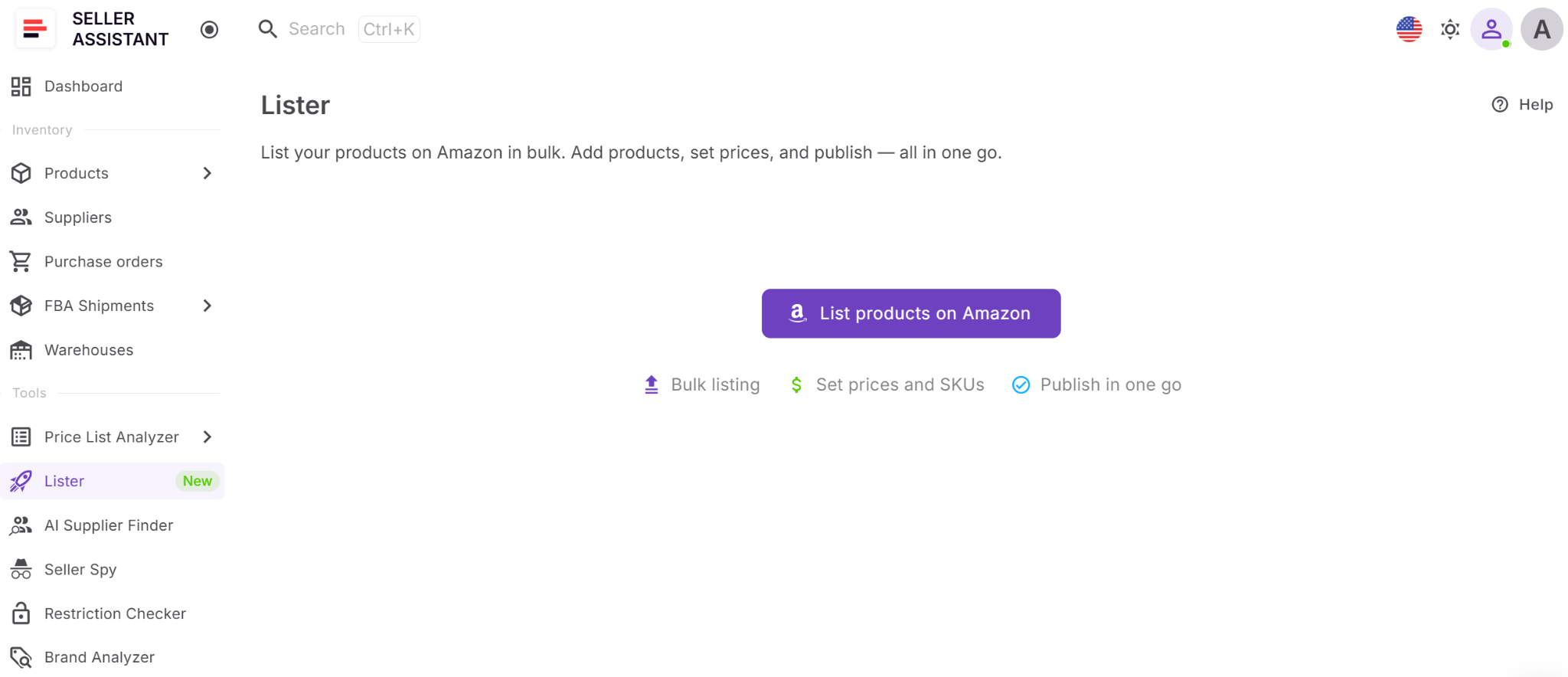
What you can do with Lister
Lister gives you full control over how your products go live on Amazon. It keeps the entire listing process inside your workflow, so you can create, manage, and launch listings without manual steps or data gaps.
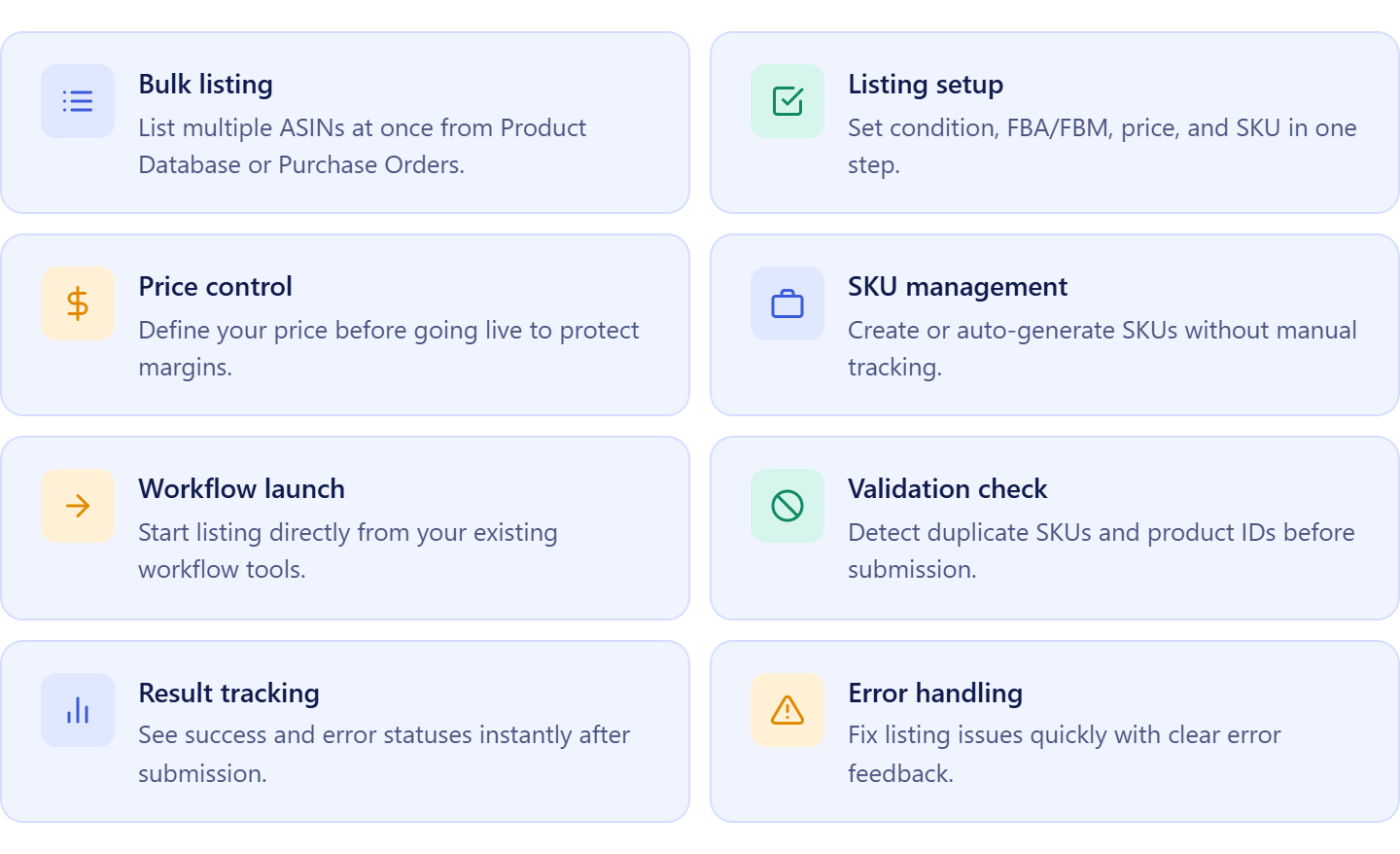
- Create listings in bulk or one by one
Select one or multiple products from Product Database or Purchase Orders and list them within a single workflow.
- Set listing details in one place
Configure condition, fulfillment method, price, and SKU before submission to ensure accurate listings from the start.
- Generate or manage SKUs
Create SKUs manually or let the system generate them to keep your catalog structured and consistent.
- Launch listings directly from your workflow
Start listing from Product Database, Purchase Orders, or Tools without searching for products again.
- Validate listings before submission
Automatically check for duplicate SKUs and product IDs to avoid errors during listing creation.
- Review results and fix issues fast
See which listings succeeded or failed after submission and resolve issues quickly to get them live.
How Lister streamlines your listing process
Lister turns listing into a simple, structured flow inside your workflow. You select products, set key parameters, and submit listings to Amazon without switching between tools. Once submitted, listings move through statuses, so you can instantly see which SKUs are active, pending, or require fixes.
When creating listings, you can configure all essential details in one place – condition, fulfillment method (FBA or FBM), price, and SKU (manual or auto-generated). This keeps the listing setup fast and consistent.
Lister connects Product Database, Listings, and SKUs into one system. You select products from your database or purchase orders, create listings, and track their status in the Listings tool, while each listing is automatically linked to a SKU with status and landed cost.
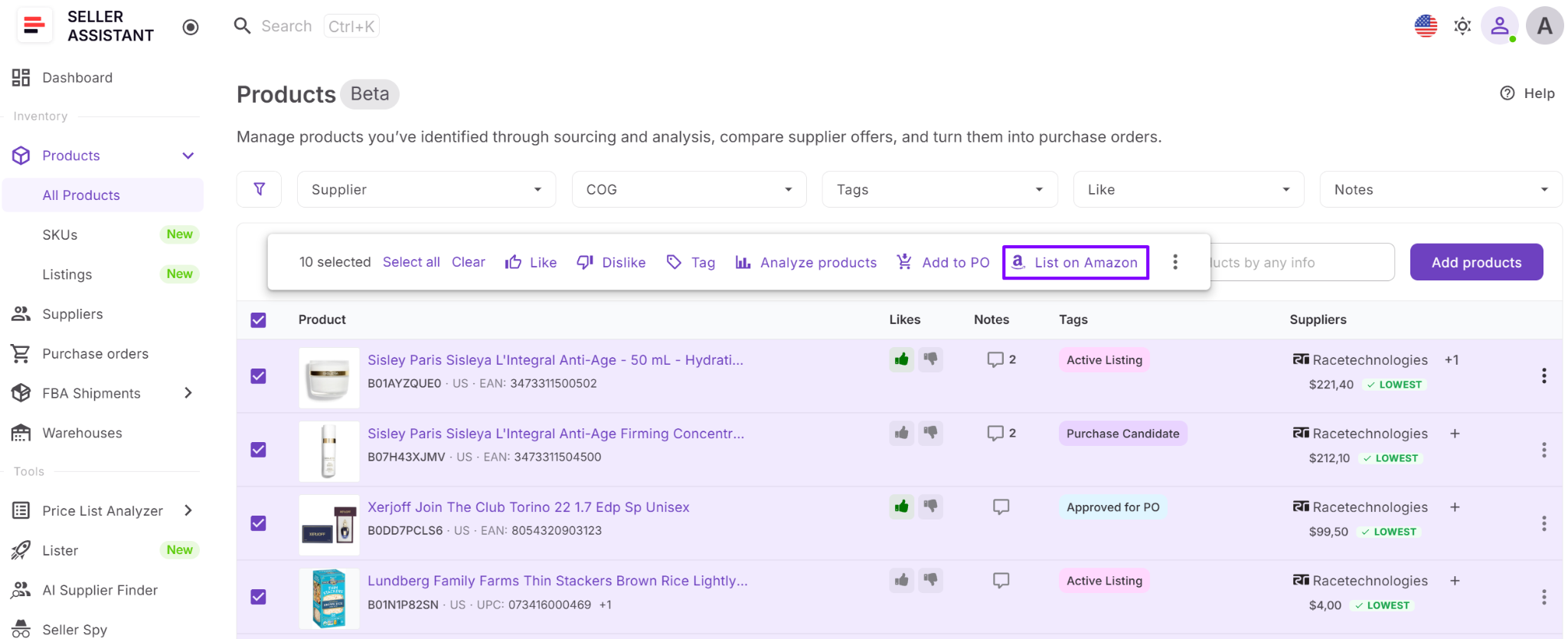
You can launch Lister directly from Product Database for quick listing or from Purchase Orders Module when inventory is ready. As part of Seller Assistant’s workflow, it keeps product, supplier, and cost data aligned from sourcing to listing without duplicate entry.
What Is Purchase Orders Module?
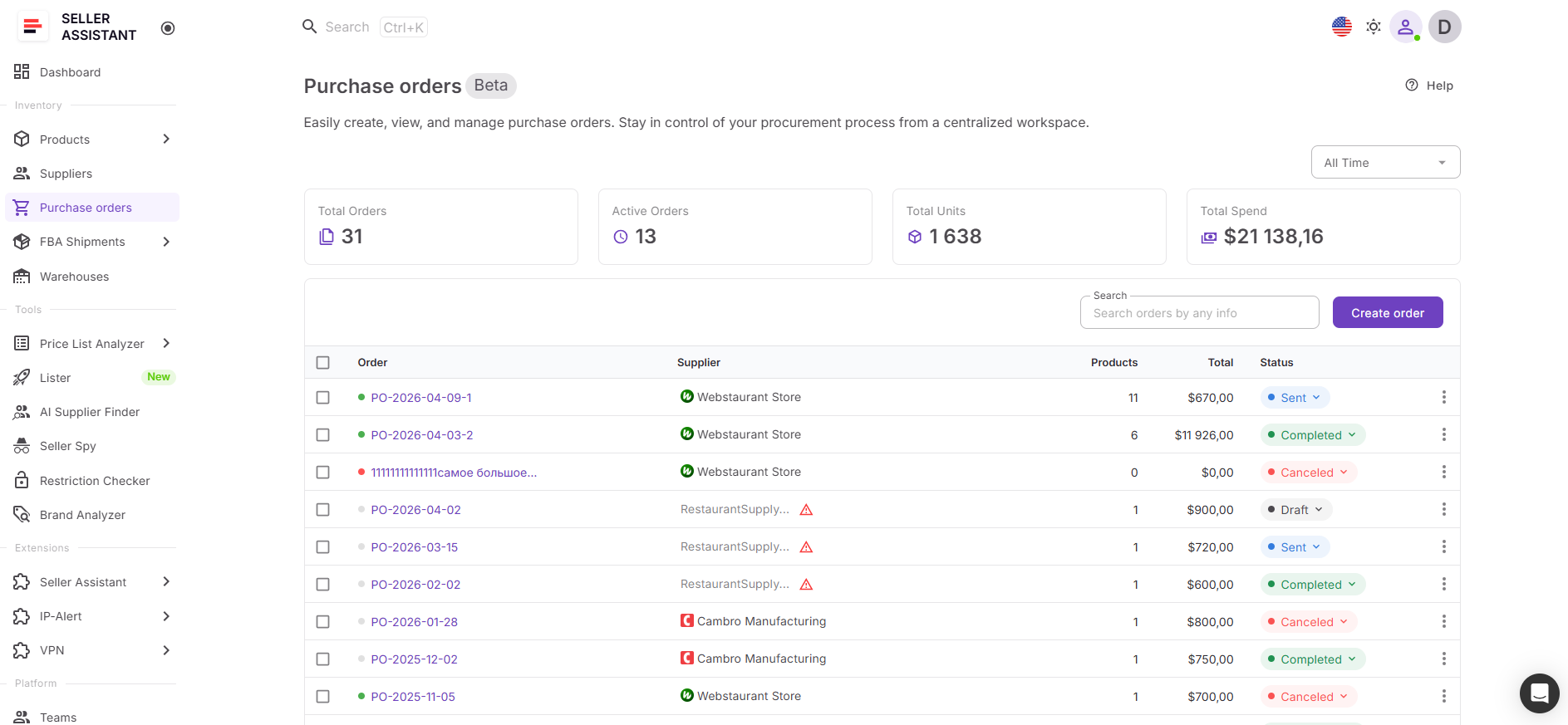
Purchase Orders Module is Seller Assistant’s purchasing tool that lets you create, manage, and track supplier orders inside your workflow. Instead of building purchase orders manually in spreadsheets, the module uses your product, supplier, and warehouse data to generate structured orders automatically. This keeps your purchasing process organized, reduces errors, and ensures consistency as your operation scales.
What You Can Do with Purchase Orders Module
Purchase Orders Module gives you a structured way to manage supplier orders without relying on spreadsheets or manual documents. It keeps your purchasing organized, automates calculations, and connects product, supplier, and warehouse data in one workflow so every order follows a consistent process.
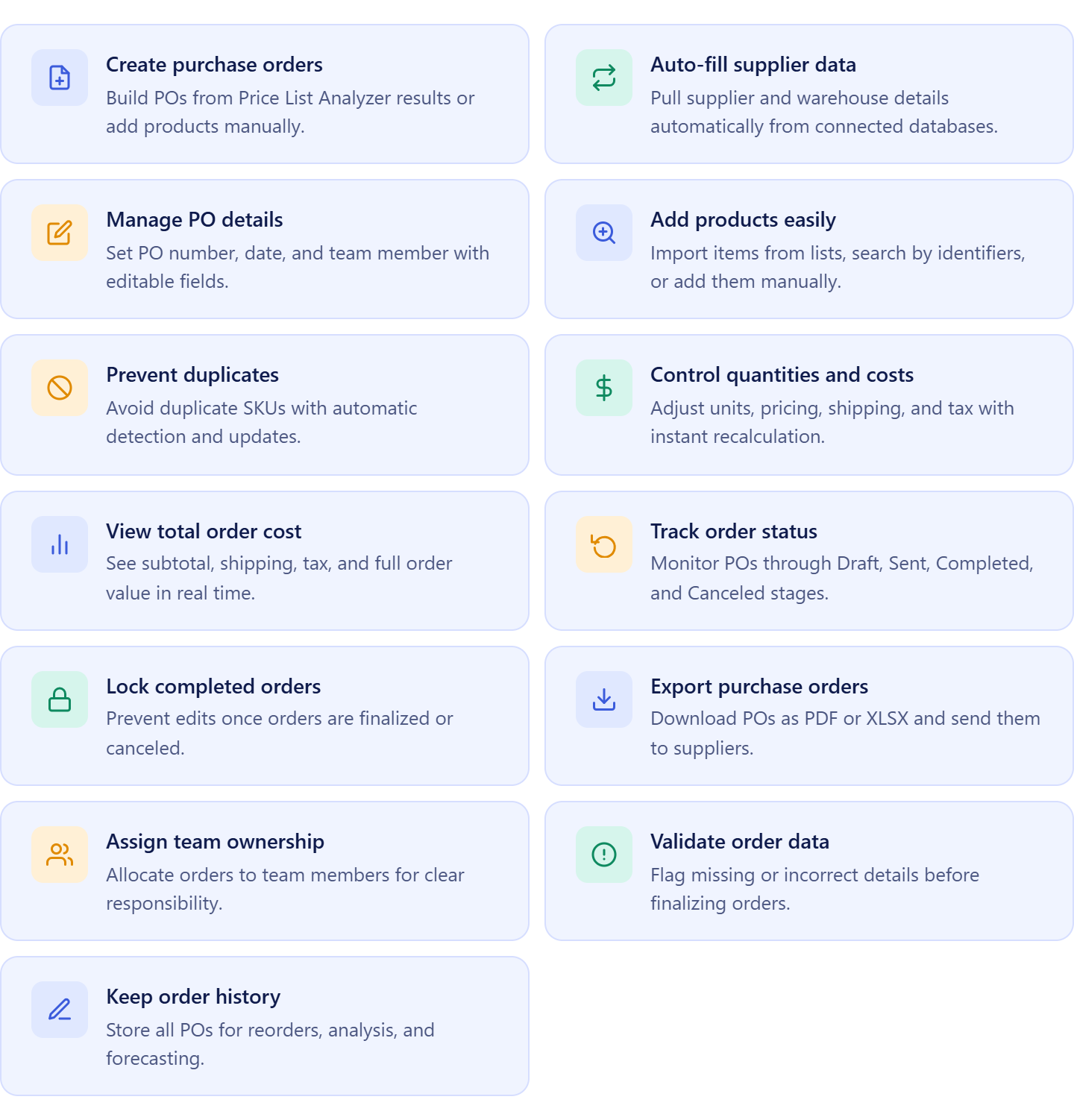
- Create purchase orders from analyzed products
Build POs directly from Price List Analyzer results or add products manually when sourcing elsewhere.
- Auto-fill supplier and warehouse data
Pull supplier details and shipping destinations automatically from connected databases to avoid repeated entry.
- Manage order details in one place
Each PO includes number, date, and assigned team member, all editable when needed.
- Add products from multiple sources
Import items from price lists and analyzed data, search by identifiers, or add them manually.
- Prevent duplicate products in orders
The system detects duplicate SKUs and updates existing entries instead of creating duplicates.
- Control quantities and costs
Adjust quantities, unit costs, shipping, and tax while totals update automatically.
- See full order cost instantly
View subtotal, shipping, tax, and total order value in real time for accurate purchasing decisions.
- Track purchase order status
Monitor each order through Draft, Sent, Completed, or Canceled stages.
- Lock completed orders
Prevent accidental edits by locking orders once they are finalized or canceled.
- Export ready-to-send orders
Download POs as PDF or XLSX and send them directly to suppliers.
- Assign orders to team members
Set responsibility for each PO to keep procurement organized across your team.
- Detect missing or incorrect data
Get alerts for incomplete supplier or routing details before finalizing orders.
- Maintain purchase history
Keep all orders stored for reorders, spend tracking, and forecasting.
How Purchase Orders Module manages your purchasing workflow
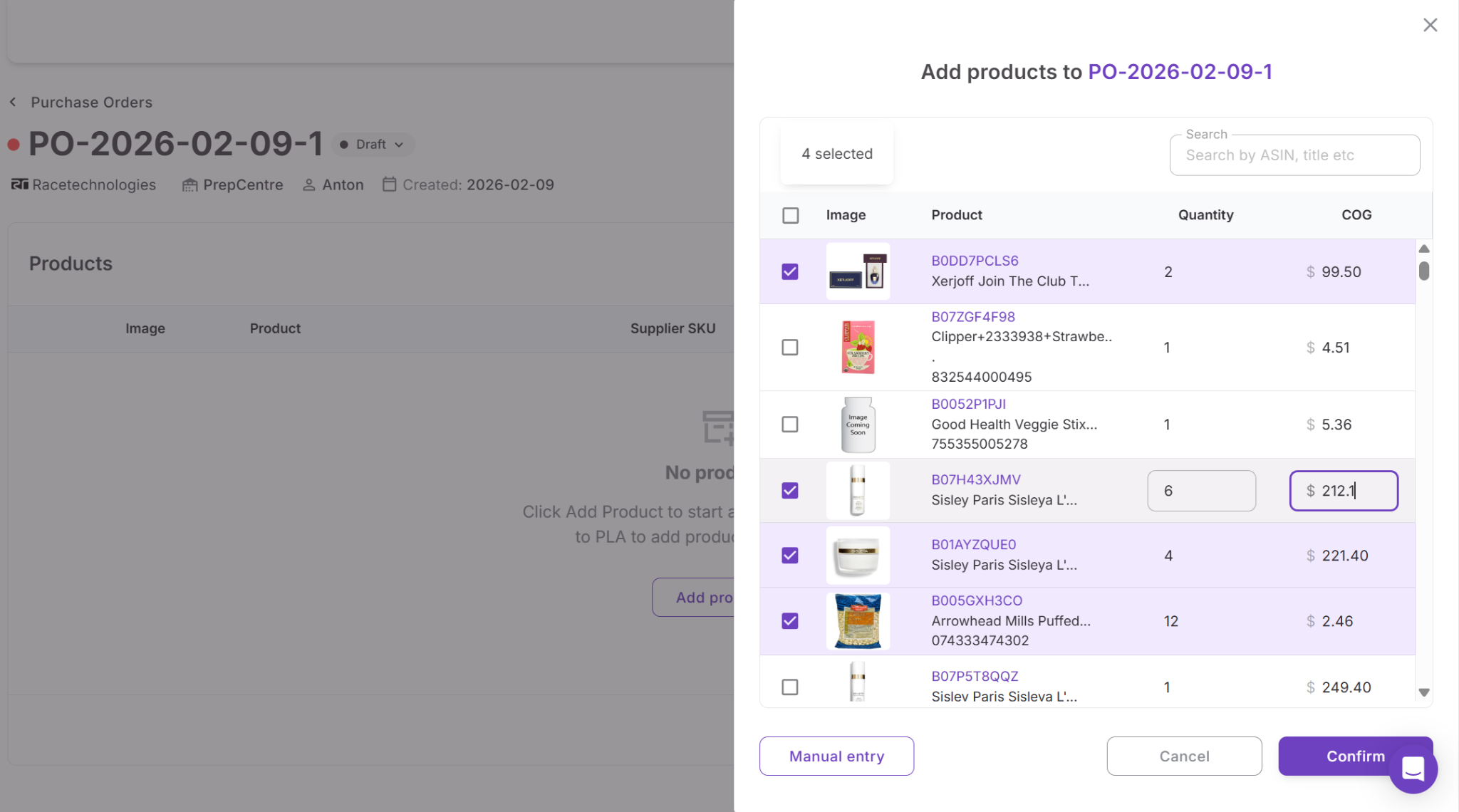
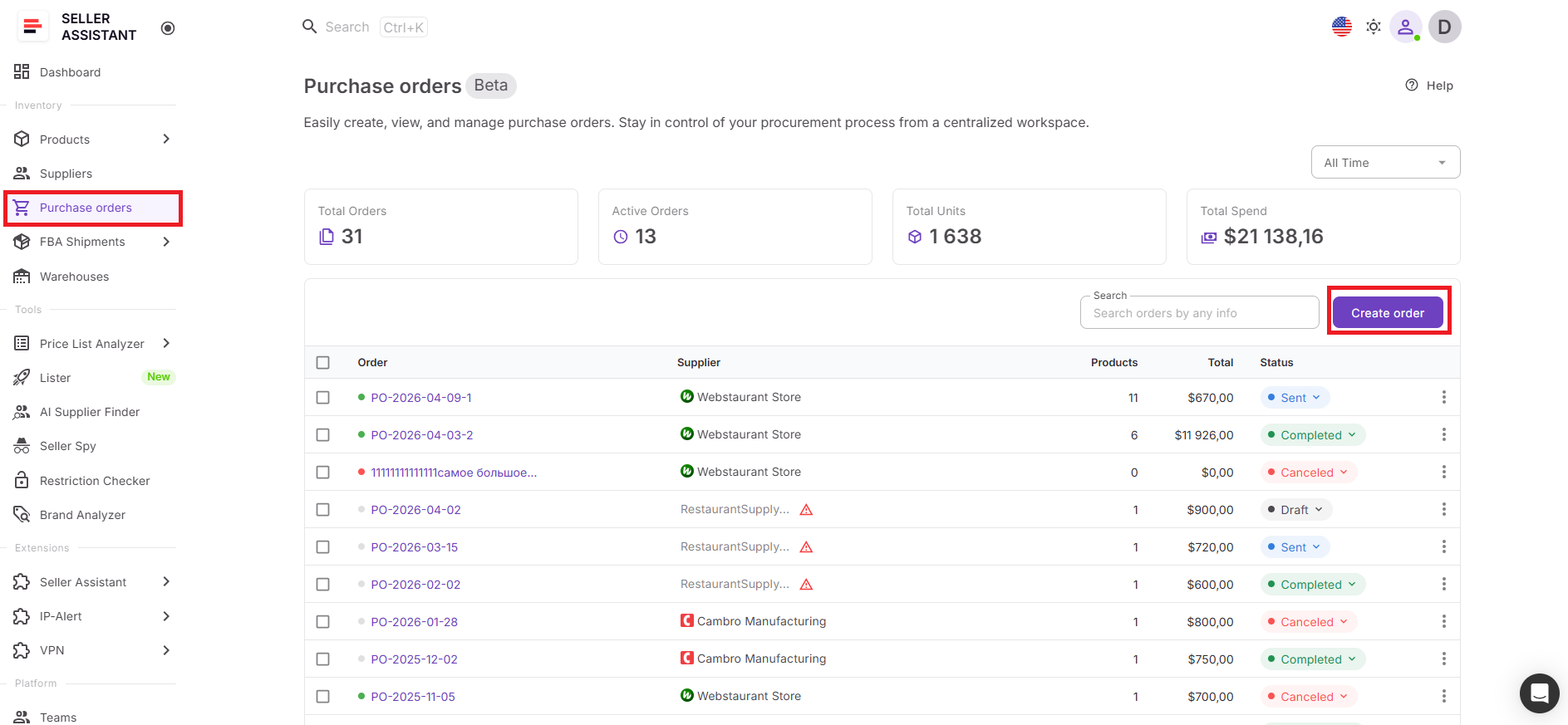
Purchase Orders Module turns sourcing into a structured purchasing process inside Seller Assistant. You create a new order, select a supplier, and the system generates a draft with a unique number and prefilled details. From there, you add products, assign a warehouse, and adjust quantities and costs while totals calculate automatically.
Products can be added from supplier price lists, Product Database, Price List Analyzer results, product search, team data, or manual entry. If the same product is added again, the system updates the existing line instead of duplicating it.
Because the module connects with tools like Product Database, Price List Analyzer, Lister, Suppliers Database, Warehouses Database, FBA Shipments, all data flows into your orders automatically. This lets you move from product research to purchasing without re-entering information, while built-in metrics like total orders, units, and spend help you track procurement performance over time.
How to Turn Purchase Orders Into Live Amazon Listings
The process starts with your purchase order. After sourcing products and confirming profitable ASINs, you create a PO that already includes all key data – products, quantities, costs, suppliers, and destinations. At this stage, your inventory is fully prepared for the next step, but in a traditional workflow, you would still need to recreate everything inside Seller Central.
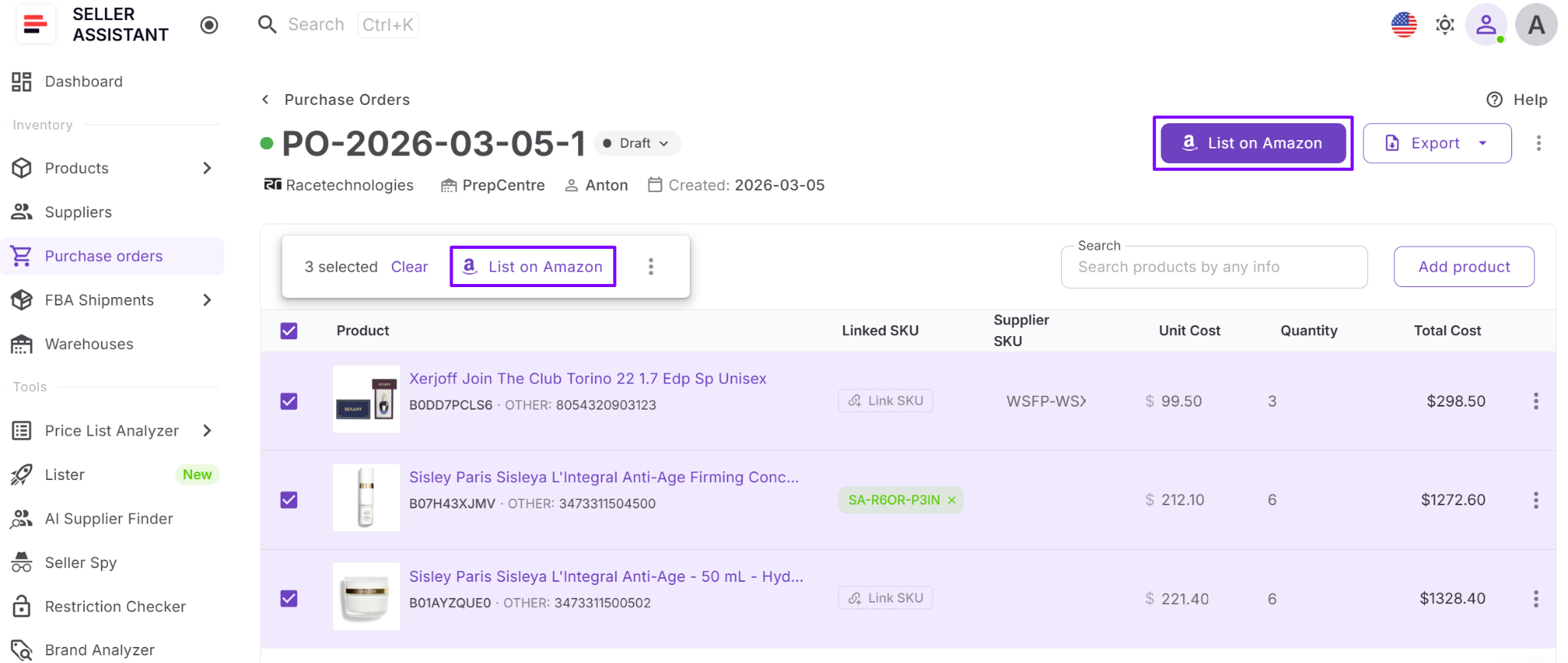
Instead of switching tools, you use Seller Assistant’s Lister directly from your purchase order. Products are already selected, so you don’t need to search for ASINs again or rebuild your workflow. You simply review and set final listing details like fulfillment method (FBA or FBM), price, and SKU.
Once submitted, your products move from purchase orders to active listings in one flow. This keeps your SKU structure consistent, eliminates duplicate work, and allows you to move from sourcing to sellable inventory much faster.
Step-by-step: Listing Products Directly from Purchase Orders
Step 1. Create or open your purchase order
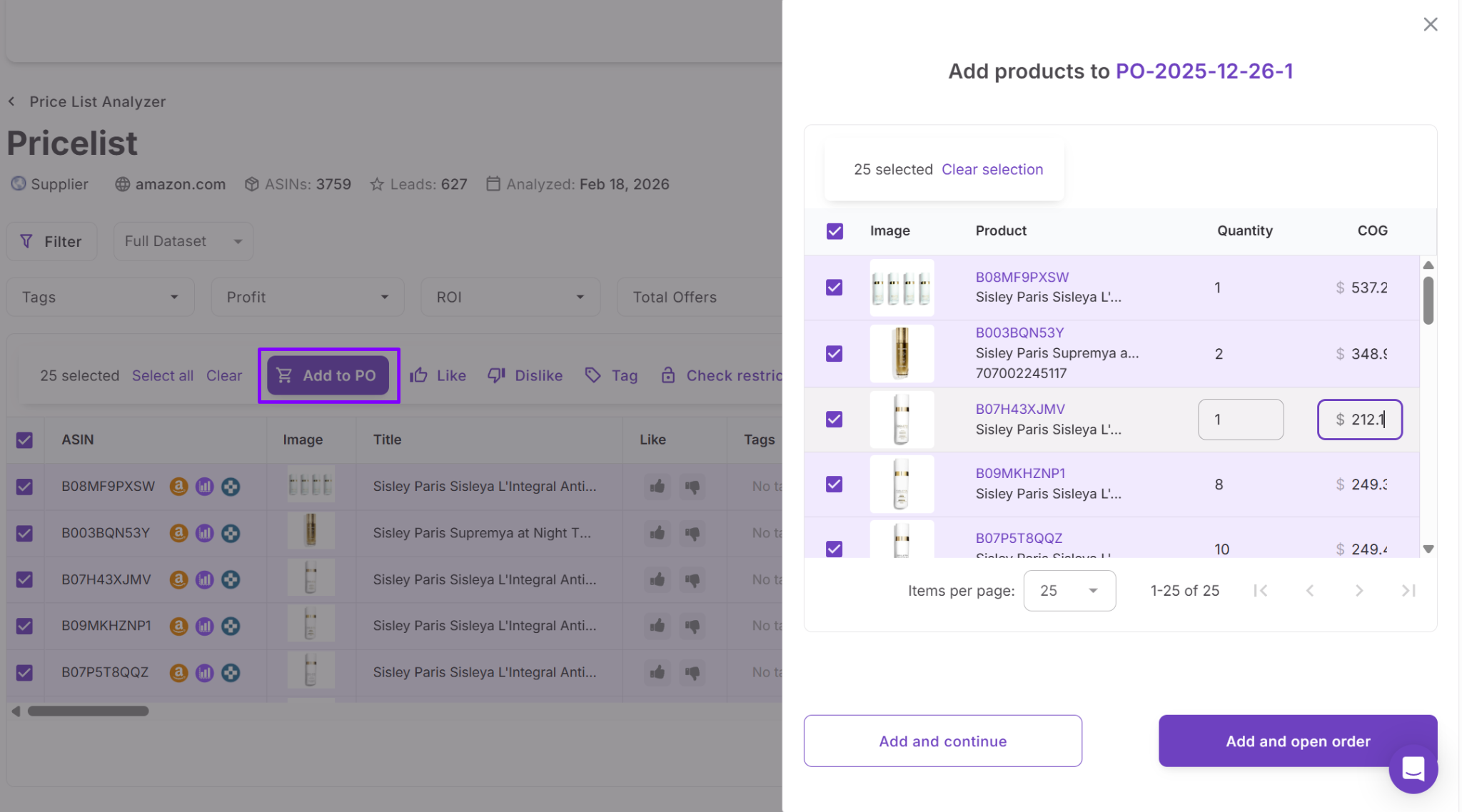
Start in the Purchase Orders Module. Create a new PO or open an existing one with approved products. At this stage, your ASINs, quantities, and costs are already structured and ready for listing.
Step 2. Select products to list
Inside the purchase order, choose the products you want to list on Amazon. You can select individual items or prepare multiple SKUs for bulk listing.
Step 3. Launch Lister from the purchase order
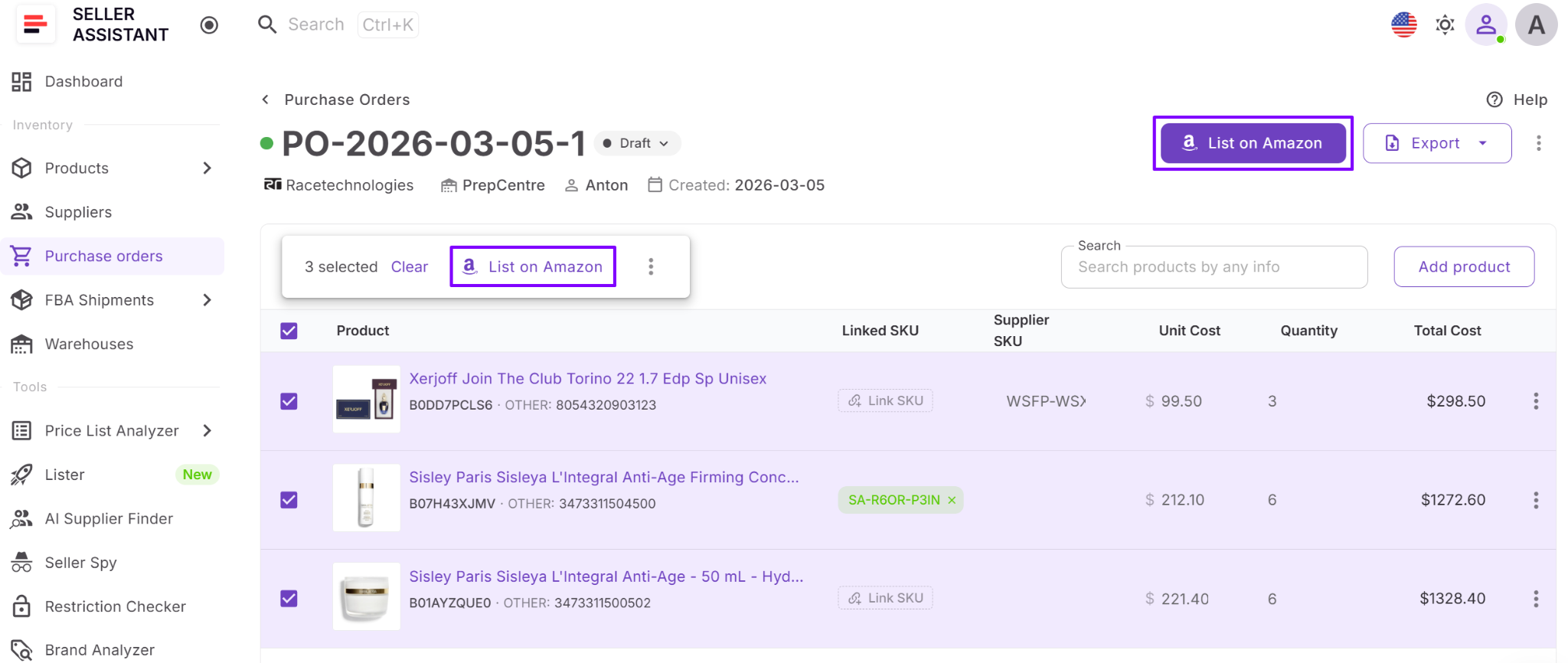
Click List on Amazon to open Seller Assistant’s Lister. The selected products are automatically transferred, so there’s no need to search for ASINs again.
Step 4. Review and set listing details
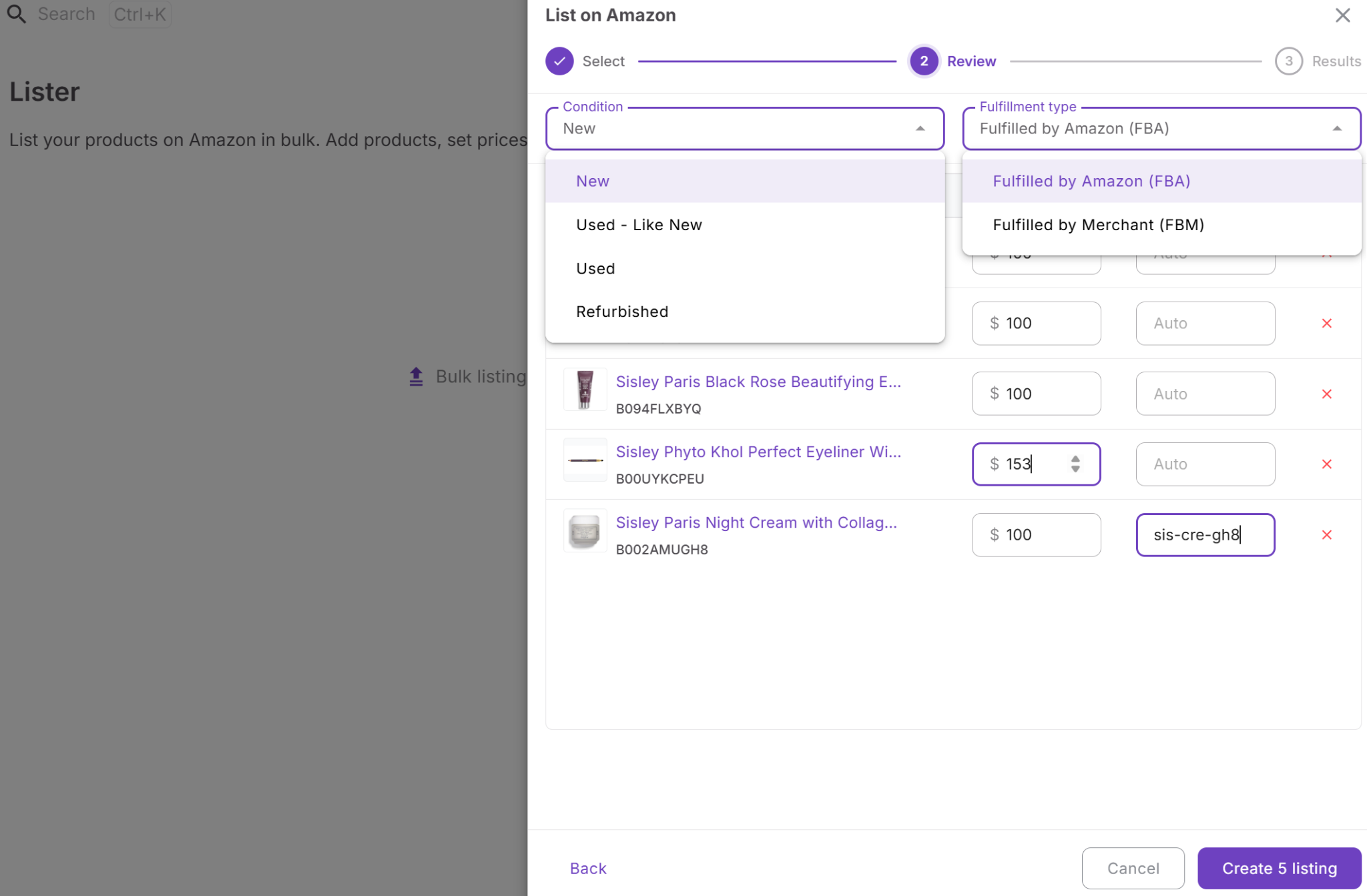
Set the key parameters for each product:
- Fulfillment method (FBA or FBM)
- Price
- SKU (manual or auto-generated)
- Condition
This is the only step where you finalize how your offer will appear on Amazon.
Step 5. Validate and submit listings
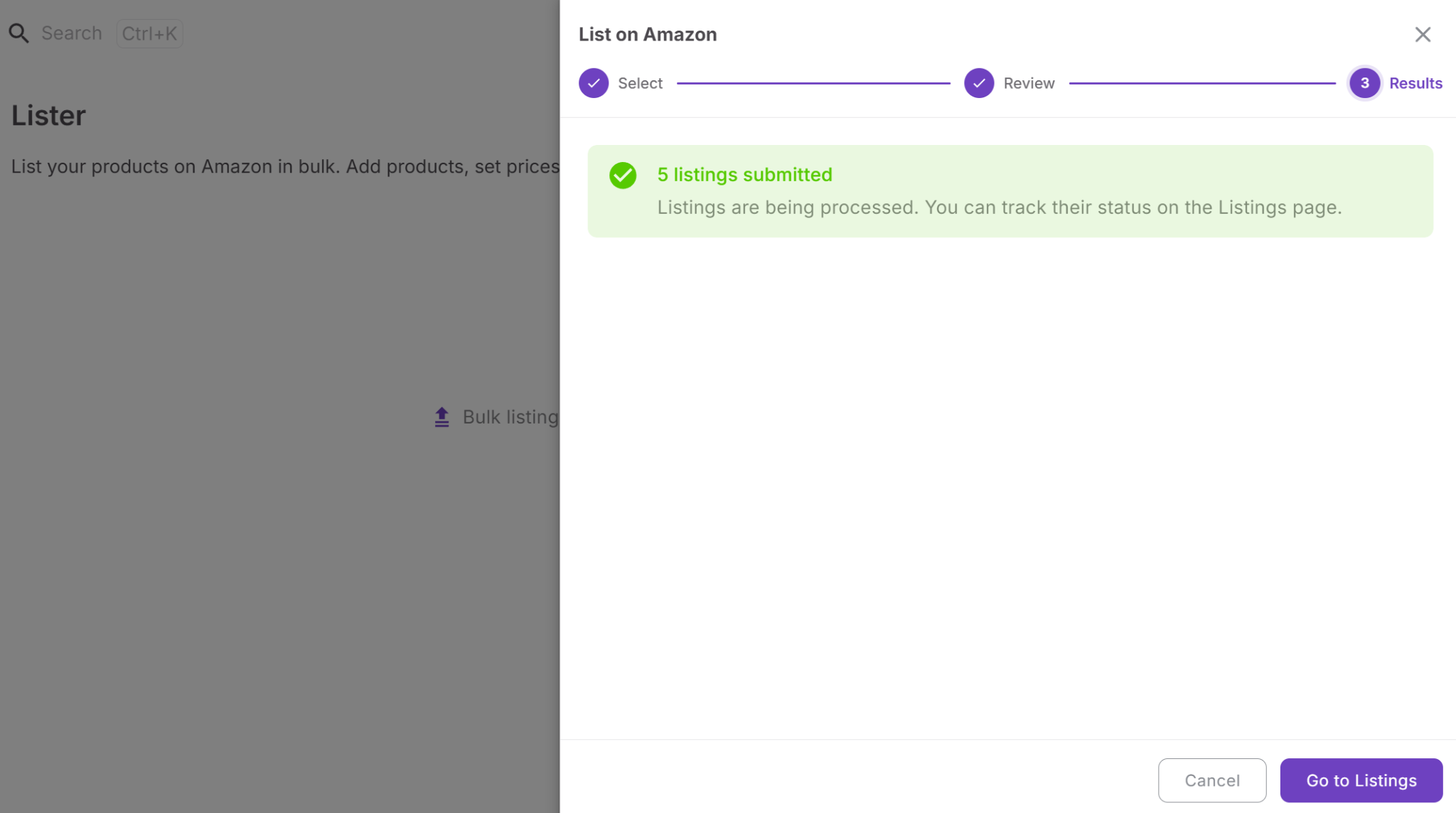
Lister checks for duplicate SKUs and product IDs before submission. Fix any issues if needed, then submit your listings.
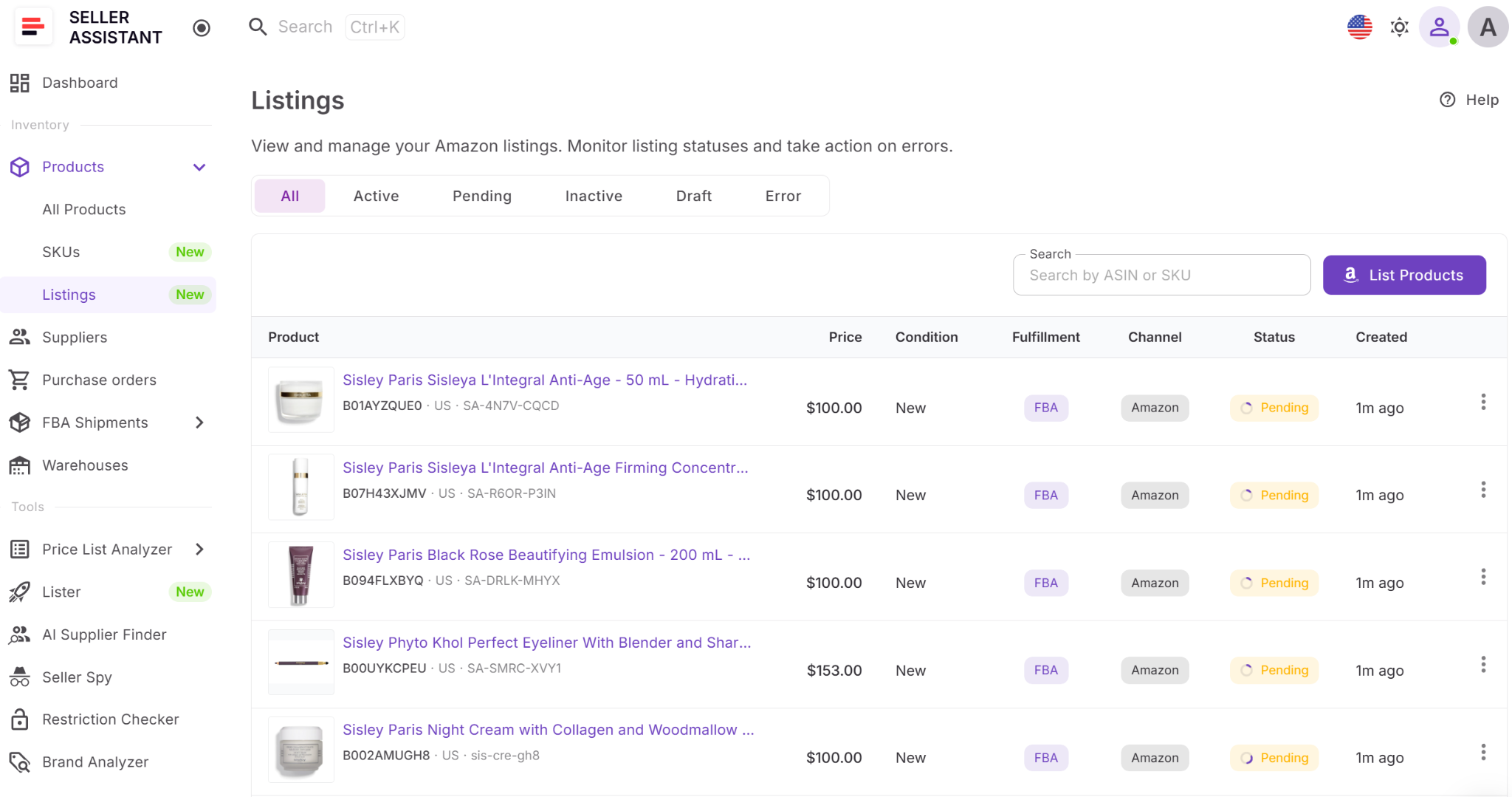
Step 6. Monitor listing status
After submission, go to the Listings tool to track statuses like Active, Pending, or Error. Resolve any issues and move products to live status quickly.
FAQ
Can I list products directly from purchase orders without using Seller Central?
Yes, you can create and submit listings from your purchase orders using Seller Assistant’s Lister. Seller Central is still used for account-level management, but you don’t need it for each listing action.
Do I need to re-enter product data when listing from a purchase order?
No, product data like ASINs, quantities, and costs are already included in your purchase order. You only need to confirm listing details such as price, fulfillment method, and SKU.
Can I list multiple products from one purchase order at once?
Yes, you can select multiple products inside a purchase order and list them in bulk. This helps speed up operations when working with large supplier orders.
What happens if a listing fails during submission?
The system shows an error with the reason for failure after submission. You can fix the issue and resubmit without restarting the entire process.
How does listing from purchase orders help with SKU management?
Listing from purchase orders keeps SKUs consistent because they are created and tracked within the same workflow. This reduces duplication and helps maintain accurate inventory and cost tracking.
Final Thoughts
Listing products shouldn’t be a separate, manual step after creating purchase orders. When you connect listing directly to your PO workflow, you remove duplicate work, keep SKU data consistent, and reduce delays between ordering and going live. Instead of switching between tools and rebuilding listings, you move from sourcing to active offers in one structured process.
Seller Assistant brings this workflow together by linking purchase orders and listing in a single system. This allows you to scale faster, launch products sooner, and keep full control over your inventory, costs, and operations as your business grows.
Seller Assistant automates and connects every stage of your Amazon wholesale and arbitrage workflow. It brings together in one platform: workflow management tools – Purchase Orders Module, Suppliers Database, Warehouses Database, FBA Shipments, bulk research & sourcing tools – Price List Analyzer, Bulk Restriction Checker, Sourcing AI, Brand Analyzer, Seller Spy, Chrome extensions – Seller Assistant Browser Extension, IP-Alert Extension, and built-in VPN by Seller Assistant, and integrations & team access features – seamless API connectivity, integrations with Zapier, Airtable, and Make, and Virtual Assistant Accounts.