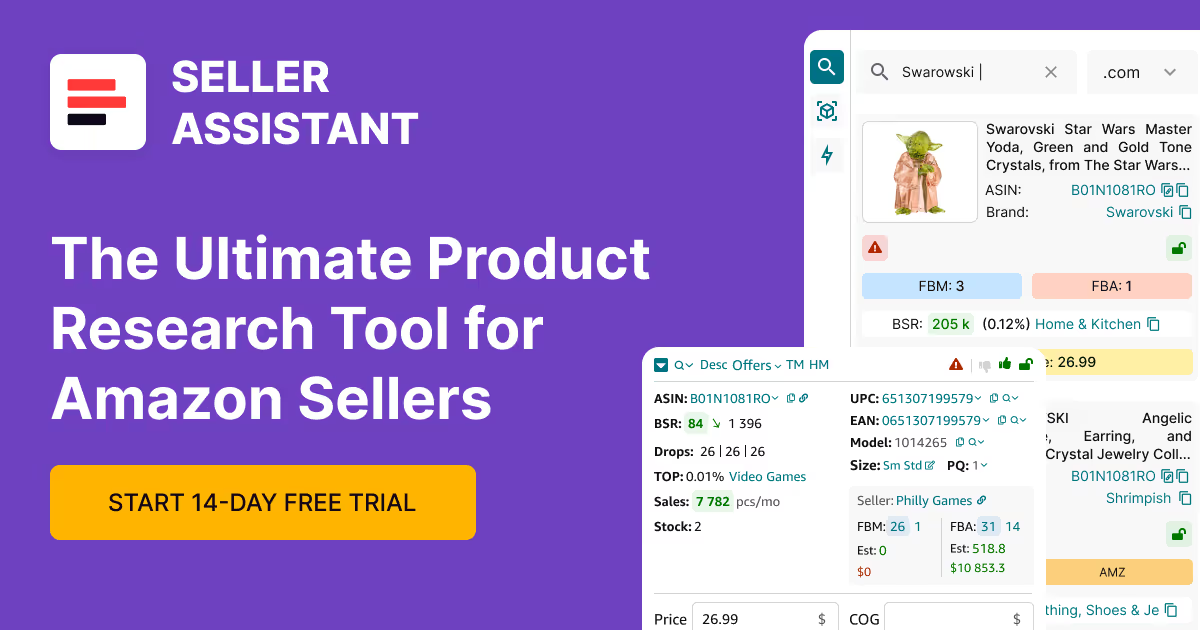



Running a profitable Amazon wholesale business takes more than spotting good deals – it requires structured sourcing, supplier tracking, and smart purchasing decisions. That’s where Amazon wholesale product sourcing software like Seller Assistant comes in.
Instead of juggling spreadsheets, disconnected tools, and risky ASINs, Seller Assistant unifies your entire workflow. From price list analysis and restriction checks to supplier management and purchase orders, it brings every step into one connected system.
In this post, you’ll learn how Seller Assistant helps you source faster, avoid costly mistakes, and scale with confidence – all without switching tabs or stitching together third-party tools.
How Wholesale Sourcing Workflow Works
Wholesale success on Amazon doesn’t happen by chance – it’s the result of a structured, repeatable sourcing workflow. Each step in the process plays a critical role: from selecting the right products to closing deals with suppliers and routing orders to prep.
Here’s how the Amazon wholesale sourcing workflow typically works.
Step 1. Define what to sell
Start by identifying high-demand products and resale-friendly brands with large catalogs, strong sales velocity, and low Amazon competition. Focus on what top sellers are already listing and evaluate which brands offer long-term profit potential.
Step 2. Check if you’re approved to sell
Before contacting suppliers, make sure you’re eligible to sell the products you’re targeting. Many ASINs, brands, and categories on Amazon are gated or restricted. Verifying your account’s selling eligibility upfront helps you avoid sourcing deals you can’t list.
Step 3. Locate trusted wholesale suppliers
Once you’ve validated your product ideas, search for real U.S.-based wholesale suppliers or distributors who carry them. Reliable sourcing means finding suppliers that offer authentic inventory, workable margins, and are open to working with Amazon sellers.
Step 4. Organize and manage your supplier contacts
As you reach out to more suppliers, it becomes critical to organize their contact info, terms, and communication status. Tracking who you’ve contacted, their response, and which products they offer prevents duplicate outreach and missed opportunities.
Step 5. Contact suppliers, open wholesale accounts, and get price lists
Start reaching out to selected suppliers. Introduce yourself professionally, request account approval, and submit any required documentation. Once approved, request full product catalogs or price lists, which will be the foundation for deal analysis.
Step 6. Set routing for suppliers
Each supplier should be linked to warehouse(s) or prep center(s) to avoid confusion during ordering. Centralized routing rules help streamline fulfillment, ensure accurate shipping, and prevent costly logistical mistakes.
Step 7. Turn supplier spreadsheets into verified purchase-ready deals
After receiving supplier price lists, analyze them for ASIN matches, pricing accuracy, restrictions, and risk flags. Filter out poor matches and build a shortlist of high-margin, compliant, low-risk products worth purchasing.
Step 8. Turn shortlisted deals into ready-to-send purchase orders
Next, convert your verified product shortlist into structured purchase orders. Include the supplier, warehouse, quantities, costs, and fees – and make sure every PO is tracked, accurate, and easy to share with your vendors.
Step 9. Scale your operations while maintaining full control
With your sourcing engine running, focus on scale: delegate tasks, automate workflows, and integrate your sourcing data with tools and teams – all while staying in control of compliance, inventory, and profit margins.
The Problem with Traditional Wholesale Sourcing
Before automation, wholesale sellers relied on messy spreadsheets, disconnected tools, and endless manual research. This not only slowed down the process but also introduced constant risks – from sourcing restricted products to losing supplier data and missing high-value opportunities. Here’s what slows most sellers down:
Limited visibility into what to sell
Without data-backed tools, sellers struggle to identify which brands or products are actually worth pursuing. Guesswork replaces strategy, and missed opportunities are common.
Wasted time chasing gated or restricted products
Many sellers discover too late that they’re not approved to sell what they sourced – costing hours in back-and-forth or unusable inventory. Without a bulk restriction checker, it’s easy to go down the wrong path.
Manual supplier research is slow and unreliable
Googling for suppliers or browsing outdated directories is time-consuming and inconsistent. Most results aren’t vetted or relevant to Amazon resellers.
Supplier information is scattered and hard to manage
When supplier details are stored in spreadsheets and inboxes, it’s easy to lose track of communication, terms, and routing. This leads to duplicate outreach, missed deals, and fulfillment errors.
Fulfillment routing is error-prone
Without centralized warehouse assignment, sellers risk shipping to the wrong address or using incorrect prep details – costing time and money.
Price list analysis is manual and inconsistent
Spreadsheets alone can’t calculate margins, detect risk flags, or account for Amazon fees at scale. This creates blind spots and forces manual verification of every ASIN.
Purchase orders are fragmented and prone to mistakes
Building POs in spreadsheets or emails often results in missing data, incorrect costs, or routing issues – all of which delay orders and reduce trust with suppliers.
Scaling requires full control – not more complexity
As sellers grow, delegating to VAs and automating workflows becomes essential. Without centralized systems like Seller Assistant, scaling introduces more risk instead of more efficiency.
How Amazon Wholesale Product Sourcing Software Streamlines Sourcing Workflow
Sourcing wholesale products on Amazon isn’t just about finding good deals – it’s about managing a complex, multi-step workflow. To scale profitably, sellers need to automate each stage: from research and restrictions to supplier outreach and purchase orders.
That’s where Seller Assistant stands out. As a complete Amazon wholesale product sourcing software, it combines all essential tools in one system. It replaces spreadsheets and disconnected apps with a streamlined process that helps you source smarter, move faster, and avoid costly mistakes.
Note. Seller Assistant is an end-to-end Amazon workflow management platform that integrates 10+ wholesale-focused solutions into one connected system. It combines sourcing workflow automation, bulk research and intelligence tools, and integrated Chrome extensions – giving you everything you need to streamline finding deals, managing suppliers, and creating purchase orders.

Seller Assistant is an end-to-end Amazon workflow management platform
The platform aggregates: workflow management tools – Purchase Orders Module, Suppliers Database, Warehouses Database to organize, automate, and scale every step of your wholesale and arbitrage operations; bulk research & sourcing tools – Price List Analyzer, Bulk Restriction Checker, Sourcing AI, Brand Analyzer, Seller Spy to evaluate supplier price lists, verify selling eligibility and restrictions, open new brands, and discover winning product ideas from competitors to expand your product catalog; Chrome extensions – Seller Assistant Browser Extension, IP-Alert Extension, and built-in VPN by Seller Assistant to deep-research products, check IP claims and compliance, and access geoblocked supplier sites directly within your browser; and integrations & team access features – seamless API connectivity and integrations with Zapier, Airtable, and Make, plus Virtual Assistant Accounts for secure, scalable team collaboration.
With Seller Assistant, every step of your Amazon wholesale and arbitrage workflow is automated and connected.
Seller Assistant vs. the “old way”
| Sourcing Step | The Old Way | With Seller Assistant |
|---|---|---|
| Find what to sell | Guessing what works, browsing Amazon manually, no competitive insight | Brand Analyzer, Storefront Widget, Seller Spy give data-backed insights into brands, products, and competitor strategies |
| Check restrictions | Manually checking ASINs one by one inside Seller Central | Bulk Restriction Checker verifies hundreds of ASINs at once with clear eligibility status |
| Find suppliers | Google searches, outdated directories, unreliable results | Sourcing AI finds 10+ verified U.S. suppliers per ASIN with pricing and MOQ data |
| Manage supplier data | Scattered spreadsheets and email threads | Supplier Database stores and links all supplier info across tools automatically |
| Assign warehouses | Manual copy-pasting addresses into every PO | Warehouse Database links default prep centers to each supplier for auto-routing |
| Analyze price lists | Manual ASIN matching, calculating ROI and fees in Excel | Price List Analyzer auto-matches, enriches data with 70+ metrics, flags risks, and filters winning deals |
| Validate product details | Clicking back and forth between tools, missing key info | Seller Assistant Extension provides live ASIN insights, restrictions, profit, IP risks, and supplier discovery in-browser |
| Create purchase orders | Spreadsheets or manual docs with frequent errors | Purchase Orders Module generates accurate POs in one click with pre-filled supplier and warehouse info |
| Delegate sourcing tasks | Risky account sharing, no user roles or visibility | Virtual Assistant Accounts allow safe VA access with permission control and built-in VPN |
| Automate & scale | Manual data sync between tools, prone to errors | Seller Assistant API + integrations (Airtable, Zapier, Make) automate sourcing, update metrics, and push deals to POs |
How to define what to sell wholesale
Why this matters
Before you contact suppliers or request a single price list, you need to know exactly which brands and product categories you want to target. Unlike private label sellers who create their own listings, wholesale sellers work with established products – which means they rely on past sales performance to make smart, low-risk decisions.
The most effective strategy? Study what top Amazon sellers are already selling, then evaluate those brands for catalog size, demand, margin potential, and competition level. Ideally, you’re looking for brands with at least 500 ASINs, healthy revenue, and low saturation by Amazon itself or dominant sellers.
This upfront research ensures you’re making data-driven sourcing decisions before ever reaching out to suppliers.
Tools that help you
Storefront Widget
- Instantly loads on Amazon seller storefronts
- Gives a high-level view of seller info: ASIN count, top categories, top brands, reviews, and country
- Shows product cards with BSR, sales estimates, pricing trends, FBA/FBM competition, and alerts like restrictions or IP complaints
- Lets you filter by brand or category to focus research
Seller Spy
- Monitors any seller’s storefront over time to spot what best-sellers you lack and they sell
- Tracks new and removed listings, complete with ASINs, pricing, and links
- Helps identify product trends and gaps compared to your own catalog
Brand Analyzer
- Evaluates whether a brand is worth pursuing
- Shows brand size (target 500+ SKUs), competition level, and revenue potential
- Flags brands dominated by Amazon (over 30% Buy Box share may be a red flag)
- Includes review count and rating insights to assess customer sentiment
How to use the tools effectively
- With Storefront Widget
Go to any seller’s Amazon storefront. The widget activates automatically, giving you instant insights into their catalog. Click into categories or brands to filter, then review product cards to evaluate opportunities based on demand, pricing, and risk indicators.
- With Seller Spy
Go to Seller Spy in your Seller Assistant personal account. Add seller storefront links to Seller Spy and let it track what products are being added or removed. Use this info to spot new trends, seasonal shifts, or poor performers you should avoid.
- With Brand Analyzer
Go to Brand Analyzer in your Seller Assistant personal account. Add a brand name to Brand Analyzer and review its profile. Look at catalog size, revenue, competition, and listing quality. If the numbers look good, shortlist the brand as a strong wholesale opportunity.
How to check if you’re eligible to sell a product
Why this matters
Before contacting suppliers or analyzing prices, you need to confirm that Amazon actually allows you to sell the brands you’re considering. Many ASINs are gated by brand or category, and some you can’t sell on your Amazon account.
If you skip this check, you risk wasting hours (or worse, money) chasing products you’ll never be able to list. Early verification protects your time, inventory, and margins.
Tool that helps you
Bulk Restriction Checker
-
Instantly scans up to 20,000 ASINs of ASINs to confirm if you’re allowed to sell each product
-
Flags whether a product is:
- Eligible – you can sell it without any extra steps
- Approval required – you need to apply for ungating before listing
- Not eligible – you’re currently not allowed to sell this item at all
-
Outputs a downloadable report with all restriction statuses for fast filtering and next-step planning
How to use it effectively
Open Bulk Restriction Checker in your Seller Assistant personal account, choose the correct Amazon marketplace, and upload your list of ASINs. In seconds, you’ll get a clear eligibility report. Use it to filter out restricted or risky products early, so you only move forward with deals that you can actually sell.
How to find real wholesale suppliers for your products
Why this matters
Once you’ve chosen the right products and verified your eligibility to sell them, the next challenge is finding trusted wholesale suppliers that actually stock those items. Random Google searches and outdated directories often waste hours and lead to low-quality results.
To source profitably, you need a reliable, automated way to discover verified U.S. suppliers that are open to Amazon resellers.
Tool that helps you
Sourcing AI
- Uses AI to find U.S.-based suppliers for any product or brand
- Returns up to 10 real offers per item, including prices, SKUs, links, and minimum order quantities (MOQs)
- Filters results using your Max Cost of Goods (COG) to highlight only profitable options
- Labels results as Exact Match or Likely Match for faster decision-making
- Works directly from Amazon listings, search pages, storefronts, or supplier sites
- Saves time and avoids low-trust or irrelevant sources
How to use it effectively
While browsing Amazon, simply click the Sourcing AI button inside Seller Assistant. Whether you’re on a product or search pages, supplier websites, or competitor storefronts, the tool will return a list of verified U.S. wholesale suppliers with pricing and link data. Review and compare them to decide which ones to contact – no endless Google searches or manual digging required.
How to build and organize your supplier database
Why this matters
Wholesale sourcing is a volume game – you might contact 1,000 suppliers and get approved by only a handful. That’s why keeping track of every supplier interaction is critical. Without a centralized system, supplier data ends up scattered across emails, spreadsheets, and notes – making it nearly impossible to stay organized.
Managing multiple contacts manually leads to repeated outreach, misrouted orders, and lost deals. A structured supplier database eliminates that chaos by storing all key details in one place – and integrating directly into your sourcing, pricing, and ordering workflows.
Tool that helps you
Suppliers Database
- Build supplier profiles with name, website, warehouse info, contact people, preferred currency, and assigned team members
- Filter and search by supplier name, domain, warehouse, location, or contact status
- Track relationship progress with labels like: New, Contacted, In negotiation, Approved, or Rejected
- Link suppliers to default prep centers or warehouses for automatic PO routing
- Keep your data synced – edits made in one place are reflected across your sourcing tools
- Access supplier info directly from other modules like Price List Analyzer and Purchase Orders, without retyping anything
How to use it effectively
In your Seller Assistant account, go to the Suppliers tab and click Add Supplier. Enter the required info – name and website – then optionally add contact details, assigned team members, warehouse, and notes. Once saved, this supplier becomes instantly available across your workflow. The next time you analyze a price list or build a purchase order, you can select them from your database, and Seller Assistant will autofill all connected fields for you.
How to assign the right warehouse to each supplier
Why this matters
As your supplier list grows, so does the complexity of routing products to the correct prep center or warehouse. Manually managing addresses in spreadsheets can lead to costly mistakes – like sending inventory to the wrong location, missing out on required fees, or miscalculating your profit margins.
A centralized warehouse system ensures that every supplier is automatically linked to their correct destination – making your operations faster, more accurate, and fully integrated with your sourcing and ordering tools.
Tool that helps you
Warehouses Database
- Stores all warehouse and prep center details in one place, including names, shipping addresses, and contact info
- Links each supplier to a default warehouse, so orders are auto-routed during price list analysis or PO creation; you can change it if several prep centers are linked to a supplier
- Eliminates manual entry and copy-paste errors during fulfillment setup
- Keeps warehouse data consistent across all tools and workflows
How to use it effectively
In your Seller Assistant account, open the Warehouses Database and add each of your prep centers or warehouses with full shipping and contact information. Then, go to each supplier profile and assign their default warehouse. Once linked, routing is handled automatically in your price lists and purchase orders – no extra steps, no errors. You can choose any warehouse if several prep centers are linked to a supplier.
How to analyze supplier price lists at scale
Why this matters
To scale your Amazon wholesale business, you need to process large price lists from suppliers – fast. But speed alone isn’t enough. You also need accurate ASIN matches, reliable profitability metrics, and built-in filters to flag high-risk or unprofitable products before they cost you time or money.
Automation handles the bulk of the work, but manual review remains essential. It ensures that every product you consider meets your business criteria for margin, demand, and compliance.
Tools that help you
Price List Analyzer
- Matches supplier SKUs to Amazon ASINs automatically
- Flags products you can’t sell – such as ASINs you can’t sell on your account or restricted items
- Populates your spreadsheet with 70+ enriched data points, including:
- Sales performance: BSR, rank trends, estimated velocity
- Profitability: ROI, margins, breakeven points, and net profit
- Pricing history: average Buy Box price and historical price movement (30/90/180 days)
- Fee breakdowns: referral, FBA/FBM, storage, shipping, prep, hazmat, and more
- Competition: seller count, Buy Box rotation, Amazon in-stock rate
- Identifies product risks automatically, such as:
- Amazon as Buy Box seller, hazmat, heavy and bulky, meltable, fragile, adult, generic brands
- IP complaints or approval required
- Variations, sets/bundles
- Missing data points: “No FBA Fees,” “No Buy Box,” “ASIN Not Found,” etc.
- Custom filters let you shortlist products by performance, profitability, or deal risk
- Save and reuse table views and filter setups across multiple price lists
- Tag products with Likes/Dislikes, filter by them, and export only shortlisted deals
Seller Assistant Extension
- Overlay real-time product intelligence directly on Amazon product pages, including:
- Sales potential and velocity
- Competition intensity and Buy Box share
- Product restrictions and eligibility
- IP complaints and Amazon policy violations
- Profitability, best-selling variations, and listing history
- Research deals on supplier websites using Side Panel View, which displays Amazon data side-by-side
- Use Quick View on Amazon search results to scan product potential at a glance
- Analyze competitor storefronts with Storefront Widget, showing store summary, sold categories and brands, and product details: sales metrics, and risks
- Detect brand and ASIN-level IP risks using IP Alert with violation types and dates
- Calculate exact ROI, margin, profit, fees, and taxes using customizable FBM&FBA Profit Calculator
- Use VAT Calculator to handle tax for US, Canada, and EU sellers
- Confirm product eligibility and restrictions using Restriction Checker
- Get instant Alerts and Flags for risky ASINs: Hazmat, meltable, adult, fragile, heavy and bulky, generic brands, or Amazon as a Buy Box seller
- Forecast sales and revenue potential with Sales Estimator
- Monitor live stock availability from FBA and FBM sellers using Stock Checker
- Use Variation Viewer to find top-performing child ASINs and variation share
- Dive into competitor offer details: price, stock, Buy Box %, and seller distribution with the Offers feature
- Export your product research instantly with Google Sheets Export
- Use Sourcing AI inside the extension to discover U.S.-based wholesale suppliers per ASIN
- Run multi-platform sourcing lookups (Google, eBay, Walmart, Target) via Lookup Links
- Record detailed product insights, links, likes/dislikes using the Notes feature
- Visualize sales history and price trends using Keepa-powered Charts Panel
How to use them effectively
In your Seller Assistant account, open Price List Analyzer and upload your supplier price list for scanning. After adding your supplier’s file to Price List Analyzer, scan and filter the results for high-ROI, low-risk opportunities. Then, open each shortlisted product in Seller Assistant Extension to double-check performance, restrictions, risks, and historical data. Only move forward with products that pass both automated checks and manual review, ensuring they’re profitable and safe to sell.
How to create purchase orders quickly and accurately
Why this matters
Once you’ve identified profitable products, the next step is turning those opportunities into clear, professional purchase orders. In wholesale, this isn’t just a formality – it’s how you keep procurement structured, eliminate errors, and avoid delays caused by missing or incorrect information.
Instead of fighting with messy spreadsheets and manual entry, you need a centralized PO creation flow that auto-fills supplier and warehouse info, catches missing data, and lets you manage everything in one workspace.
Tool that helps you
Purchase Orders Module
- Create POs instantly from your Price List Analyzer shortlist or build them manually from scratch
- Auto-fill supplier and warehouse details from your connected databases
- Edit order quantities, cost of goods, shipping, and tax estimates before sending
- Search for and add products using ASIN, UPC/EAN, title, or brand – even retrieve missing info from Keepa
- Export POs in PDF or XLSX formats for supplier communication
- Track PO progress with clear status labels: Draft, Sent, Completed, Canceled
- Collaborate with your team in a shared interface – no disconnected spreadsheets
- Prevent order issues with built-in checks for missing ASINs, pricing, or invalid warehouse routing
How to use it effectively
In your Seller Assistant account, open Purchase Orders Module. Click “Create PO” and Seller Assistant will auto-generate a draft using your saved supplier, warehouse, and other details. Select the products you want to order: add shortlisted deals from Price List Analyzer, via search in your supplier database, or from Keepa. Review the line items, adjust quantities or costs if needed, and add shipping or tax data. Once finalized, export the PO in your preferred format and send it directly to the supplier. All orders stay organized and trackable within the Purchase Orders module.
How to scale sourcing while staying in control
Why this matters
Once your sourcing workflow is running smoothly, the next step is scaling operations – without sacrificing accuracy, compliance, or control. That means delegating tasks to your team or VAs, automating data flows between platforms, and maintaining full visibility into every action.
To scale successfully, your sourcing process must become repeatable, trackable, and secure, even as your volume grows.
Tools that help you
Virtual Assistant Account
- Lets your sourcing team or VAs perform research and restriction checks without needing Seller Central access
- Includes Restriction Checker, Bulk Restriction Checker, and a built-in VPN for handling geo-restrictions
- Ensures sensitive data is protected and team actions stay within approved workflows
Seller Assistant API
- Retrieves critical product data like sales metrics, ROI, margins, restrictions, and risk flags
- Pulls real-time info from Keepa and Amazon SP-API
- Integrates with Airtable, Google Sheets, Zapier, Make, or your custom software
- Automates your sourcing logic to surface only deals that meet your requirements
Airtable, Make, and Zapier integrations
- Auto-syncs your product databases with up-to-date Amazon metrics
- Provides you with ROI, restriction status, and profitability – no manual updates needed
- Seamlessly itegrates with your existing workflows
How to use them effectively
Start by creating a Virtual Assistant Account inside Seller Assistant. Invite your team via the Teams menu, giving them access to research tools without exposing your Seller Central credentials.
Next, connect the Seller Assistant API to your Airtable base or Google Sheets to automatically fetch product data and run your sourcing logic – for example: ROI ≥ 30%, Sales Rank ≤ 0.5%, No restrictions. Use Zapier or Make to push qualified products directly into your PO workflow.
This automation lets your team handle higher sourcing volume – while you stay in full control of accuracy and risk.
What is the best software for Amazon sellers?
The best software for Amazon sellers is one that supports the entire sourcing workflow – from product research to purchase orders – with automation and precision. Seller Assistant offers an all-in-one toolkit, including Price List Analyzer, Sourcing AI, Brand Analyzer, and Purchase Orders, to help wholesale and arbitrage sellers scale efficiently.
Can I make $1,000 a month selling on Amazon?
Yes, many sellers make $1,000+ per month by sourcing the right products and managing costs and risks carefully. Seller Assistant helps increase your odds by identifying profitable ASINs, avoiding restricted products, and connecting you to verified wholesale suppliers.
What is product sourcing in Amazon?
Product sourcing on Amazon means finding profitable products to resell, either through wholesale, retail arbitrage, or private label. Tools like Sourcing AI and Brand Analyzer help Amazon sellers discover in-demand products and brands with strong sales potential.
How to be a product sourcer?
To become a product sourcer, you need to research product demand, evaluate profitability, check restrictions, and connect with suppliers. Seller Assistant simplifies this process with tools like Price List Analyzer, Seller Spy, and the Bulk Restriction Checker.
How do I find the supplier of a product on Amazon?
You can find U.S.-based wholesale suppliers for specific Amazon products using Seller Assistant’s Sourcing AI, which delivers verified supplier offers and contact details. This replaces guesswork and unreliable search methods with clean, actionable supplier data.
Final Thoughts
Succeeding in Amazon wholesale isn’t just about finding products – it’s about building a sourcing engine that’s fast, data-driven, and scalable. Manual research, spreadsheets, and disconnected tools slow you down and expose your business to costly risks.
Seller Assistant was built to solve this. With integrated tools for price list analysis, deal validation, brand research, restriction checks, supplier discovery, and purchase order creation, it streamlines your entire workflow – from idea to invoice.
If you’re ready to spend less time clicking and more time growing, it’s time to put your sourcing on autopilot.
Seller Assistant automates and connects every stage of your Amazon wholesale and arbitrage workflow. It brings together in one platform: workflow management tools – Purchase Orders Module, Suppliers Database, Warehouses Database, bulk research & sourcing tools – Price List Analyzer, Bulk Restriction Checker, Sourcing AI, Brand Analyzer, Seller Spy, Chrome extensions – Seller Assistant Browser Extension, IP-Alert Extension, and built-in VPN by Seller Assistant, and integrations & team access features – seamless API connectivity, integrations with Zapier, Airtable, and Make, and Virtual Assistant Accounts.