


Managing fulfillment locations is a critical part of running a successful Amazon business. As you add more suppliers, warehouses, and prep centers, keeping shipping information organized becomes increasingly difficult. Relying on spreadsheets or scattered documents can lead to routing errors, outdated records, and unnecessary manual work.
Seller Assistant’s Warehouses Database helps wholesale sellers, online arbitrage sellers, and dropshippers centralize warehouse management in one place.
This post explains everything you need to know about Warehouses Database, from creating and organizing warehouse records to connecting prep centers and integrating fulfillment locations into your Amazon workflow.
What is Seller Assistant’s Warehouses Database?
Seller Assistant’s Warehouses Database is a centralized tool for managing the warehouses and prep centers you use to receive, prepare, and route inventory before it reaches Amazon. Instead of keeping fulfillment locations in spreadsheets or entering the same shipping information repeatedly, you can store all warehouse details in one organized database and reuse them throughout your workflow.
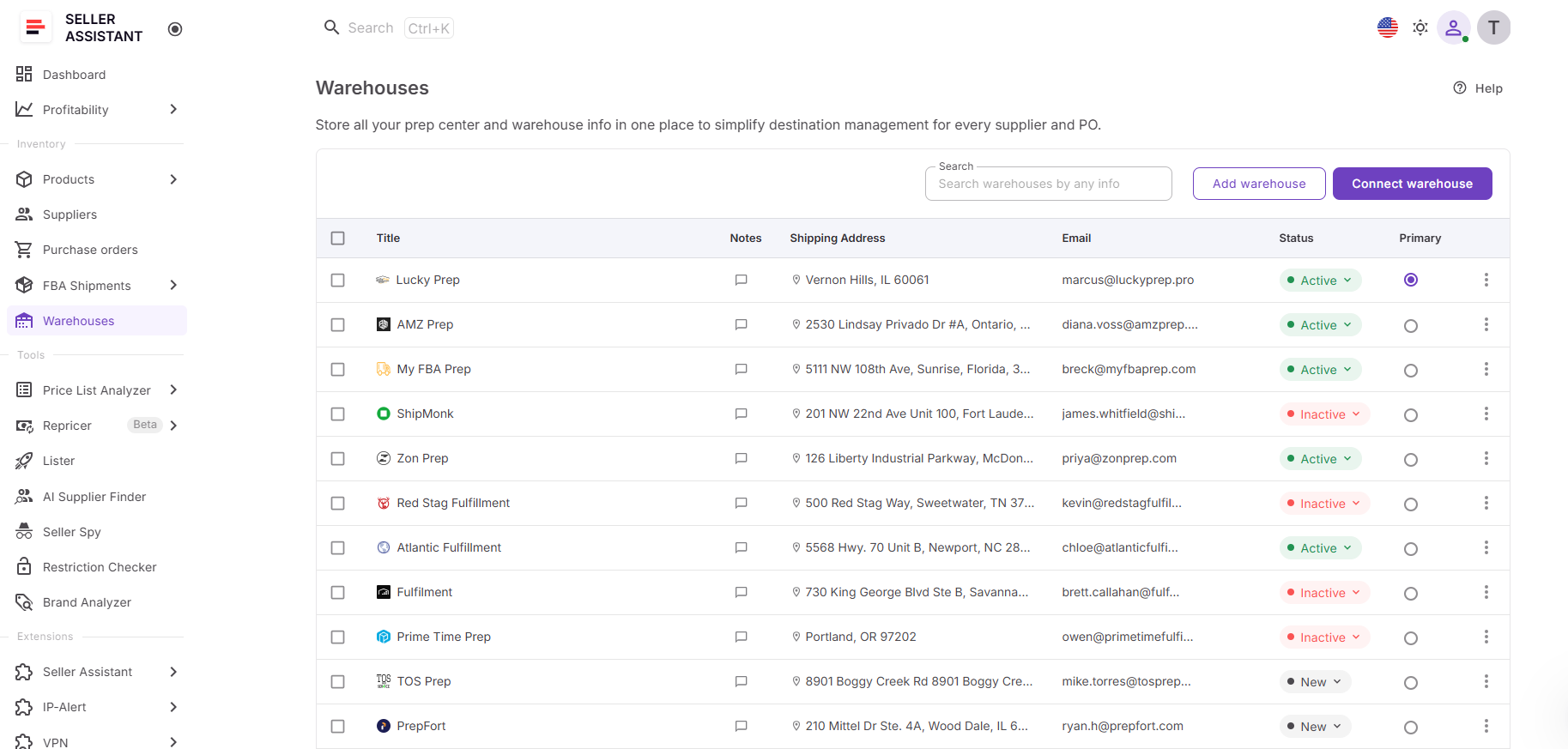
The tool lets you create warehouse profiles with shipping addresses, contact information, notes, and operational statuses, making it easier to keep fulfillment data accurate and up to date. You can also designate a primary warehouse, organize multiple locations, and quickly search or update records as your business grows.
Warehouses Database also works with Prep Center Integration, allowing you to connect supported prep centers and automatically sync their warehouse locations with Seller Assistant. Together, these tools create a connected fulfillment workflow, so warehouse information is available whenever you manage suppliers, create purchase orders, or prepare FBA shipments.
Seller Assistant’s Warehouses Database summary
| Feature | What It Does | Benefit |
|---|---|---|
| Centralized warehouse database | Stores all warehouse and prep center records in one place | Keeps fulfillment information organized and easy to manage |
| Warehouse profiles | Saves addresses, contacts, notes, websites, and statuses | Eliminates scattered records and simplifies updates |
| Primary warehouse | Lets you designate a default fulfillment location | Speeds up routine workflows and keeps routing consistent |
| Warehouse statuses | Marks locations as New, Active, or Inactive | Makes it easy to identify current fulfillment locations |
| Prep Center Integration | Connects supported prep centers to Seller Assistant | Automatically imports warehouse locations from connected providers |
| Synced warehouse records | Displays imported prep center locations with sync status | Reduces duplicate records and manual maintenance |
| Quick search and organization | Finds warehouse records by name or details | Saves time when managing multiple fulfillment locations |
| Connected workflow | Reuses warehouse information across Seller Assistant | Simplifies supplier management, Purchase Orders, and FBA shipment creation |
| Scalable warehouse management | Supports multiple warehouses and prep centers | Grows with your Amazon wholesale, online arbitrage, or dropshipping business |
Benefits of Seller Assistant’s Warehouses Database
Managing fulfillment locations becomes more challenging as your Amazon business grows. Seller Assistant’s Warehouses Database helps wholesale sellers, online arbitrage sellers, and dropshippers organize warehouse information, reduce manual work, and keep fulfillment operations running smoothly.
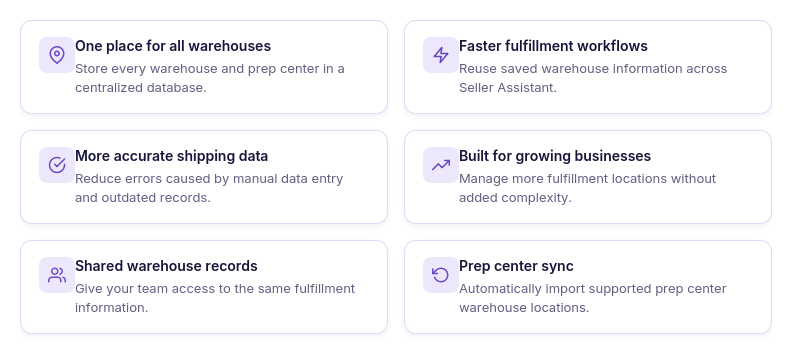
Centralized warehouse management
Keep all warehouse and prep center information in one place instead of across multiple spreadsheets or documents. This makes fulfillment data easier to maintain and access whenever you need it.
Faster daily operations
Save warehouse information once and reuse it throughout your workflow. This reduces repetitive data entry and speeds up routine fulfillment tasks.
Fewer fulfillment mistakes
Using standardized warehouse records helps prevent shipping to outdated or incorrect locations. Accurate information also improves communication with suppliers and prep centers.
Easier business growth
Add new warehouses and prep centers as your supplier network expands. The database scales with your business without making warehouse management more complicated.
Better team collaboration
Your team can access the same warehouse records instead of maintaining separate files. This helps everyone work with consistent and up-to-date fulfillment information.
Prep center synchronization
Connect supported prep centers and automatically sync their warehouse locations with Seller Assistant. This reduces duplicate records and keeps fulfillment data consistent across connected workflows.
What Warehouses Database shows
Warehouses Database provides a centralized view of all your warehouses and prep centers in one place. Instead of simply storing addresses, it organizes fulfillment locations, routing information, warehouse status, and prep center connections, making warehouse data easy to manage and reuse throughout your Amazon sourcing, purchasing, and fulfillment workflow.
Warehouse directory
The main dashboard displays every warehouse and prep center saved in your account. For each location, sellers can view key details, including:
- Warehouse name
- Website
- Notes
- Shipping address
- Email address
- Status
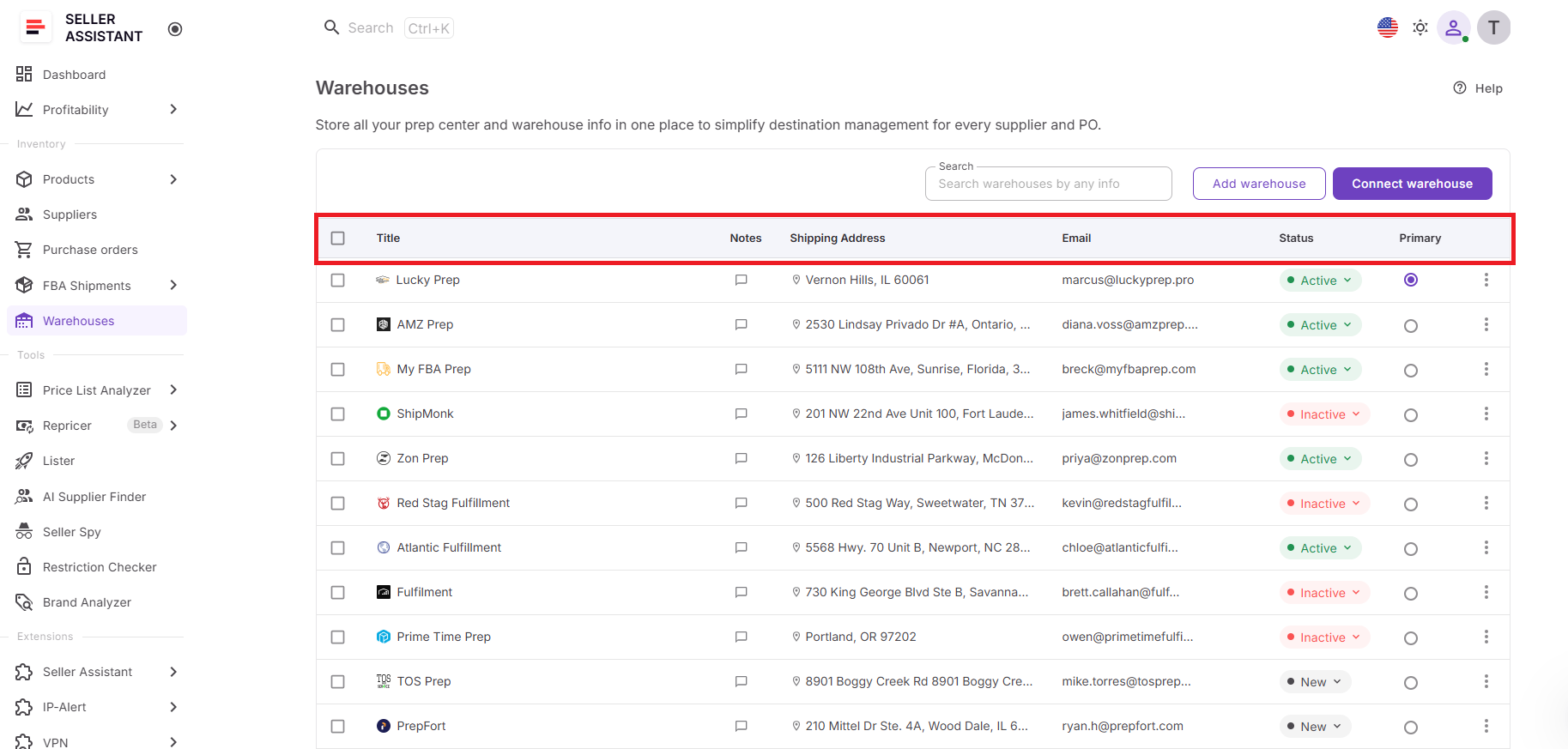
These details give sellers a complete overview of their fulfillment network and make it easy to locate, organize, and maintain warehouse records.
Warehouse status
Each location is assigned one of three statuses:
- New
- Active
- Inactive
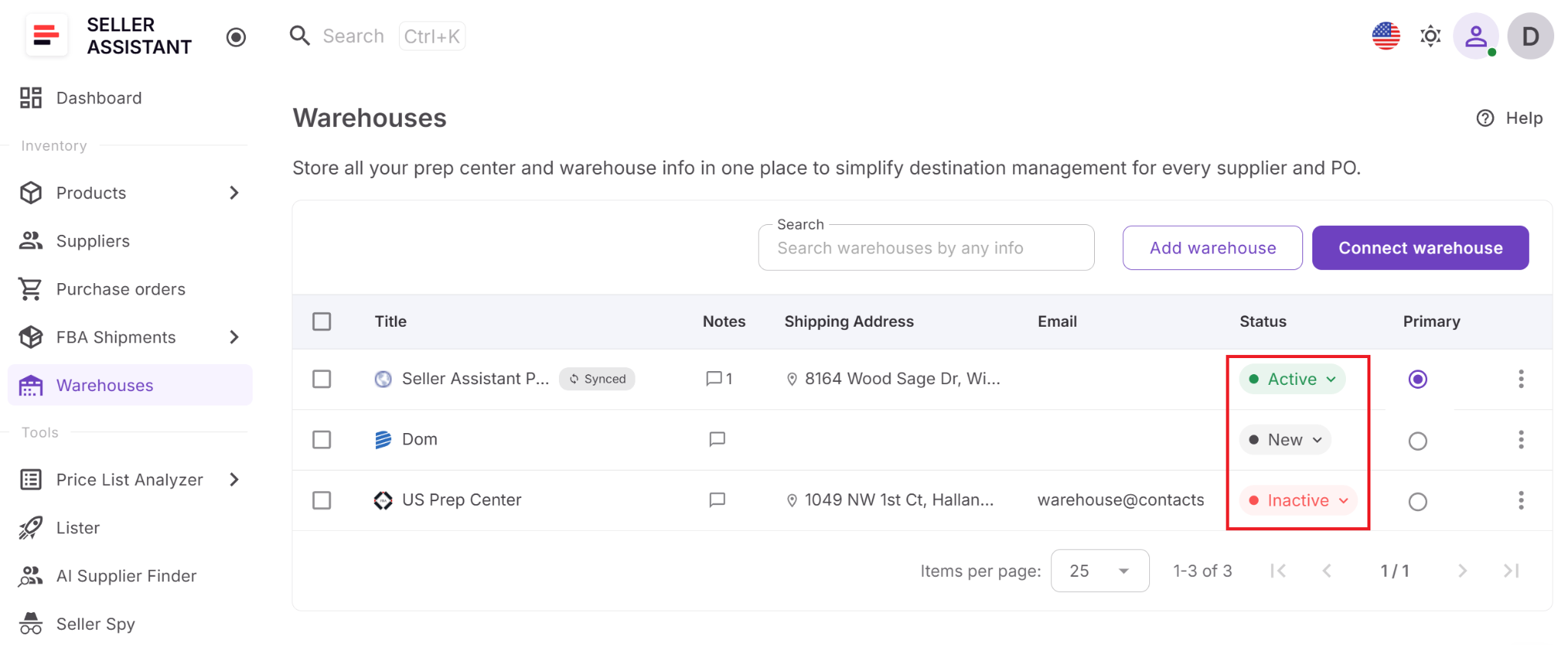
These statuses help sellers distinguish operational warehouses from locations that are no longer in use while preserving historical records.
Primary warehouse
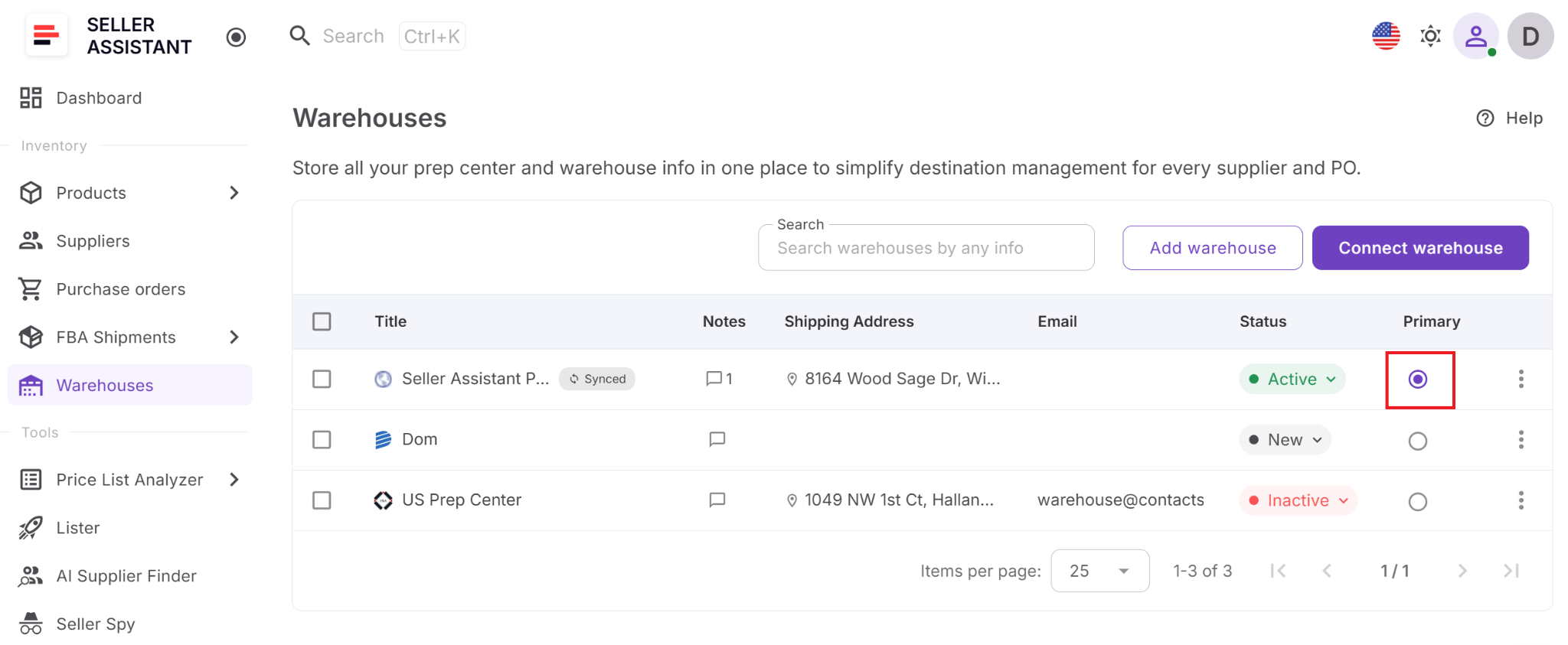
The database identifies your Primary Warehouse, which serves as the default fulfillment location across Seller Assistant unless another warehouse is selected. Every account starts with a default My Warehouse, and only one warehouse can be designated as the primary location at a time.
Prep Center Integration
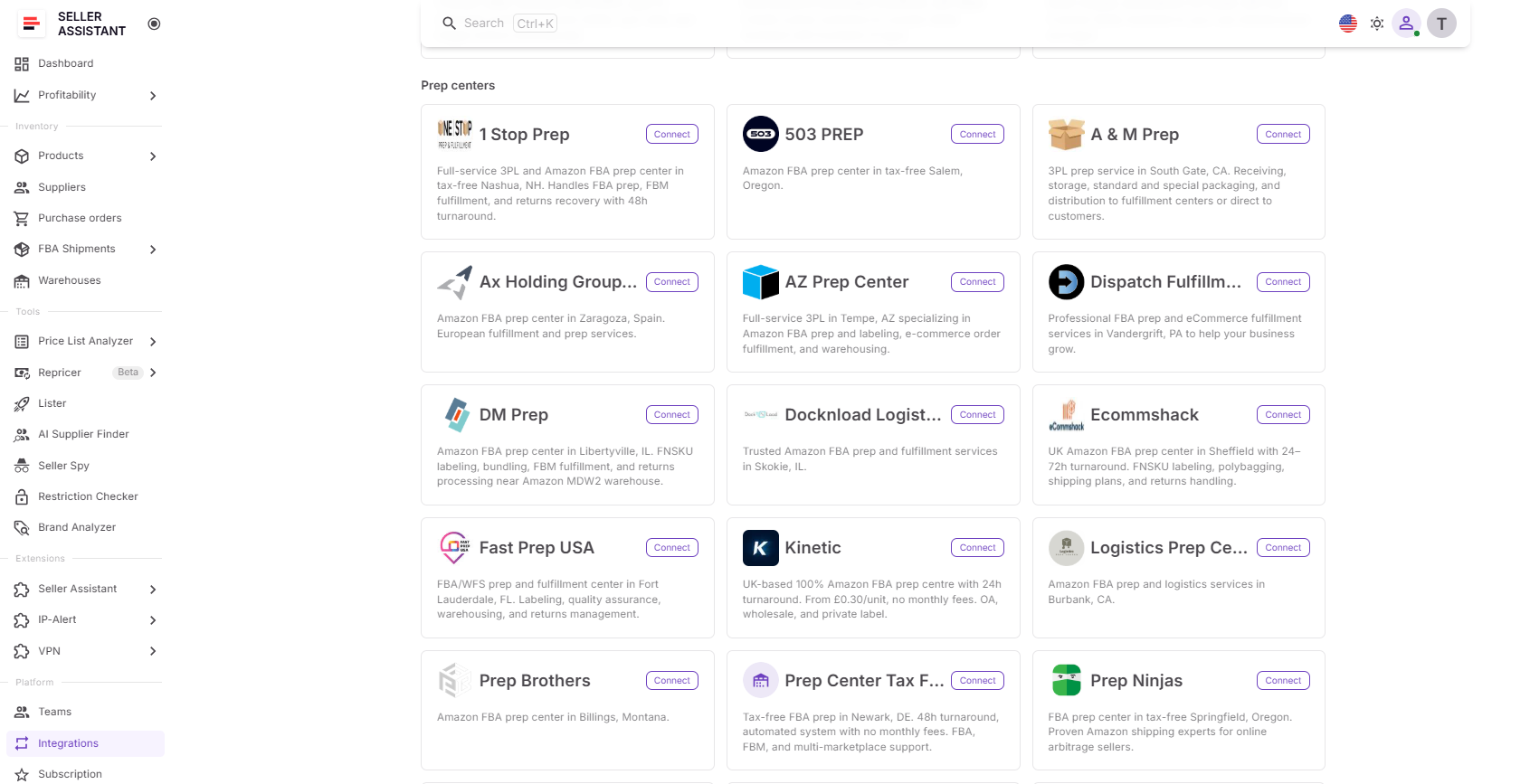
Supported prep centers can be connected directly to Seller Assistant using secure Merchant ID and API Token credentials. Once connected, warehouse locations from the prep center are automatically imported into the database.
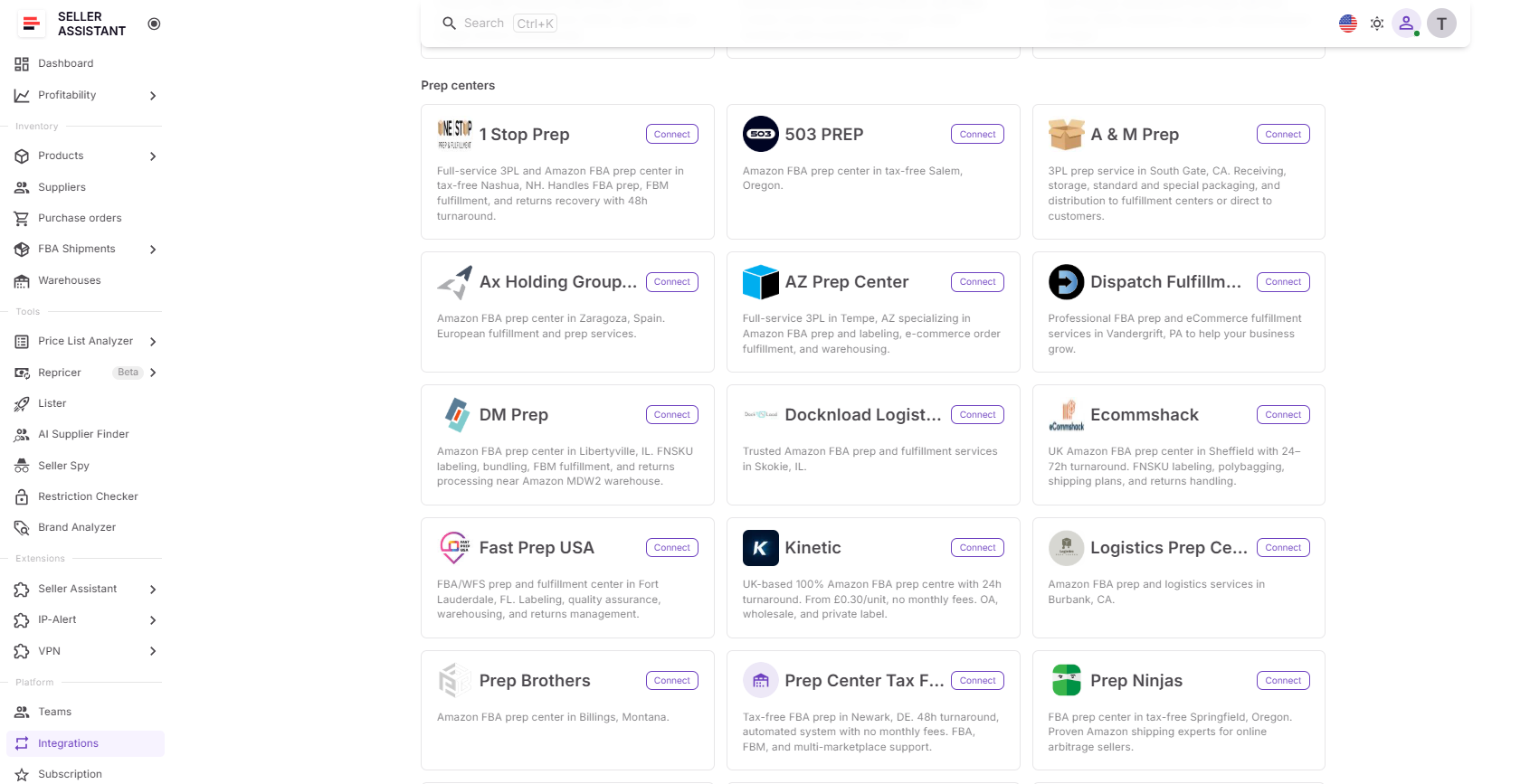
Synced warehouse locations
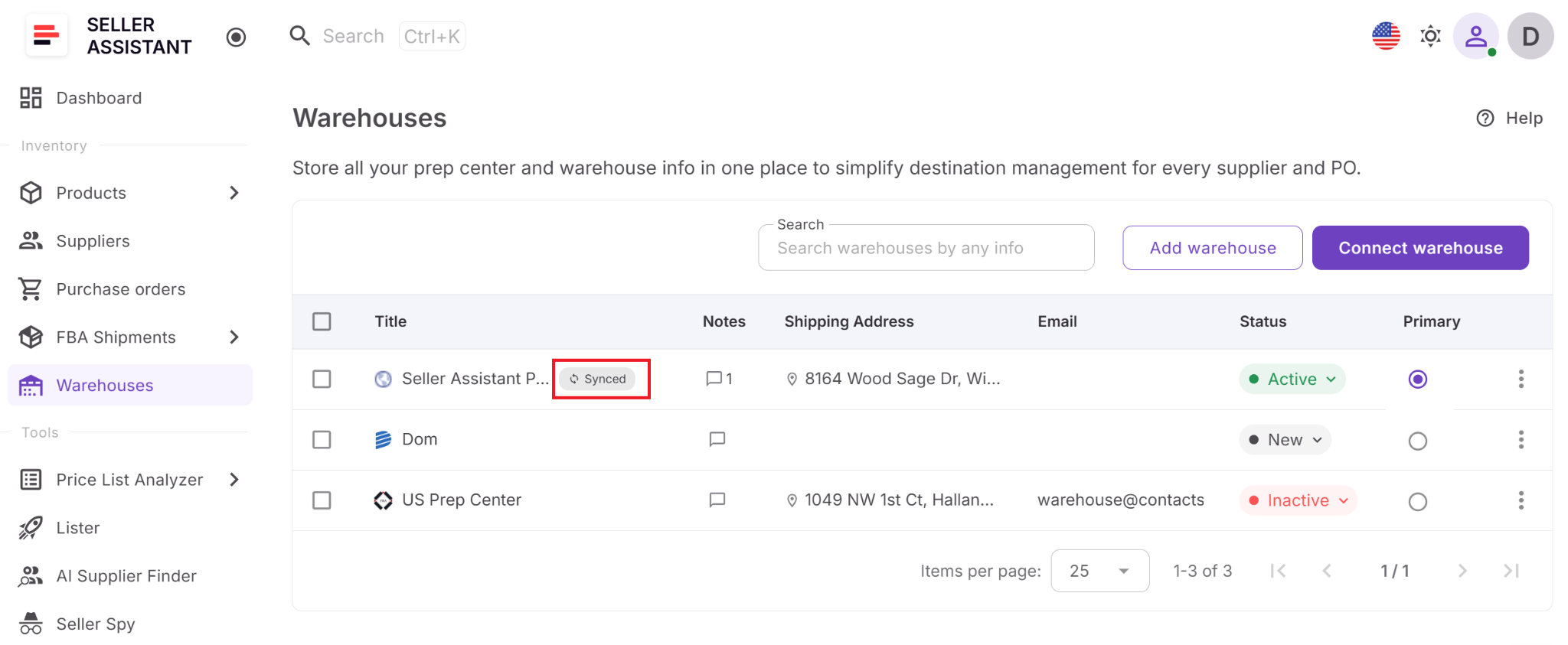
Warehouses imported through Prep Center Integration are clearly marked with a Synced badge and provider name. For synced locations, sellers can see:
- Sync status
- Connected prep center
- Provider label
These indicators help distinguish synchronized warehouses from manually created records while reducing duplicate data and manual maintenance.
Search and organization
The database includes search and sorting tools that make it easy to find warehouses by:
- Warehouse name
- Shipping address
- Status
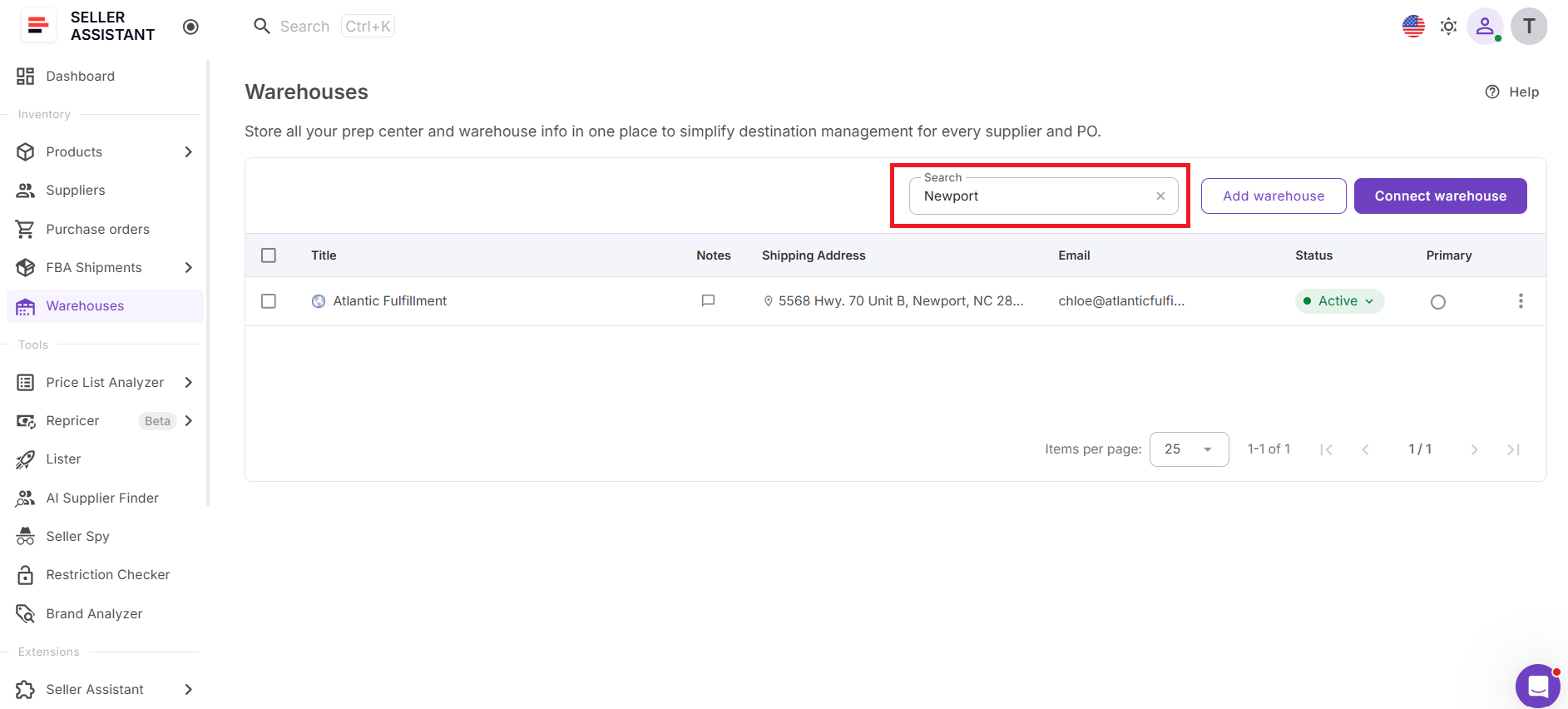
This becomes increasingly valuable as businesses expand their supplier network and fulfillment operations.
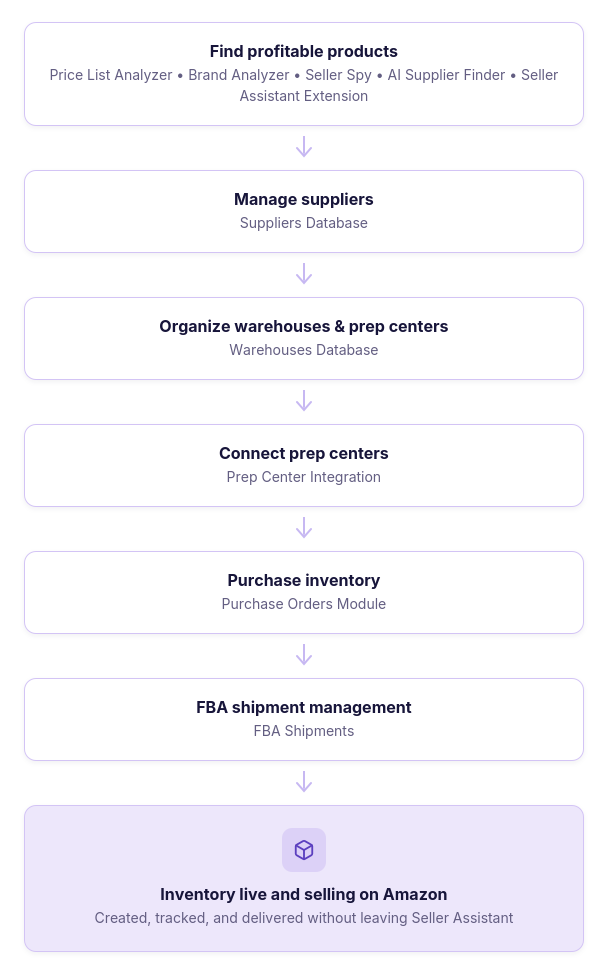
Connected fulfillment workflow
Warehouse information is reused across other Seller Assistant tools, including Suppliers Database, Purchase Orders Module, Prep Center Integration, and FBA Shipments. This eliminates repeated data entry and keeps fulfillment information consistent throughout the entire sourcing workflow.
Seller Assistant’s Warehouses Database Use Cases
Managing warehouses isn’t just about storing addresses. As your Amazon wholesale, online arbitrage, or dropshipping business grows, fulfillment becomes more complex, with more suppliers, prep centers, and inventory moving between locations.
Warehouses Database helps centralize warehouse information, streamline routing, and reduce manual work across your fulfillment workflow. Below are some of the most common ways Amazon sellers use the tool.
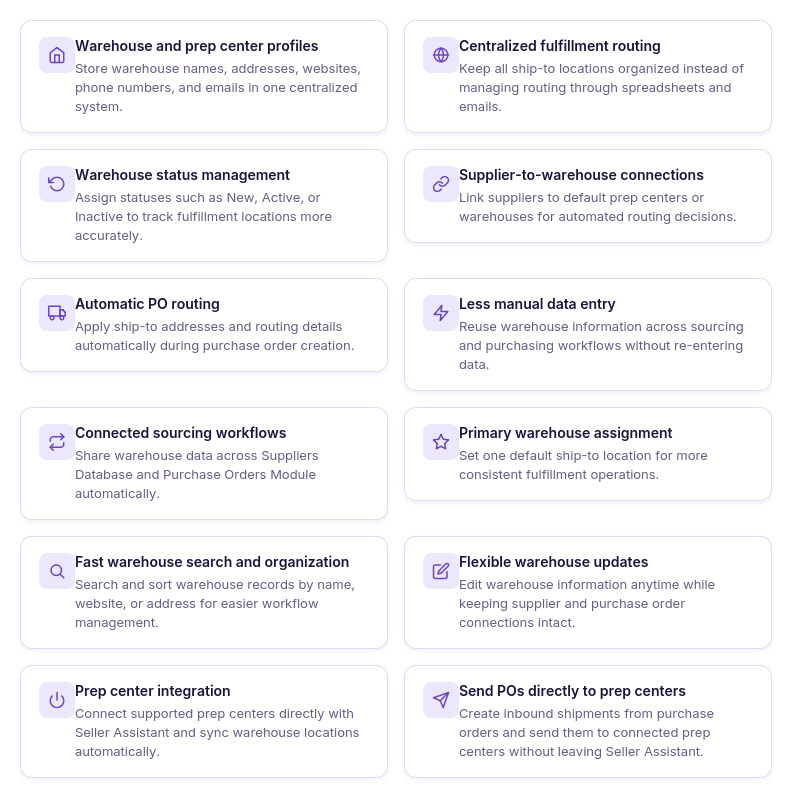
Organizing multiple fulfillment locations
Use case
A seller works with several warehouses and prep centers and needs a simple way to keep them organized.
Solution
Warehouses Database stores every fulfillment location in one centralized database, making it easy to manage warehouse information without relying on multiple spreadsheets or documents.
Creating standardized warehouse records
Use case
Different team members save warehouse information in different formats, leading to inconsistent records.
Solution
Warehouse profiles standardize addresses, contact information, notes, websites, and statuses so everyone works from the same fulfillment data.
Reducing manual data entry
Use case
A seller repeatedly enters the same warehouse information when creating orders and managing suppliers.
Solution
Warehouse records can be reused throughout Seller Assistant, eliminating repetitive typing and reducing administrative work.
Managing supplier shipping destinations
Use case
Different suppliers ship inventory to different warehouses or prep centers.
Solution
Warehouses Database works with the Suppliers Database, allowing sellers to assign fulfillment locations to suppliers and keep routing information organized.
Setting a default warehouse
Use case
Most inventory is shipped to the same warehouse, but the seller has to select it repeatedly.
Solution
The Primary Warehouse automatically serves as the default fulfillment location, simplifying routine workflows and ensuring consistent routing.
Keeping warehouse information up to date
Use case
A warehouse changes its address, contact person, or operating status.
Solution
Update the warehouse profile once, and the latest information remains available whenever that warehouse is used throughout Seller Assistant.
Managing inactive fulfillment locations
Use case
A seller no longer works with a warehouse but wants to keep its information for future reference.
Solution
Warehouses can be marked as Inactive, allowing sellers to preserve historical records without cluttering active operations.
Connecting prep centers
Use case
A seller uses a supported prep center and wants to avoid maintaining duplicate warehouse records.
Solution
Prep Center Integration automatically imports warehouse locations from the connected provider and keeps them synchronized with Seller Assistant.
Scaling fulfillment operations
Use case
A growing business regularly adds new suppliers, warehouses, and prep centers.
Solution
Warehouses Database scales alongside the business, making it easy to organize an expanding fulfillment network without changing existing workflows.
Improving team collaboration
Use case
Several employees manage purchasing and fulfillment, but each keeps separate warehouse information.
Solution
A centralized warehouse database ensures every team member has access to the same up-to-date fulfillment records, improving consistency across operations.
Speeding up purchase order creation
Use case
Creating purchase orders takes longer because shipping information must be entered manually.
Solution
Saved warehouse records are available when creating purchase orders, reducing manual entry and helping ensure inventory is routed to the correct destination.
Preparing inventory for Amazon FBA
Use case
Inventory moves through a prep center before being shipped to Amazon fulfillment centers.
Solution
Warehouses Database keeps prep center locations organized and connected to your workflow, making it easier to manage inventory as it moves toward FBA Shipments.
How Seller Assistant’s Warehouses Database Works
Getting started with Warehouses Database only takes a few minutes. Simply create your warehouse records, organize your fulfillment locations, connect suppliers and prep centers, and reuse the same warehouse information throughout Seller Assistant to streamline your fulfillment workflow.
Step 1. Access Warehouses Database
Open Inventory → Warehouses from Seller Assistant menu. Here, you’ll see all manually created warehouses and synced prep center locations in a single dashboard.
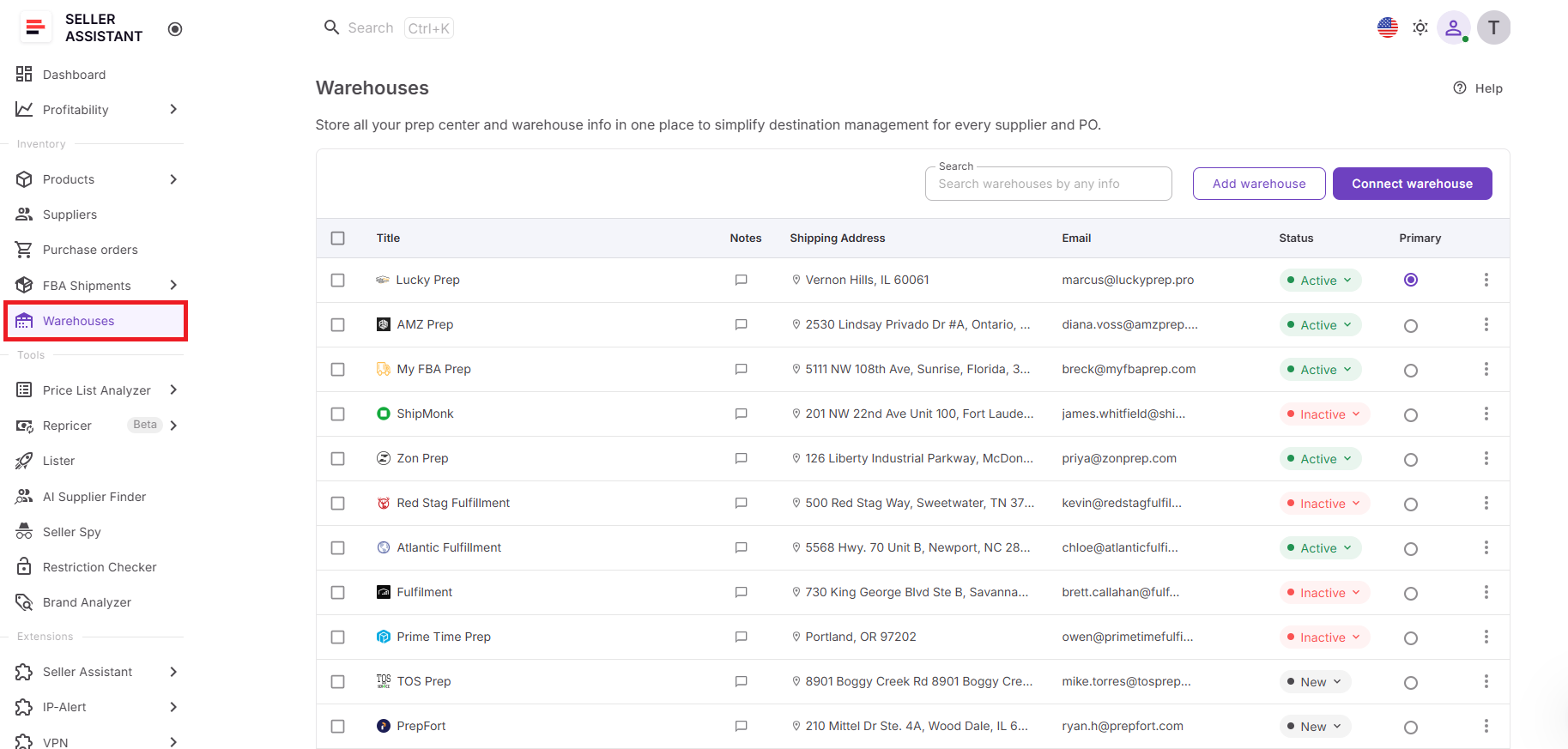
Keeping all fulfillment locations together makes them easier to manage and eliminates the need to search through multiple spreadsheets or documents.
Step 2. Create a warehouse profile
Click Add Warehouse and enter the warehouse website and name. Then complete the profile by adding the shipping address, email, phone number, contact details, notes, and operational status.
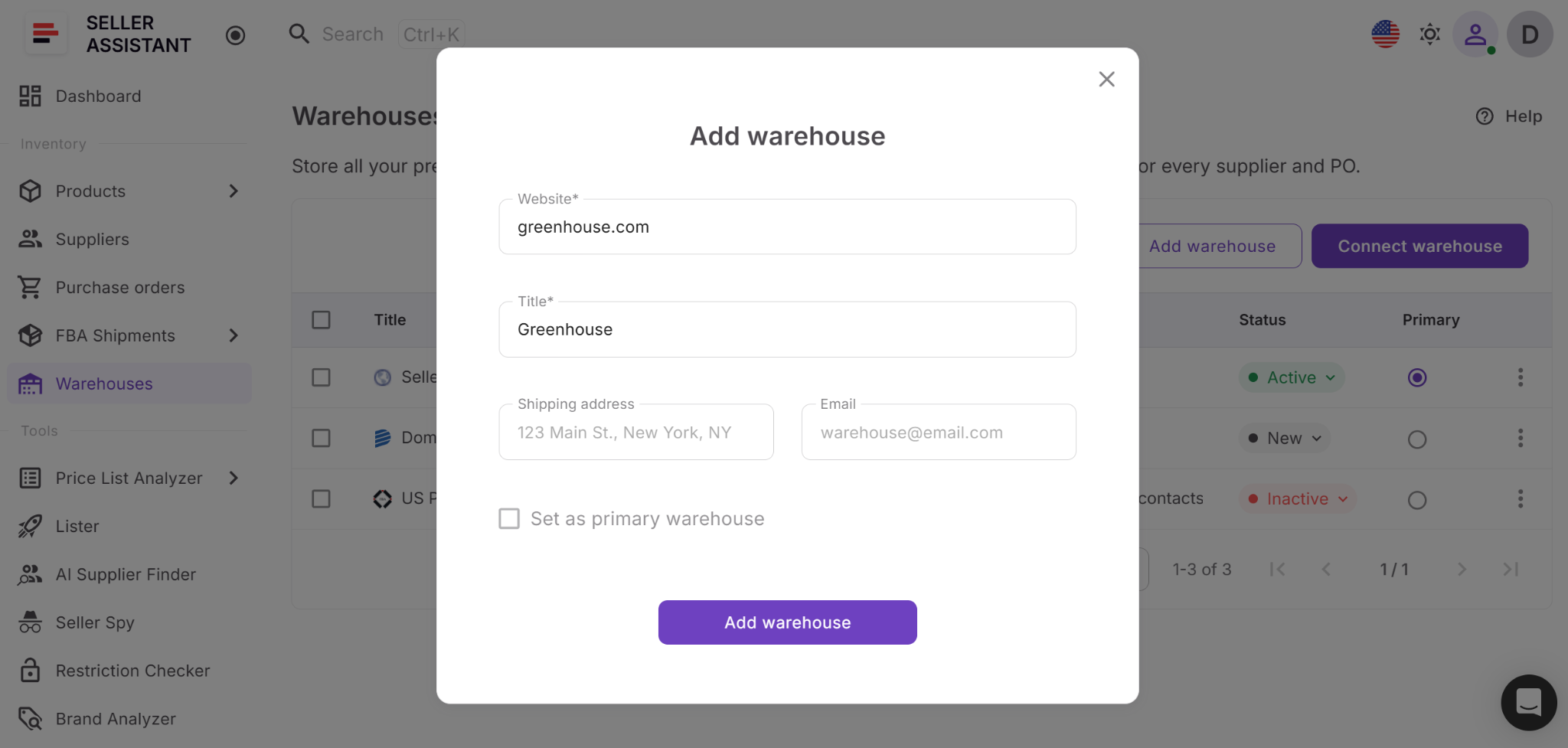
A complete warehouse profile ensures accurate fulfillment information is always available when you need it.
Step 3. Define the warehouse status
Choose the appropriate status for the location:
- New
- Active
- Inactive
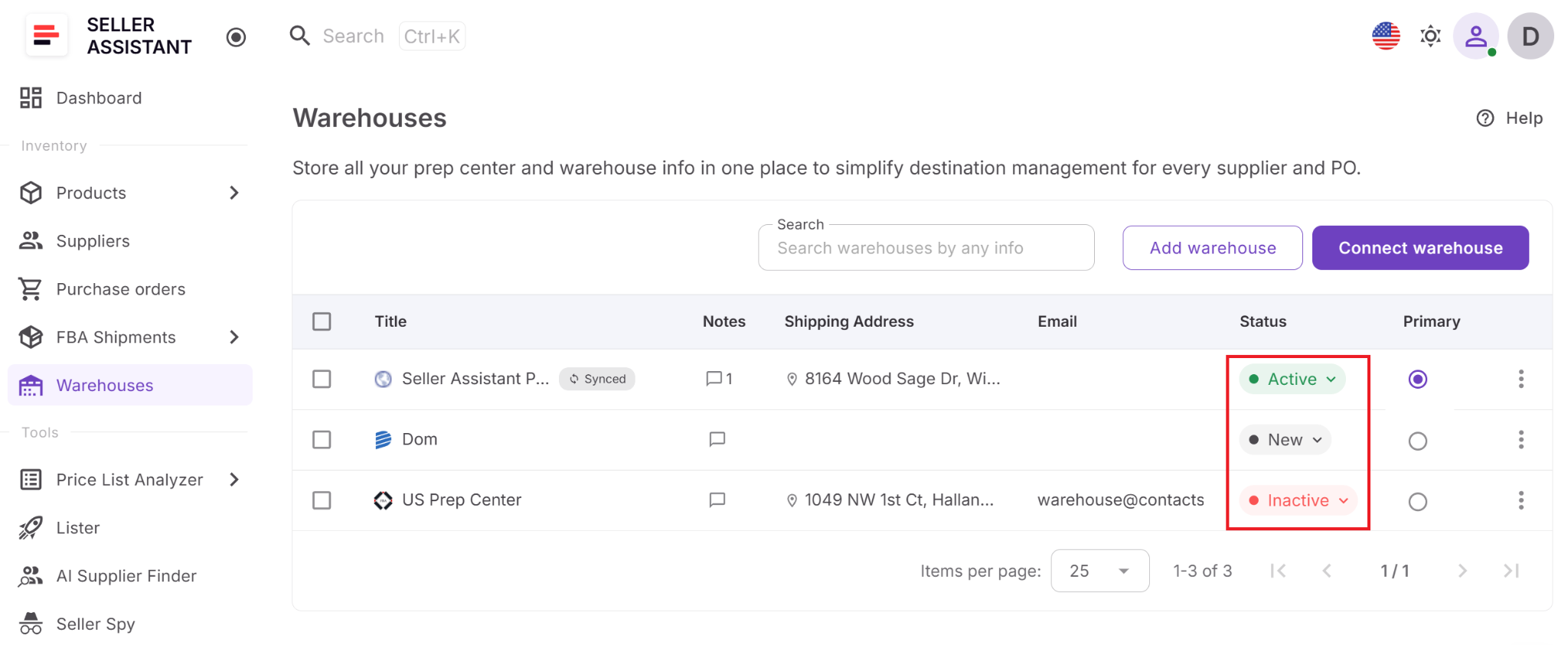
Using statuses helps you quickly identify which fulfillment locations are currently in use while keeping older records for future reference.
Step 4. Choose your primary warehouse
Select one warehouse as your Primary Warehouse, which becomes the default fulfillment location across Seller Assistant. Every account includes a default My Warehouse, and only one primary warehouse can be assigned at any time.
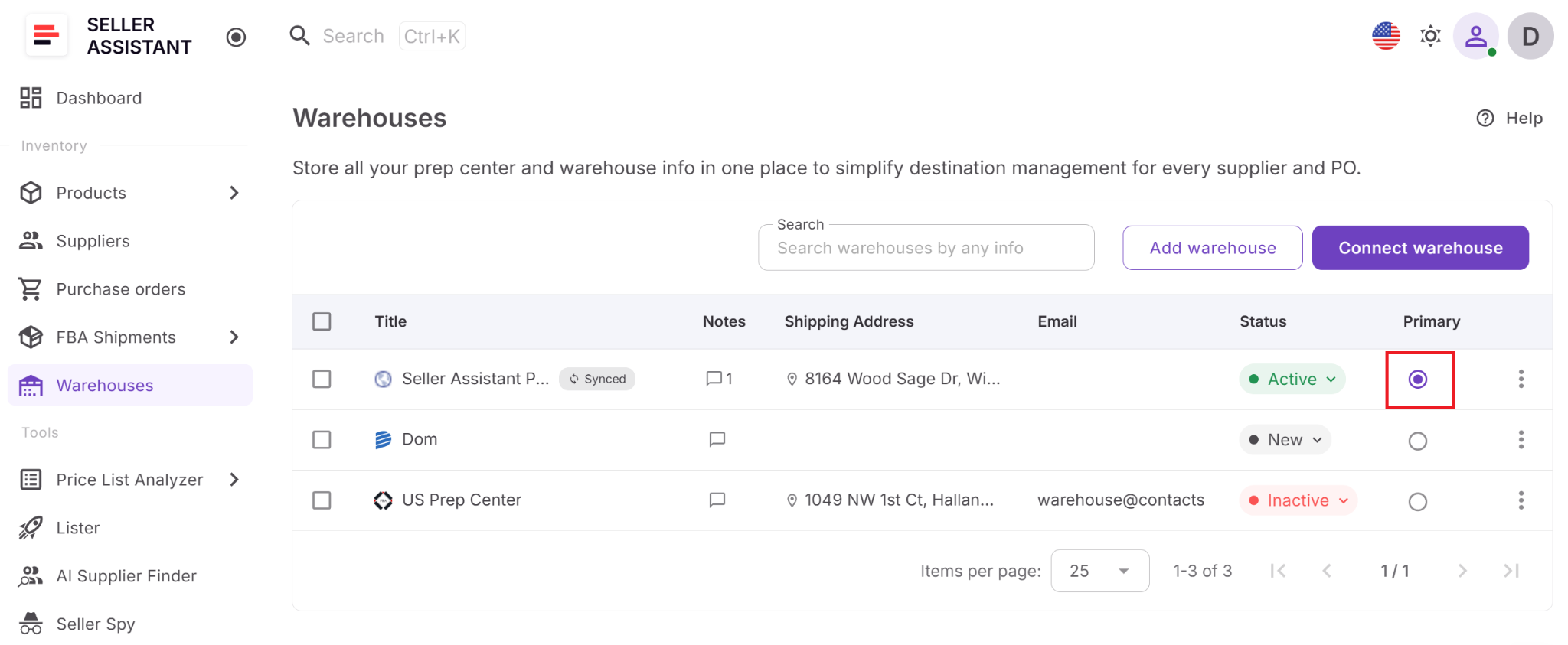
This saves time during routine operations and keeps inventory routing consistent.
Step 5. Record operational notes
Use the Notes section to save delivery instructions, warehouse contacts, service updates, operating hours, account information, or any other details your team may need.
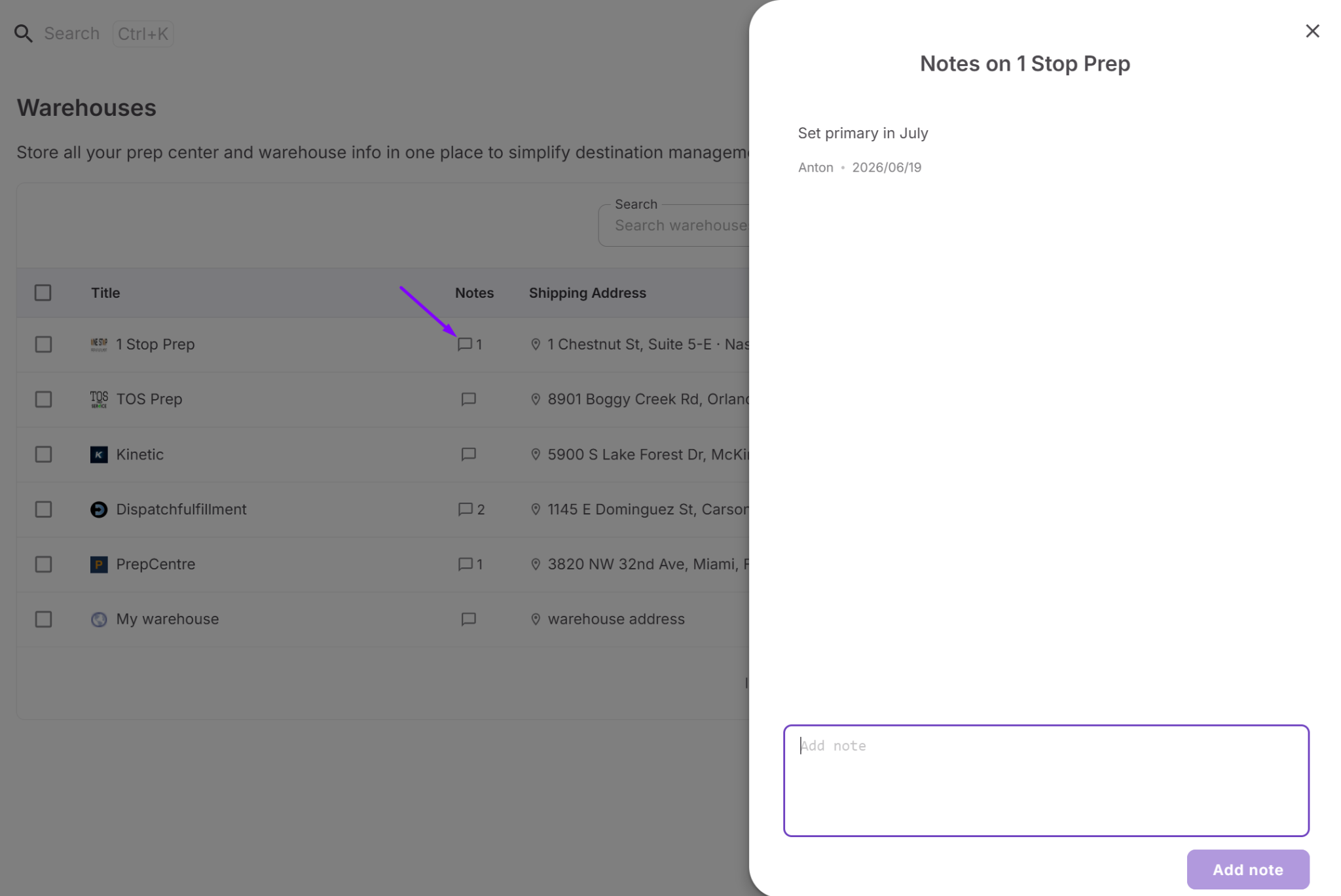
Keeping operational notes with each warehouse record improves communication and gives everyone access to the latest information.
Step 6. Assign warehouses to suppliers
Link warehouses or prep centers to supplier profiles in Suppliers Database. When creating purchase orders, the assigned fulfillment location is already associated with that supplier.
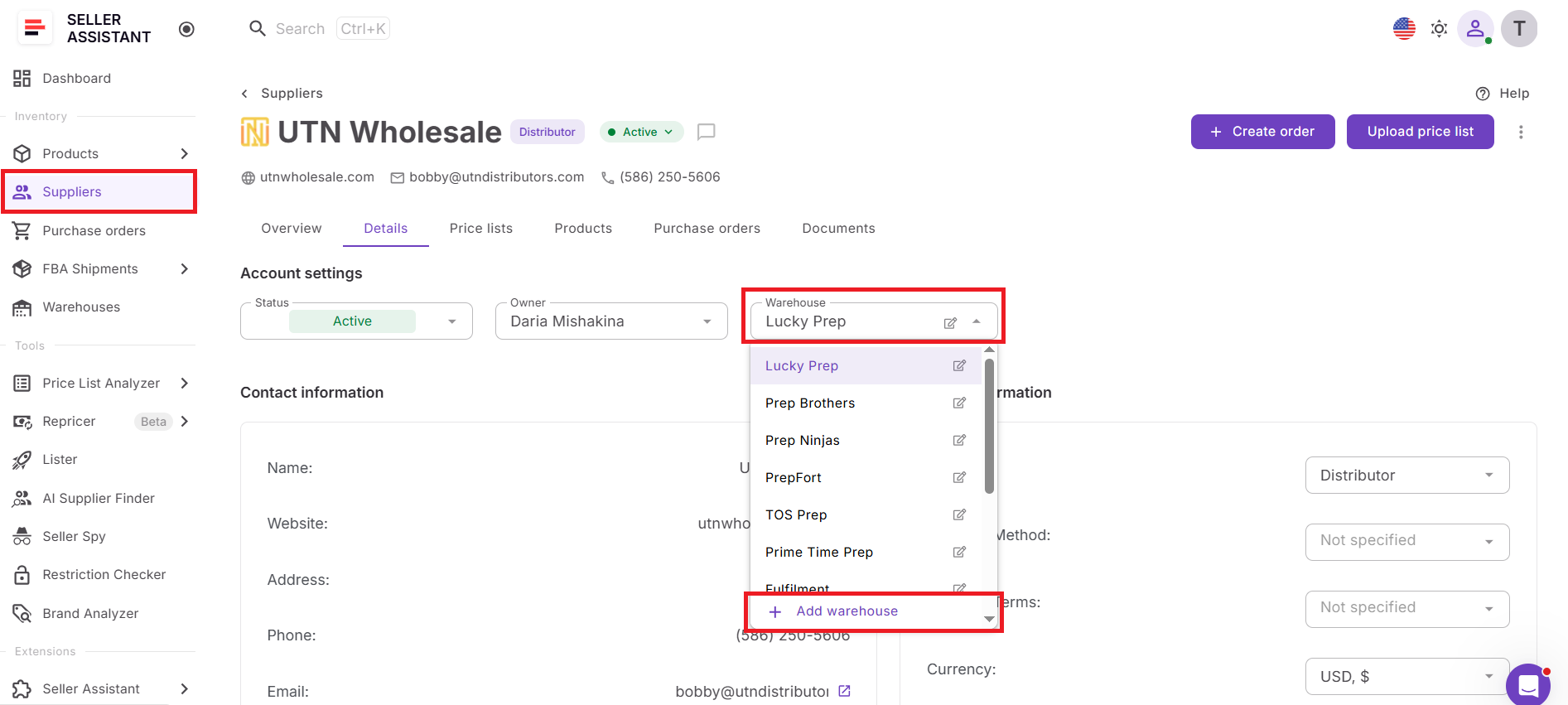
This keeps supplier routing organized and reduces manual selection during purchasing.
Step 7. Reuse warehouse information to create POs or FBA shipments
Whenever you create purchase orders or manage FBA Shipments, simply select an existing warehouse instead of entering shipping details manually.
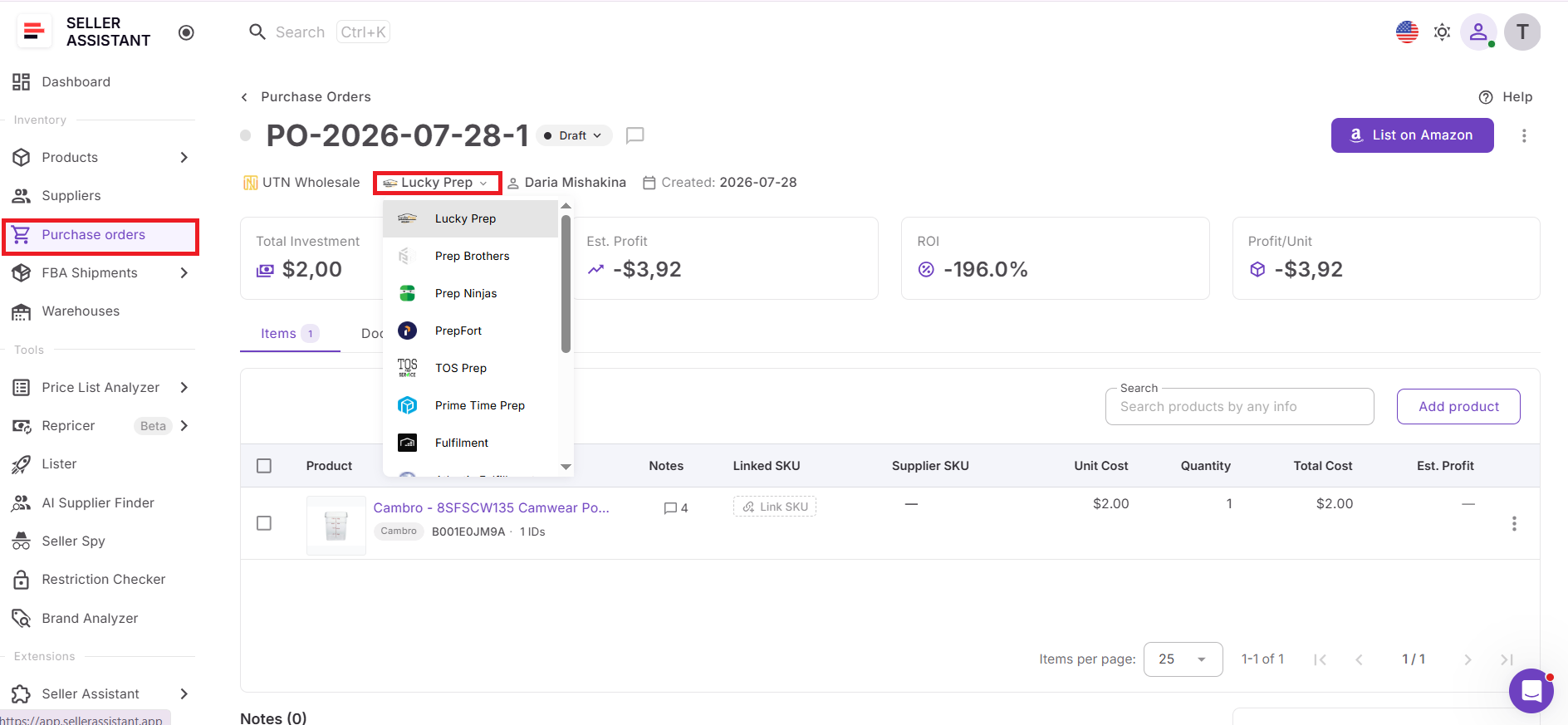
Using saved warehouse records speeds up fulfillment workflows while helping maintain accurate routing information.
Step 8. Connect a prep center
If you use a supported prep center, go to Integrations → Prep Centers and connect your account using your Merchant ID and API Token.
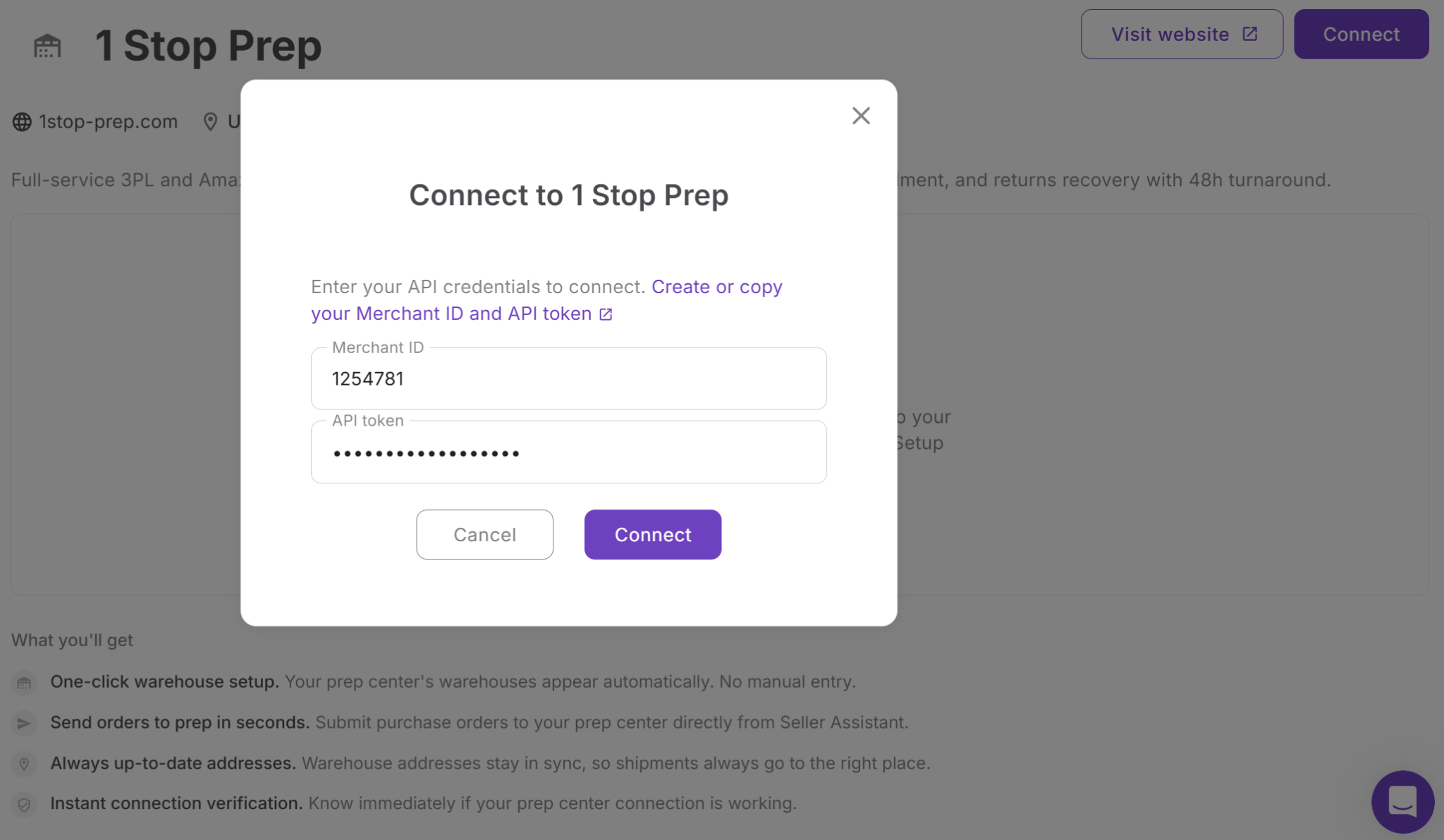
Once connected, Seller Assistant automatically imports your prep center warehouse locations.
Step 9. Manage synchronized warehouses
Imported warehouse locations appear with a Synced badge and the prep center provider name. These records stay synchronized with the connected prep center and don’t require manual maintenance.
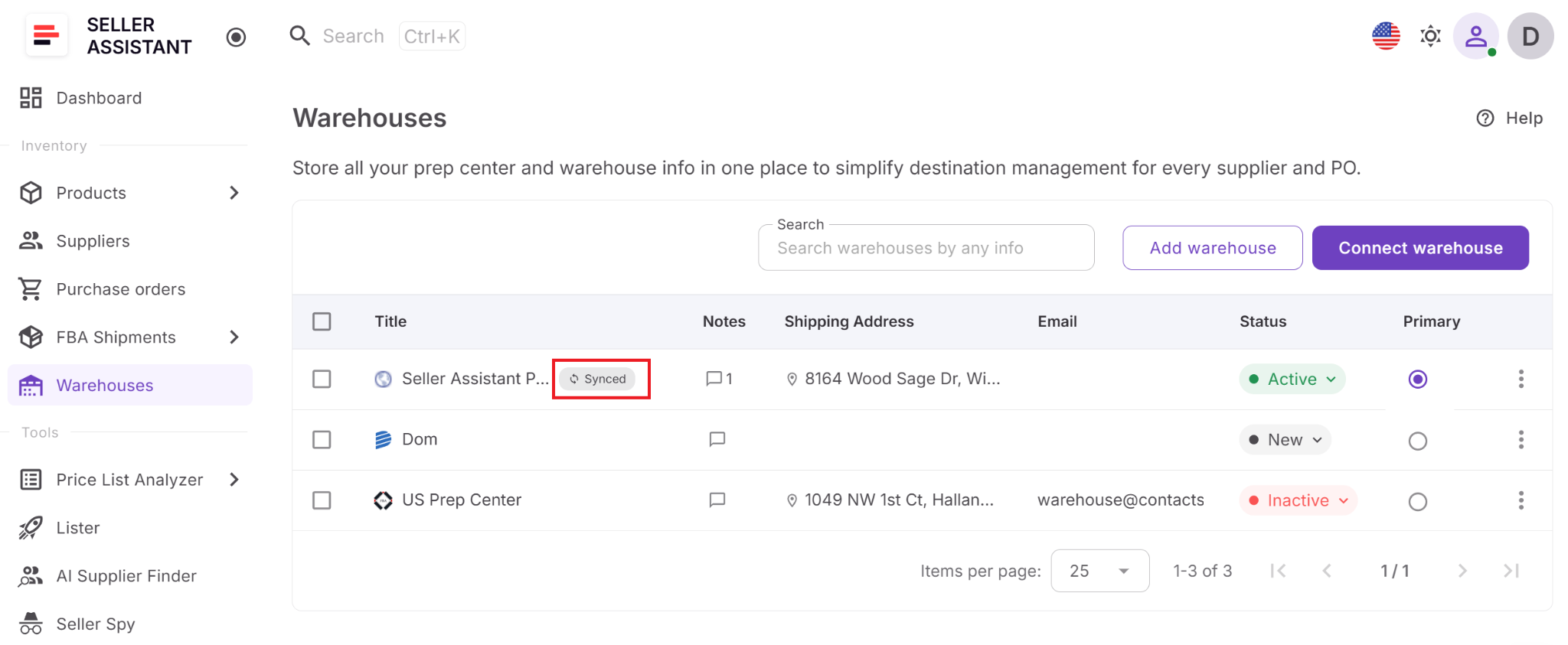
This helps prevent duplicate warehouse records and keeps fulfillment information consistent across systems.
Step 10. Maintain accurate warehouse records
Review your warehouse database regularly and update manually created records whenever addresses, contacts, or operational details change. For connected prep centers, synchronization keeps imported warehouse locations current automatically.
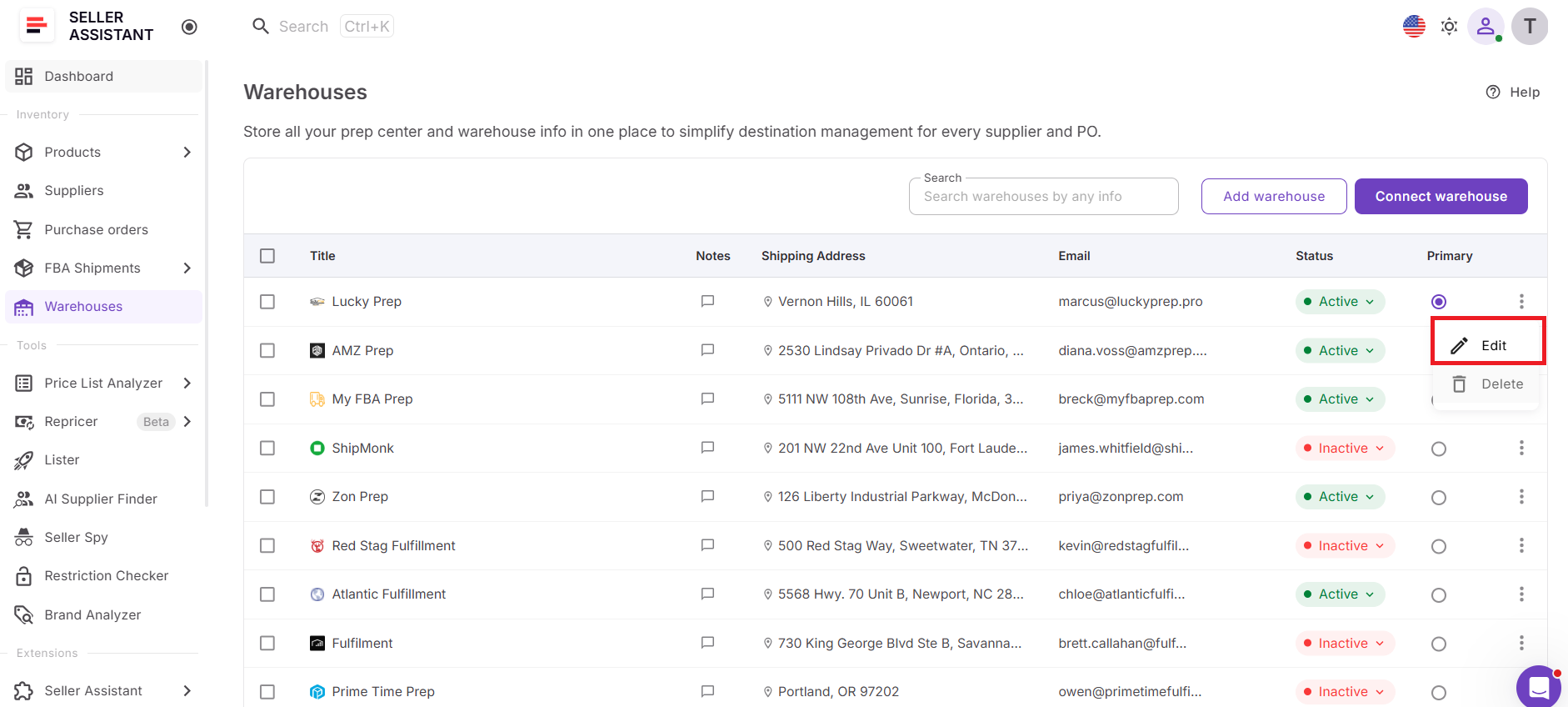
Maintaining accurate warehouse information helps ensure smooth purchasing, fulfillment, and supplier communication as your Amazon business grows.
FAQ
Can I create separate warehouse records for different supplier destinations?
Yes. If different suppliers ship to different warehouses or prep centers, you can create a dedicated record for each destination. This makes it easier to keep routing organized as your supplier network expands.
What happens if a prep center changes its warehouse information?
For supported integrations, updated warehouse information is synchronized from the prep center, so you don’t have to recreate those records manually. This helps keep fulfillment data aligned between both platforms.
Can I use the Warehouses Database if I don’t work with a prep center?
Absolutely. The Warehouses Database works independently, so you can manage your own warehouses or third-party fulfillment locations without connecting a prep center. You can always add a supported integration later if your workflow changes.
Does the Warehouses Database track inventory levels?
No. The Warehouses Database is designed to organize fulfillment locations and shipping information, not to monitor inventory quantities or warehouse stock. It complements inventory management by ensuring products are routed to the correct locations.
Who benefits most from the Warehouses Database?
The tool is useful for any Amazon reseller who manages more than one fulfillment location or expects their business to grow. It’s especially valuable for wholesale sellers, online arbitrage sellers, and dropshippers working with multiple suppliers, warehouses, or prep centers.
Final Thoughts
As your Amazon business grows, managing warehouses and prep centers becomes just as important as finding profitable products and reliable suppliers. A centralized system for organizing fulfillment locations helps reduce manual work, improve routing accuracy, and keep warehouse information consistent across your operations.
Seller Assistant’s Warehouses Database gives wholesale sellers, online arbitrage sellers, and dropshippers one place to manage warehouse records, connect supported prep centers, and reuse fulfillment information throughout their workflow. Whether you operate a single warehouse or a growing network of fulfillment partners, the tool helps you build a more organized, scalable, and efficient sourcing and fulfillment process.
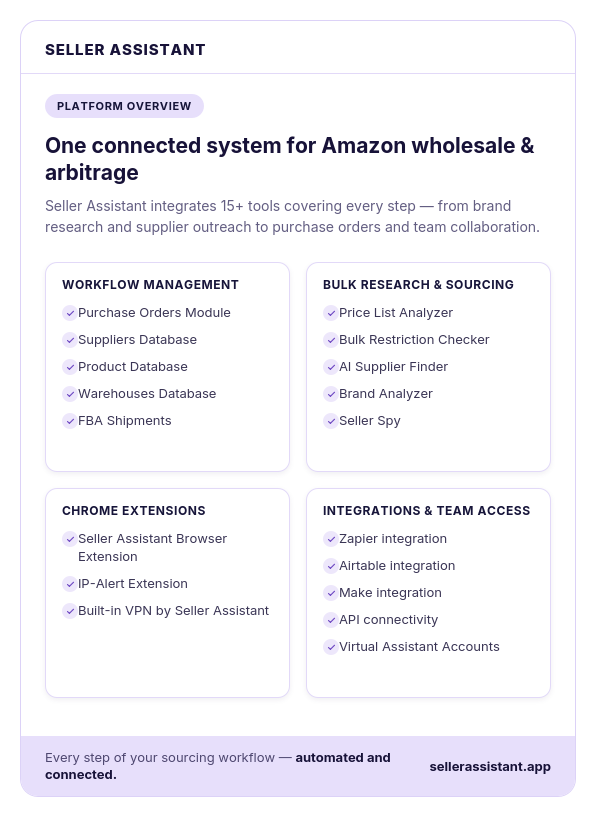
Seller Assistant automates and connects every stage of your Amazon wholesale and arbitrage workflow. It brings together in one platform: workflow management tools – Purchase Orders Module, Suppliers Database, Product Database, Warehouses Database, FBA Shipments, bulk research & sourcing tools – Price List Analyzer, Bulk Restriction Checker, AI Supplier Finder, Brand Analyzer, Seller Spy, Chrome extensions – Seller Assistant Browser Extension, IP-Alert Extension, and built-in VPN by Seller Assistant, and integrations & team access features – seamless API connectivity, integrations with Zapier, Airtable, and Make, and Virtual Assistant Accounts.