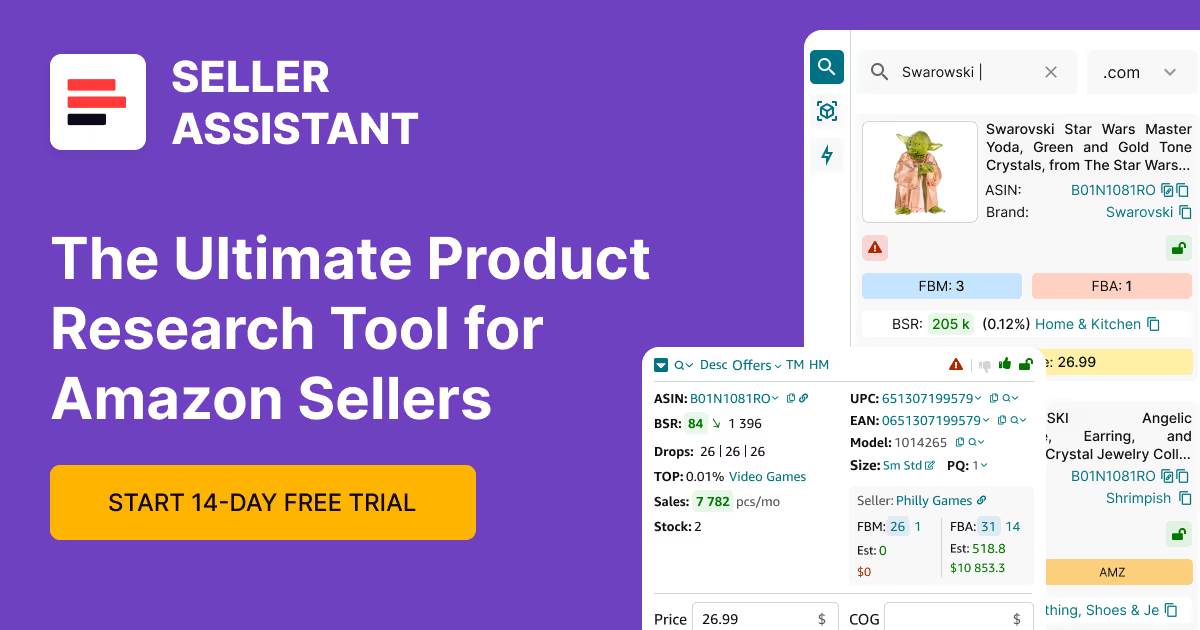



Finding profitable Amazon wholesale deals requires more than locating products with low supplier prices. Sellers must identify reliable suppliers, gain access to wholesale catalogs, validate product profitability, and organize sourcing decisions before investing capital.
Without a structured process, it’s easy to waste time on unreliable suppliers, unprofitable products, or opportunities that can’t scale.
Seller Assistant helps sellers move from supplier discovery to profitable wholesale opportunities within one connected workflow. In this post, we’ll show how Amazon wholesale sellers, online arbitrage sellers, and dropshippers can find trusted suppliers, analyze supplier catalogs, identify the best deals, and build a pipeline of products ready for purchasing.
Note. Seller Assistant is an end-to-end Amazon workflow management platform that integrates 15+ wholesale-focused solutions into one connected system. It combines sourcing workflow automation, bulk research and intelligence tools, and integrated Chrome extensions – giving you everything you need to streamline finding deals, managing suppliers, and creating purchase orders.

The platform aggregates: workflow management tools – Purchase Orders Module, Suppliers Database, Product Database, Warehouses Database, FBA Shipments to organize, automate, and scale every step of your wholesale and arbitrage operations; bulk research & sourcing tools – Price List Analyzer, Bulk Restriction Checker, AI Supplier Finder, Brand Analyzer, Seller Spy to evaluate supplier price lists, verify selling eligibility and restrictions, open new brands, and discover winning product ideas from competitors to expand your product catalog; Chrome extensions – Seller Assistant Browser Extension, IP-Alert Extension, and built-in VPN by Seller Assistant to deep-research products, check IP claims and compliance, and access geoblocked supplier sites directly within your browser; and integrations & team access features – seamless API connectivity and integrations with Zapier, Airtable, and Make, plus Virtual Assistant Accounts for secure, scalable team collaboration.
With Seller Assistant, every step of your Amazon wholesale and arbitrage workflow is automated and connected.
How Amazon Sellers Find Profitable Wholesale Deals
Finding profitable wholesale deals is one of the biggest challenges for Amazon sellers. A product may have strong sales, healthy margins, and stable demand, but none of that matters if you can’t find a reliable supplier or secure competitive wholesale pricing. Successful sourcing requires a process that connects supplier discovery, supplier relationships, product validation, and buying decisions.
From supplier search to profitable opportunities
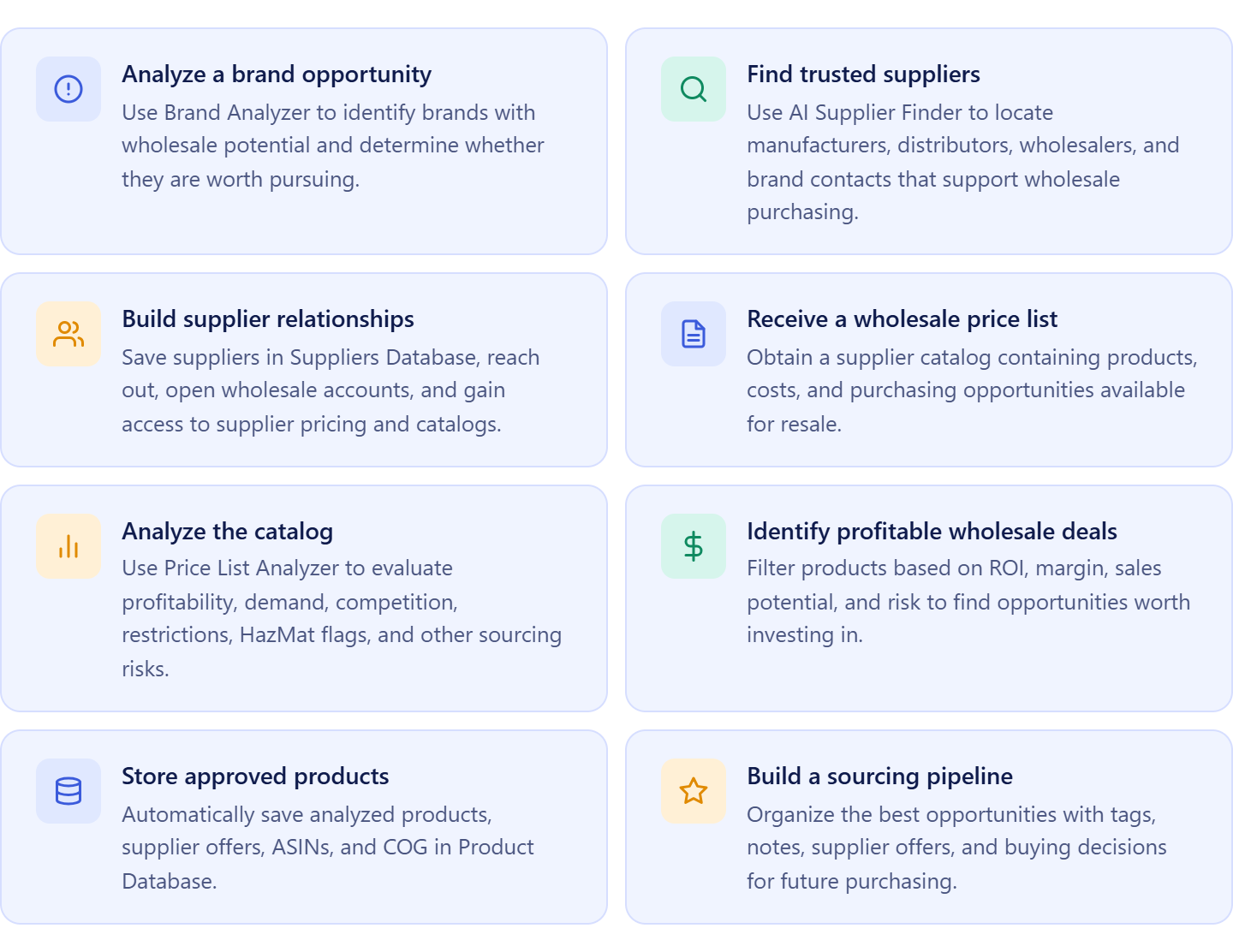
The process usually begins with identifying a brand that has potential on Amazon. Sellers then look for manufacturers, distributors, wholesalers, or brand owners that can provide access to wholesale pricing and inventory.
After opening a supplier account and receiving a wholesale catalog, the next step is evaluating the available products. Sellers analyze profitability, demand, competition, restrictions, and sourcing risks to identify which products have the strongest potential to generate profit.
Why validating deals before buying matters
Not every product in a supplier catalog is a good wholesale opportunity. Products with low margins, heavy competition, restrictions, or declining demand can tie up capital and reduce overall business performance.
Carefully validating each opportunity helps sellers focus on products that support profitable growth while minimizing unnecessary risk.
Why sourcing works best as a connected workflow
As sellers work with more suppliers and larger catalogs, managing sourcing activities manually becomes increasingly difficult. Supplier information, product evaluations, and sourcing decisions can quickly become scattered across multiple spreadsheets and tools.
A connected workflow keeps supplier discovery, catalog analysis, and product management linked together. This makes it easier to identify profitable wholesale deals, maintain organized sourcing records, and build a repeatable process for scaling Amazon wholesale operations.
Why Successful Wholesale Sourcing Requires a Connected Workflow
Finding profitable wholesale deals involves much more than reviewing supplier catalogs. Amazon sellers must identify reliable suppliers, manage supplier relationships, analyze thousands of products, compare opportunities, and organize sourcing decisions before making a purchase. When these activities are spread across spreadsheets, emails, and separate tools, valuable information gets lost and sourcing becomes harder to scale.
A connected workflow keeps supplier discovery, supplier management, catalog analysis, and product organization linked together. This allows Amazon wholesale sellers, online arbitrage sellers, and dropshippers to find, validate, and manage wholesale opportunities more efficiently.
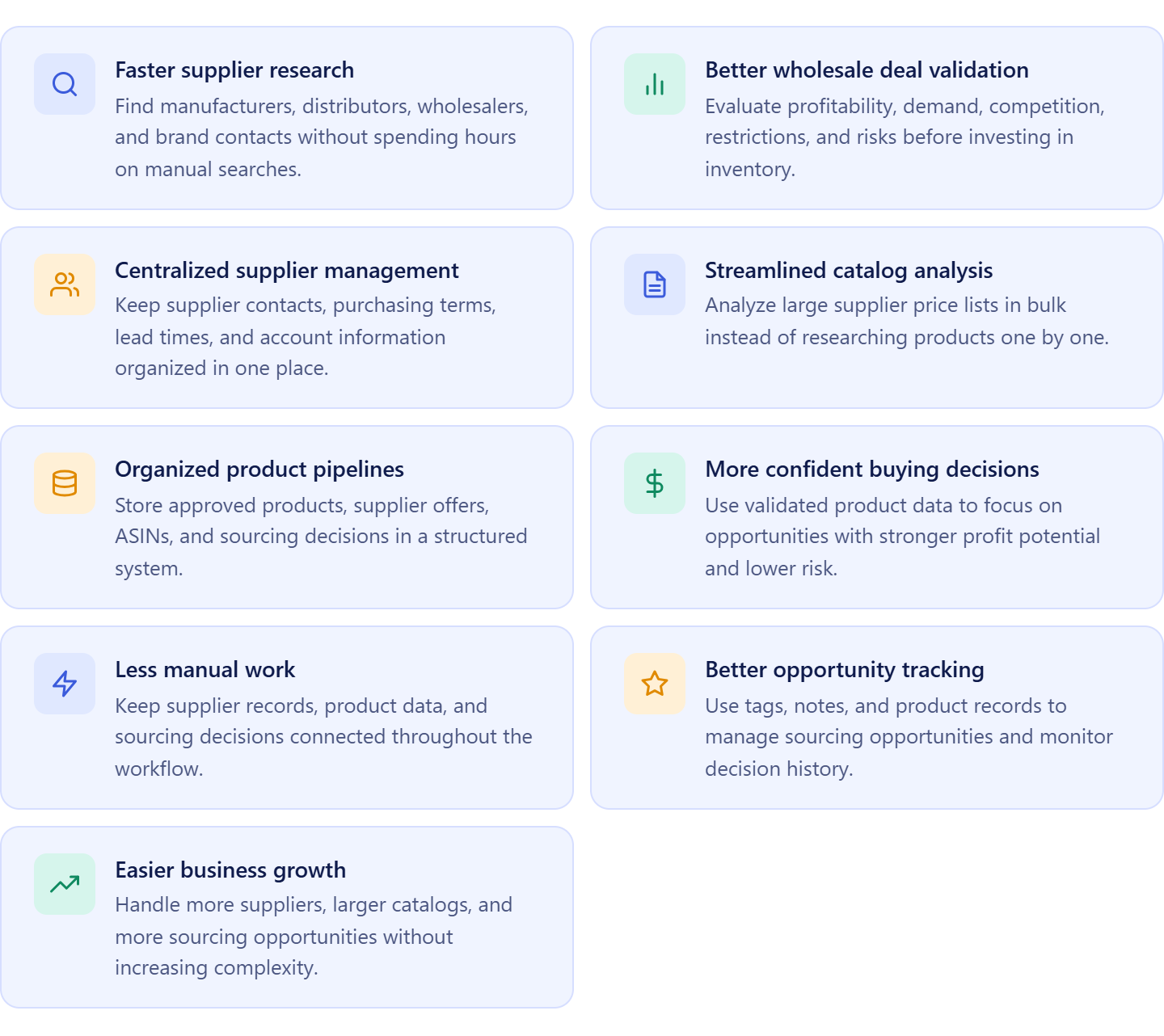
Faster supplier research
Connecting supplier discovery directly to the sourcing process helps sellers spend less time searching and more time evaluating opportunities. Qualified suppliers can be identified and added to the workflow immediately.
Better wholesale deal validation
Analyzing supplier catalogs with profitability, demand, competition, and risk data helps sellers focus on products with stronger sales potential and avoid weak opportunities.
Centralized supplier records
Keeping supplier contacts, purchasing terms, lead times, and account information in one place makes supplier relationships easier to manage as sourcing operations grow.
More organized product pipelines
Storing approved products, supplier offers, ASINs, and costs in a centralized system creates a structured sourcing pipeline that supports future purchasing decisions.
Less repetitive work
When supplier information and product data remain connected, sellers don’t need to repeatedly enter the same information across multiple sourcing and purchasing activities.
Easier scaling
As the number of suppliers, catalogs, and sourcing opportunities increases, a connected workflow helps sellers maintain visibility, consistency, and control without adding operational complexity.
How Seller Assistant Helps Sellers Find Profitable Wholesale Deals
Finding profitable wholesale deals requires a repeatable process. Sellers must identify reliable suppliers, gain access to wholesale catalogs, analyze products, compare opportunities, and organize sourcing decisions before committing inventory dollars. When these tasks are handled separately, sourcing becomes slower, research gets duplicated, and profitable opportunities can be overlooked.
Seller Assistant connects supplier discovery, supplier management, catalog analysis, and product organization into one workflow. Instead of moving information between spreadsheets, supplier emails, and sourcing tools, sellers can manage the entire journey from brand research to deal validation inside a single system.
How the workflow works
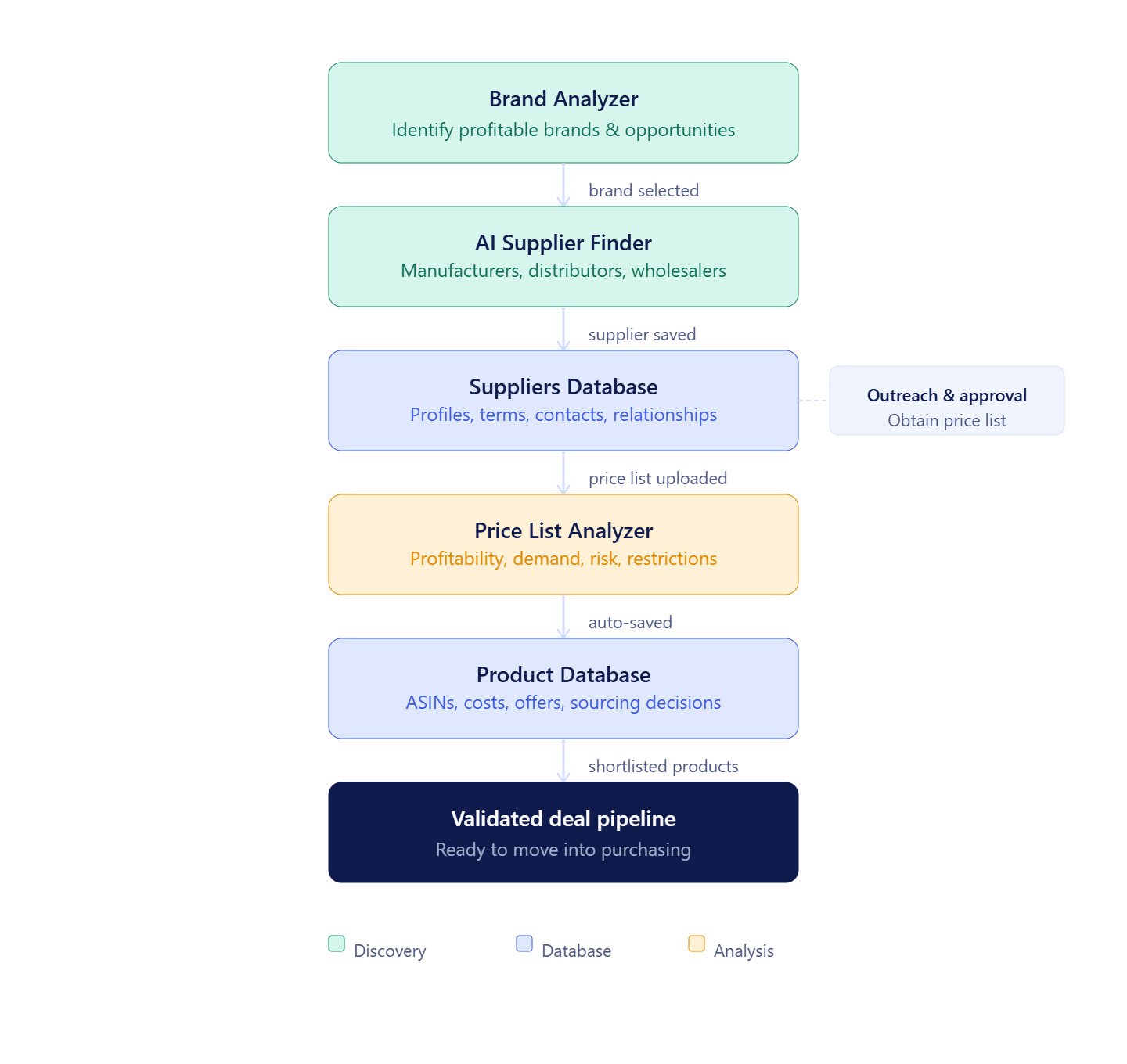
The process begins when a seller identifies a promising brand using Brand Analyzer. Once the brand is selected, AI Supplier Finder is used to locate manufacturers, distributors, wholesalers, and brand contacts that may offer wholesale purchasing opportunities.
After finding potential suppliers, the seller saves them in Suppliers Database, where supplier profiles, contact information, purchasing terms, and relationship details can be managed. The next step is supplier outreach, account approval, and obtaining access to a wholesale catalog.
Once a supplier price list is received, it is uploaded to Price List Analyzer. The tool evaluates profitability, demand, competition, restrictions, HazMat status, IP risks, and other key metrics to identify products with the strongest potential.
All analyzed products and supplier offers are automatically stored in Product Database. Sellers can then filter, compare, and organize sourcing opportunities while building a shortlist of products that meet their purchasing criteria.
The result is a structured pipeline of validated wholesale deals ready to move into purchasing whenever inventory replenishment is needed.
Seller Assistant tools used in the workflow
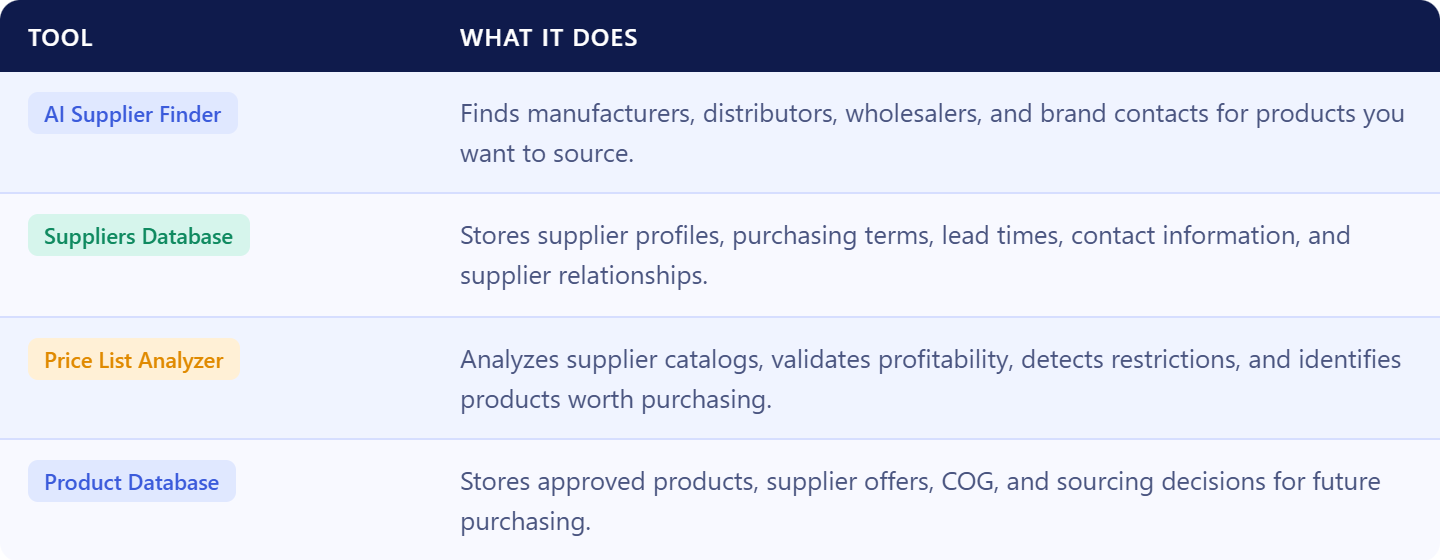
How AI Supplier Finder Helps Sellers Find Wholesale Suppliers
AI Supplier Finder is Seller Assistant’s supplier discovery tool built for Amazon wholesale sellers, online arbitrage sellers, and dropshippers. It helps sellers locate wholesale sources for the brands they want to sell by identifying manufacturers, distributors, wholesalers, and brand-authorized suppliers.
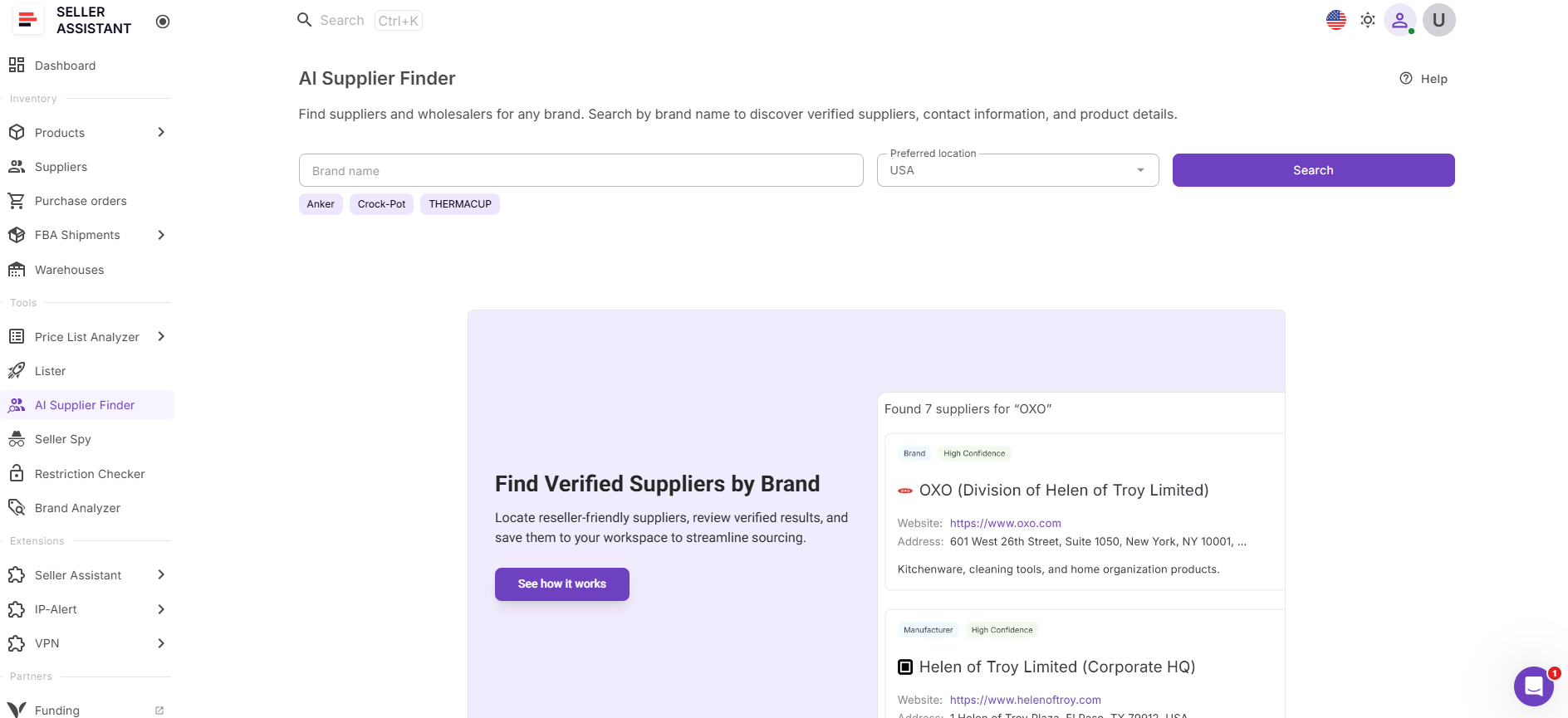
Instead of spending hours searching online and manually verifying supplier legitimacy, sellers receive a curated list of supplier opportunities focused on wholesale sourcing and Amazon resale.
What AI Supplier Finder does
AI Supplier Finder helps sellers find and qualify suppliers before requesting wholesale pricing and product catalogs.
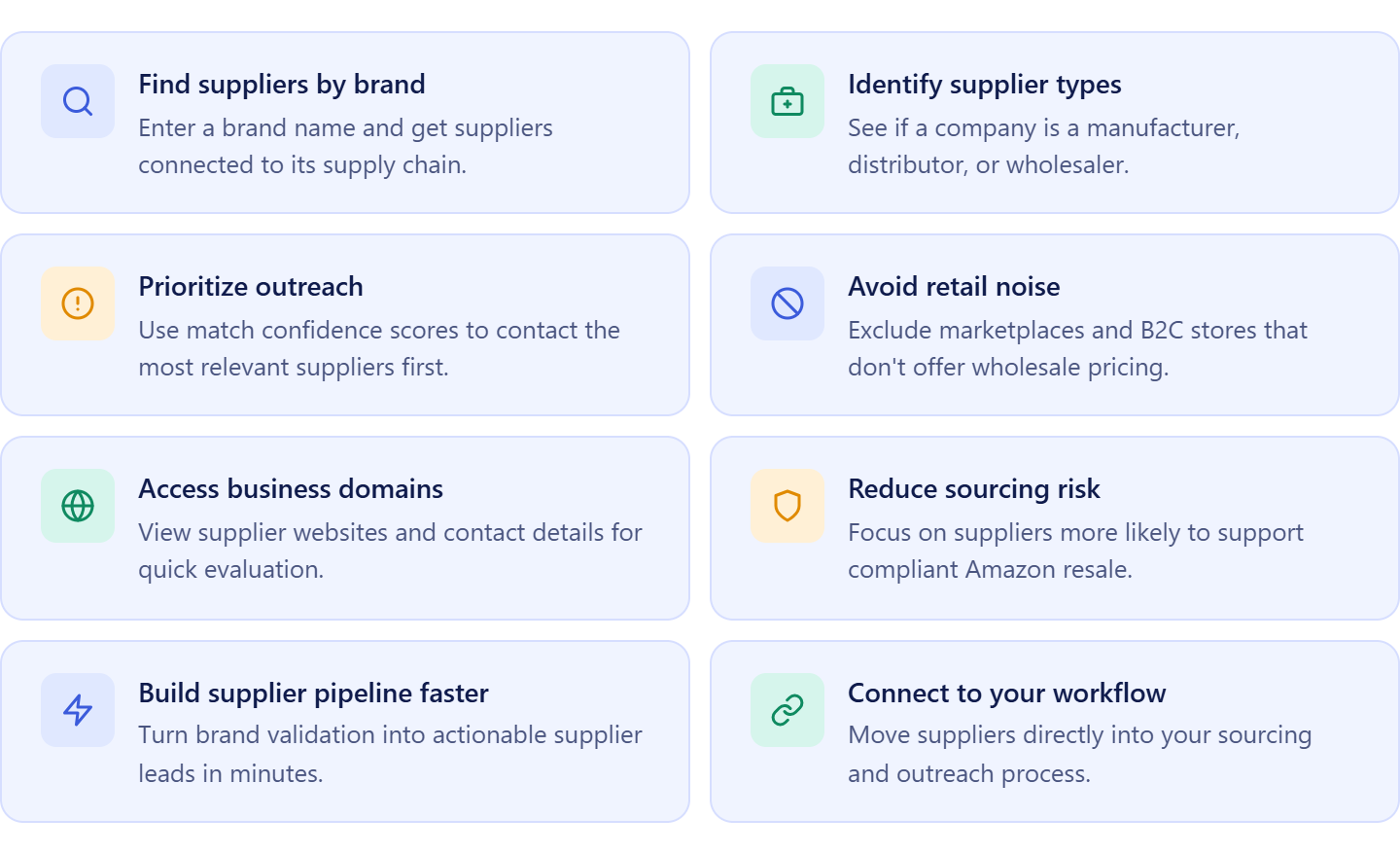
It allows sellers to:
- Search suppliers by brand name;
- Find manufacturers, distributors, wholesalers, and brand contacts;
- Prioritize suppliers based on wholesale relevance;
- Access supplier websites and available contact information;
- Review supplier match confidence scores;
- Exclude retail stores, marketplaces, and consumer-focused websites;
- Launch supplier searches directly from sourcing workflows;
- Save suppliers directly into Suppliers Database.
How AI Supplier Finder helps find profitable wholesale deals
AI Supplier Finder helps sellers find profitable wholesale deals by solving the first challenge in wholesale sourcing – finding legitimate suppliers. Even the most profitable product opportunity has little value if sellers cannot identify a supplier that offers wholesale pricing and reliable inventory access.
Once suppliers are identified, sellers can move directly into outreach, account approval, and catalog acquisition. Supplier information remains connected to the rest of the workflow, allowing sellers to quickly progress from brand research to catalog analysis and wholesale deal validation. This creates a faster and more efficient path to finding products that can generate sustainable profits on Amazon.
How Suppliers Database Helps Sellers Manage Supplier Relationships
Building profitable wholesale deals requires more than finding suppliers. Sellers must keep track of supplier contacts, account approvals, purchasing terms, lead times, and communication history to maintain reliable sourcing relationships over time.
Suppliers Database is Seller Assistant’s supplier organization tool designed for Amazon wholesale sellers, online arbitrage sellers, and dropshippers. It provides a centralized workspace where supplier information remains organized, accessible, and connected to the sourcing workflow.
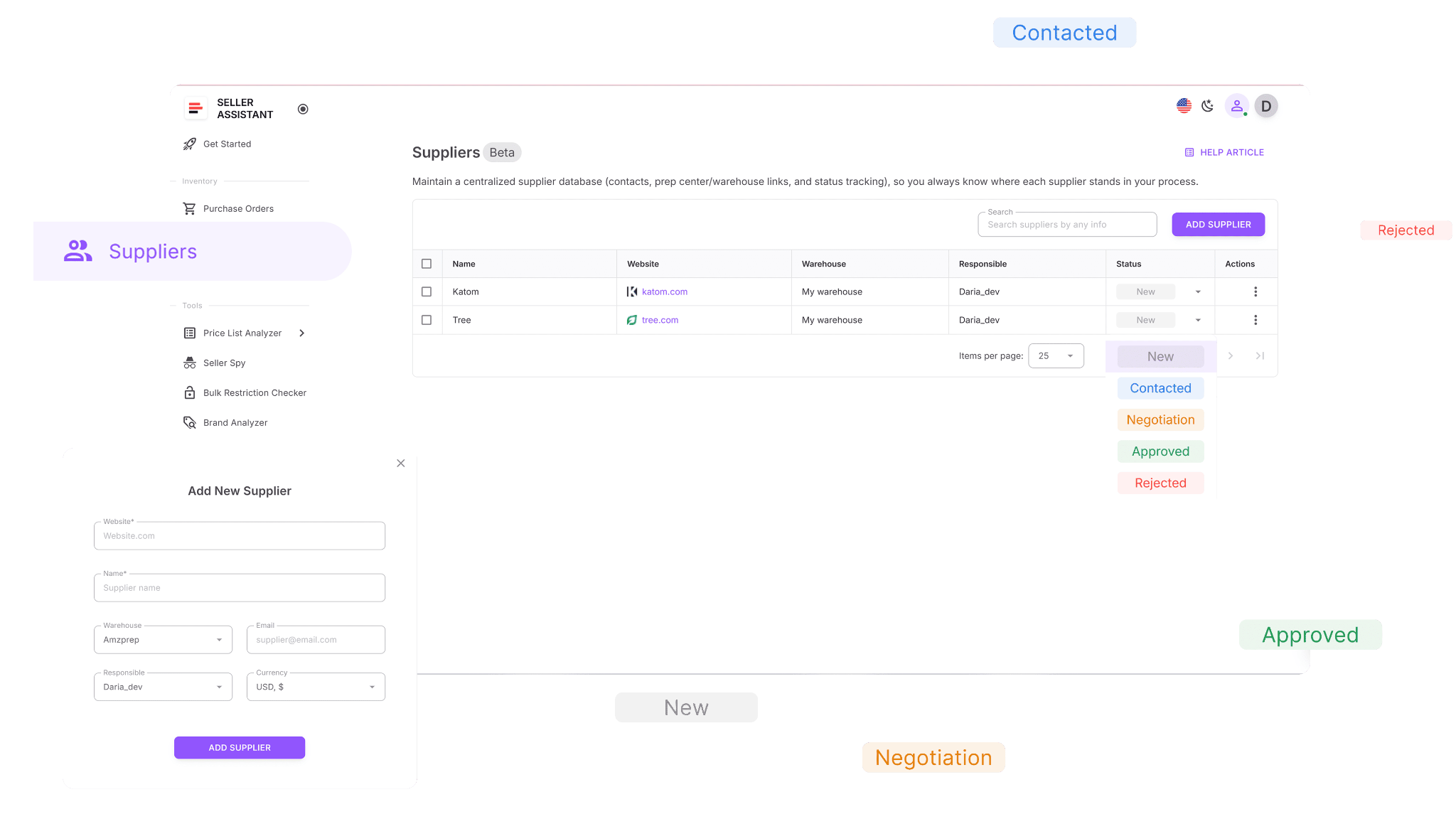
What Suppliers Database does
Suppliers Database allows sellers to organize supplier records and manage wholesale sourcing relationships more effectively.
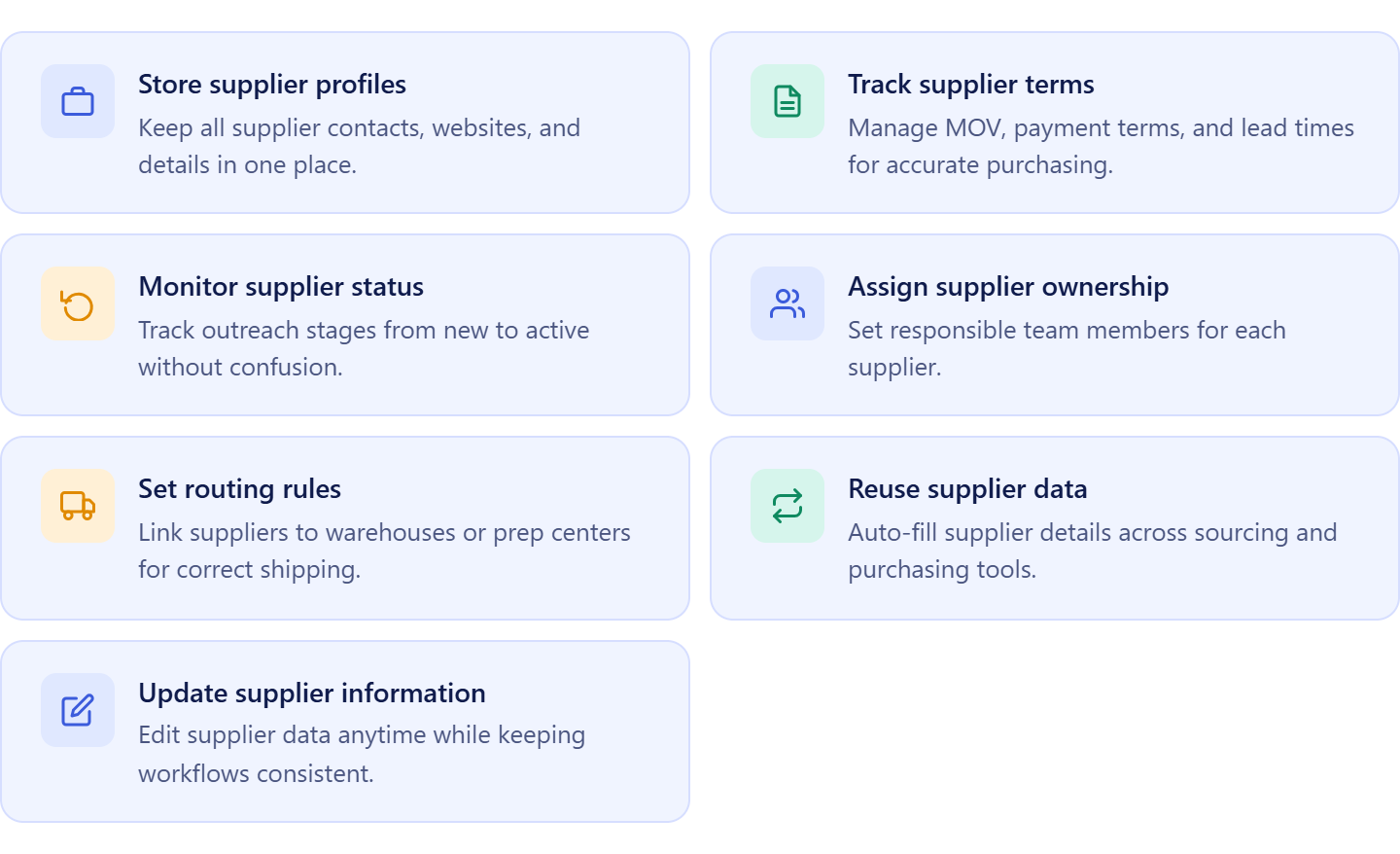
It allows sellers to:
- Store supplier profiles and business contact information;
- Manage MOQ requirements, payment terms, lead times, and shipping conditions;
- Track supplier approval status and outreach activity;
- Assign suppliers to buyers, sourcing specialists, or virtual assistants;
- Connect suppliers to fulfillment destinations when needed;
- Maintain supplier records in one centralized location;
- Update supplier information as business relationships develop.
How Suppliers Database helps find profitable wholesale deals
Suppliers Database helps sellers find profitable wholesale deals by creating a structured system for managing supplier relationships. Instead of losing supplier information across emails, spreadsheets, and notes, sellers can keep all supplier records organized and ready for future sourcing opportunities.
As suppliers provide new catalogs, pricing updates, and product offers, those relationships remain connected to the sourcing workflow. This makes it easier to compare suppliers, access wholesale opportunities faster, maintain consistent communication, and build a reliable network of sourcing partners that supports long-term profitability.
How Price List Analyzer Helps Sellers Identify Profitable Wholesale Deals
Getting access to a supplier catalog is only the beginning. The real challenge is determining which products are actually worth buying. Sellers must separate profitable opportunities from low-margin products, restricted items, and inventory that is unlikely to perform well on Amazon.
Price List Analyzer is Seller Assistant’s bulk catalog analysis tool designed for Amazon wholesale sellers, online arbitrage sellers, and dropshippers. It helps sellers evaluate supplier price lists at scale and quickly identify products with the highest profit potential.
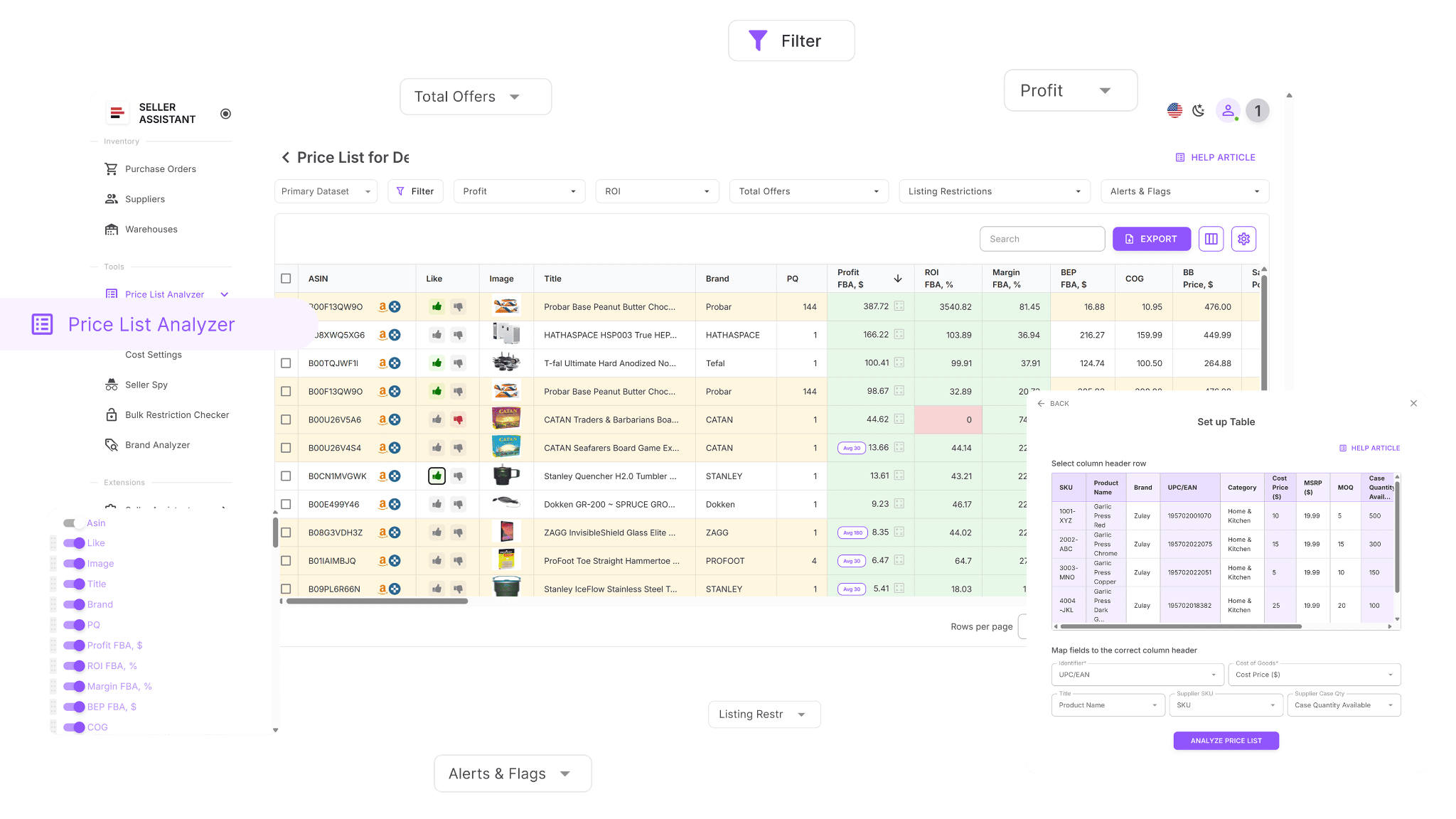
What Price List Analyzer does
Price List Analyzer helps sellers transform supplier catalogs into validated wholesale opportunities.
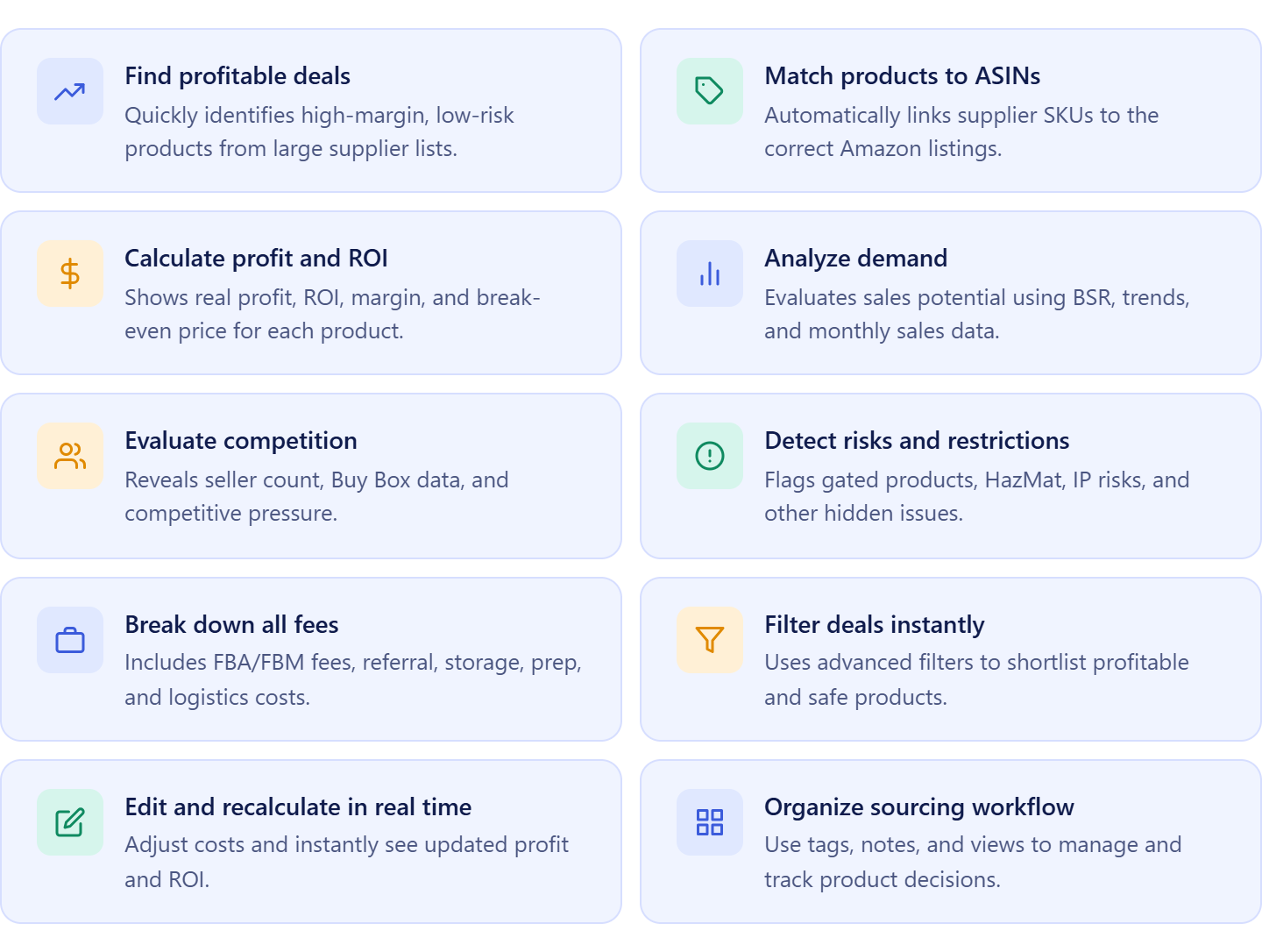
It allows sellers to:
- Analyze large supplier catalogs in bulk;
- Match supplier products to Amazon ASINs automatically;
- Calculate ROI, margin, profit, and break-even pricing;
- Evaluate demand using sales estimates and BSR trends;
- Analyze competition, Buy Box conditions, and Amazon presence;
- Detect restrictions, HazMat products, IP complaints, and other sourcing risks;
- Filter products by profitability, demand, competition, and risk;
- Adjust COG, shipping, prep, and logistics costs dynamically;
- Organize sourcing decisions with tags, notes, and saved views;
- Automatically move analyzed products into Product Database.
How Price List Analyzer helps find profitable wholesale deals
Price List Analyzer helps sellers find profitable wholesale deals by replacing guesswork with data-driven product validation. Rather than relying solely on supplier pricing, sellers can evaluate every opportunity using real Amazon marketplace metrics before investing capital.
By analyzing profitability, sales potential, competition levels, and sourcing risks, sellers can quickly identify products that meet their buying criteria and eliminate weak opportunities. The best products can then move directly into the next stage of the workflow, ensuring that future purchasing decisions are based on validated opportunities rather than assumptions.
How Product Database Helps Sellers Organize Profitable Wholesale Opportunities
Finding profitable products is only part of the sourcing process. Sellers also need a reliable way to store supplier offers, track sourcing decisions, compare opportunities, and keep validated products organized for future purchasing.
Product Database is Seller Assistant’s centralized product organization tool designed for Amazon wholesale sellers, online arbitrage sellers, and dropshippers. It provides a structured workspace where analyzed products, supplier offers, costs, and sourcing data remain connected throughout the wholesale workflow.
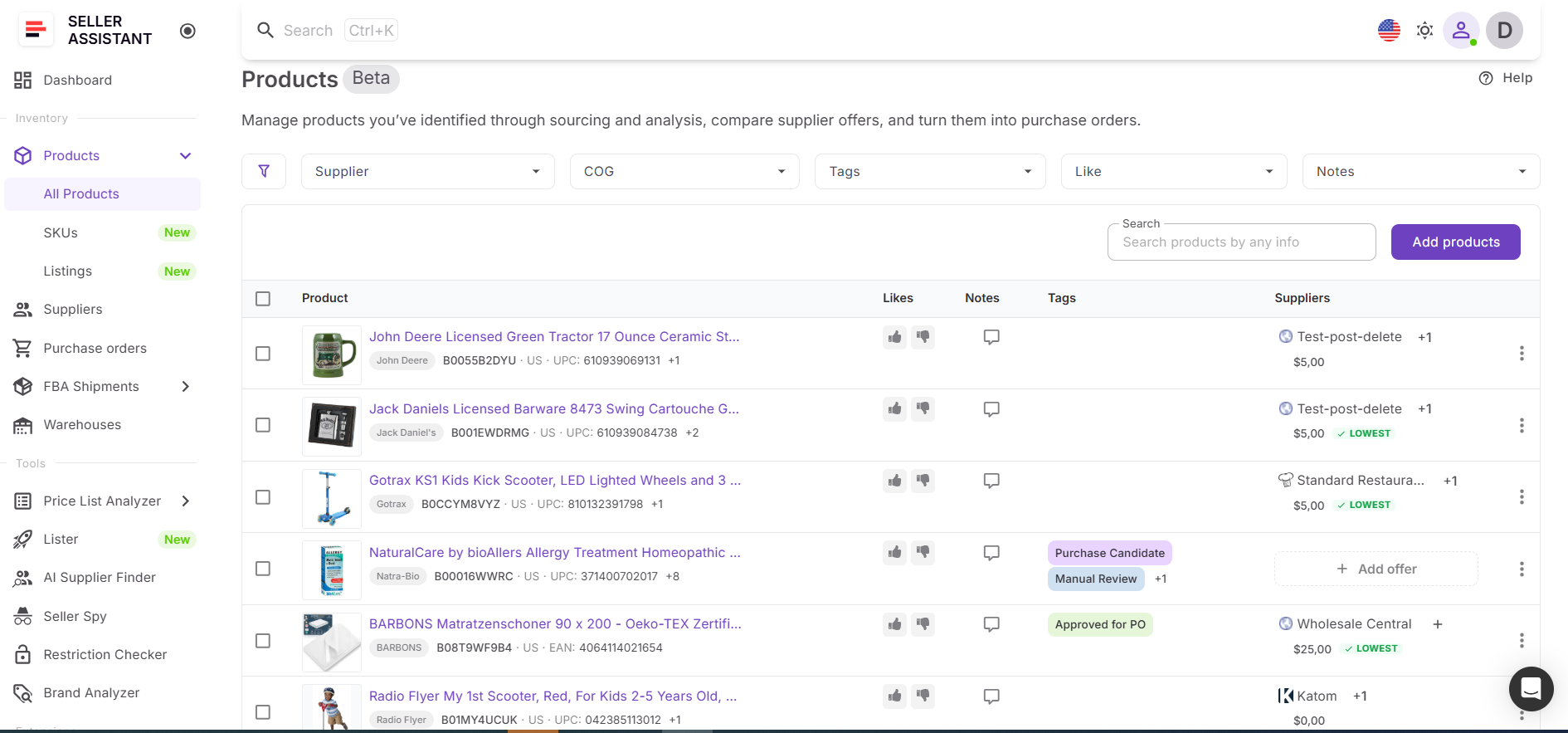
What Product Database does
Product Database helps sellers manage sourcing opportunities and build an organized pipeline of products ready for purchasing.
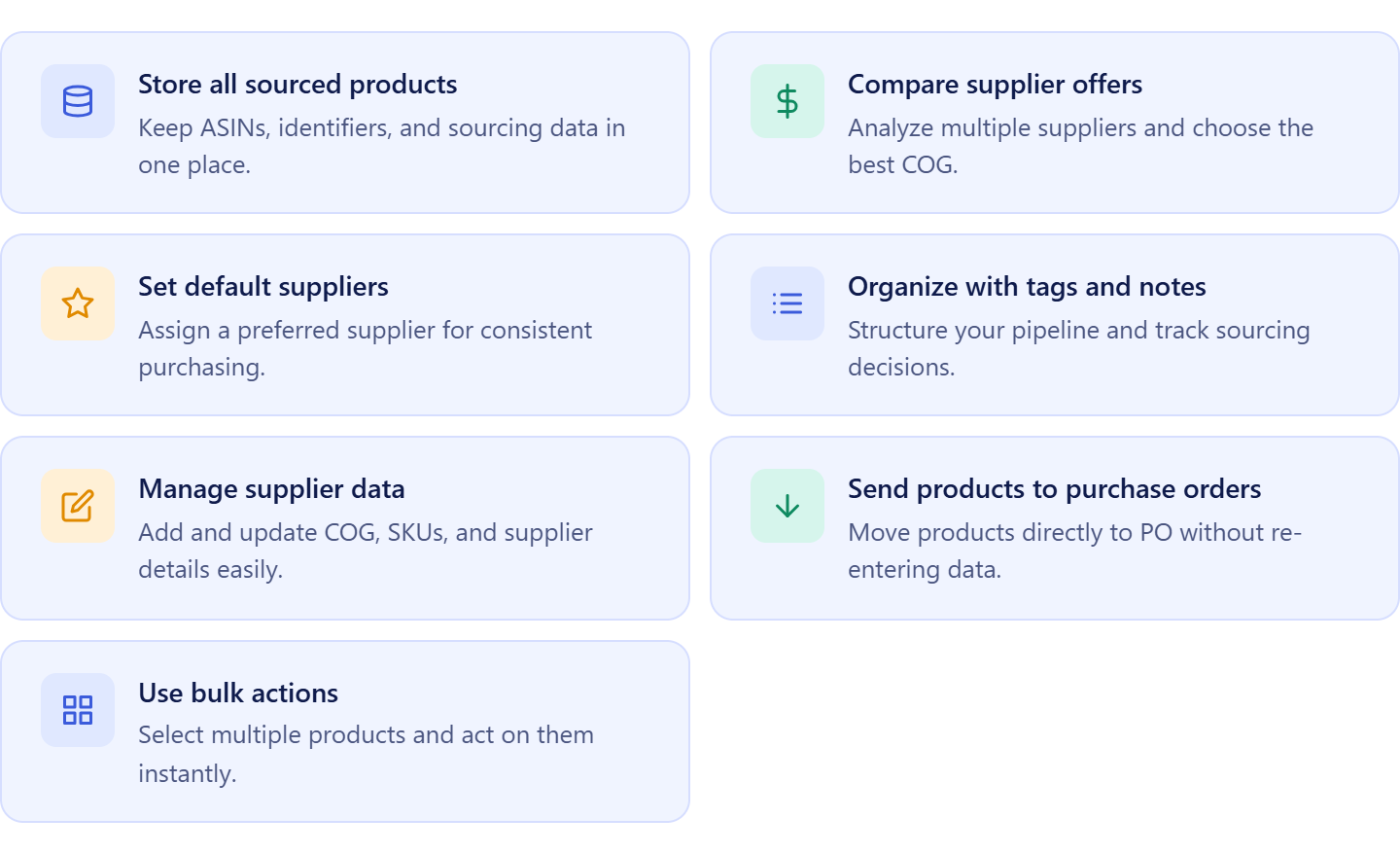
It allows sellers to:
- Store analyzed products and ASIN information in one location;
- Keep supplier offers connected to individual products;
- Compare multiple supplier offers for the same ASIN;
- Assign preferred suppliers to sourcing opportunities;
- Organize product evaluations with tags, notes, and likes;
- Manage COG, supplier SKUs, and product identifiers;
- Move selected products into purchasing workflows;
- Apply bulk actions across multiple products.
How Product Database helps find profitable wholesale deals
Product Database helps sellers find profitable wholesale deals by keeping validated opportunities organized and easy to manage. Once products have been analyzed and approved, they are automatically stored together with supplier offers, costs, and sourcing decisions, creating a centralized record of wholesale opportunities.
This allows sellers to compare offers, revisit previously analyzed products, track sourcing decisions, and build a shortlist of high-potential opportunities without repeating research. As supplier catalogs and product portfolios grow, Product Database helps sellers maintain a structured sourcing pipeline and focus on the deals most likely to generate profit.
How to Find Profitable Wholesale Deals Step by Step
Finding profitable wholesale deals requires more than getting access to a supplier catalog. Sellers must identify reliable suppliers, evaluate product opportunities, and organize sourcing decisions before investing capital. A structured workflow helps eliminate guesswork and focus on opportunities with the strongest profit potential.
Step 1. Analyze a brand and find suppliers
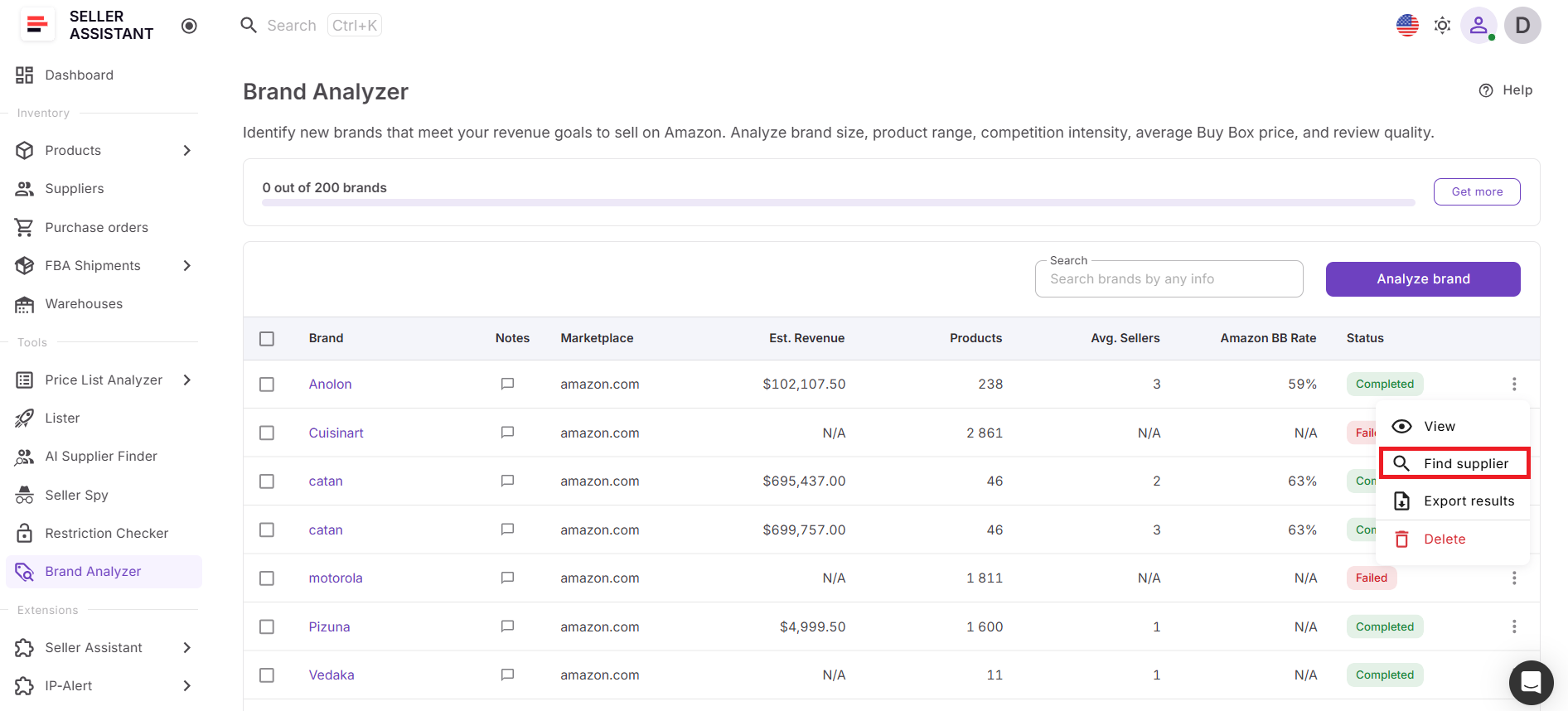
Start by evaluating a brand with Brand Analyzer and then use AI Supplier Finder to locate manufacturers, distributors, wholesalers, and brand contacts. Focus on suppliers that can provide wholesale pricing, reliable inventory, and long-term sourcing opportunities.
Step 2. Build supplier relationships
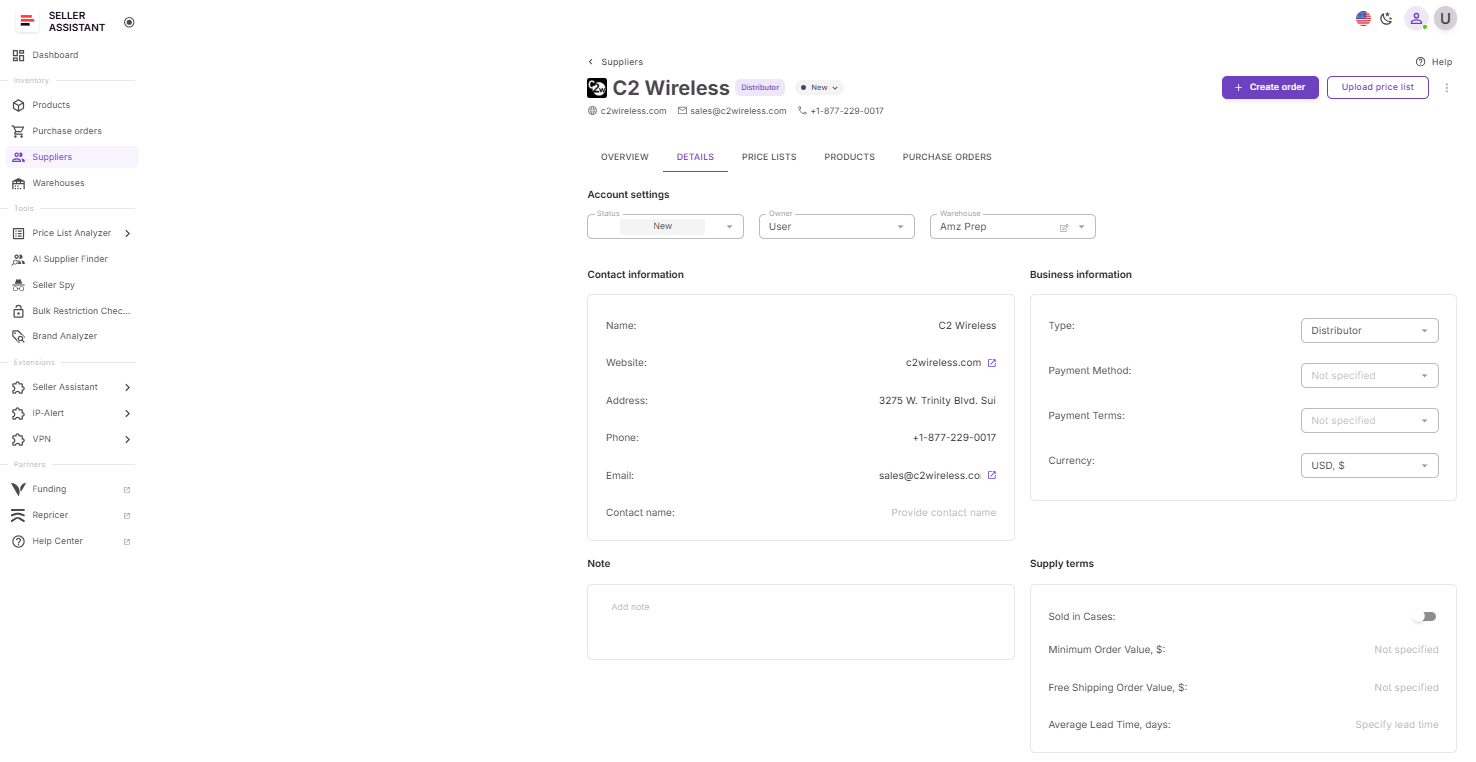
Save suppliers in Suppliers Database and track key information such as contact details, purchasing terms, lead times, and account status. Reach out to suppliers, complete the approval process, and obtain access to their wholesale catalogs.
Step 3. Analyze the supplier catalog
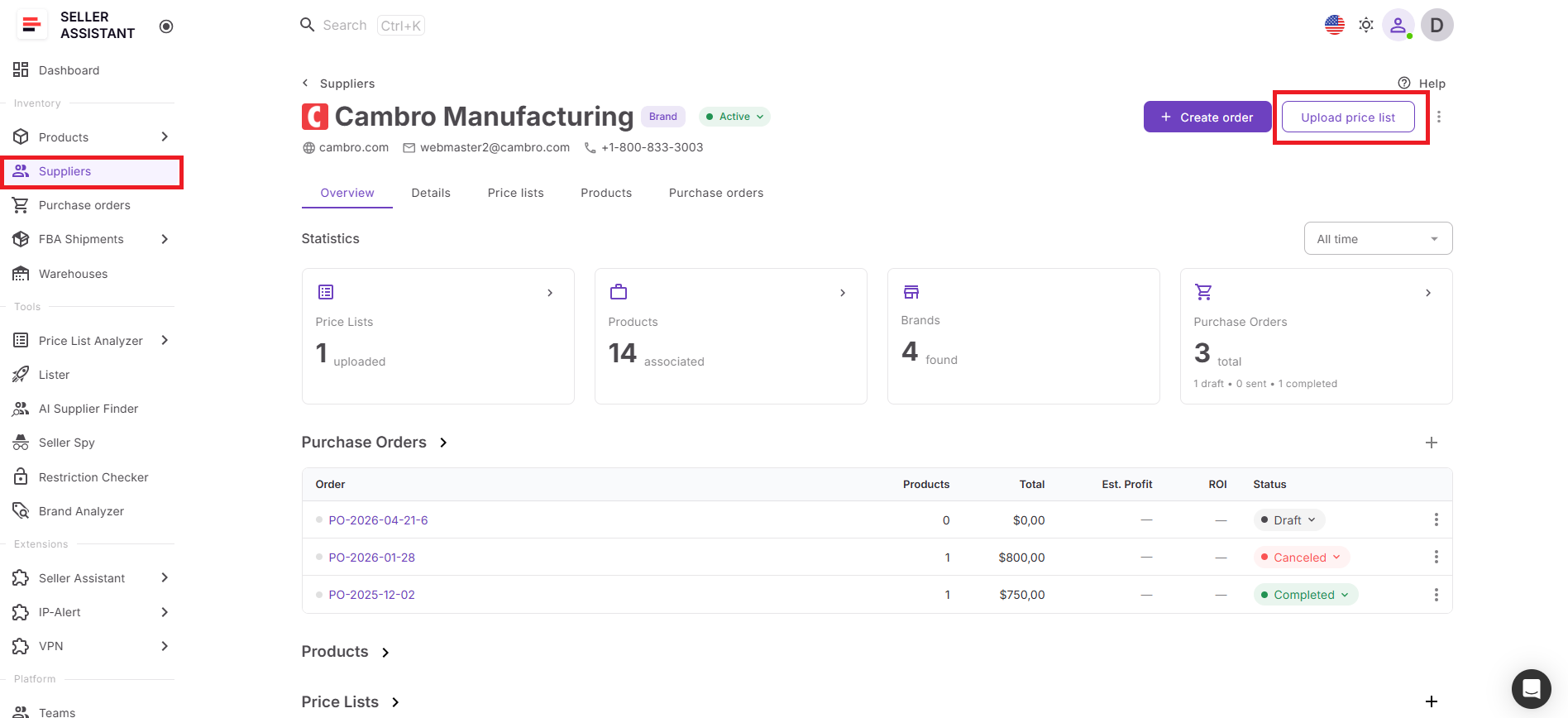
Upload the supplier price list to Price List Analyzer and evaluate products using Amazon marketplace data. Review profitability, demand, competition, restrictions, HazMat status, IP risks, and other sourcing factors to identify products worth buying.
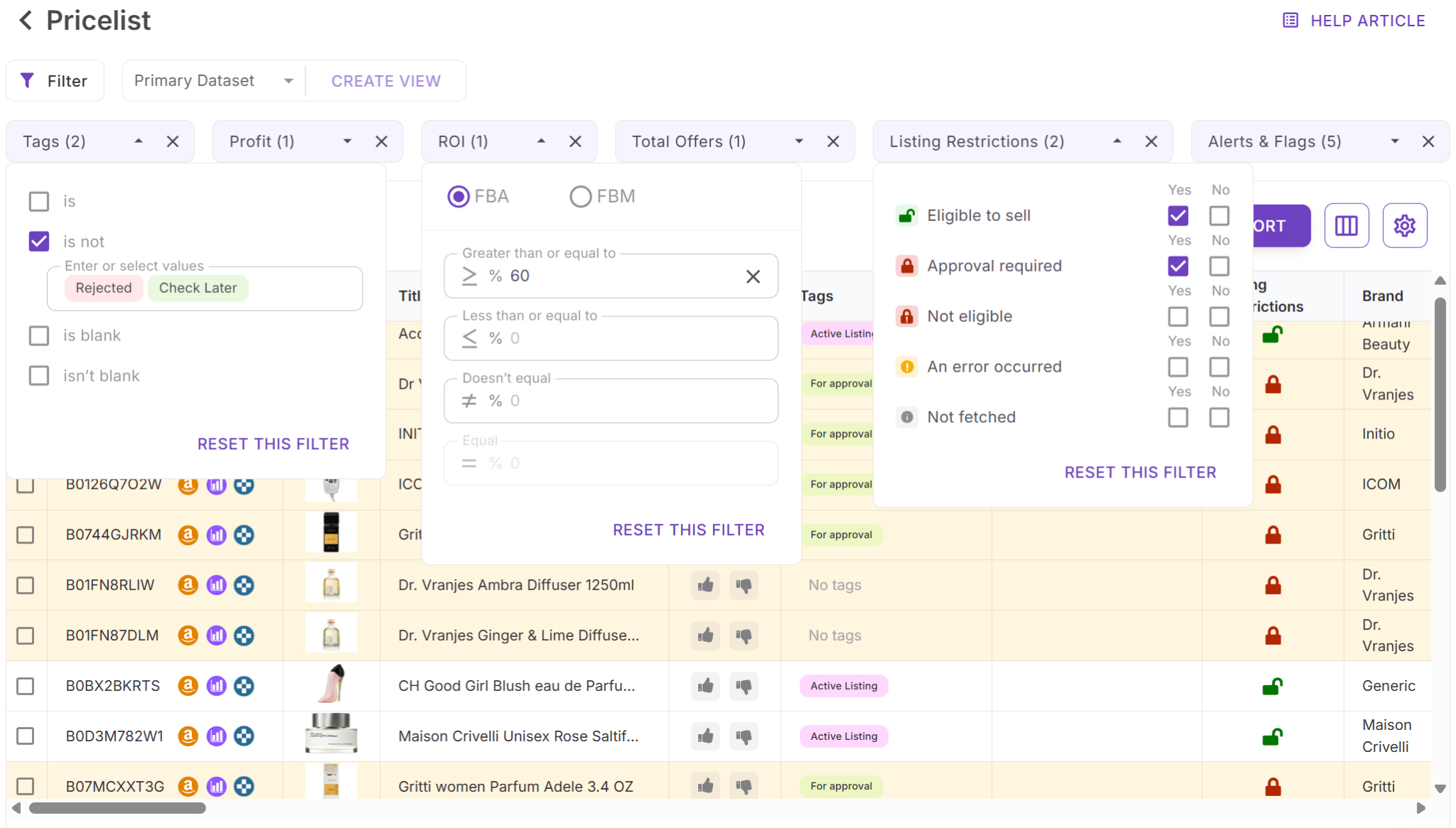
Step 4. Identify the best wholesale deals
Filter products based on your sourcing criteria and focus on opportunities with strong margins, healthy demand, manageable competition, and acceptable risk levels. Remove products that don’t meet your profitability requirements.
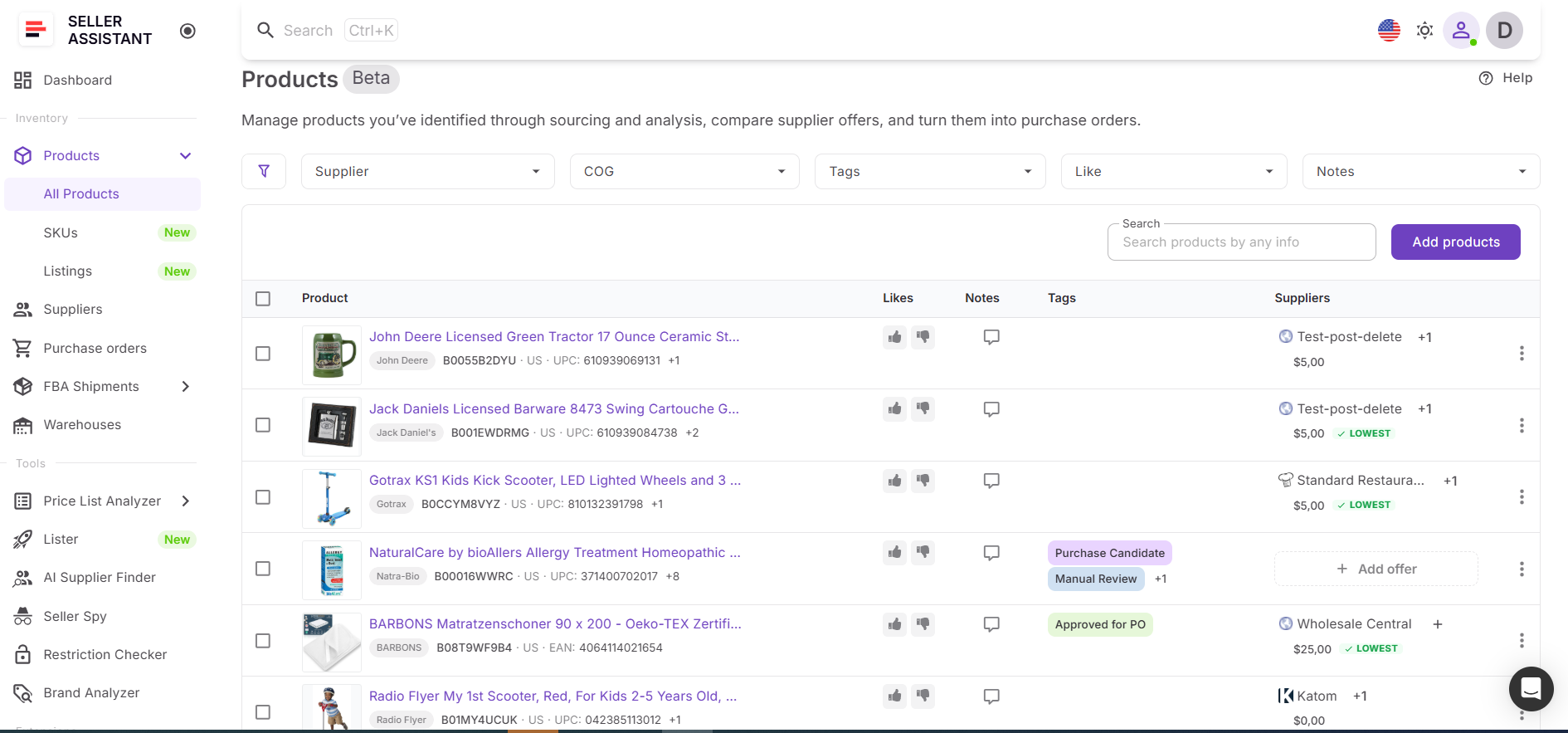
Step 5. Organize approved opportunities
All analyzed products and supplier offers are automatically stored in Product Database. Use it to compare supplier offers, manage sourcing decisions, track costs, and maintain a structured pipeline of products ready for future purchasing.
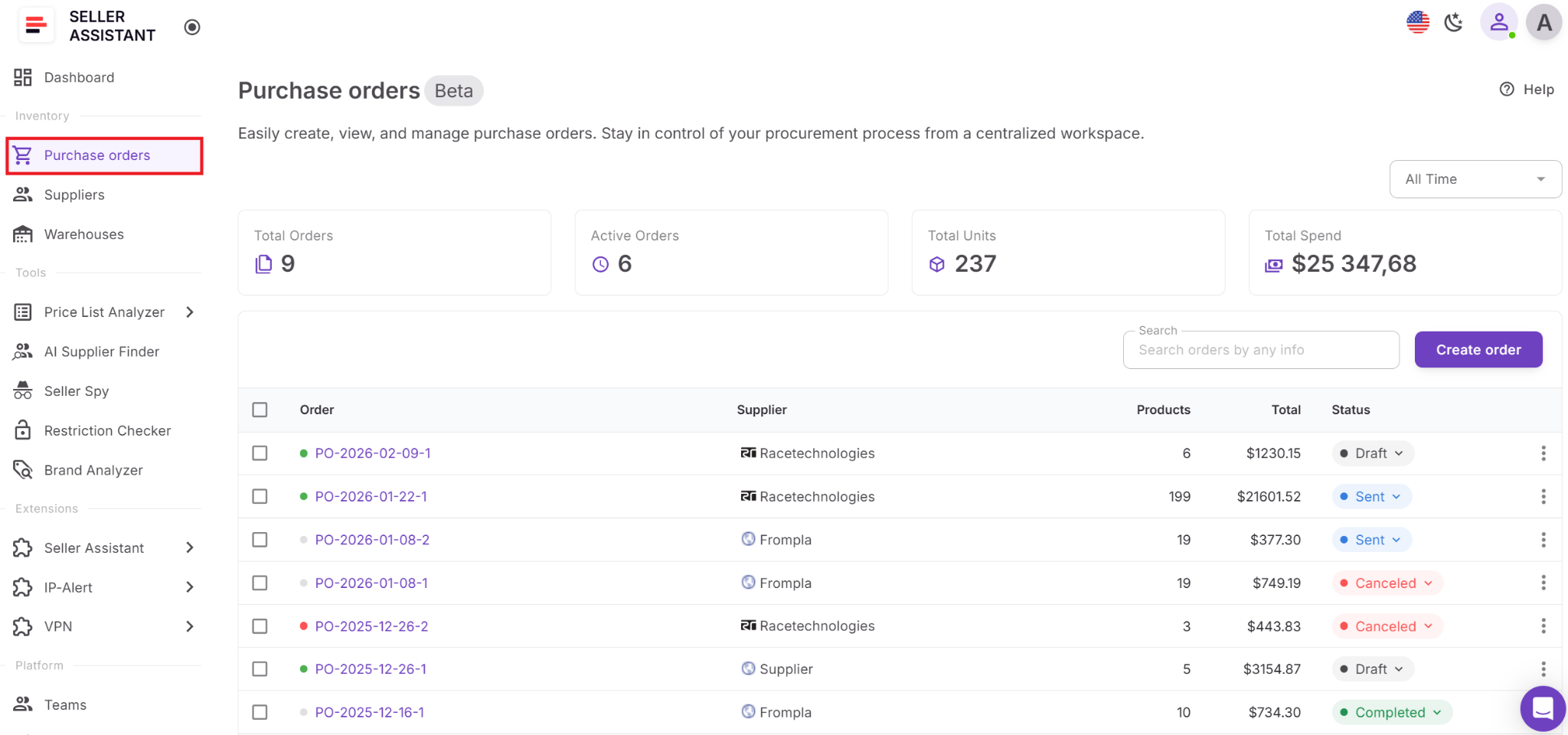
Step 6. Turn sourcing opportunities into inventory
Once the strongest opportunities have been validated, move them into your purchasing process and place orders with confidence. Because supplier information, product data, and sourcing decisions remain organized with Purchase Orders Module, scaling wholesale operations becomes faster and more efficient.
FAQ
What is a wholesale deal on Amazon?
A wholesale deal is a product opportunity sourced from a manufacturer, distributor, wholesaler, or brand owner that can be resold profitably on Amazon. A good wholesale deal combines competitive supplier pricing with strong demand, healthy margins, and manageable competition.
How do I find wholesale suppliers for Amazon?
The most effective approach is to start with a brand and then identify manufacturers, distributors, wholesalers, or brand contacts that offer wholesale accounts. Building direct supplier relationships gives sellers access to better pricing, inventory availability, and long-term sourcing opportunities.
Why should I analyze supplier catalogs before buying inventory?
Not every product in a wholesale catalog is worth purchasing. Catalog analysis helps sellers identify profitable products, avoid restrictions and sourcing risks, and focus their capital on opportunities with stronger sales potential.
What makes a wholesale deal profitable?
A profitable wholesale deal typically has sufficient margin after Amazon fees, shipping costs, and other expenses are considered. Demand, competition, Buy Box conditions, inventory stability, and sourcing risks also play a major role in overall profitability.
Why is it important to keep supplier and product data organized?
As supplier networks and product catalogs grow, managing sourcing information manually becomes increasingly difficult. Keeping supplier records, product offers, costs, and sourcing decisions organized makes it easier to compare opportunities, track relationships, and scale wholesale operations efficiently.
Final Thoughts
Profitable Amazon wholesale deals don’t happen by chance. They result from a structured process that starts with finding the right suppliers, continues with careful catalog analysis, and ends with selecting products that meet your profitability and risk requirements.
Seller Assistant helps connect every stage of that process. From discovering suppliers with AI Supplier Finder and managing supplier relationships in Suppliers Database to analyzing catalogs with Price List Analyzer and organizing opportunities in Product Database, sellers can move from supplier discovery to validated wholesale deals within one workflow.
Seller Assistant automates and connects every stage of your Amazon wholesale and arbitrage workflow. It brings together in one platform: workflow management tools – Product Database, Purchase Orders Module, Suppliers Database, Warehouses Database, FBA Shipments, bulk research & sourcing tools – Price List Analyzer, Bulk Restriction Checker, Sourcing AI, Brand Analyzer, Seller Spy, Chrome extensions – Seller Assistant Browser Extension, IP-Alert Extension, and built-in VPN by Seller Assistant, and integrations & team access features – seamless API connectivity, integrations with Zapier, Airtable, and Make, and Virtual Assistant Accounts.