


A competitor drops their price by fifty cents at 2 a.m., and by the time you check your listings the next morning, the Buy Box has already changed hands – along with a chunk of your sales.
Amazon pricing doesn’t wait for business hours, and neither do the sellers competing for the same ASIN. Tracking competitor prices manually means constantly refreshing listings, guessing when to react, and hoping you don’t reprice into a loss once fees and landed cost are factored in.
There’s a better way to stay on top of the market – one that watches prices and reacts to them in the same motion – Seller Assistant Repricer.
What Happens When You Don’t Track Competitor Prices
Amazon pricing conditions can change throughout the day as sellers adjust prices, inventory levels change, and Buy Box ownership shifts. If you aren’t tracking those changes, you’re making pricing decisions with outdated information – which can cost you both sales and profit.
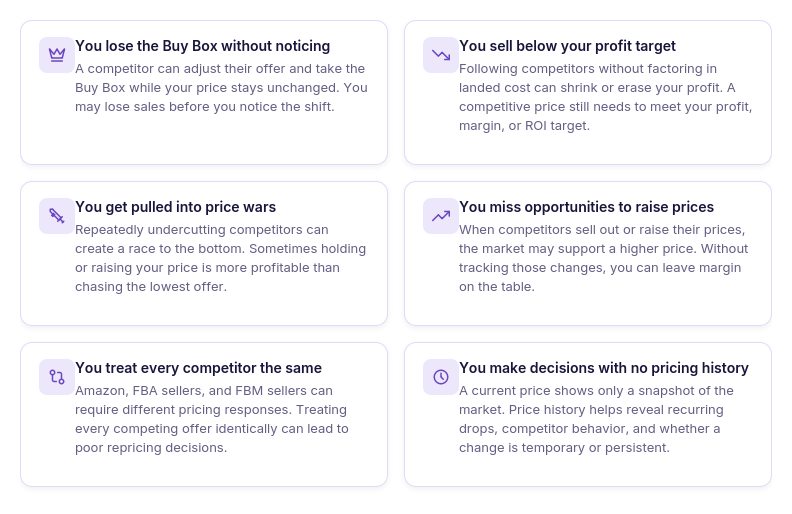
You lose the Buy Box without noticing
A competitor can change their offer and take the Buy Box while your price remains unchanged. By the time you manually check the listing, you may have already lost hours of potential sales.
You sell below your profit target
Following competitors without considering your actual costs can turn a sale into a poor deal. Your pricing decisions need to account for landed cost, Amazon fees, inbound costs, and your required profit, margin, or ROI – not just the lowest competing price.
You get pulled into price wars
Constantly undercutting the lowest seller can trigger a race to the bottom, especially when competitors are also using automated pricing. Tracking competitor behavior helps you recognize when lowering the price makes sense and when holding or increasing it is the better move.
You miss opportunities to raise prices
Competitor tracking isn’t only about knowing when to lower your price. If sellers go out of stock or competition disappears, keeping yesterday’s lower price can mean leaving profit on the table when the market would support a higher price.
You treat every competitor the same
Not every competing offer should trigger the same response. Amazon itself entering the listing, an FBA seller holding the Buy Box, or a single FBM competitor can each call for a different pricing decision.
You make decisions with no pricing history
Looking only at the current Buy Box or lowest price doesn’t tell you how the listing reached that point. Without pricing history, it’s harder to identify recurring price drops, understand competitor behavior, and determine whether a sudden change is temporary or part of a broader pricing pattern.
What You Actually Need to Track
Tracking Amazon competitor pricing means looking beyond the lowest offer. To know when and how to reprice, you need the full market and profitability context – Buy Box performance, competitors, pricing trends, landed cost, and the lowest price you can safely accept.
The pricing signals that matter
These metrics help you understand not only what competitors are doing, but whether following them makes financial sense.
| What to Track | What It Tells You | Why It Matters |
|---|---|---|
| Buy Box status | Whether your offer currently holds the Buy Box | Shows when you’re winning or losing the featured position |
| Buy Box price | The current winning offer price | Provides a reference for matching, beating, or pricing above the Buy Box |
| Amazon Buy Box share | How much of the Buy Box Amazon itself controls | Helps assess how strongly you’re competing against Amazon |
| Buy Box holder | Whether Amazon, an FBA seller, or an FBM seller holds the Buy Box | Different competitors may require different pricing responses |
| Competitor count | How many sellers compete on the listing | Shows how crowded the ASIN is and how much pricing pressure exists |
| Lowest price | The lowest competing offer | Identifies aggressive pricing without assuming you should automatically follow it |
| Your price | Where your offer sits relative to the market | Shows the gap between your offer, the Buy Box, and competing prices |
| Landed cost | Your real per-unit cost, including relevant cost components | Gives you the cost basis needed to calculate a safe pricing floor and profitability |
| Effective minimum price | The lowest price allowed by your SKU limits and strategy rules | Helps prevent repricing below the floor set by your profit protection strategy |
| Profit, ROI, and margin | Expected profitability at different price points | Shows whether competing for the Buy Box still makes financial sense |
| Price history | How your price, Buy Box price, and effective limits change over time | Reveals price patterns, temporary drops, and recurring competitive pressure |
Why Repricing Tools Are the Better Way To Track Competitor Prices
Tracking competitor prices and reacting to them are really one job. Knowing that the Buy Box price changed isn’t very useful if you still have to open the listing, assess the competition, calculate a safe price, and update your offer manually.
An Amazon repricer closes that gap. It monitors the market and applies your pricing strategy automatically, so competitor tracking becomes an active pricing process rather than another dashboard you have to watch.
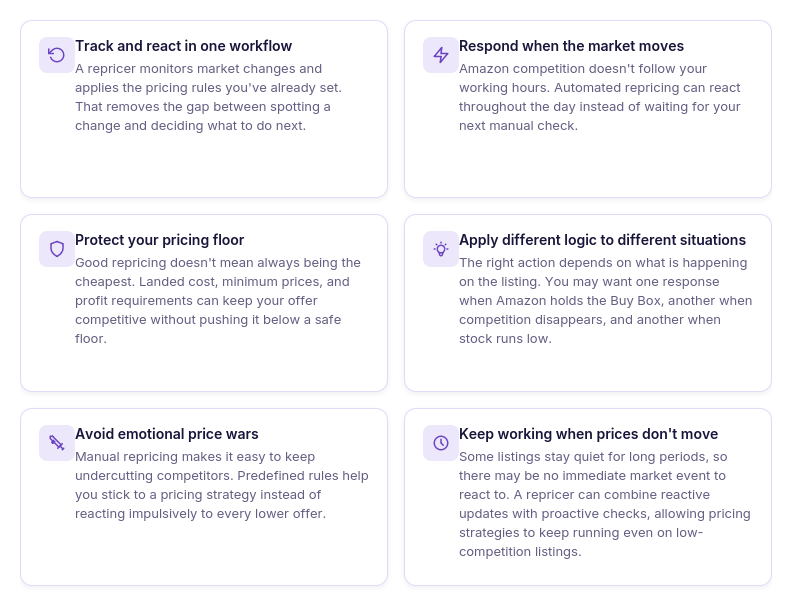
Track and react in one workflow
A repricer doesn’t just show that the market changed – it can respond according to rules you’ve already defined. That matters when you’re managing hundreds or thousands of SKUs and can’t review every price movement yourself.
Respond when the market moves
Amazon competition doesn’t follow your working hours. Automated repricing can react to changing prices and Buy Box conditions throughout the day instead of waiting for your next manual catalog review.
Protect your pricing floor
Good repricing isn’t about automatically becoming the cheapest seller. When pricing rules incorporate landed cost, minimum prices, and profit requirements, the repricer can compete without blindly following another seller below your acceptable floor.
Apply different logic to different situations
The right response depends on what’s happening on the listing. You may want one action when Amazon holds the Buy Box, another when competition disappears, and another when inventory runs low – rule-based repricing makes those decisions repeatable.
Avoid emotional price wars
Manually seeing a competitor undercut you can make lowering your price feel like the obvious response. Automated rules let you decide your strategy beforehand and respond according to market conditions rather than repeatedly chasing the lowest offer.
Keep working when prices don’t move
Reactive monitoring alone can miss listings where nothing triggers a new market event. A repricer can combine reactions to marketplace changes with proactive checks, allowing strategies such as time-based pricing to continue working even on quieter listings. Seller Assistant’s Repricer, for example, uses reactive repricing when Amazon prices change and also performs proactive sweeps of listings.
How Seller Assistant’s Repricer Tracks and Responds to Competitors
Seller Assistant Repricer is an automated pricing tool that helps Amazon wholesale sellers, online arbitrage sellers, and dropshippers track marketplace changes and adjust their prices according to predefined strategies. It connects competitor monitoring, Buy Box data, profitability, and automated repricing in one workflow, so sellers don’t have to monitor listings and update prices manually.
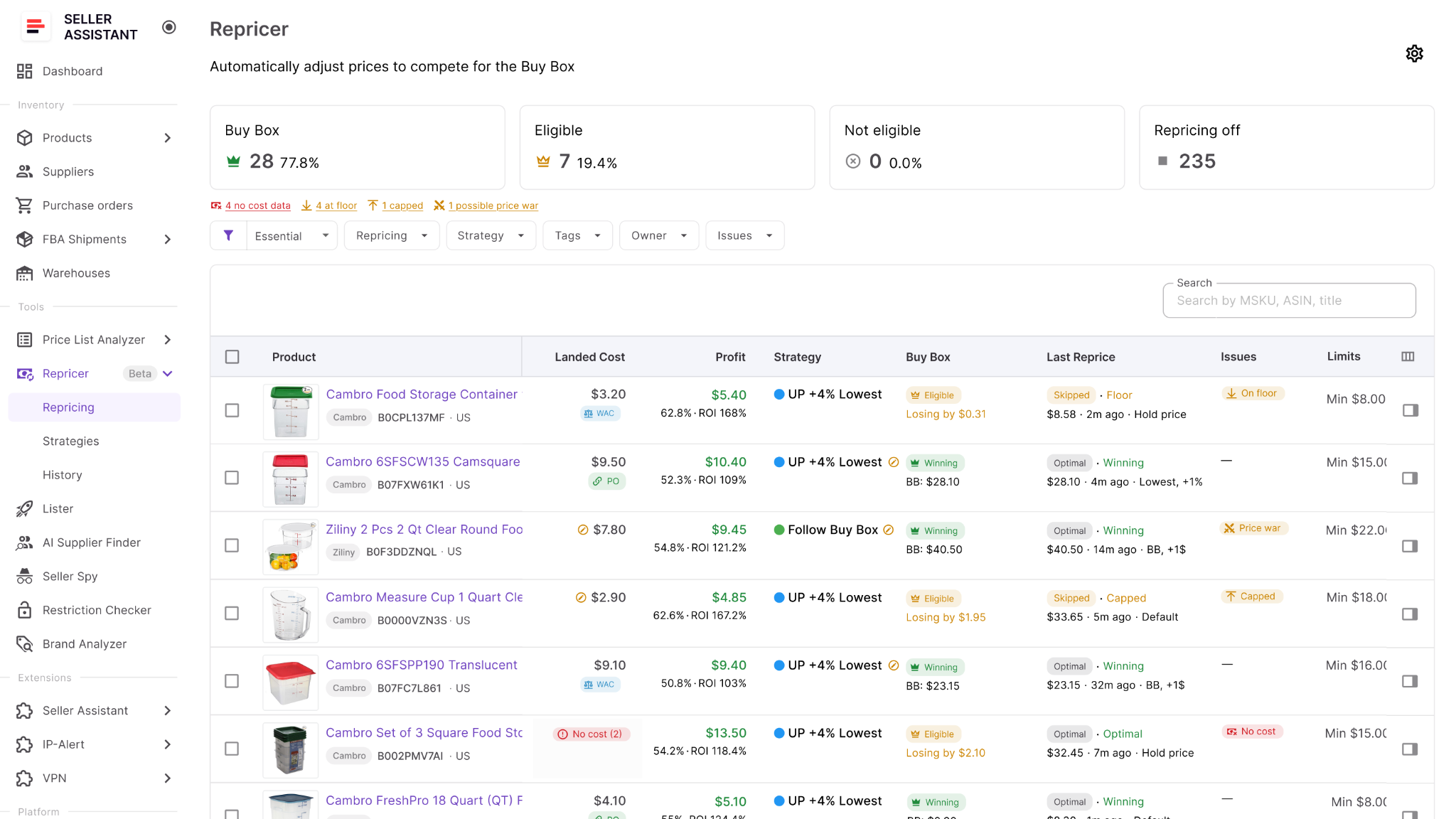
Instead of simply undercutting the lowest offer, Seller Assistant Repricer lets sellers define how prices should respond to different market conditions. It uses landed cost and pricing limits to protect profitability, supports conditional repricing strategies, and tracks pricing decisions over time. Because the Repricer is built into Seller Assistant, pricing also connects with existing SKU, inventory, landed cost, and purchase order data.
What you can do with Seller Assistant Repricer
Seller Assistant Repricer provides the tools to monitor competition, automate pricing decisions, and protect profitability across your Amazon catalog.
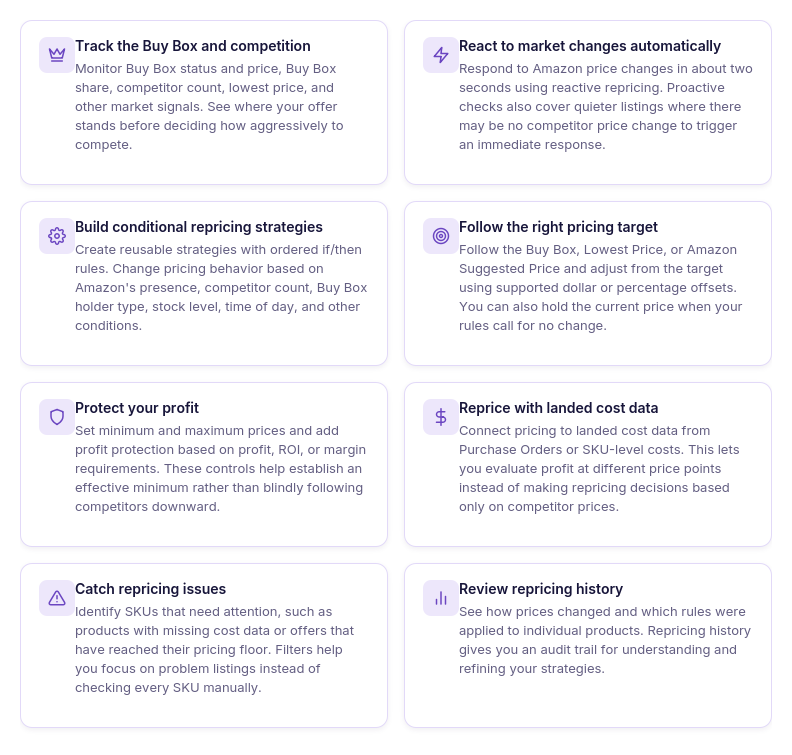
- Track the Buy Box and competition
Monitor your Buy Box status, Buy Box price, Buy Box share, competitor count, lowest price, and other market data from the Repricer. This gives you the context behind a price change instead of showing competitor prices in isolation.
- React to market changes automatically
The Repricer’s main mode is reactive – when Amazon pricing changes, Seller Assistant can react in about two seconds and send a new price based on your strategy. It also performs proactive checks on quieter listings where there may be no new price event to trigger a reaction.
- Build conditional repricing strategies
Create reusable strategies with default actions and ordered if/then rules. Strategies can respond differently based on conditions such as Amazon selling, competitor count, Buy Box holder type, your stock level, and time of day.
- Follow the right pricing target
Set actions to Follow Buy Box, Follow Lowest Price, use Amazon’s suggested price, with dollar or percentage adjustments where supported, or create your own rules. Rules can also hold the current price when market conditions don’t justify a change.
- Protect your profit
Use SKU-level minimum and maximum prices together with strategy-level profit protection. Seller Assistant can use landed cost to establish an effective minimum based on profit, ROI, or margin requirements, helping prevent competition from pulling your price below your acceptable floor.
- Connect repricing with landed cost
Cost data can flow from purchase orders into the SKU or be entered manually. With cost data available, Seller Assistant can calculate profitability at your current, minimum, and maximum prices, giving pricing decisions financial context.
- Identify repricing problems
Use Repricer issues and status information to identify SKUs that need attention – for example, products without cost data or products that have reached their pricing floor. Instead of checking the catalog SKU by SKU, sellers can filter problem listings and investigate them directly.
- Review pricing history
Track how your price and pricing limits change over time and review the history of repricing decisions for individual products. This helps you understand what the Repricer did and investigate how a strategy behaved under changing market conditions.
How Seller Assistant Repricer connects tracking and repricing
Seller Assistant Repricer turns competitor tracking into an automated decision workflow. Marketplace data provides the signal, your strategy determines the response, and landed cost plus pricing limits define how far the price is allowed to move.
This means sellers don’t have to treat competitor monitoring, profitability calculations, and repricing as separate tasks. The Repricer can monitor the market, evaluate the relevant rules, calculate a safe pricing range, update the offer, and record what happened – while remaining connected to the SKU, cost, inventory, and purchasing data already stored in Seller Assistant.
How Seller Assistant Repricer Works
Seller Assistant Repricer combines live Amazon market data, seller-defined strategies, SKU cost data, and profit limits to decide when and how a price should change. Instead of applying one blanket rule to every listing, it evaluates market conditions against the strategy assigned to each product and reprices only within the limits you define.
How Seller Assistant Repricer makes pricing decisions
The Repricer starts with the SKUs synced from your connected Amazon account. For each product, it monitors market signals such as your current price, Buy Box status and price, competitor count, lowest offer, stock, and other listing conditions. It can also use landed cost and profitability data linked to the SKU.
Repricing strategies and rules
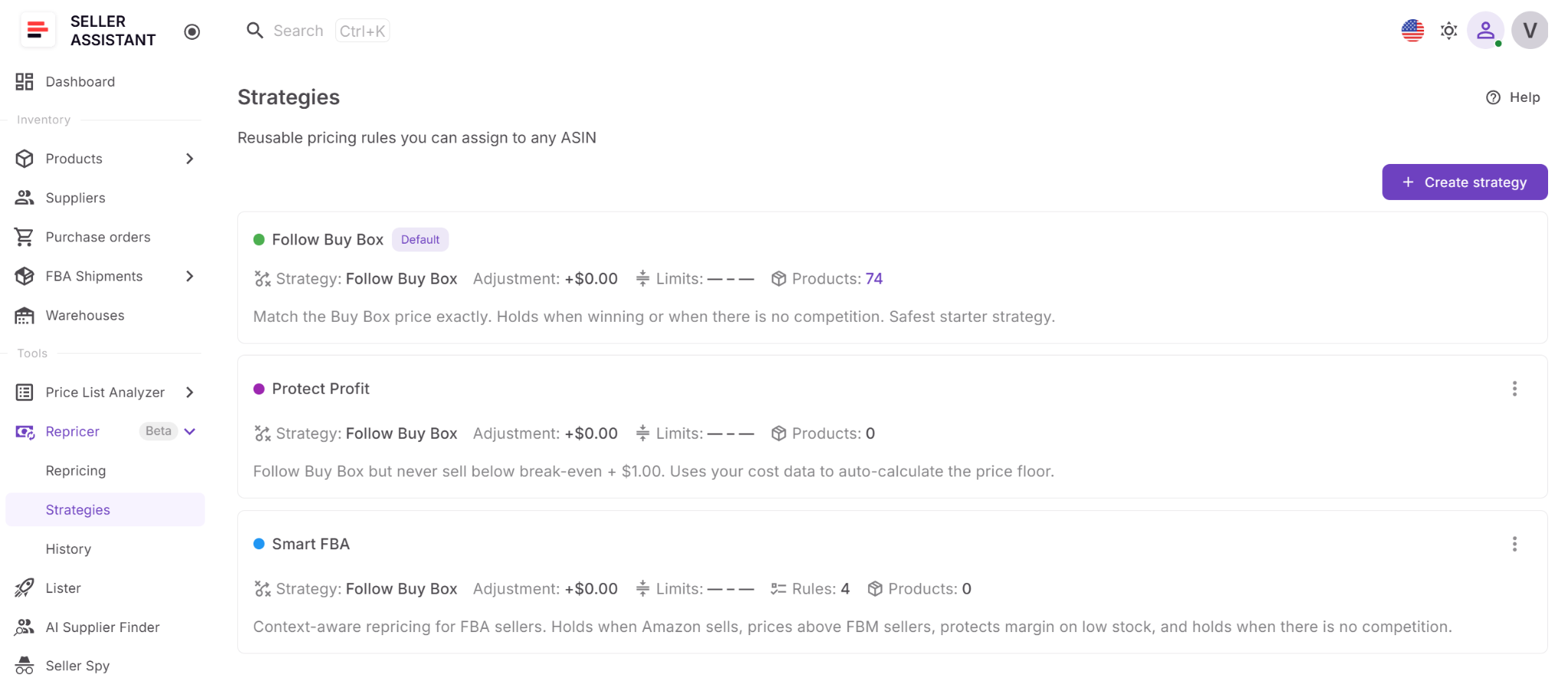
Each product is assigned a repricing strategy. A strategy is a reusable set of pricing rules that can be assigned to individual products or in bulk. Sellers can start with a blank strategy or use ready-made templates such as:
- Follow Buy Box – matches the Buy Box when you’re losing it and holds your price when you’re winning.
- Match Buy Box – matches the Buy Box price exactly without undercutting.
- Smart FBA – adapts to competition, prices above FBM sellers, holds when Amazon is selling, and protects margin when stock is low.
- Protect Profit – follows the Buy Box but doesn’t sell below break-even plus $1, using your cost data to calculate the floor.
- Target 25% ROI – follows the Buy Box while maintaining at least 25% ROI and skips SKUs without cost data.
Conditional rules let the strategy react differently as market conditions change. Rules are evaluated from top to bottom, and the first matching rule wins. Conditions can include Amazon selling, Buy Box holder type, competitor count, no competition, stock level, time of day, and day of week, with multiple conditions combined using AND or OR logic.
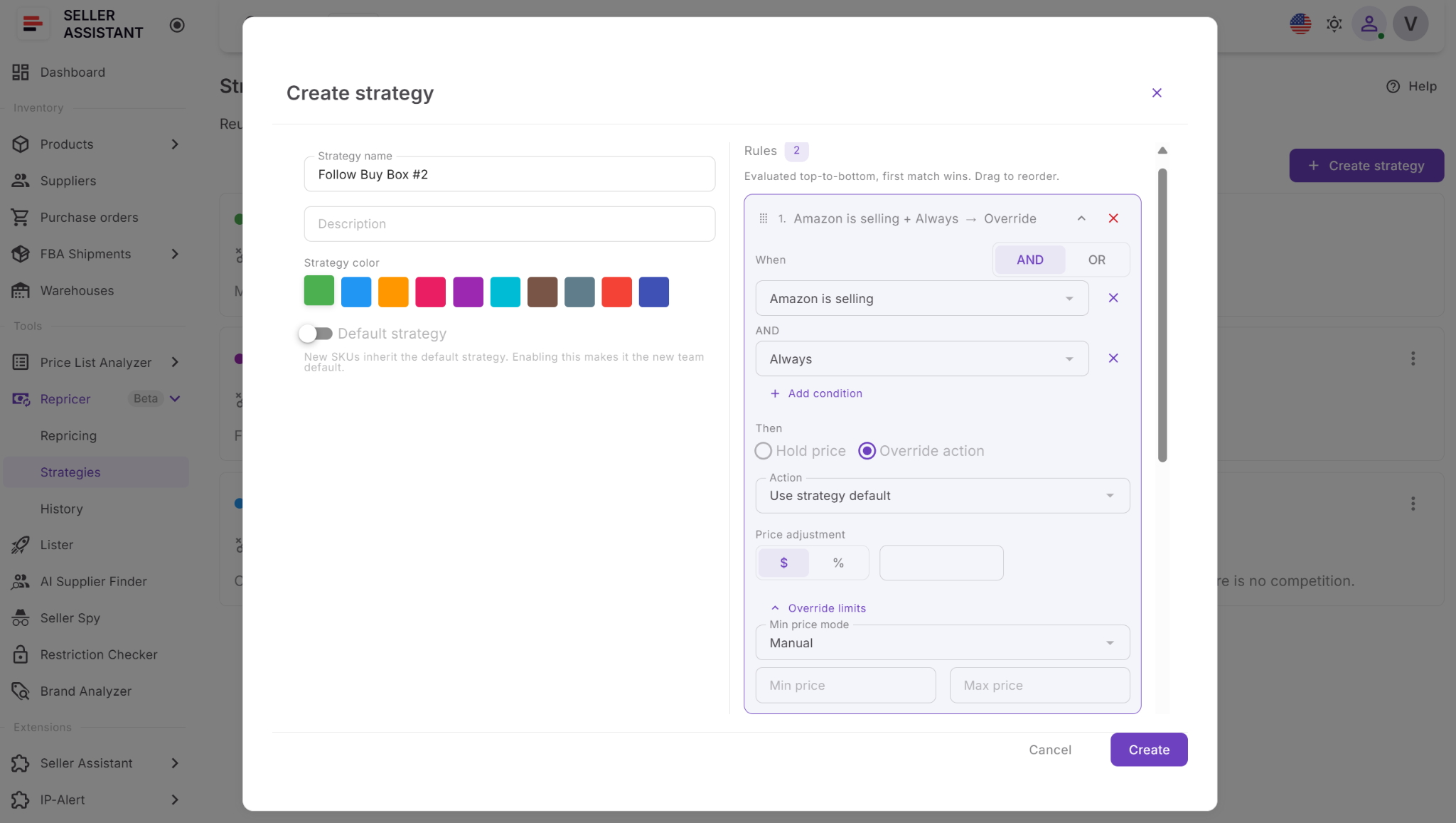
For example, a seller could hold the price when Amazon is selling, use different logic when there is no competition, or change pricing behavior overnight. If no conditional rule matches, the strategy applies its default action.
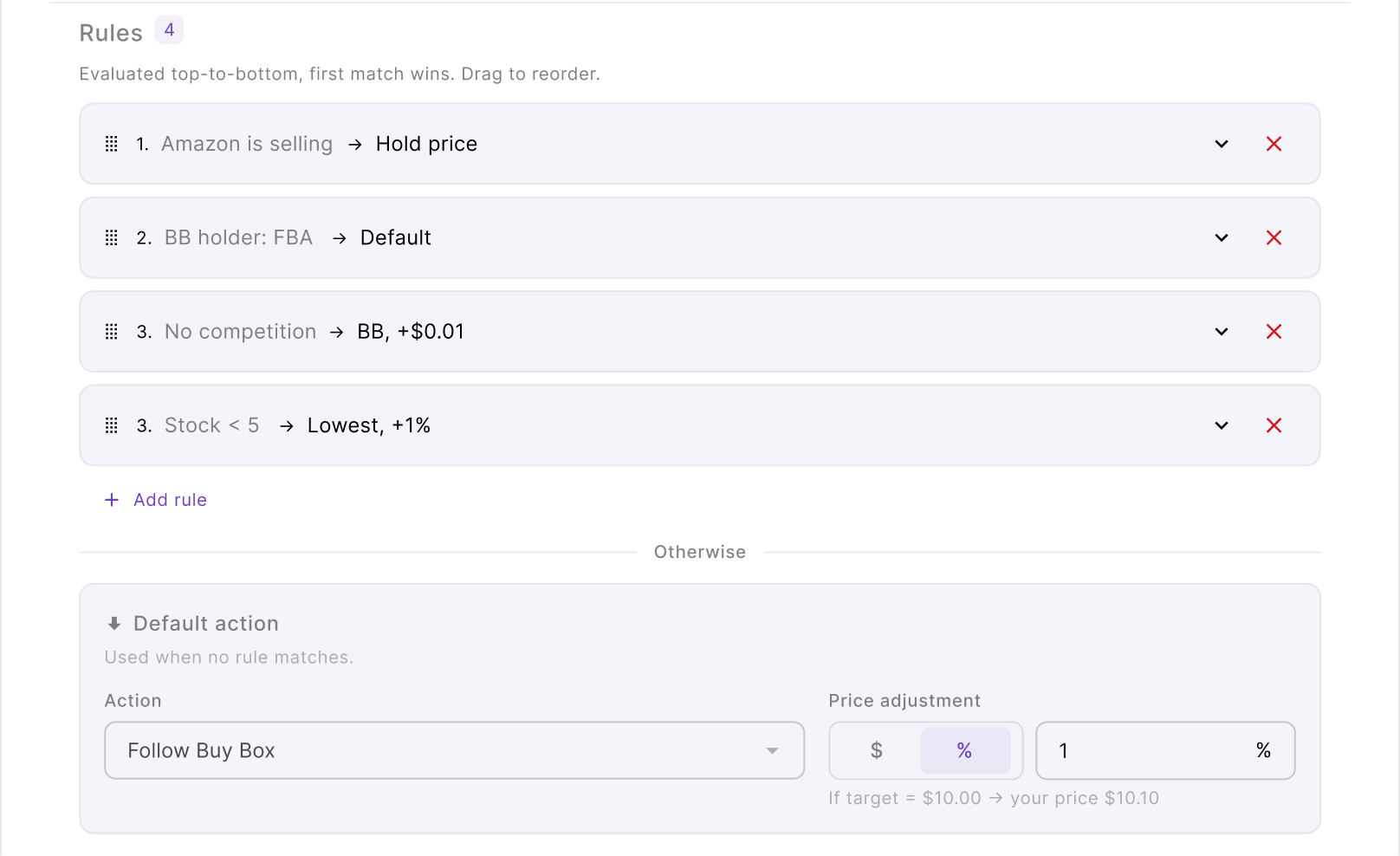
Pricing actions and limits
Seller Assistant can Follow Buy Box, Follow Lowest Price, or follow Amazon’s suggested price (FOEP). Sellers can match the target exactly or apply a fixed-dollar or percentage adjustment, while Hold Price keeps the current price when a rule calls for no repricing.
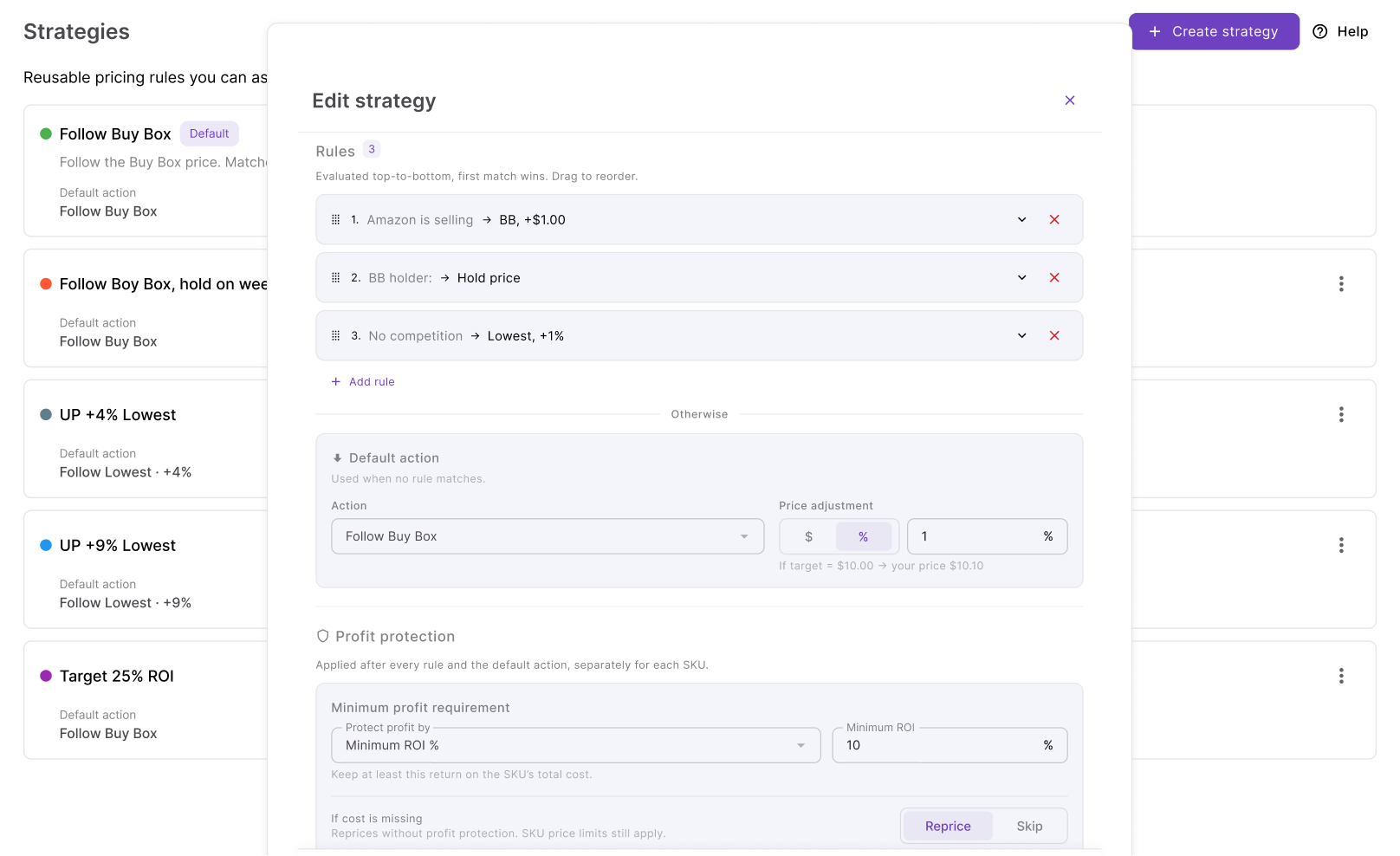
Each strategy also defines how far pricing is allowed to move. The minimum price can be set manually or calculated dynamically using minimum ROI, minimum margin, or target profit, with an additional safety minimum and maximum price. Sellers can also define what happens when cost data is missing and limit the maximum price change allowed in a single repricing action.
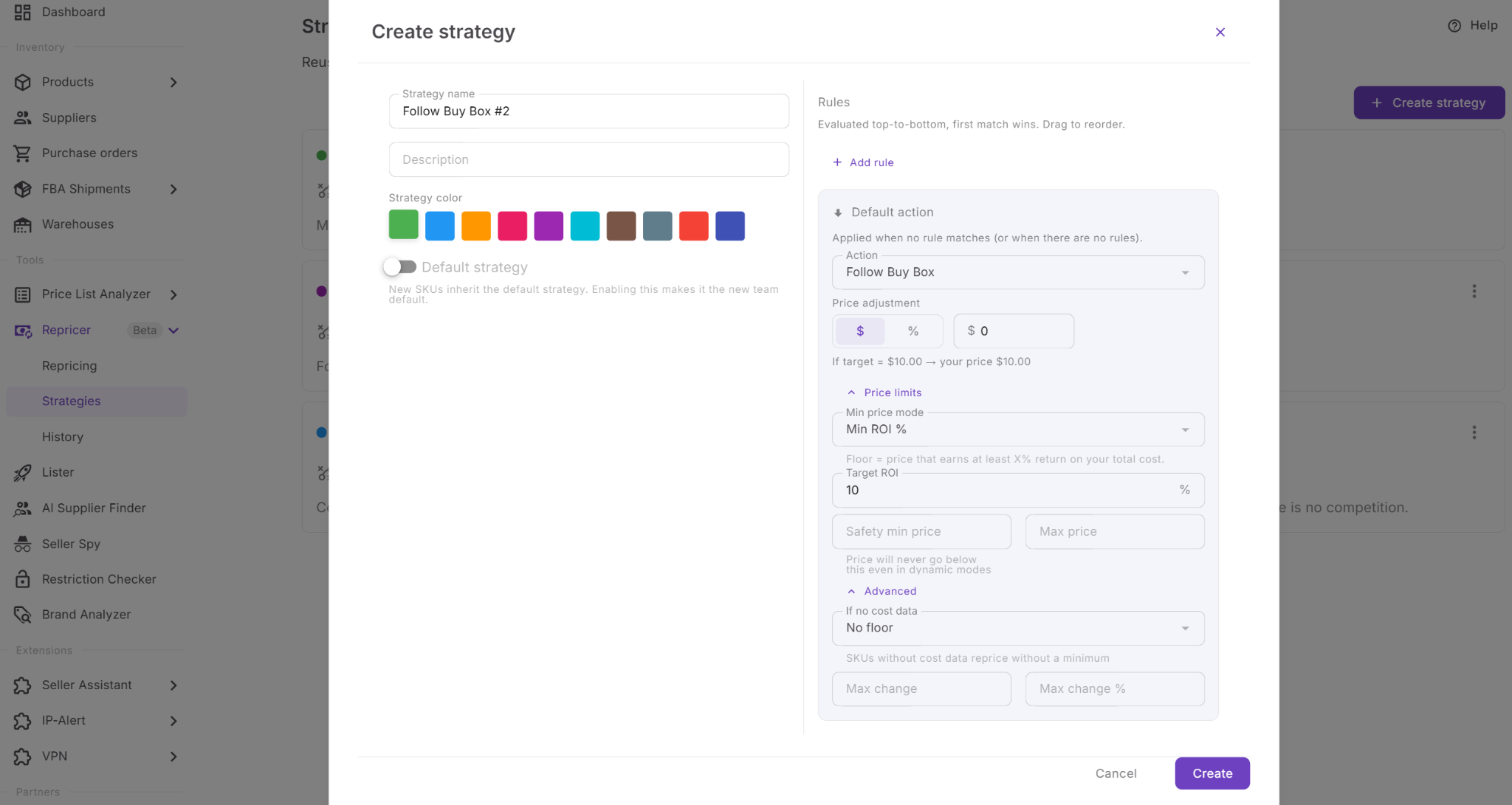
Profit protection and landed cost
Profit protection sits underneath those competitive rules. Sellers can set SKU-level minimum and maximum prices, while strategies can calculate an effective minimum based on landed cost and required profit, ROI, or margin. This prevents an aggressive competitor from automatically dragging your offer below the financial floor you have set.
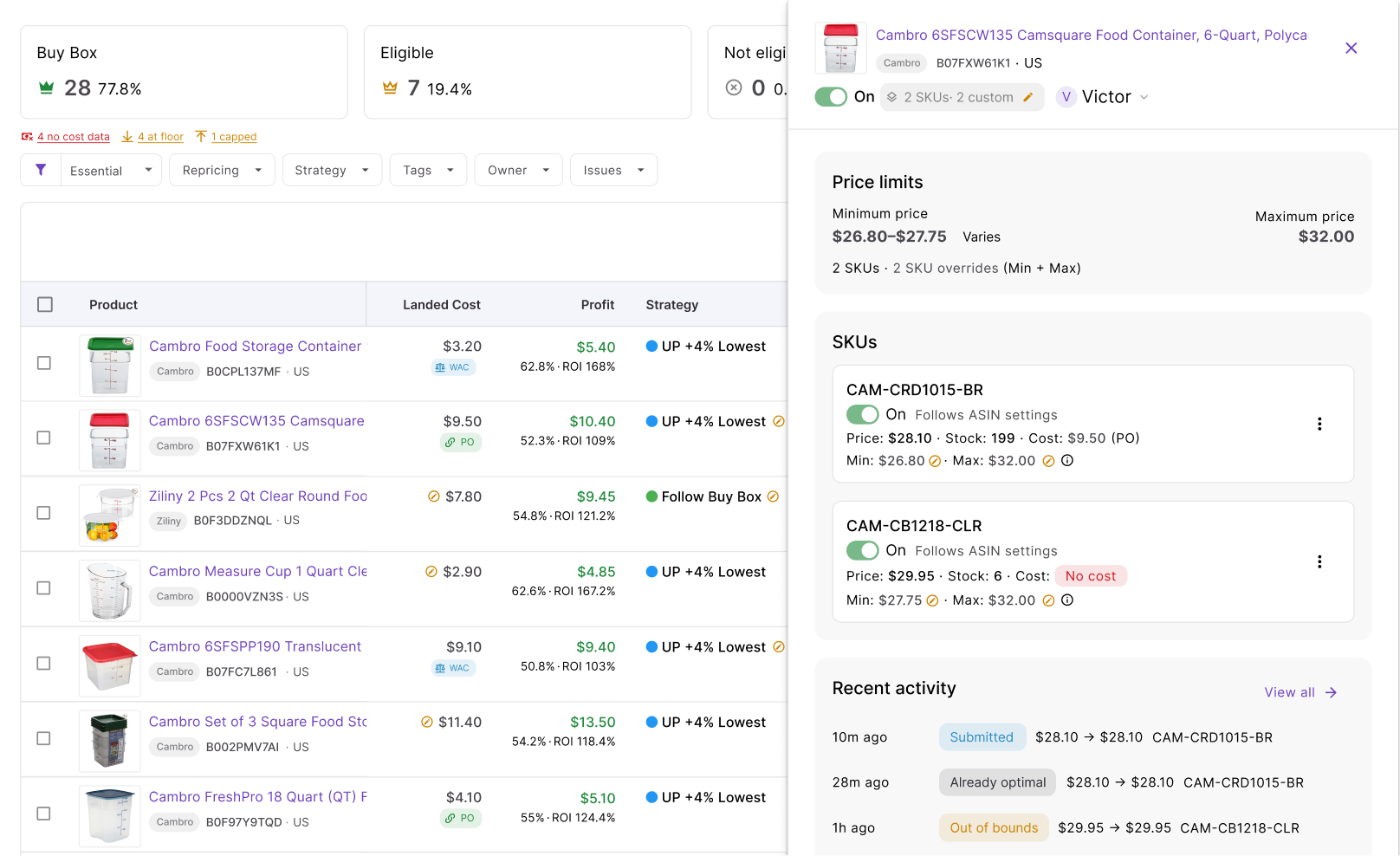
Landed cost can come from connected purchase order data or be entered at SKU level. Seller Assistant can then show profitability at current, minimum, and maximum price points, so the Repricer is working with actual cost context rather than competitor prices alone.
Reactive and proactive repricing
The system uses both reactive and proactive repricing. Its primary mode reacts when Amazon market data changes, with a response typically in the range of about 2–5 seconds. Periodic proactive checks also cover quieter listings where there may be no new competitor event to trigger an immediate repricing decision.
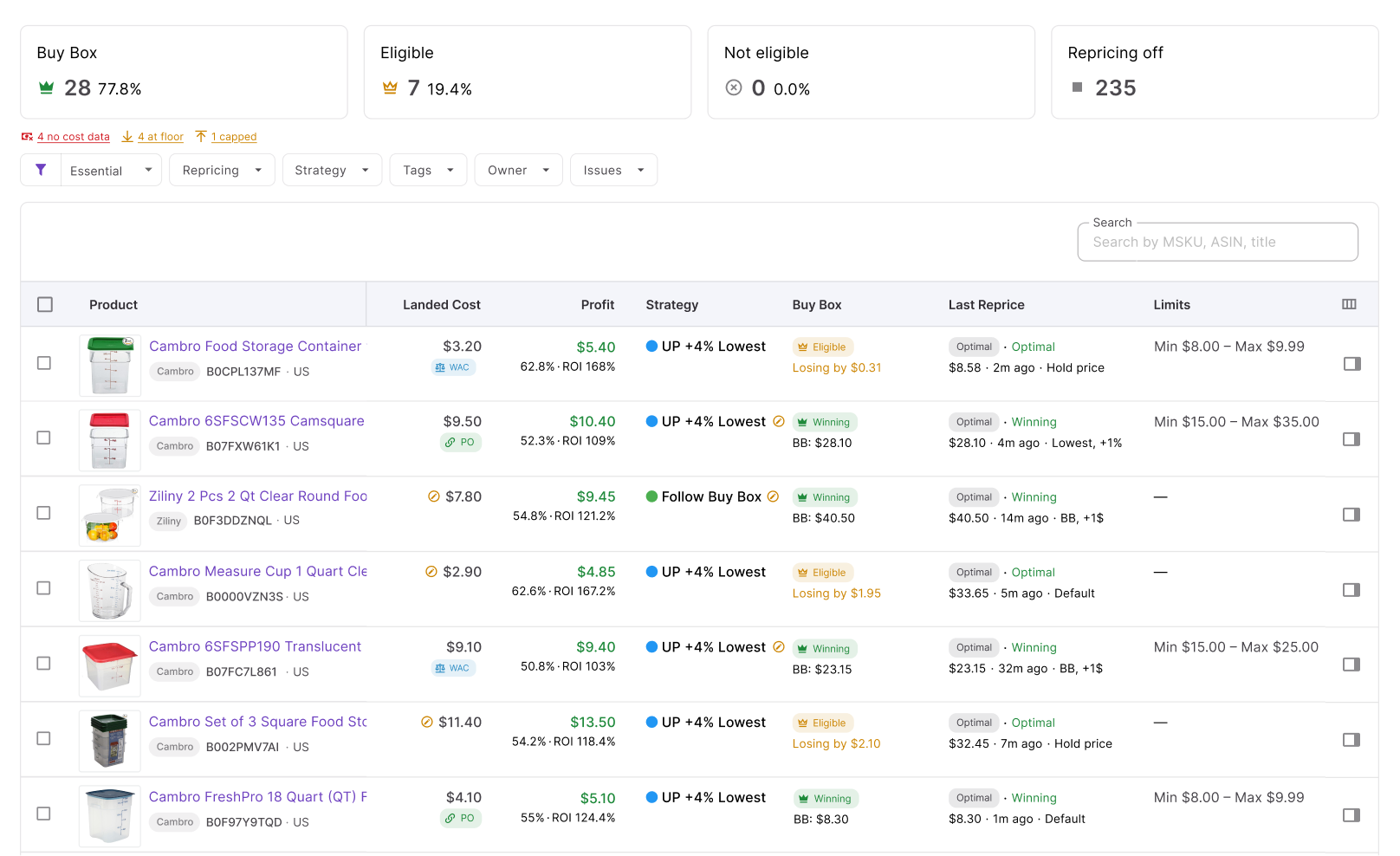
Repricing history and decision tracking
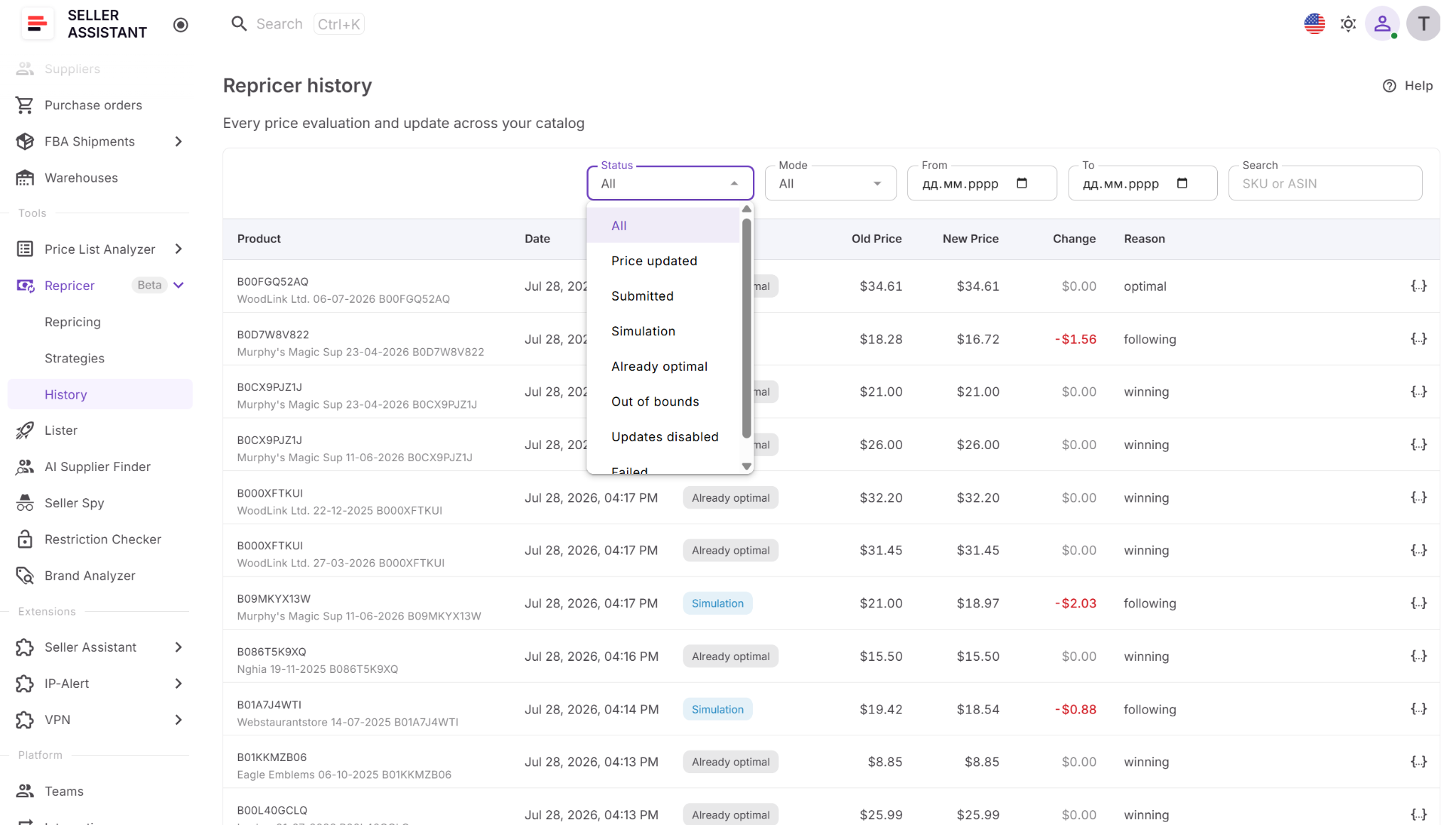
The Repricer keeps a detailed history of pricing decisions for each product, showing how the price changed and which rules were applied. Sellers can use this audit trail to understand why a specific repricing action occurred, investigate unexpected changes, and refine their strategies over time.
Key benefits of Seller Assistant Repricer
| Benefit | How It Helps Amazon Resellers |
|---|---|
| 2–5 second reaction time | Responds quickly when Buy Box or competitor conditions change instead of waiting for a long polling cycle |
| Reactive + proactive repricing | Handles fast-moving listings while still revisiting quiet ASINs where no immediate market event occurs |
| Conditional if/then rules | Lets one strategy respond differently to Amazon, FBA/FBM competitors, stock levels, competition, and other conditions |
| First-match rule logic | Applies rules in a predictable order, making complex strategies easier to control |
| Multiple pricing targets | Follow Buy Box, Lowest Price, or Amazon Suggested Price rather than relying on a single repricing model |
| Dollar and percentage adjustments | Price above or below a target without being forced to simply match or undercut it |
| Hold Price action | Gives you a deliberate way to stay put when changing price would not support your strategy |
| Profit protection | Uses profit, ROI, or margin requirements to help keep pricing above an acceptable floor |
| Landed-cost-aware repricing | Connects pricing decisions with unit cost, PO expenses, prep, FBA inbound cost, and other SKU-level costs |
| Effective minimum and maximum prices | Keeps repricing inside a controlled range instead of letting competition dictate the entire price |
| Buy Box and competitor visibility | Shows Buy Box status, price, competitors, lowest price, and related market signals in the same workspace |
| Profitability visibility | Lets you see profit, ROI, and margin around current and limit prices before judging whether a price is worth chasing |
| Issue detection | Flags situations such as missing cost data, hitting the pricing floor, being capped, or possible price-war conditions |
| Repricing history | Records price changes and applied logic so you can review why the Repricer made a decision |
| Connected wholesale workflow | Uses data already available in Seller Assistant, including SKUs, Purchase Orders, landed costs, products, inventory, and listings |
| Team-friendly management | Supports product ownership, filtering, tagging, and centralized monitoring for sellers managing catalogs with a team |
| Automatic coverage for new inventory | New SKUs can be brought into repricing automatically instead of requiring repeated manual setup |
How to Use Seller Assistant Repricer Step by Step
Once your products are available in Seller Assistant, you can configure how they should be repriced, organize responsibility across your team, check cost and pricing problems, and then activate automatic repricing. Here is the workflow.
Step 1. Go to Repricer
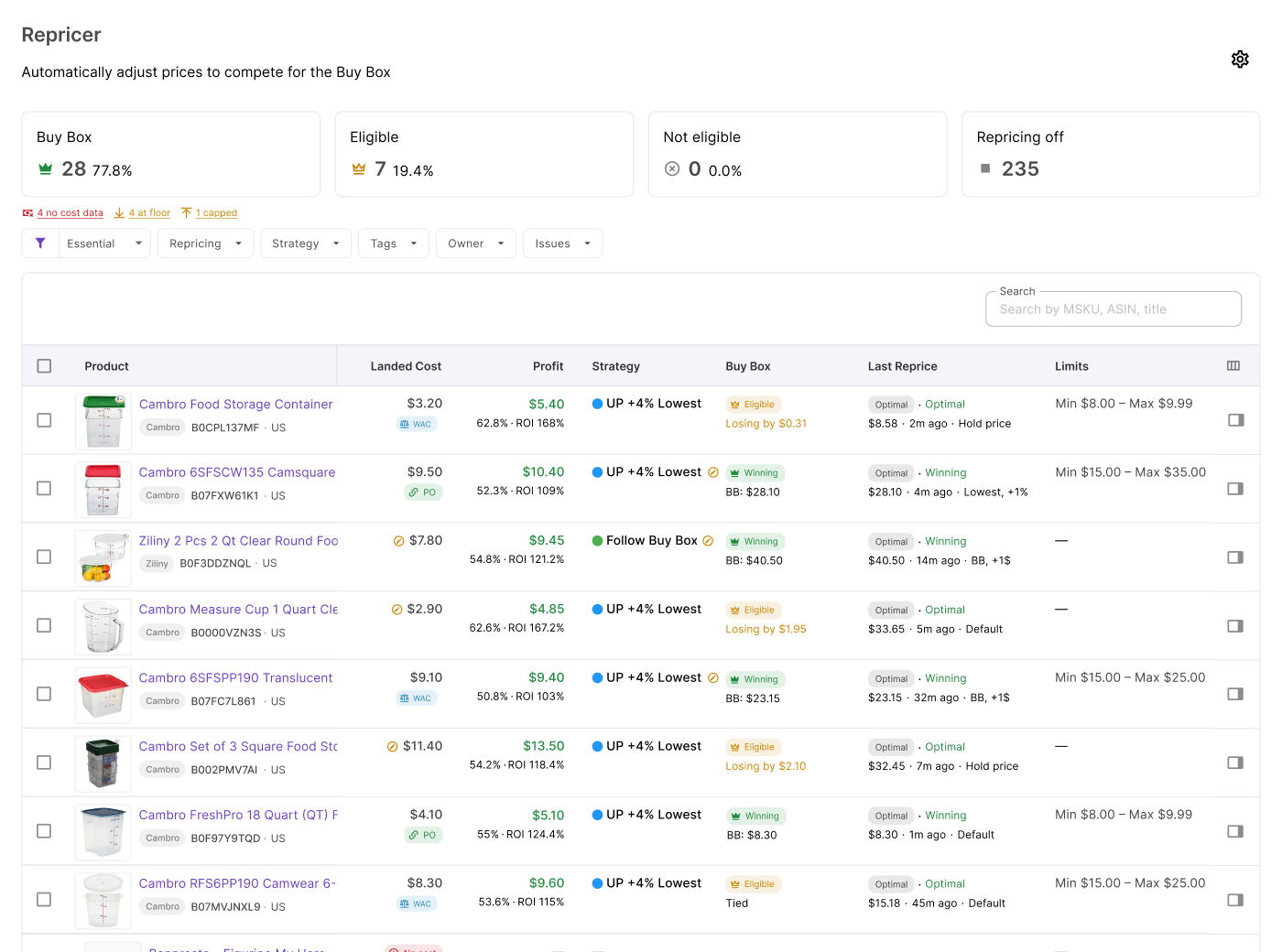
In your Seller Assistant account, open Repricer → Repricing. This is the main workspace where you can see your products, SKUs, repricing status, assigned strategies, owners, tags, and detected issues.
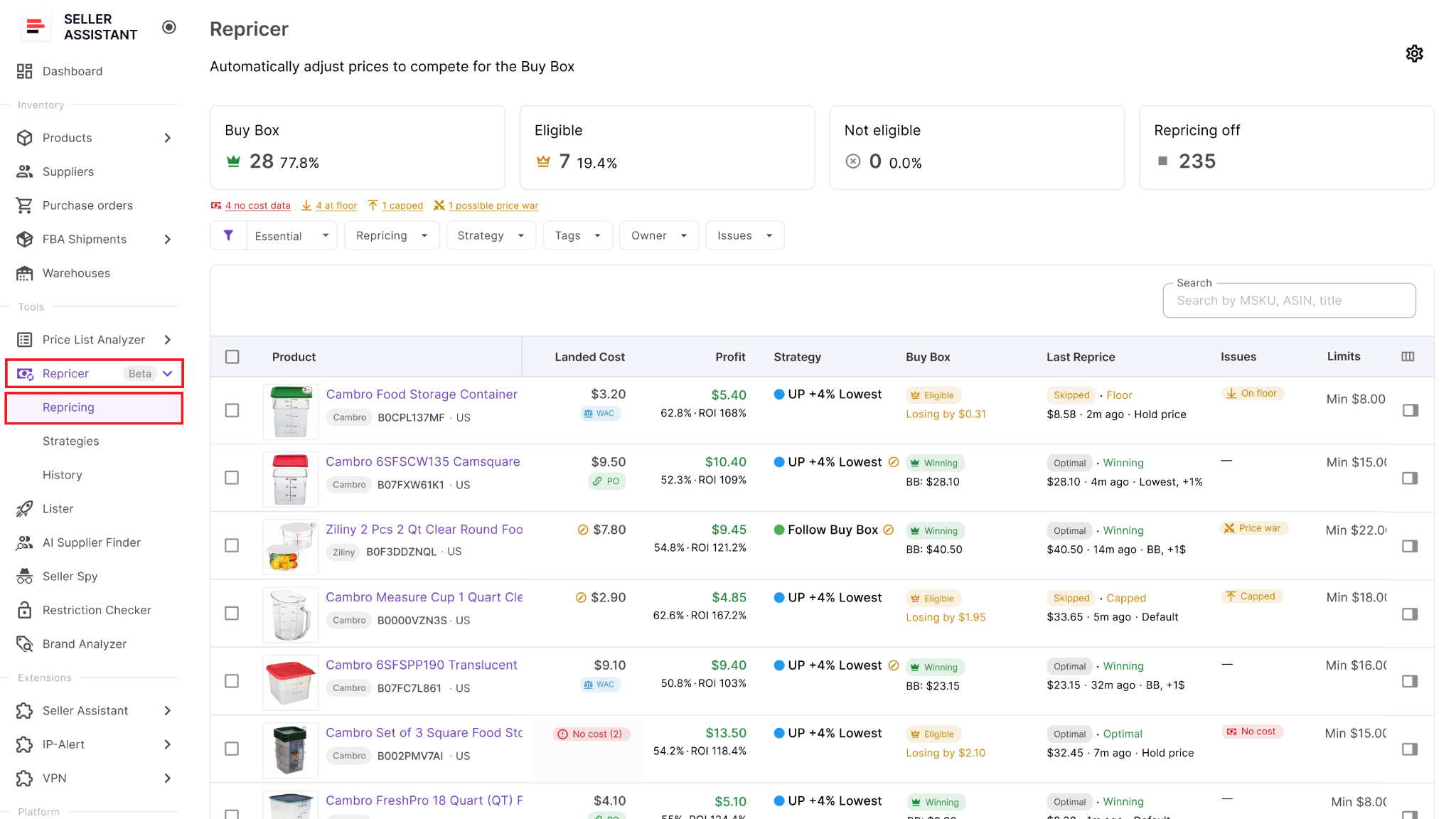
It gives you one place to configure repricing and monitor which products are ready before prices start changing.
Step 2. Turn repricing on in settings
Click the Settings icon and switch Repricing on for your team. You can also choose whether newly listed products should be automatically added to repricing or remain off until you enable them manually.
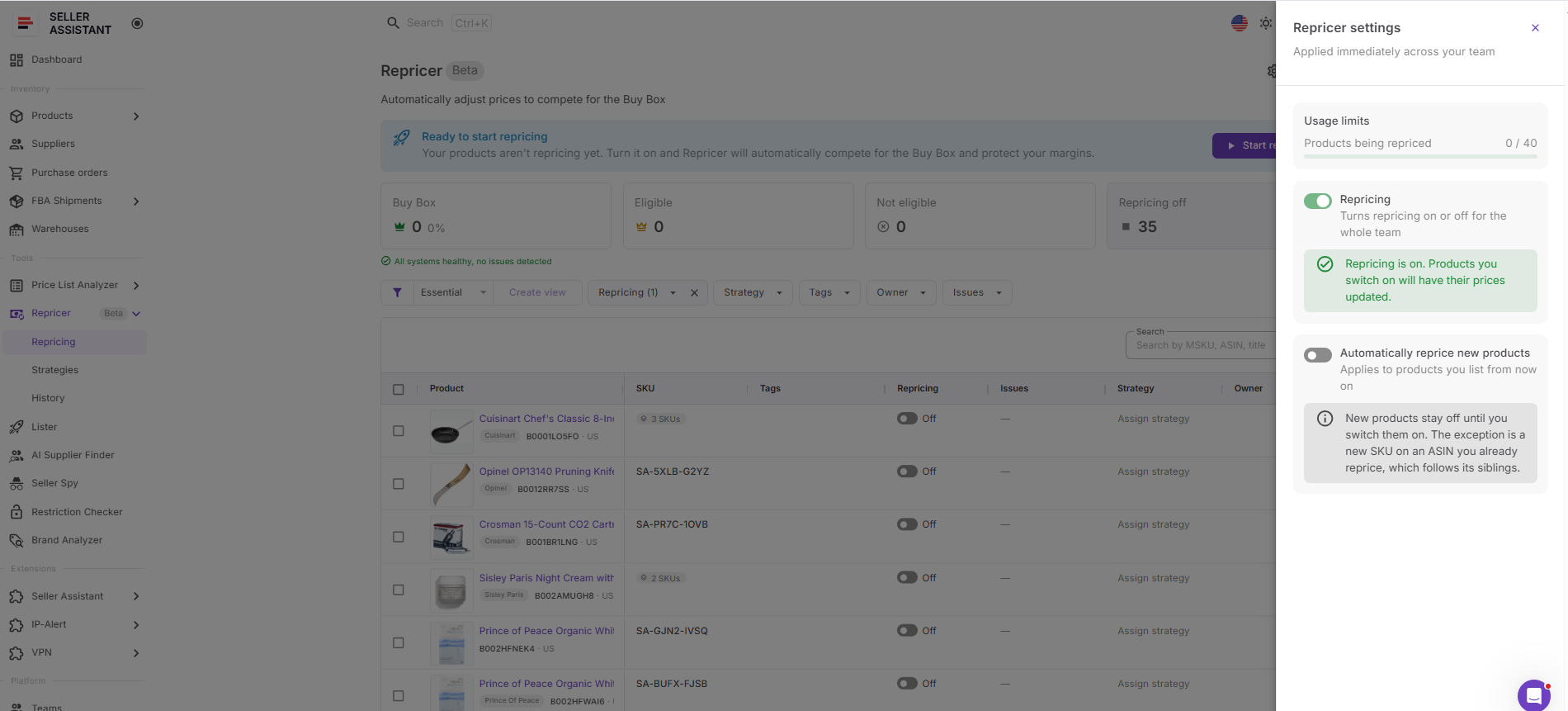
The team-level setting controls whether Repricer can update prices at all, while the new-product setting lets you decide how much control you want over newly added inventory.
Step 3. Select or create a strategy
Assign an existing strategy to a product from the Strategy column, or select Create new strategy. You can use a ready-made strategy as your starting point or create one for your own pricing approach.
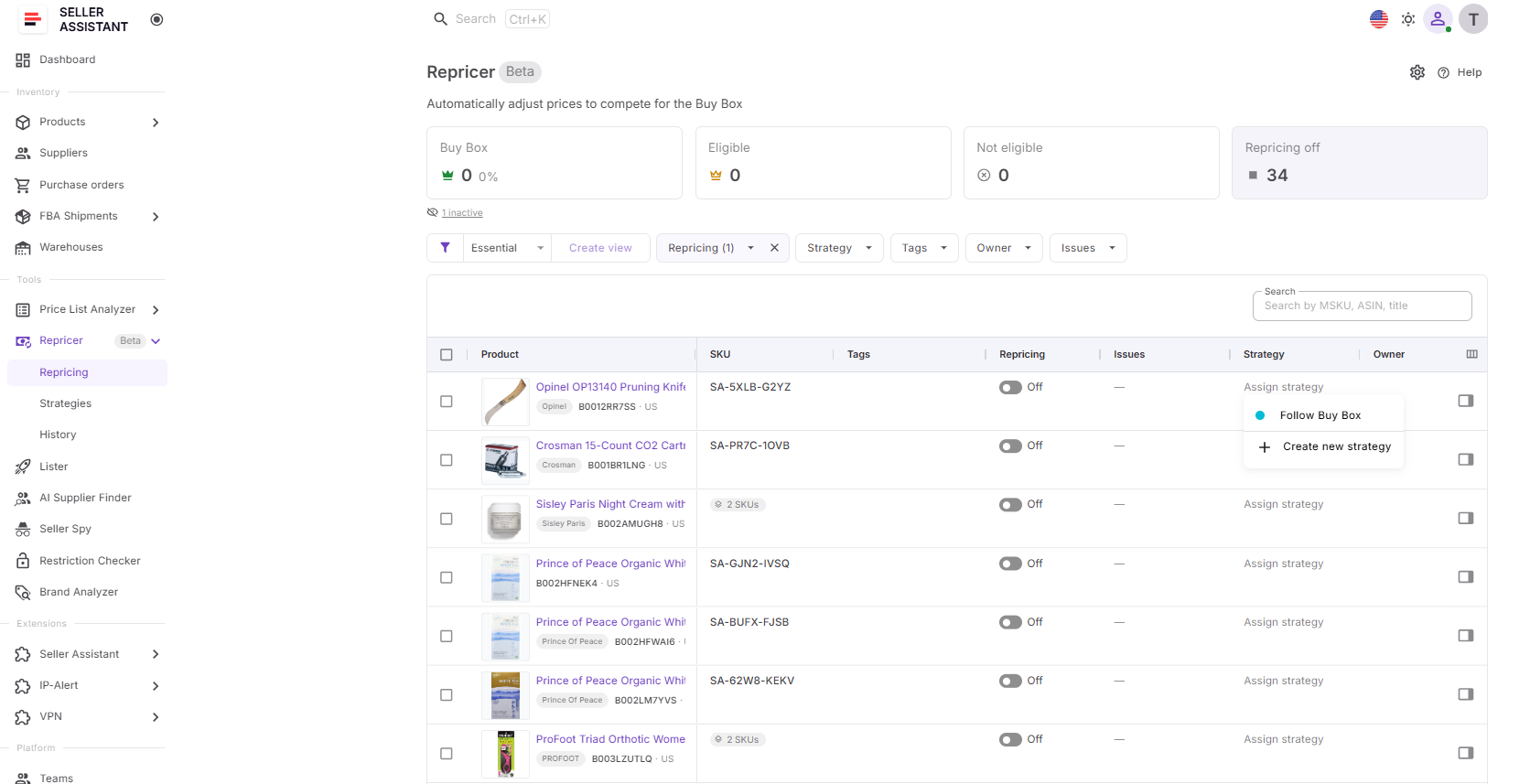
The strategy tells Repricer what pricing objective to follow instead of simply lowering prices whenever competition changes.
Step 4. Set your repricing rules and limits
Configure the conditions and actions inside the strategy. For example, you can hold the price when Amazon is selling, react differently depending on the Buy Box holder, raise prices when stock is low, or change behavior when there is no competition.
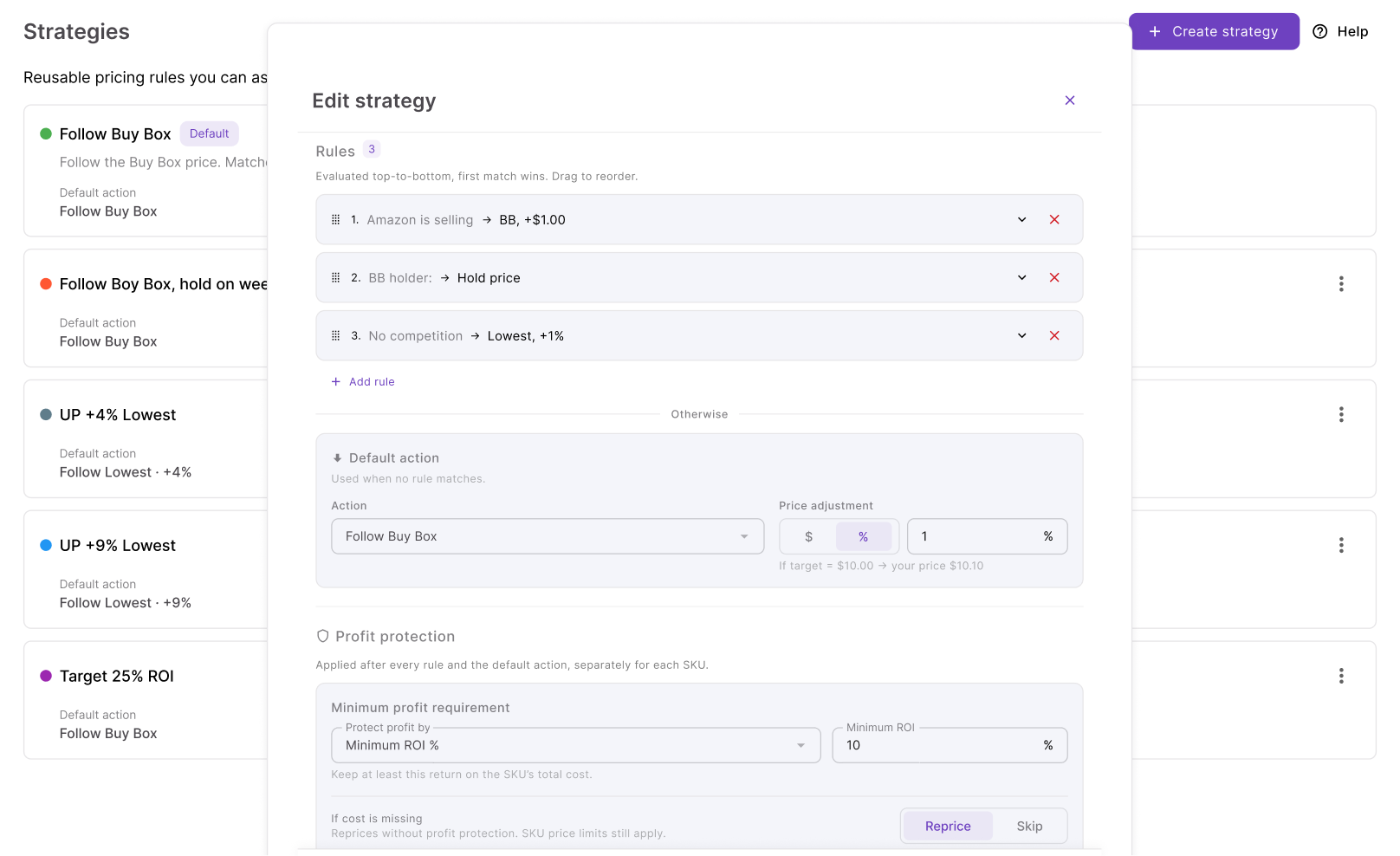
Set your minimum price logic, maximum price, and profit protection as well.
Rules determine when and how the price changes, while limits prevent the strategy from moving outside the boundaries you consider safe or profitable.
Step 5. Add tags and assign owners
Use Tags to group products by criteria relevant to your workflow, such as seasonal inventory or a particular sourcing group. Use Owner to assign products to specific team members.
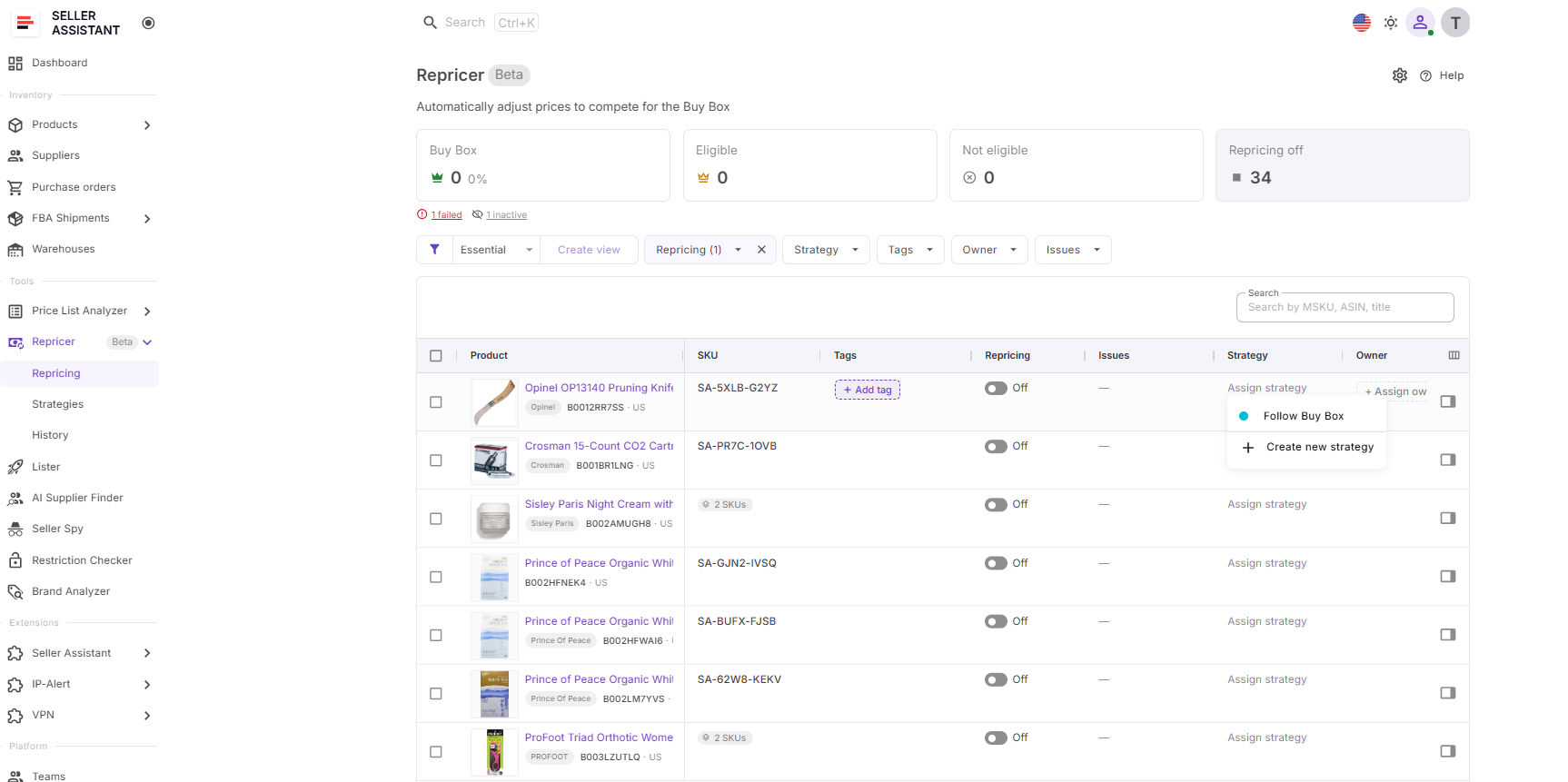
Tags make a large catalog easier to filter and manage, while owners make it clear who is responsible for monitoring particular products.
Step 6. Check landed cost
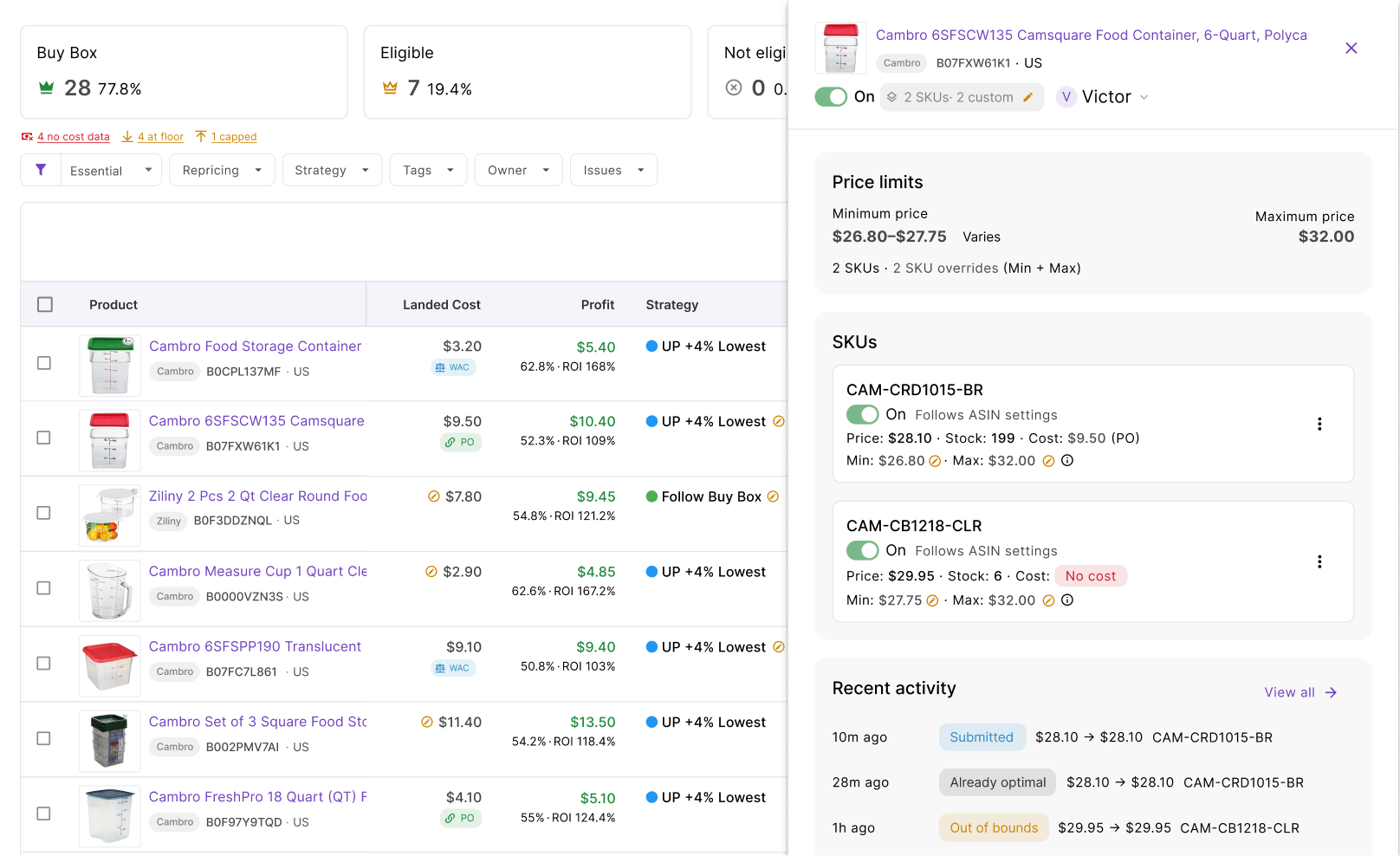
Review the Landed Cost for the products you plan to reprice. Seller Assistant can account for cost components such as unit cost, PO expenses, prep cost, and FBA inbound cost when the relevant data is available.
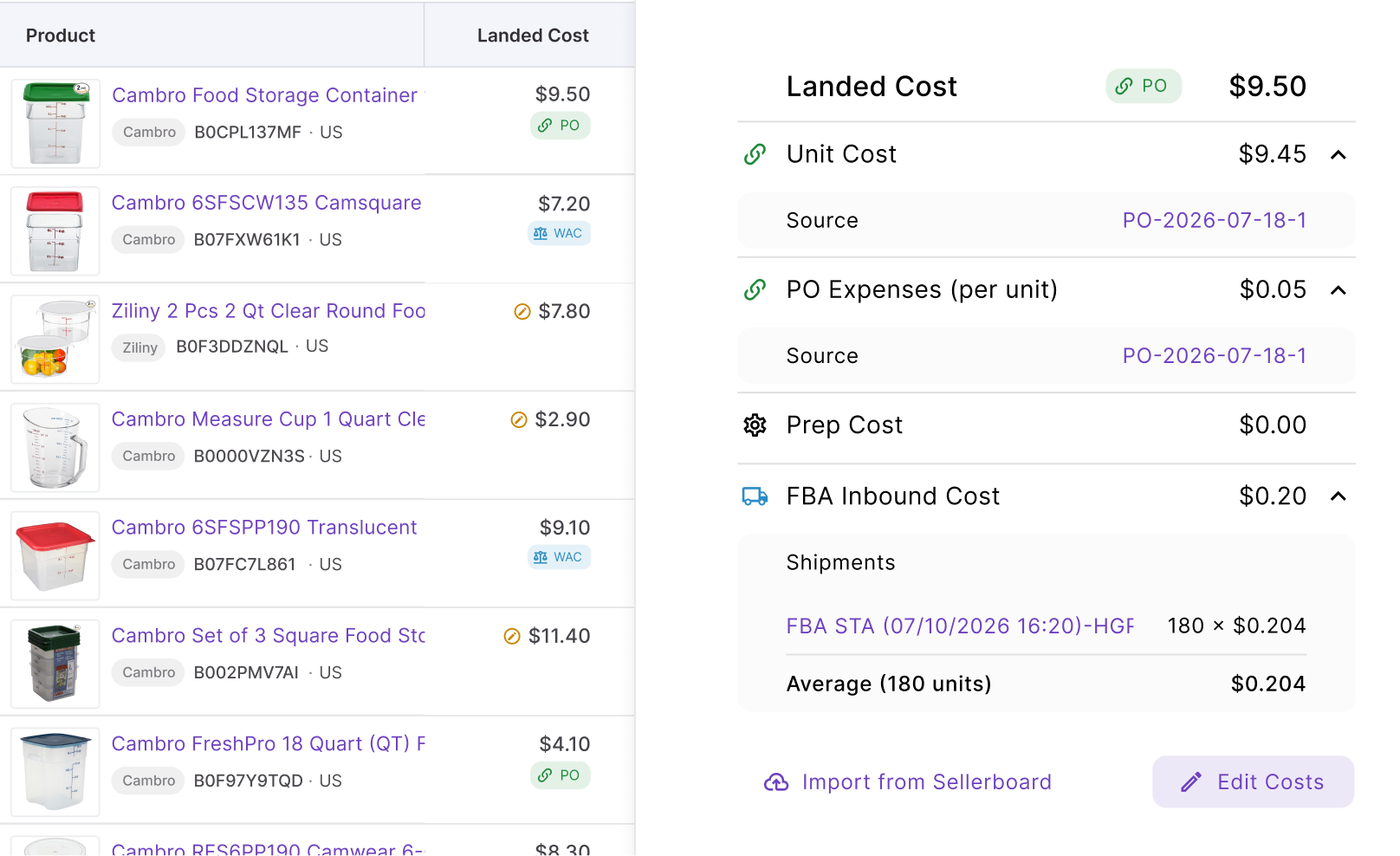
Repricing based only on competitor prices can protect the Buy Box while destroying margin. Accurate landed cost gives profit-, ROI-, and margin-based pricing rules a real cost basis.
Step 7. Catch and correct repricing issues
Check the Issues column and issue filters before activating products. Repricer can surface situations such as No cost, On floor, Capped, and a possible Price war, so you can identify products that need attention.
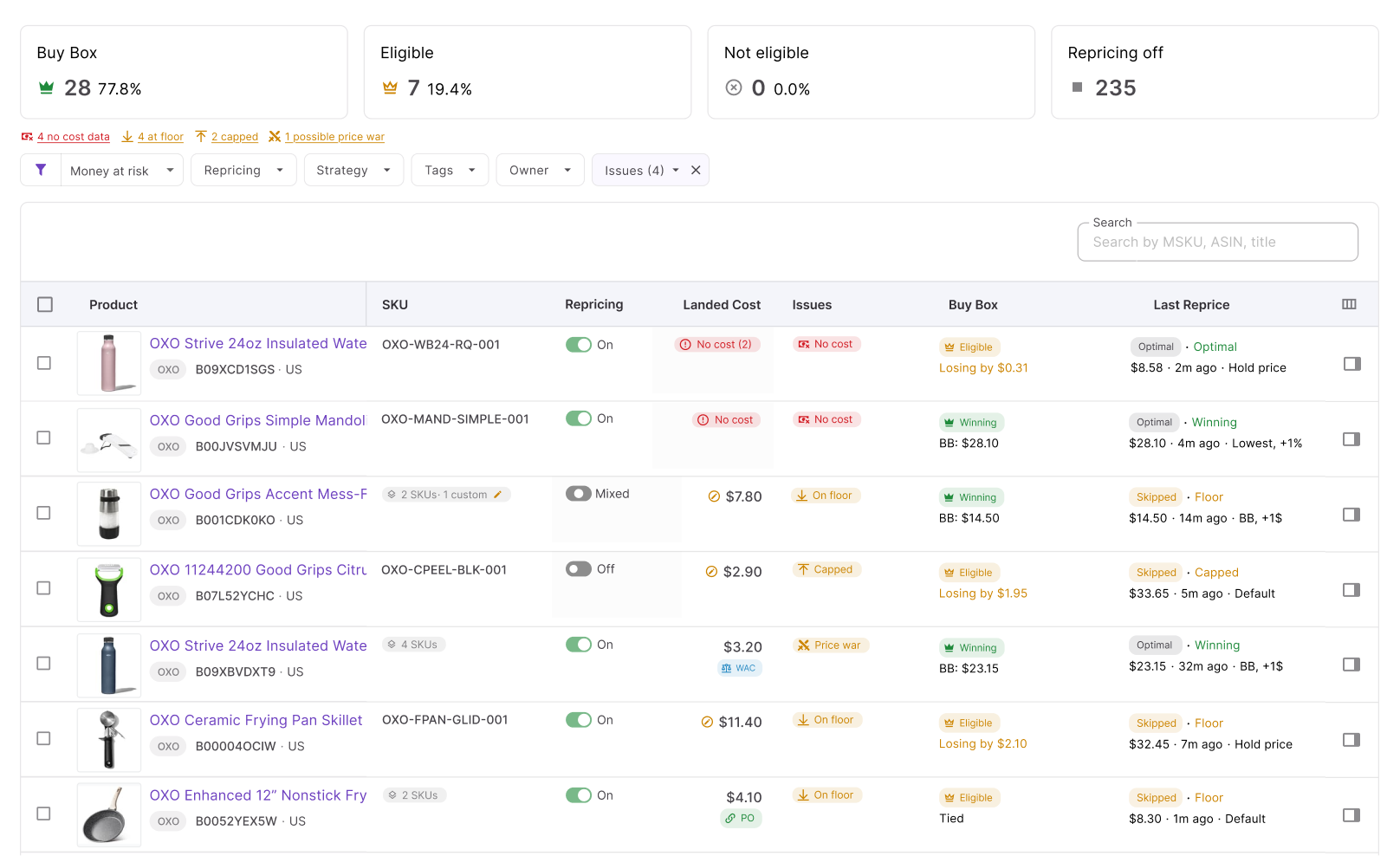
An issue may explain why a product cannot move to the expected price or why repricing could produce an undesirable result. Fixing these problems first gives your strategy better data and safer boundaries to work with.
Step 8. Start repricing
When your strategies, costs, rules, and limits are ready, enable repricing for the products you want to automate and click Start repricing. Confirm the products that will be activated; you can also choose whether new products should be automatically repriced going forward.
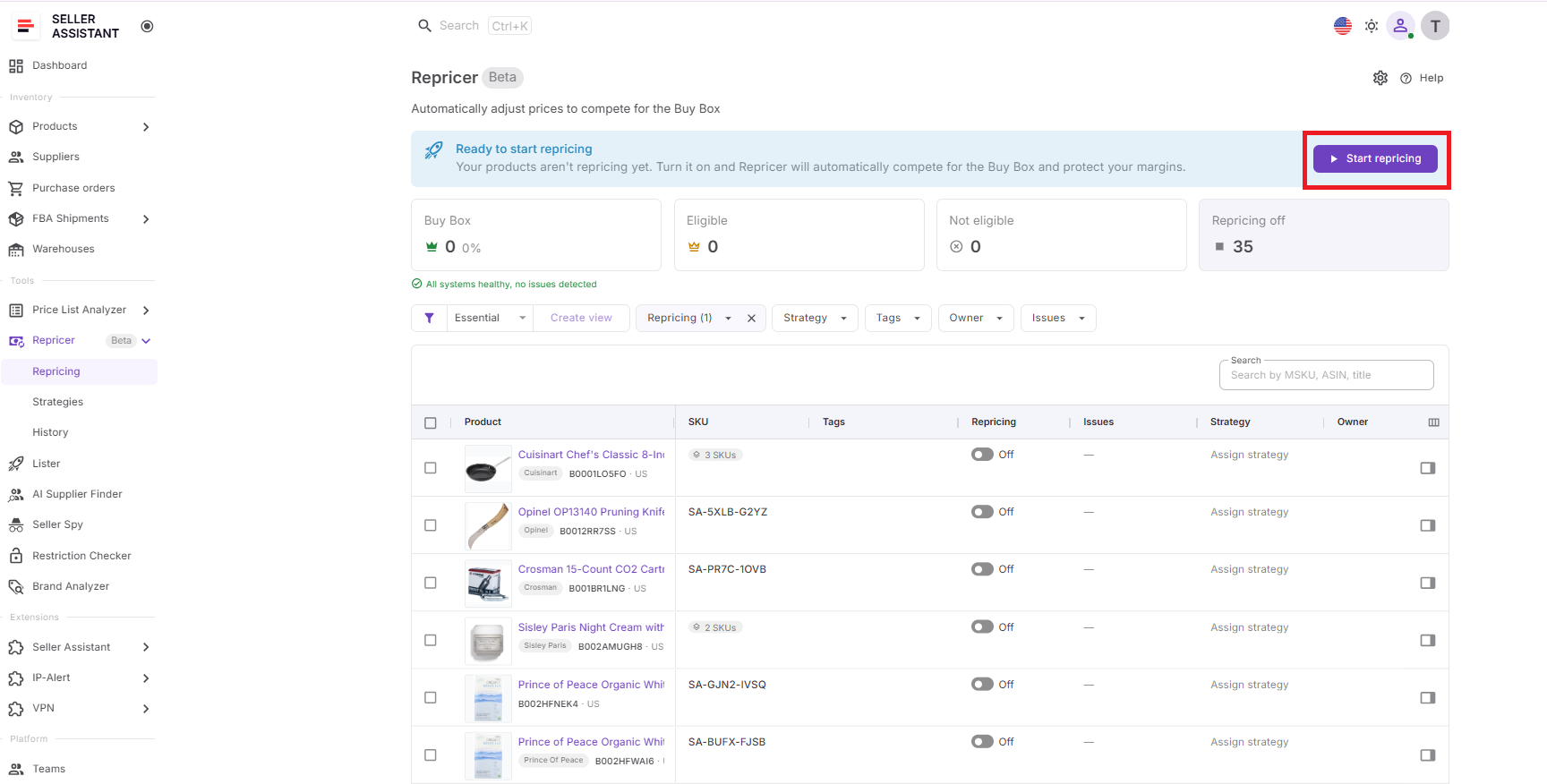
This is the point when your setup becomes active and Seller Assistant begins adjusting prices according to the strategies and safeguards you configured.
FAQ
How often should you review your Amazon repricing strategy?
Review it whenever your costs, inventory position, competitive environment, or sales goals change significantly. Even automated repricing benefits from periodic checks to make sure the underlying rules still match your business priorities.
Can Amazon prices change even when competitors do not change theirs?
Yes. Buy Box conditions can shift because of factors beyond the displayed product price, including fulfillment method, shipping terms, seller performance, and offer availability, so a static competitor price does not necessarily mean the competitive situation is static.
Should every Amazon SKU use the same repricing strategy?
Usually not, because high-stock, low-stock, fast-moving, seasonal, and high-margin products may require different pricing behavior. Segmenting SKUs lets you pursue the Buy Box aggressively where appropriate while taking a more margin-focused approach elsewhere.
Can a higher-priced offer win the Amazon Buy Box?
Yes, because Amazon does not determine the Buy Box winner using price alone. Fulfillment, delivery speed, seller performance, inventory availability, and other offer-level factors can allow a higher-priced seller to remain competitive.
When should you avoid undercutting the lowest Amazon price?
Avoid automatically undercutting when the lowest offer would push you below your required profit level or when competing sellers are already engaged in aggressive price reductions. In these situations, holding or raising your price can be preferable to following competitors into an unprofitable price war.
Final Thoughts
Tracking Amazon competitor pricing is most useful when monitoring and action happen together. Knowing that the Buy Box changed or a competitor lowered their price has limited value if you cannot respond quickly, while repricing without accurate costs and clear limits can turn competition into lost margin.
For wholesale and online arbitrage sellers managing many SKUs, an Amazon repricer removes much of that manual work. Seller Assistant Repricer brings competitor-driven pricing together with landed cost, profitability metrics, configurable strategies, pricing rules, issue detection, and repricing history, so pricing decisions stay connected to the economics of each product.
The goal is not simply to offer the lowest price. It is to react to the market quickly enough to compete for the Buy Box while protecting the profit that makes each sale worthwhile.
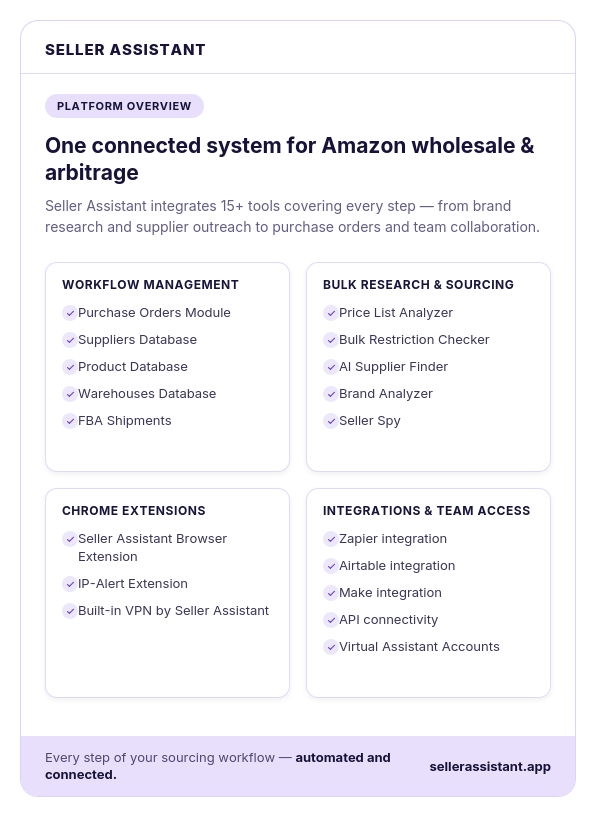
Seller Assistant automates and connects every stage of your Amazon wholesale and arbitrage workflow. It brings together in one platform: workflow management tools – Purchase Orders Module, Suppliers Database, Product Database, Warehouses Database, FBA Shipments, bulk research & sourcing tools – Price List Analyzer, Bulk Restriction Checker, AI Supplier Finder, Brand Analyzer, Seller Spy, Chrome extensions – Seller Assistant Browser Extension, IP-Alert Extension, and built-in VPN by Seller Assistant, and integrations & team access features – seamless API connectivity, integrations with Zapier, Airtable, and Make, and Virtual Assistant Accounts.