

Pet supply wholesalers and distributors for Amazon sellers are the brands, authorized distributors and wholesalers that sell branded pet food, treats, toys and care products by the case to resellers. You find them brand by brand, verify each one, and check its price list against Amazon before you order. In pet, the Buy Box comes first. According to Seller Assistant’s State of Amazon Wholesale (Q3 2026), Pet Supplies gives more leads than the all-category average, but on 62.4% of its listings with Buy Box history one seller wins the Buy Box 80% of the time or more.
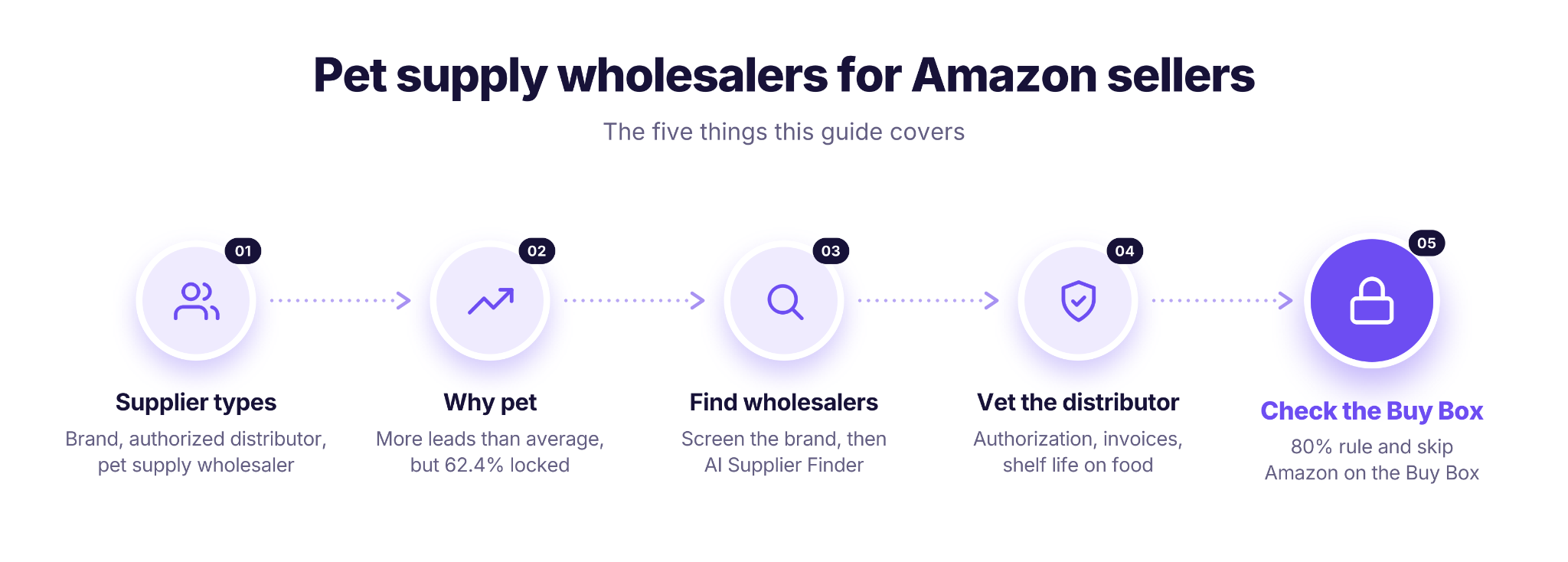
Search results for pet wholesale mostly help pet stores and groomers fill their shelves. Here, the focus is on reselling on Amazon. You’ll learn how to find a distributor for each pet brand, what to check before you open an account, and how to spot listings you can’t win before you buy.
What a Pet Supply Distributor Is for an Amazon Seller
A pet supply distributor is a company that buys pet products from brands and sells them in bulk to retailers. When you resell on Amazon, your supplier will usually be one of three types.
Where pet products come from
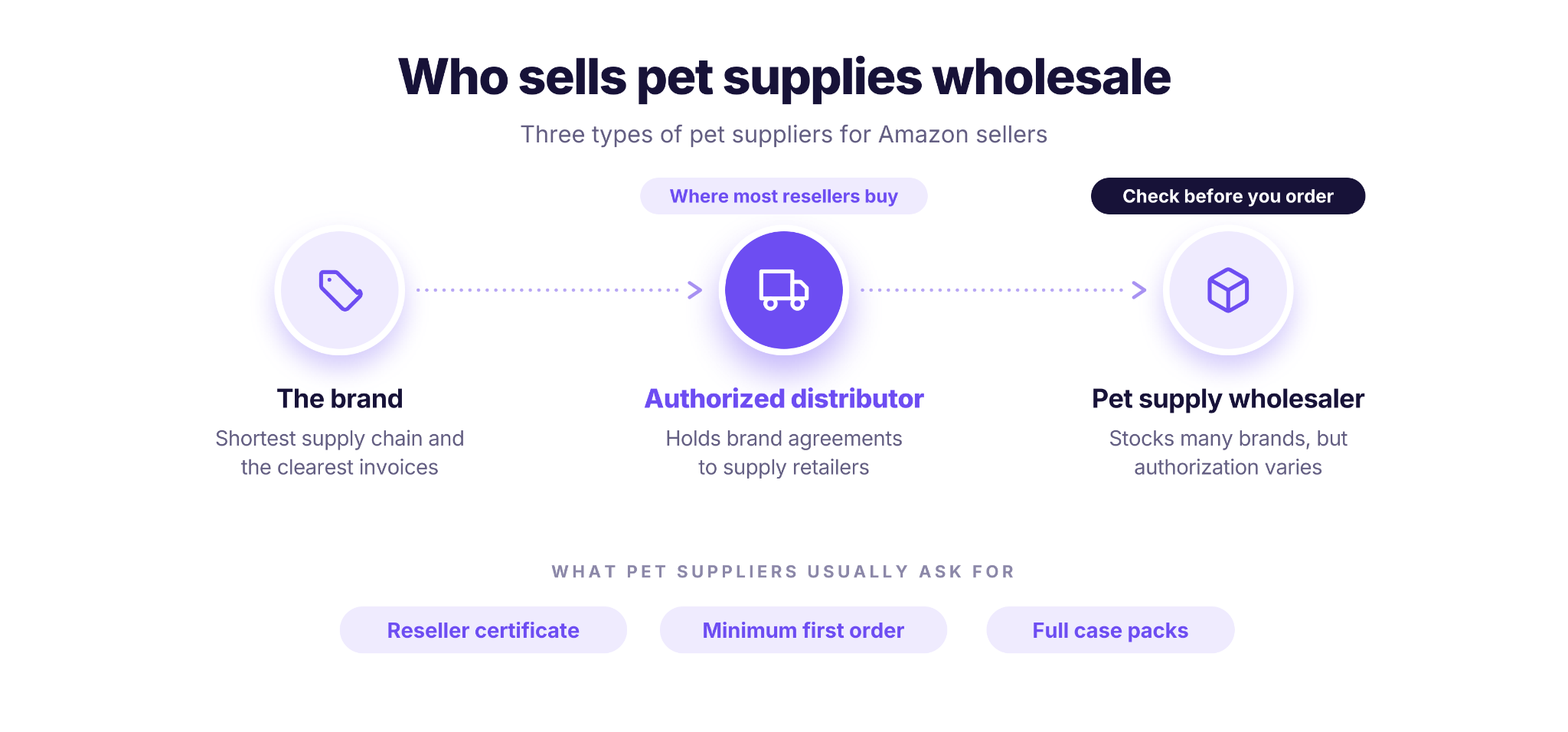
- The brand. Some pet brands open wholesale accounts for resellers directly. Buying from the brand gives you the shortest supply chain and invoices that show where the stock came from.
- Authorized distributors. Pet product distributors hold agreements with brands to supply retailers, often across a whole region or the country. Many branded pet food, treats and toys reach resellers this way.
- Pet supply wholesalers. They stock many brands at once and sell to stores of all sizes. Range is their strength, but authorization can differ from brand to brand, so ask before you order.
Some pet brands sell only through pet specialty stores or veterinary clinics. Their pet supply distributors may not supply an online reseller at all.
What you need to open an account
Most pet suppliers ask for:
- a reseller certificate or sales tax ID
- a minimum first order
- full case packs, since pet products usually ship by the case
Why Pet Is a High-Lead, Hard-to-Win Category
Pet supplier price lists turn up more deals than the average category, but many of those listings are hard to win.
More leads than average
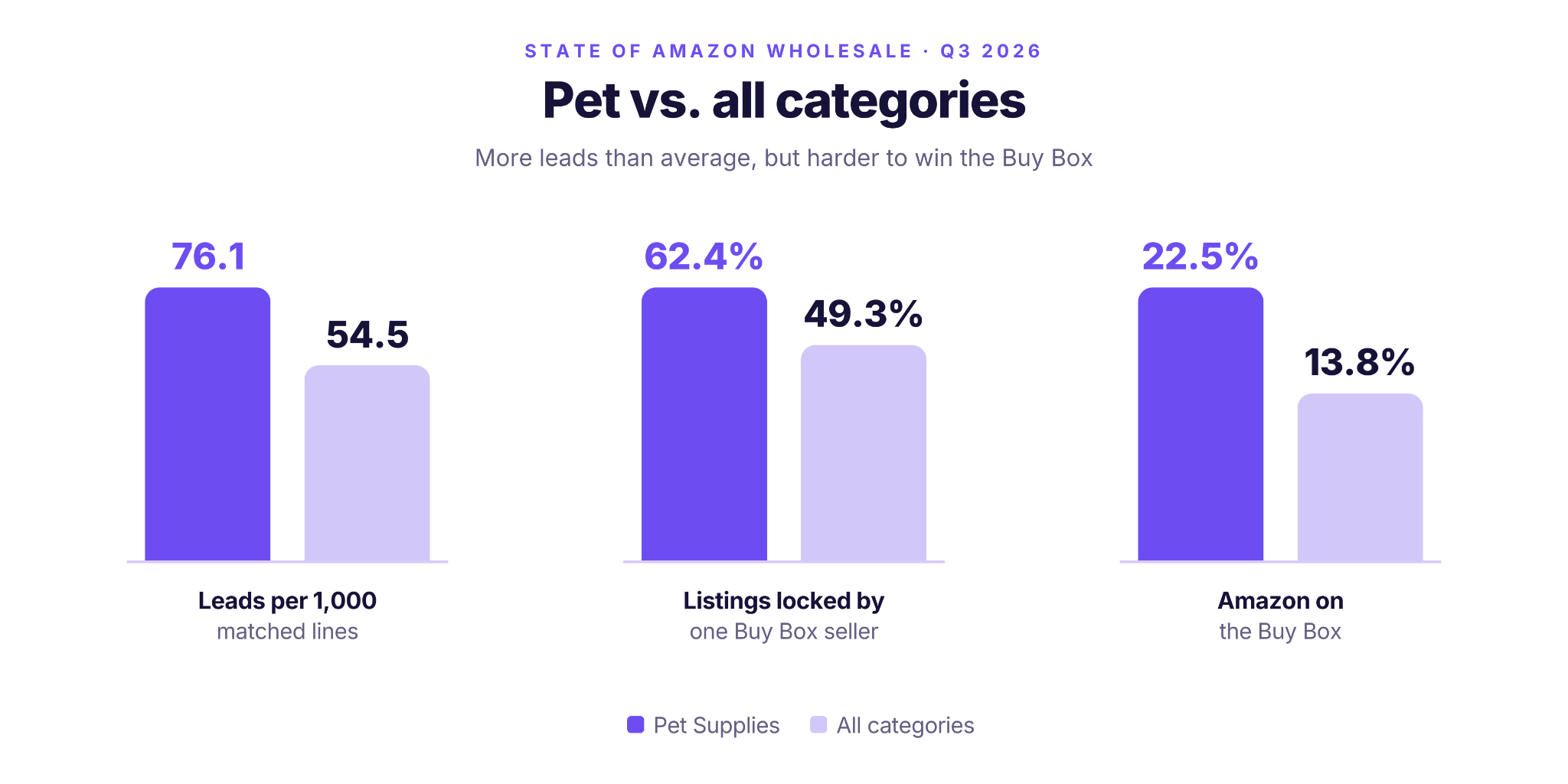
According to Seller Assistant’s State of Amazon Wholesale (Q3 2026), price lists of wholesale pet products give 76.1 leads per 1,000 matched lines, against 54.5 across all categories. A matched line is a price list line that has a listing on Amazon. A few large catalogs pull that average up. The median seller finds 51.2 leads per 1,000 matched lines.
Harder to win the Buy Box
Pet Supplies has the second-highest locked share in the report. Listings have 3 offers at the median, yet 62.4% of listings with Buy Box history are locked by one seller who wins the Buy Box 80% of the time or more. Only books is higher, at 63.8%.
| Measure | Pet Supplies | All categories |
|---|---|---|
| Leads per 1,000 matched lines | 76.1 | 54.5 |
| Listings locked by one Buy Box seller (of listings with Buy Box history) | 62.4% | 49.3% |
| Amazon on the Buy Box | 22.5% | 13.8% |
Amazon holds the Buy Box on more pet listings than average. The lead count already excludes those listings, but it still includes locked ones, so check who wins the Buy Box on each lead before you buy.
How to Find Pet Supply Wholesalers for a Brand
In Pet, which brand you pick matters as much as which supplier you buy from. A brand whose listings one seller already controls isn’t worth a supplier search, so screen it first, then look for its distributors.
Screen the brand first with Brand Analyzer
Brand Analyzer shows how competitive a brand is on Amazon across all its products, before you contact anyone.
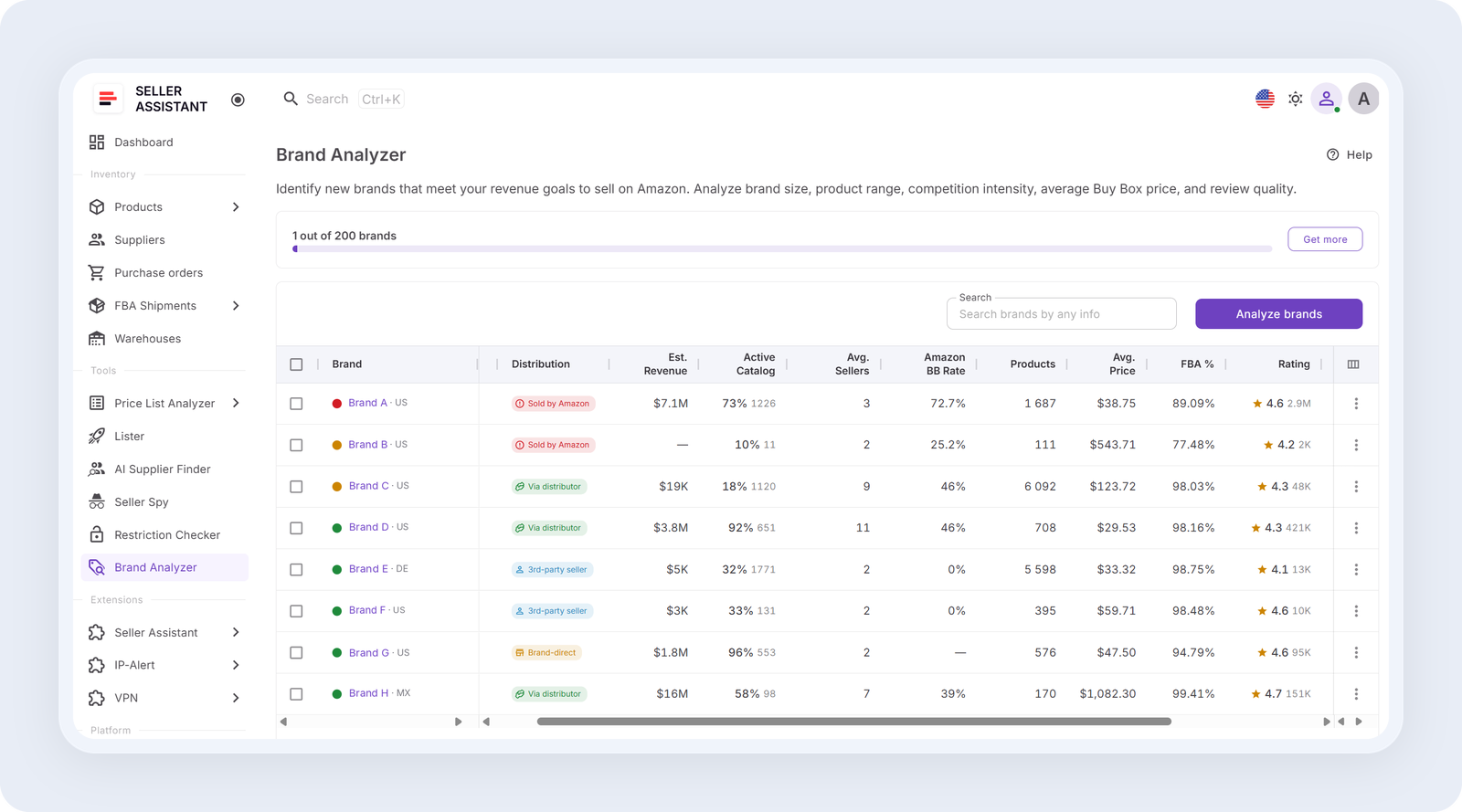
What to look at
- Top sellers: the sellers that win the most of the brand’s products, and whether each one is Amazon, the brand or a distributor.
- Amazon presence: the share of the brand’s listings where Amazon sells. You can also filter brands by Amazon’s Buy Box rate.
- Average sellers per listing and unique sellers: how many resellers compete on the brand.
How to read it
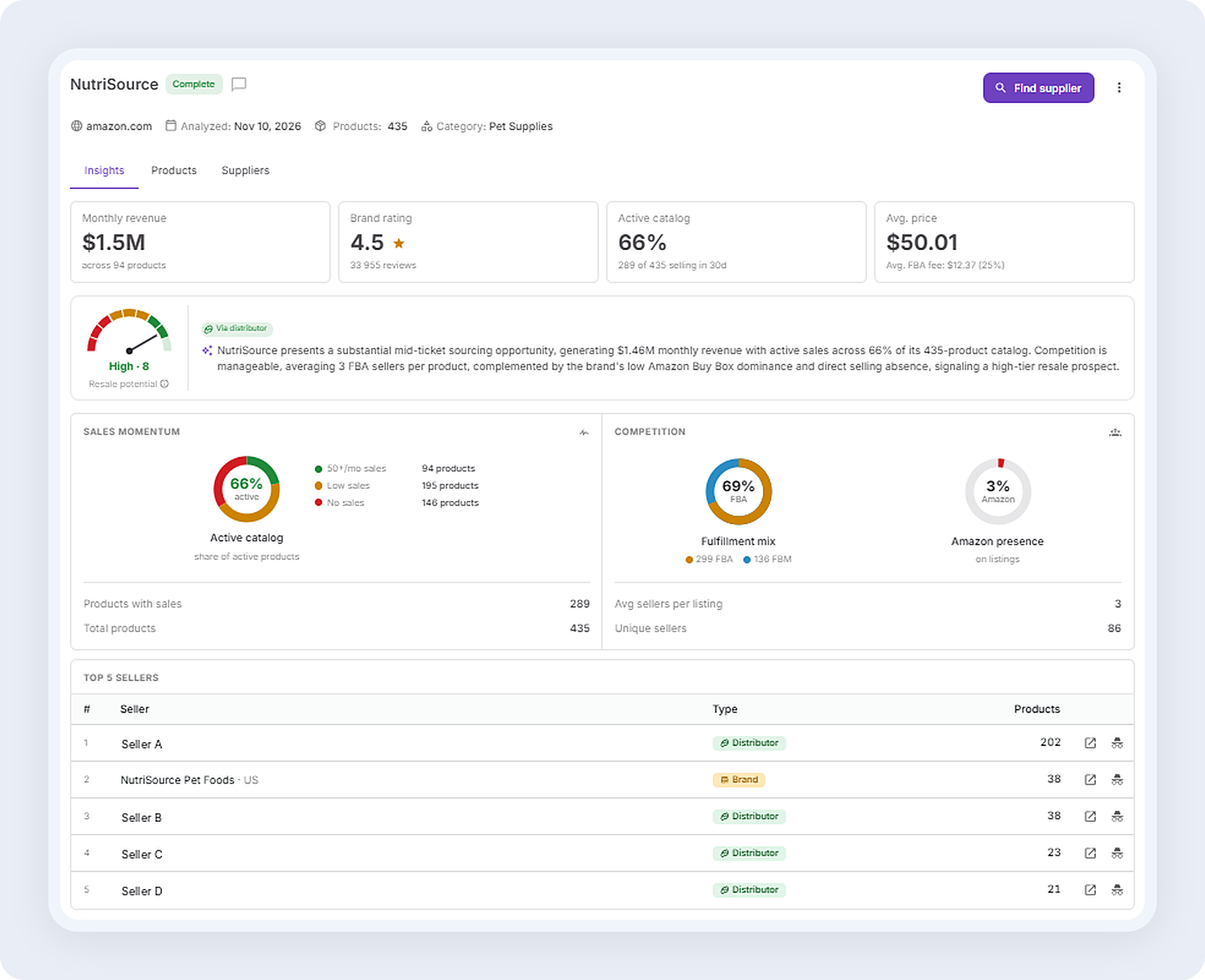
A check of the dog and cat food brand NutriSource shows a brand worth a supplier search:
- Resale potential: 8 out of 9.
- Distribution: sold via distributors.
- Amazon presence: only 3% of the brand’s listings.
- Competition: 86 unique sellers, with an average of 3 per listing.
The top sellers list adds a warning. One distributor wins 202 of the brand’s 435 products, so many of those listings may be locked. Check the Buy Box on each product before you order.
Brand Analyzer screens pet brands for a supplier search.
Find who distributes the brand with AI Supplier Finder
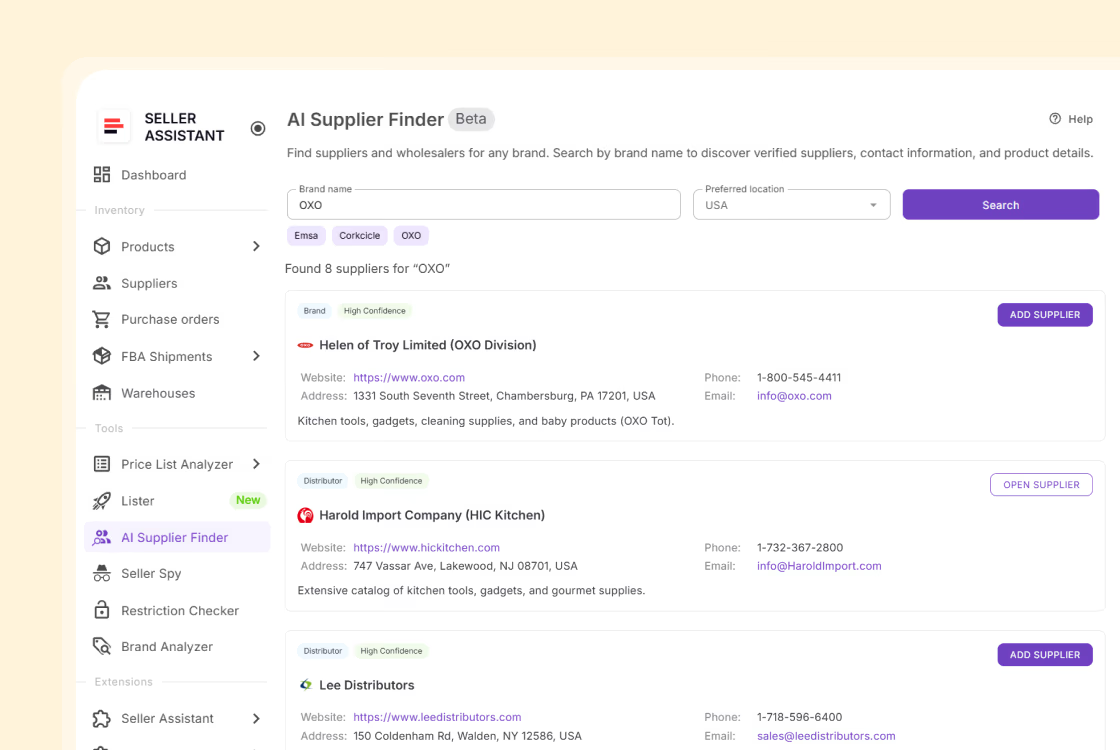
Once a brand passes the screen, click “Find supplier” in Brand Analyzer to open AI Supplier Finder with the brand already filled in. You can also enter a brand name and a preferred location yourself. The tool looks for wholesale suppliers and groups each result as brand, distributor or wholesaler, with a high, medium or low match confidence.
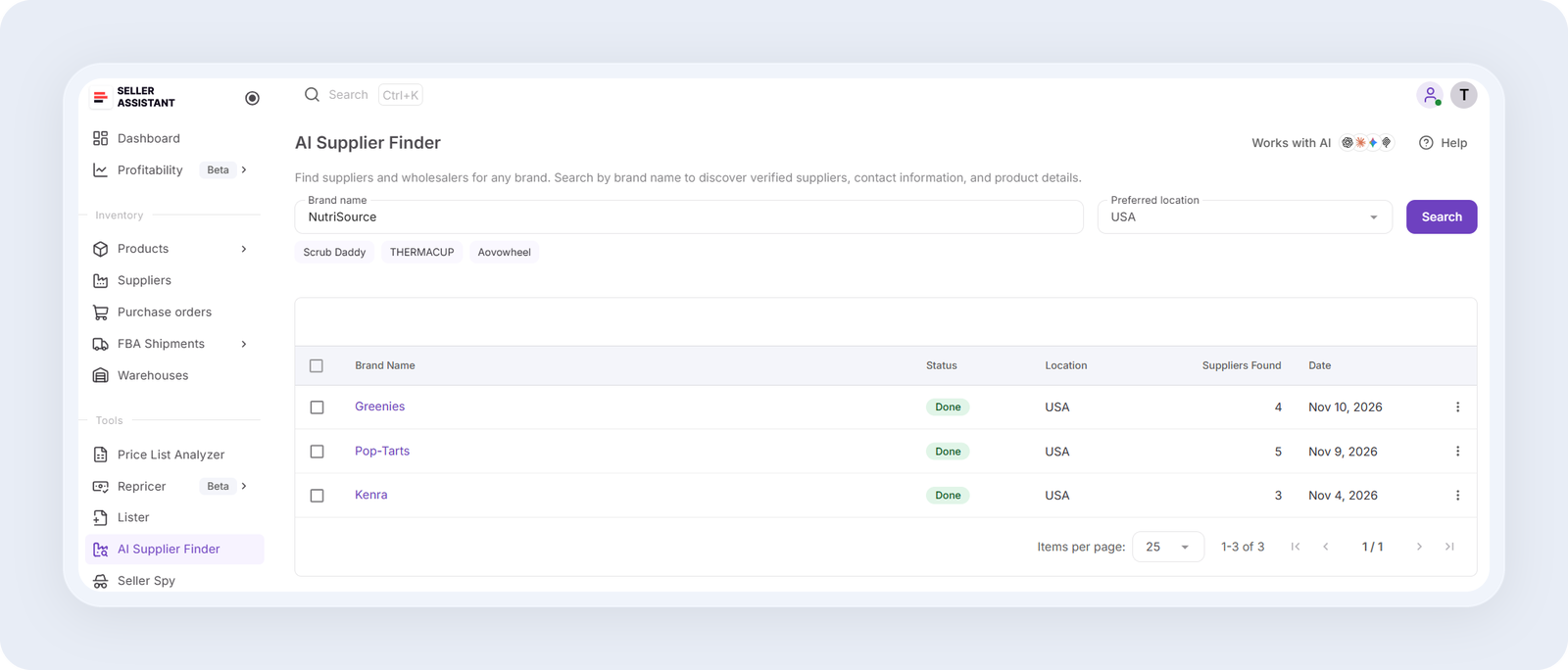
How to read the results
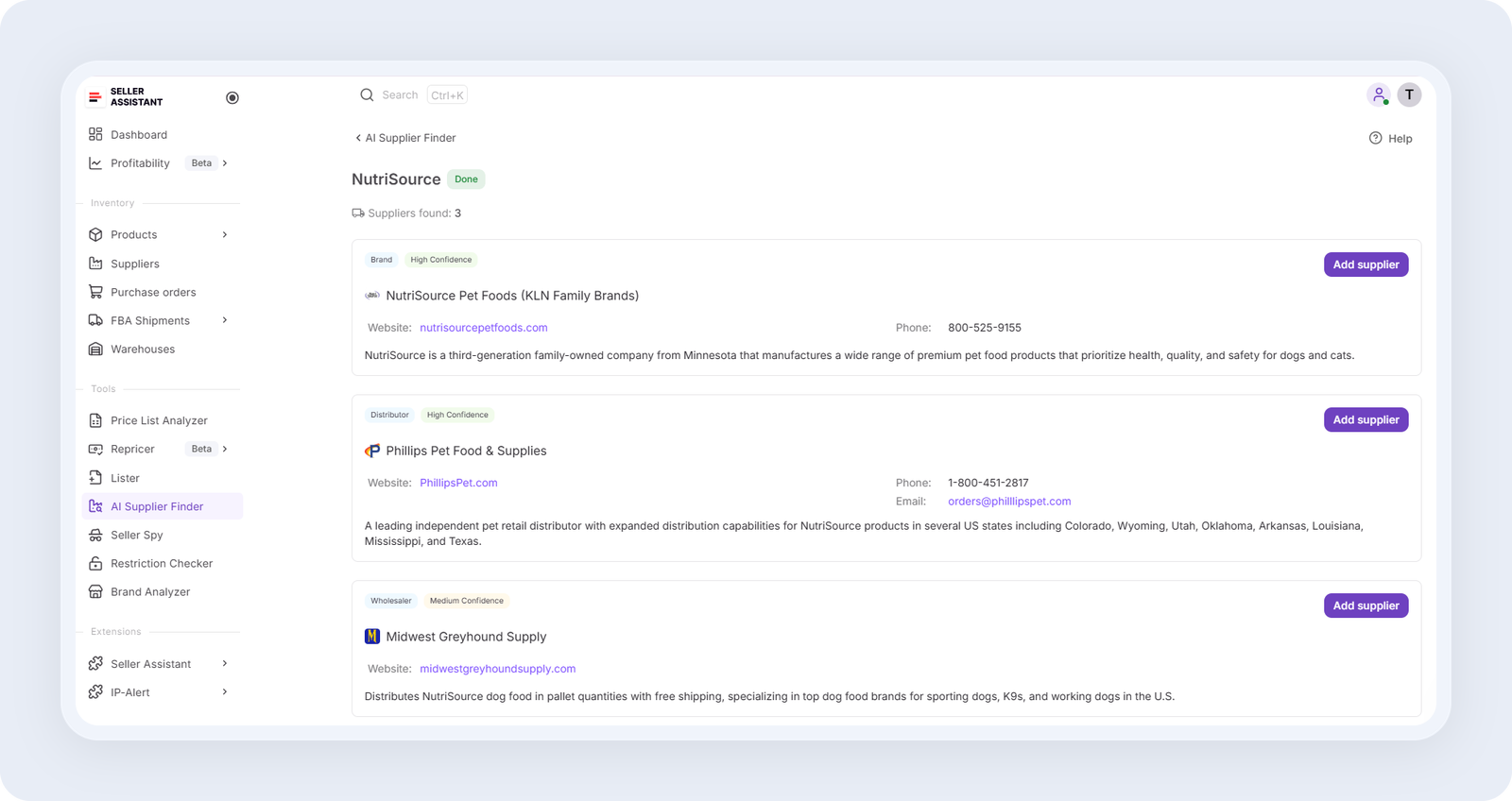
A search for NutriSource in the USA returns three suppliers:
- The brand, NutriSource Pet Foods (KLN Family Brands): a family-owned pet food maker in Minnesota.
- A distributor, Phillips Pet Food & Supplies: an independent pet retail distributor that carries the brand in several US states.
- A wholesaler, Midwest Greyhound Supply: sells the brand’s dog food in pallet quantities, mainly to owners of sporting and working dogs.
The descriptions help you choose whom to contact first. A distributor that supplies pet retailers is a natural fit for a reseller. A wholesaler that sells by the pallet to dog owners may not open a reseller account. Click “Add supplier” to save a promising result to your Suppliers list.
These are examples from one search. Treat every result as a candidate, and verify that the company is real and authorized for the brand.
Ask the brand for its authorized distributors
The brand is the most reliable source for its own distributor list. Look on its website for a retailer or wholesale inquiry form, or write to its sales department.
What to ask
- Which distributors are authorized to supply online resellers in your country.
- Whether the brand opens direct accounts, and on what conditions.
- Whether there are any limits on selling the brand’s products on Amazon.
Some pet brands sell only through specialty stores or vet clinics, so the last answer matters most.
How to Vet a Pet Supply Distributor
A promising search result is only a starting point. Before you send documents or pay for stock, make sure the distributor can supply what Amazon expects from a reseller. The full process is in our guide on how to verify a wholesale supplier. In Pet, focus on three things.
What to check
- Authorization for the brand. Ask the brand to confirm the company is on its list of authorized distributors, or ask the distributor how it buys the brand. Pet suppliers often carry dozens of brands, and authorization can cover some of them but not others.
- Invoices that Amazon accepts. If a pet brand or product needs Amazon’s approval, you’ll be asked for invoices from a manufacturer or distributor. Check that the supplier issues proper invoices with your business name and address, its own details and the products you bought.
- Expiry dates on food and treats. Pet food, treats and supplements have expiration dates. Ask how much shelf life is left on products when they ship, so you have time to sell and the stock meets Amazon’s rules for expiration-dated products.
Check Amazon’s rules for pet products
Some pet products, such as medications, pesticides and certain supplements, are restricted on Amazon. Before you order them, read Amazon’s policy on animals and animal-related products.
Start with a small order
A small first order shows how the distributor handles delivery, packaging and paperwork. Keep every invoice, because Amazon may ask you to prove where your products came from.
The examples of restricted products (medications, pesticides, certain supplements) are general. I didn’t take them from the Amazon page, which needs a sign-in. If you want strictly no rules from memory, cut “such as medications, pesticides and certain supplements” and keep only the link.
Check the Buy Box Before You Buy
In Pet, check who wins the Buy Box on each product before you order, because many pet listings leave little room for a new seller. If you need a refresher on the basics, see how the Amazon Buy Box works.
Read the Buy Box seller shares in Price List Analyzer
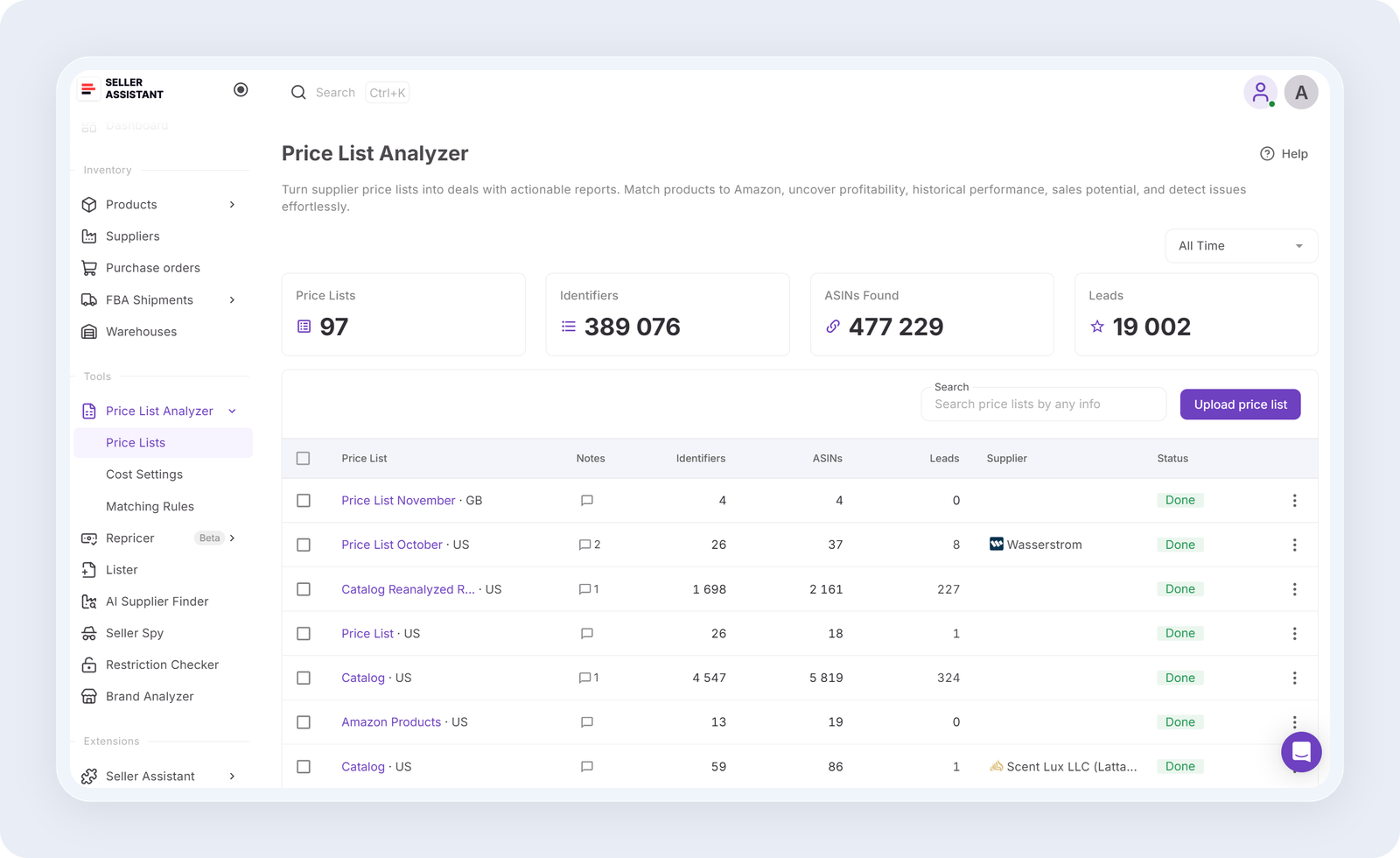
Price List Analyzer matches each line of a supplier’s price list to its Amazon listing and adds the Buy Box data for every product.
What it shows
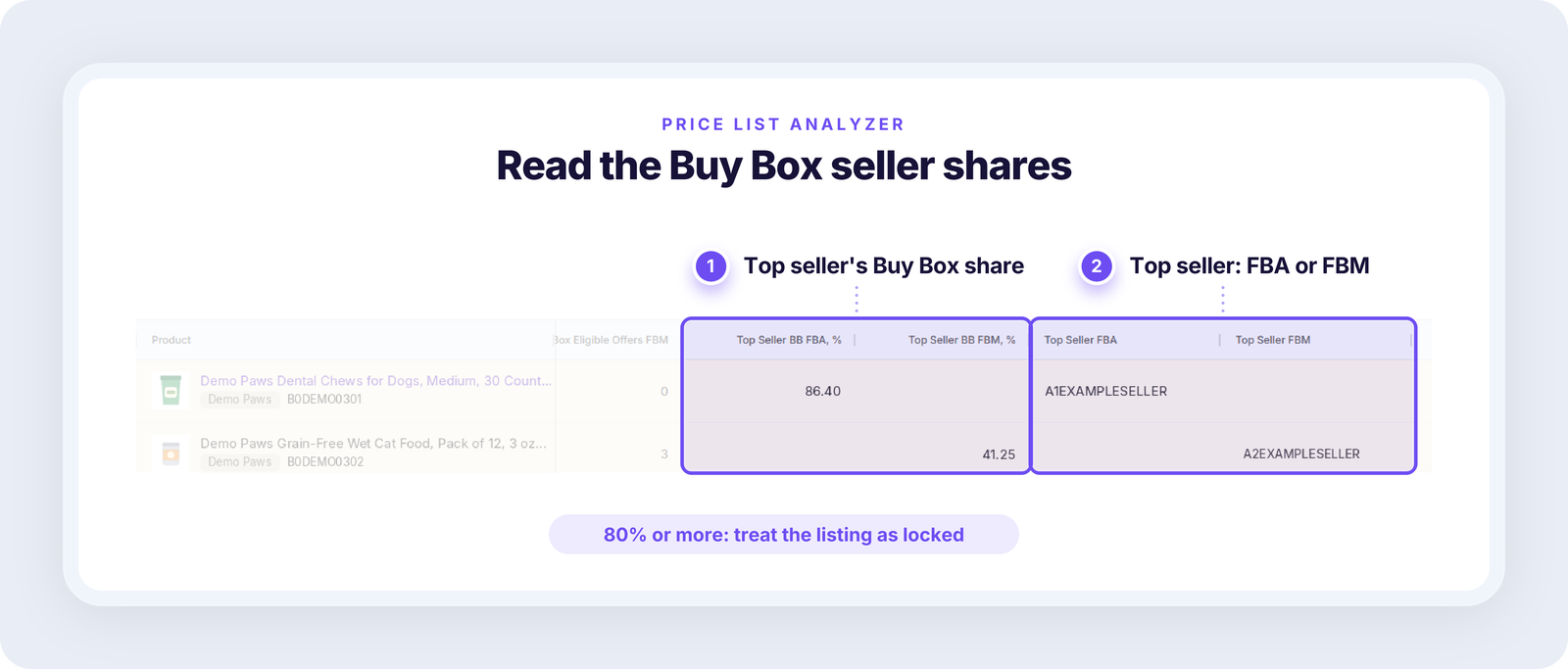
- The top seller’s Buy Box share: how often the leading seller wins the Buy Box, for FBA and FBM offers.
- Buy Box-eligible offers: how many sellers actually compete for the Buy Box.
- The top seller: who leads the listing, and whether it ships through FBA or fulfills its own orders.
How to use the 80% rule
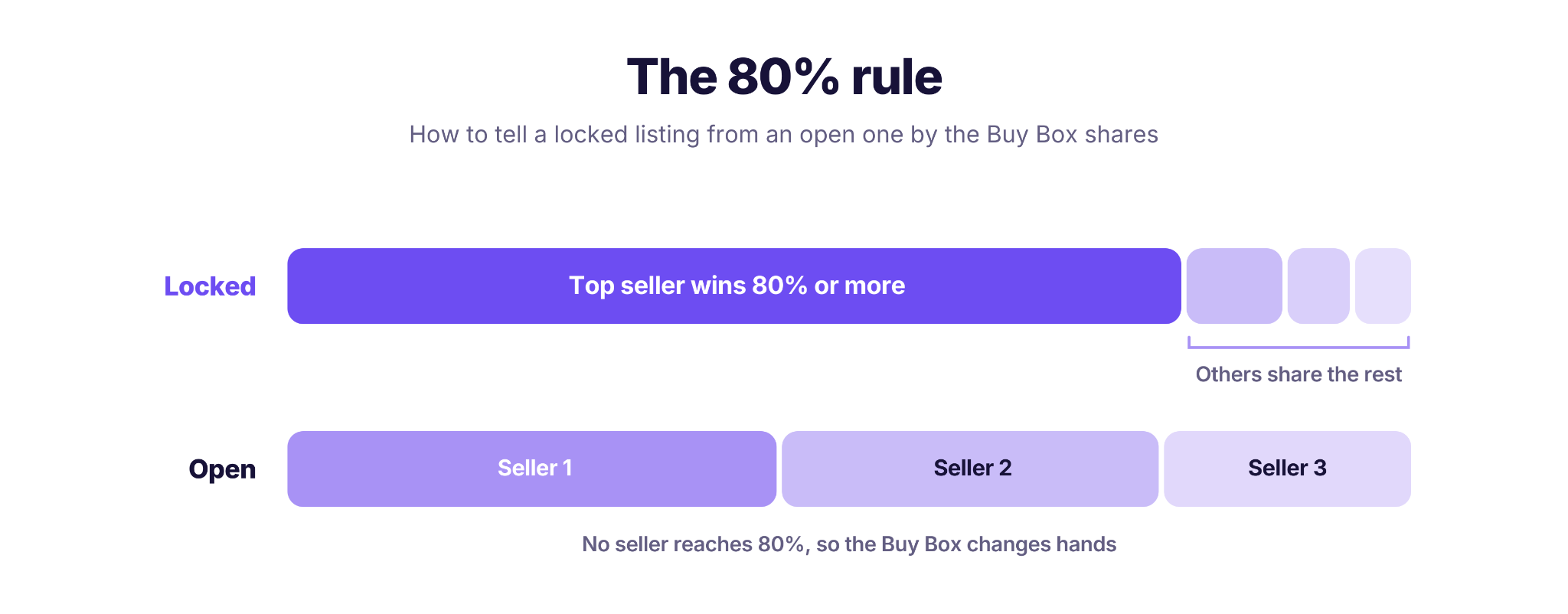
If one seller wins the Buy Box 80% of the time or more, treat the listing as locked: the other sellers share what’s left. Keep the open listings, and buy locked ones only if their sales and margin still work for a small share of the Buy Box.
Why the offer count doesn’t show who wins
A listing with few sellers can still be hard to win. According to Seller Assistant’s State of Amazon Wholesale (Q3 2026), et listings have a median of 3 offers, yet 62.4% of them are locked by one seller. A low offer count can mean one seller dominates the listing.
Judge competition by the Buy Box shares. For the full category picture, see how many listings one seller locks.
Skip listings where Amazon holds the Buy Box
Amazon holds the Buy Box on more pet listings than in most categories. According to the same report, Amazon holds the Buy Box on 22.5% of pet listings, against 13.8% across all categories. When Amazon is on the Buy Box, expect a small share of sales.
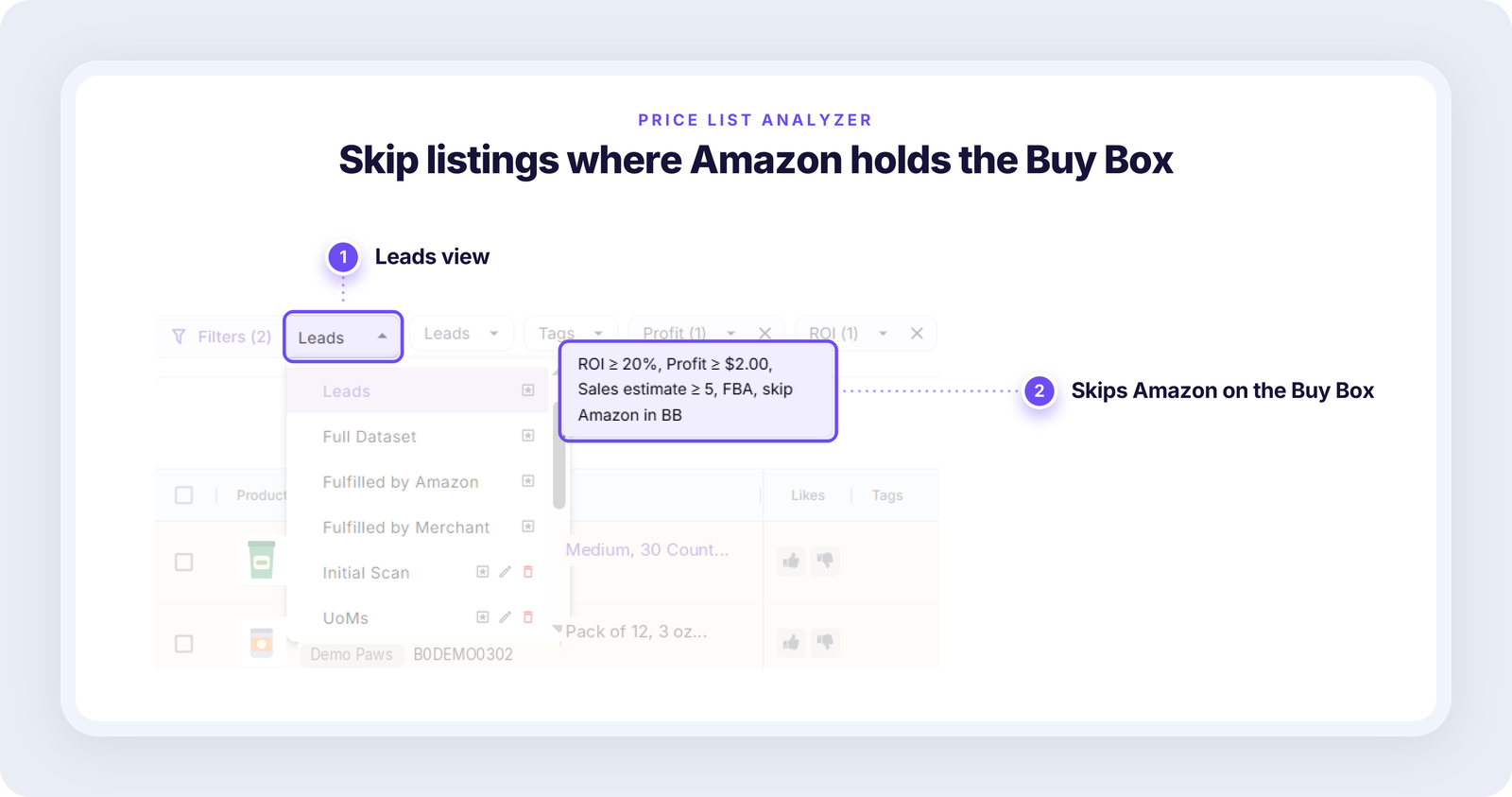
Price List Analyzer’s default lead rules already skip these products. A product counts as a lead only if it:
- is sold through FBA
- has an ROI of 20% or more
- makes at least $2 profit
- sells an estimated 5 or more units a month
- doesn’t have Amazon on the Buy Box.
Common Mistakes When Buying from Pet Supply Wholesalers
Pet price lists look rich in deals, which makes these mistakes easy to make:
- Picking a brand because it has many products. A large catalog means more lines to scan, not more you can sell. If Amazon or one seller wins most of the brand’s products, a long product list won’t help. Screen the brand in Brand Analyzer before you contact any supplier.
- Trusting the offer count. Three sellers on a listing sounds like an easy win, but in pet many listings with few offers are locked by one of them. Check each product’s Buy Box share and apply the 80% rule.
- Ignoring the brand selling direct. Some pet brands sell on Amazon themselves and win many of their own listings. Check the top sellers list for the brand’s own store before you buy, because you’d be competing with the company that sets the price.
- Ordering from last year’s price list. A usual 10% supplier price increase cuts pet leads from 76.1 to 52.7 per 1,000 matched lines, about 31% fewer. Re-run every new price list before you reorder.
FAQ
Is pet supplies a good category for Amazon wholesale?
It is for resellers who check the Buy Box line by line. The same report finds that how you select products matters more than which category you sell in, so a high lead count doesn’t settle it. Run each pet price list through Price List Analyzer and check the top seller’s share before you buy.
What if a pet brand sells only through specialty stores or vet clinics?
Its distributors may not supply online resellers. Ask the brand whether it authorizes Amazon resale, and move on to another brand if it doesn’t.
Do I need approval to sell pet products on Amazon?
Some pet products and brands need Amazon’s approval, and it differs by account. Run the brand’s ASINs through Bulk Restriction Checker to see which ones your account can sell, which need approval and which are blocked. Read Amazon’s policy on animals and animal-related products for the rules that apply to pet items.
What is a minimum order with a pet supply distributor?
Minimums vary by distributor. Some set a minimum per order, others per brand, and most sell only in full cases. Ask each distributor for its minimum order and the case pack of the products you want before you plan your first purchase. A minimum per brand is easier to meet when a distributor carries several brands you can sell.
Key Takeaways
Pet supply wholesalers can fill your price lists with leads, but in pet the Buy Box decides which of those leads you can sell.
- Pet gives more leads but is harder to win. According to Seller Assistant’s State of Amazon Wholesale (Q3 2026), pet price lists give 76.1 leads per 1,000 matched lines, against 54.5 overall, but 62.4% of pet listings with Buy Box history are locked by one seller.
- Screen the brand before the supplier. Use Brand Analyzer to check Amazon’s presence, the top sellers and sellers per listing, then find distributors with AI Supplier Finder.
- Verify every distributor. Confirm authorization for the brand, get proper invoices, and ask about shelf life on food and treats.
- Check the Buy Box on every product. Apply the 80% rule to the top seller’s share, and skip listings where Amazon holds the Buy Box. Amazon is on 22.5% of pet listings.
- Re-run every new price list. A usual 10% supplier increase cuts pet leads from 76.1 to 52.7 per 1,000 matched lines.