

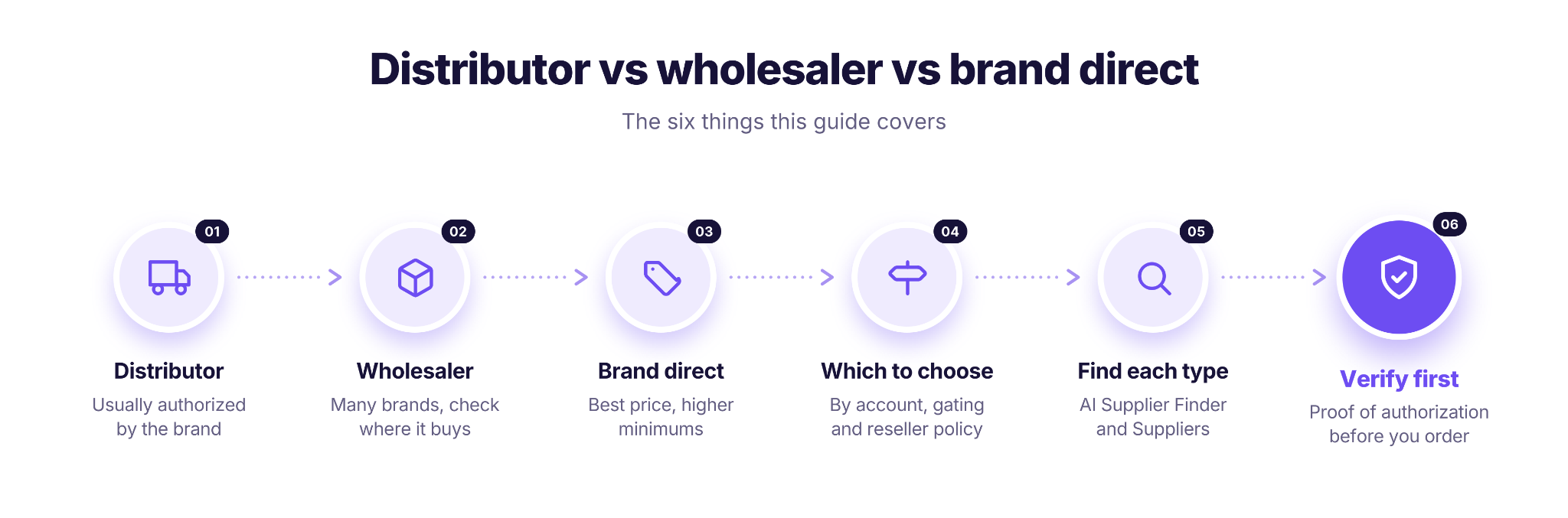
The difference between a distributor and a wholesaler is the relationship with the brand. A distributor buys from the brand under an agreement and resells its products to retailers, often with the brand’s authorization. A wholesaler buys in bulk, often from several brands or distributors, and resells to retailers, usually without a direct agreement with each brand. Brand direct means you open an account with the brand itself.
For an Amazon seller, the best source is the one that can prove its supply chain to Amazon and still leave a margin, so check each brand separately.
Distributor vs Wholesaler vs Brand Direct: The Short Answer
All three sell you products at wholesale prices to resell, but they stand in different places in the supply chain. That changes what they ask from you and what they can prove to Amazon.
| | Distributor | Wholesaler | Brand direct | | | ----------------------- | -------------------------------------------- | -------------------------------------------- | --------------------------------- | | Buys from | The brand, under an agreement | Several brands or distributors | Makes or owns the products | | Brand authorization | Often authorized for the brands it carries | Usually no direct agreement with each brand | You deal with the brand itself | | Catalog | A brand’s full line, often from a few brands | Many brands, often only part of each line | One brand’s products | | Minimum order | Usually moderate | Often lower | Often higher, with an application | | Price level | Brand price plus the distributor’s markup | Can vary, depending on where it buys | Often the best price | | What Amazon may ask for | Invoices that trace back to the brand | Invoices that show where the wholesaler buys | The brand’s own invoices |
The key difference between a distributor and a wholesaler is the link to the brand. A distributor usually has one. A wholesaler usually doesn’t, so you need to know where it gets its stock.
What a Distributor Is
A distributor is a company that buys products from a brand and sells them on to retailers. It sits between the brand and the stores, and it often handles storage, shipping and account management for the brand, so the brand doesn’t have to deal with every retailer itself.
Authorized vs unauthorized distributors
An authorized distributor has an agreement with the brand to sell its products. That agreement matters most to an Amazon seller, because invoices from an authorized distributor trace back to the brand.
Some companies call themselves distributors without any agreement. They buy the brand’s products wherever they can and resell them. Their invoices may not show a clear link to the brand, so ask before you order.
Regional and national distributors
Some distributors cover the whole country. Others cover one region, and a brand may work with several of them. A regional distributor may only sell to retailers in its area.
Why many brands sell only through distributors
Handling hundreds of small accounts is costly for a brand. Many brands, especially large ones, prefer to work with a few distributors and send every retailer to them. For a reseller, that often makes a distributor the only way to buy the brand.
The trade-off
A distributor adds its own markup to the brand’s price, so its prices can be higher than buying direct. In exchange, you get easier access and smaller orders.
What a Wholesaler Is
A wholesaler buys products in bulk and resells them to retailers in smaller amounts. Unlike a distributor, it usually doesn’t have an agreement with each brand it carries. It buys from several sources: brands, distributors and sometimes other wholesalers.
What a wholesaler offers
- A wide catalog: many brands and products in one place, often across several categories.
- Smaller orders: wholesalers often accept smaller minimums than distributors or brands, which helps when you’re testing a product.
- Fewer requirements: opening an account is often simpler.
Why the invoice chain matters to Amazon
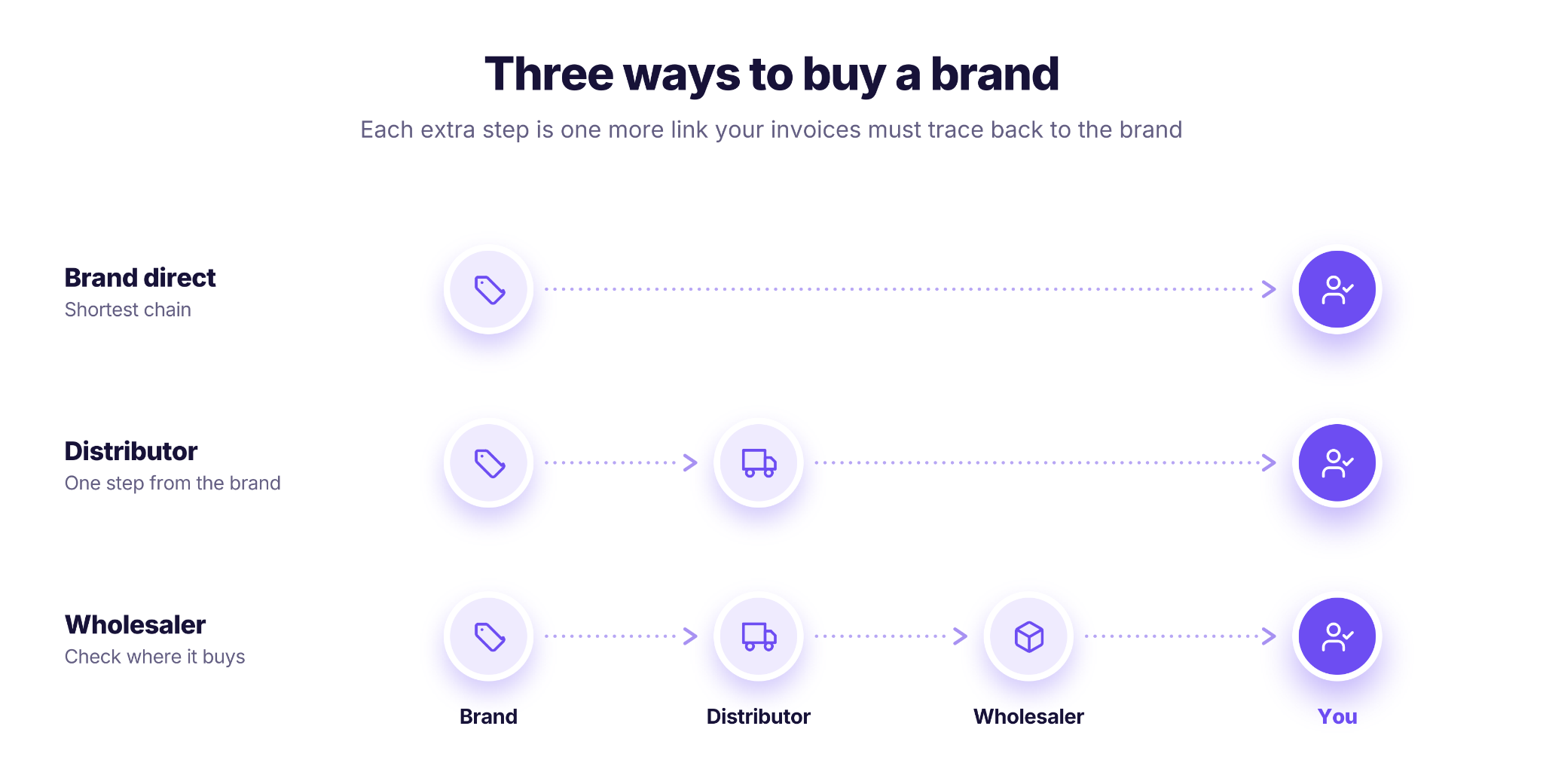
When Amazon asks where your products came from, it looks at your invoices. An invoice from a wholesaler shows only that you bought from the wholesaler, not where the wholesaler bought from. If its source is the brand or an authorized distributor, the chain is clean. If it bought from another reseller, the link to the brand is weaker. That’s the main difference between a wholesaler and a distributor for an Amazon seller.
Where you fit in the chain
In the distributor vs wholesaler vs retailer picture, you’re the retailer: the last step before the customer. The usual path is brand, then distributor, then retailer. A wholesaler sometimes adds a step between the distributor and you. Every step adds a markup, and every step is one more link that has to trace back to the brand.
What Buying Brand Direct Means
Buying brand direct means you open a wholesale account with the company that owns the brand and buy from it with no one in between. It’s the shortest supply chain there is.
The advantages
- Often the best price: no distributor or wholesaler markup.
- The cleanest invoices: they come from the brand itself, so they leave no question about where your products came from.
- A direct relationship: you hear about new products, price changes and the brand’s rules first.
The trade-offs
- Higher minimums: brands often ask for larger orders than distributors. See the guide to minimum order quantity.
- An application: many brands review each reseller before opening an account, and some ask for a store, a sales history or a signed agreement.
- Not every brand sells to Amazon resellers: some send resellers to their distributors, and some don’t allow marketplace sales at all.
Manufacturer vs brand
A manufacturer can be a different company from the brand. One factory can make products for several brands, and a brand can use several factories. For resale on Amazon, what counts is the brand owner, because the brand owner decides who’s authorized to sell its products. That’s also why “manufacturers vs distributors” is the wrong comparison for a reseller. The question is who the brand has authorized.
For how buying from brands and their distributors fits the whole business model, see what Amazon wholesale is.
Which One Should an Amazon Seller Buy From?
The right source depends on the brand and on where your business is. These are the most common situations.
You have a new account
Start with authorized distributors. They’re usually easier to open an account with than brands, their minimums are often lower, and their invoices trace back to the brand. Brands often prefer resellers with a track record, so brand direct accounts tend to come later.
The brand is gated on Amazon
To check whether a product needs approval, find it in Catalog > Add Products in Seller Central. “Apply to sell” next to the listing means you need approval.
To apply, you need invoices from a verifiable supplier, such as the brand, its manufacturer or an authorized distributor, so buy from one of them. The invoices should show:
- your business name and address
- the supplier’s name, address and contact details
- the products you’re applying for
- the quantities and the dates
For a brand approval, the brand name and product details must also be clear on the invoice. For the full rules, see Amazon’s help page Categories and products that require approval.
The brand has a strict reseller policy
Some brands control who sells their products online. Buy only from the brand or from a distributor on its authorized list, and ask whether the brand allows Amazon sales before you order. Products from an unauthorized source can lead to complaints from the brand.
You want a small first order
A wholesaler can be a good place to test a product with a small order. Ask where it buys the brand before you order, and keep the invoice. If the product sells, move to the brand or an authorized distributor for larger orders.
In every case, check two things
- Authorization: ask the brand for its list of authorized distributors, and ask the supplier for proof. See how to verify that a supplier is authorized.
- Margin: a cleaner source with a higher price may still leave no profit. Run the numbers before you choose.
To contact a brand or distributor for the first time, see how to email a distributor or a brand.
How to Find Each Type for a Brand
Once you know which type of supplier you need, look for it one brand at a time. For the full search process, see how to find Amazon FBA wholesale distributors.
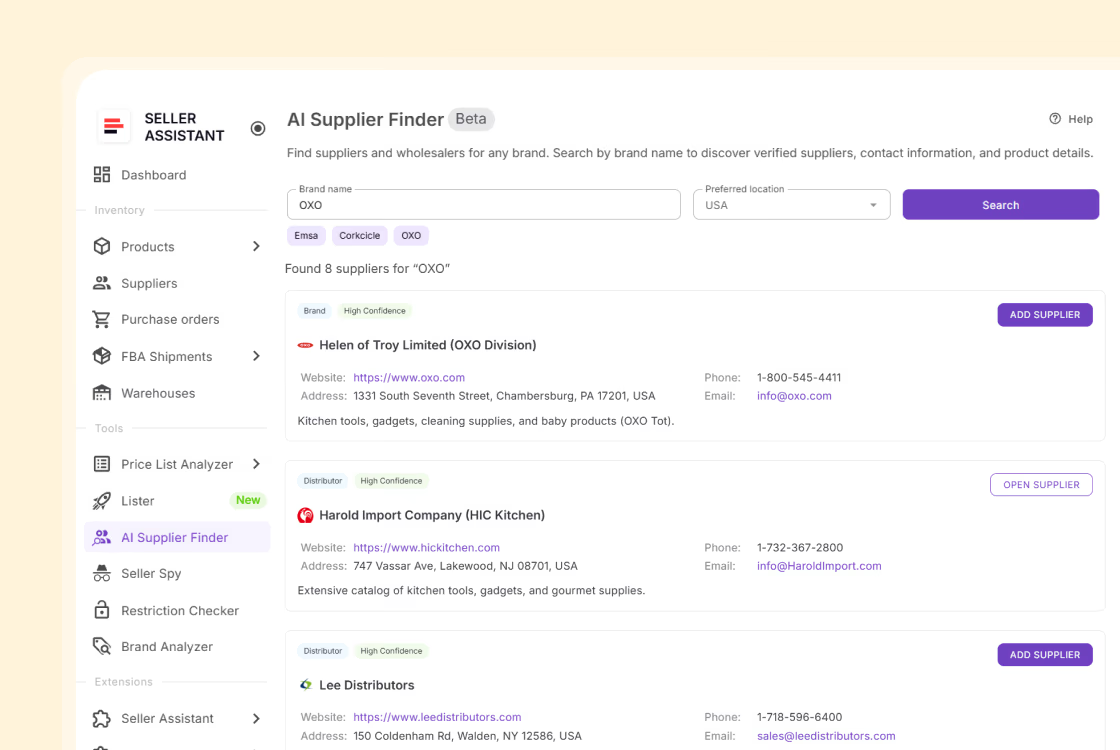
Find supplier candidates for a brand with AI Supplier Finder
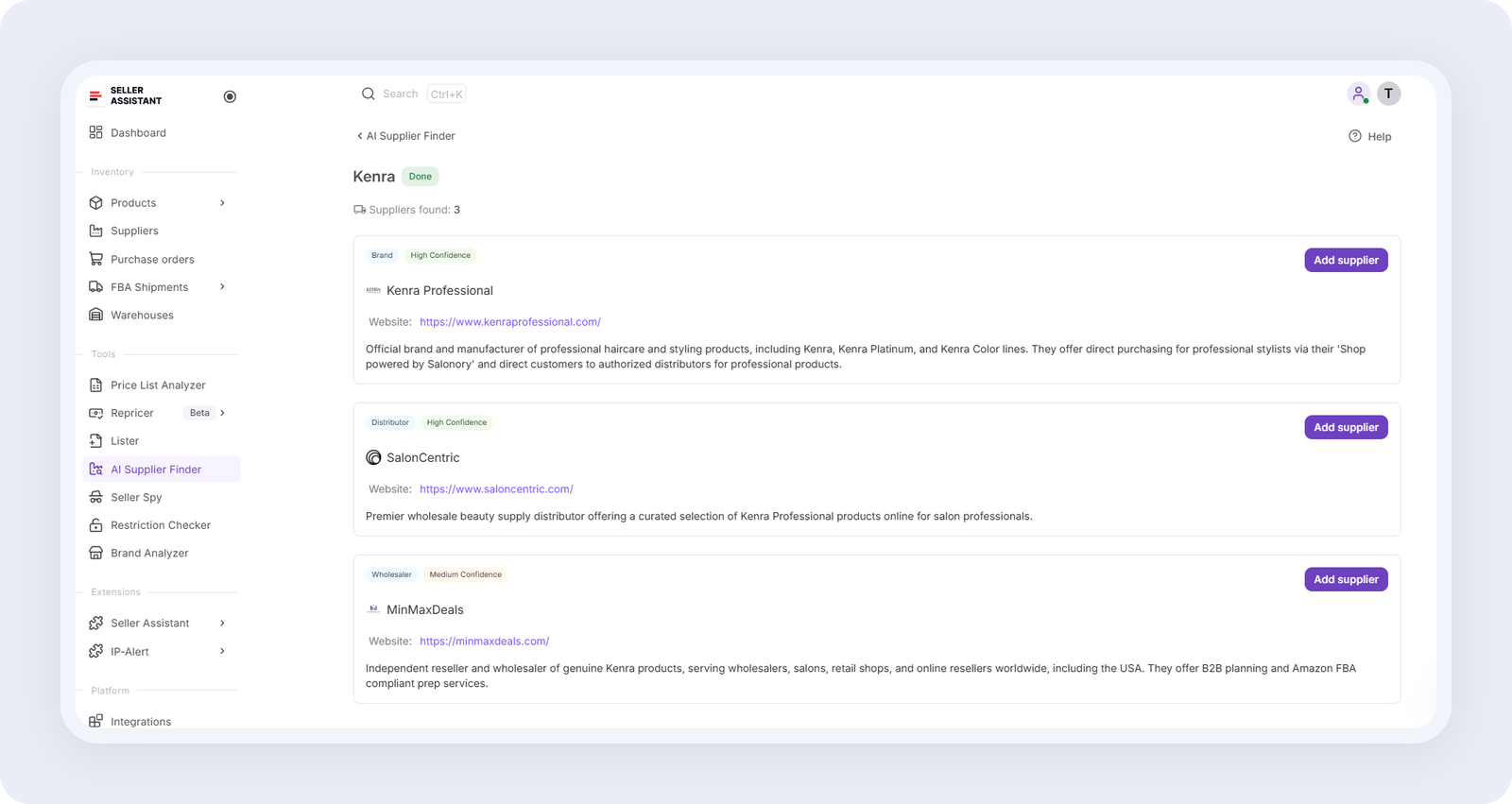
AI Supplier Finder searches for wholesale suppliers and distributors that may carry a brand. Enter the brand name and your preferred location, and it returns supplier candidates labeled by type, with their website and, where available, phone and email.
How the types show up
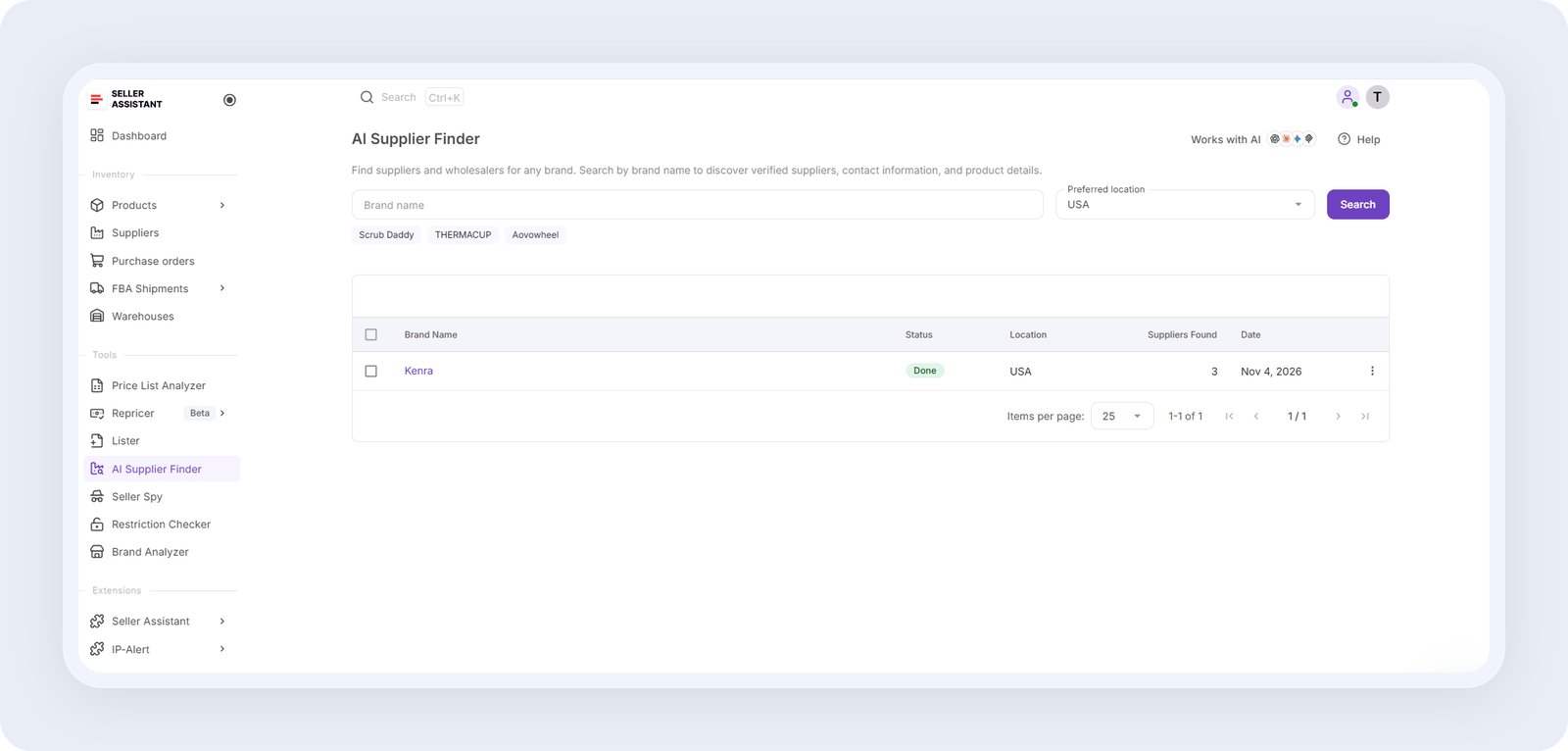
A search for the hair care brand Kenra in the USA returns one of each type covered in this guide:
- The brand, Kenra Professional: sells to professional stylists and sends other customers to its distributors.
- A distributor, SalonCentric: supplies the brand’s products to salon professionals.
- A wholesaler, MinMaxDeals: says it serves online resellers.
These companies are examples only. A result doesn’t prove that a company is authorized, still carries the brand, or will open an account for you. Treat every result as a candidate, and check it with the brand.
Record what each company is in Suppliers
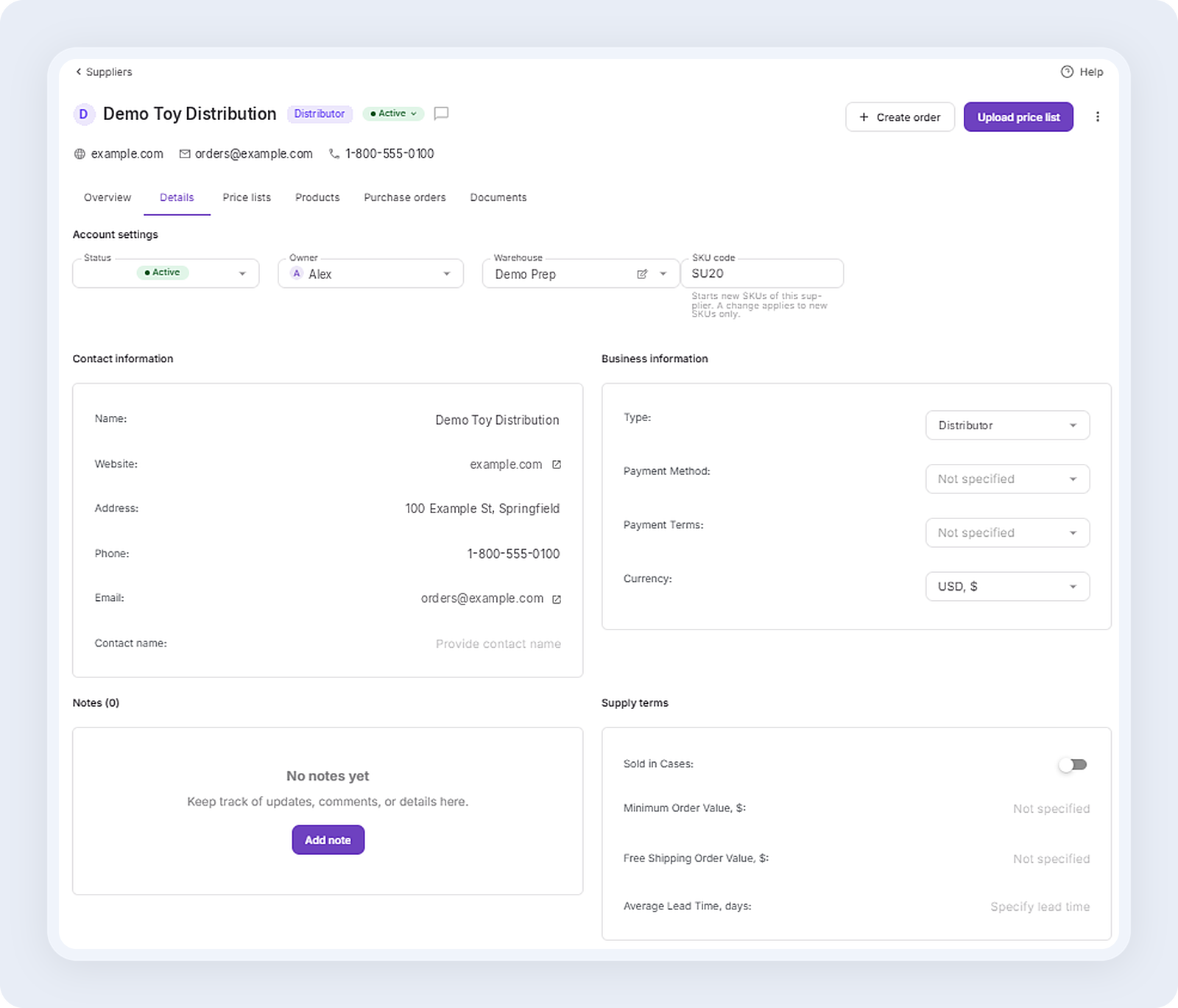
Click “Add supplier” to save a candidate to Suppliers Database. Then fill in what you learn about it, so you always know which kind of source you’re buying from:
- Supplier type: distributor, manufacturer, brand or wholesaler.
- Status: New, Contacted, No response, Negotiation, Approved, Active, On hold or Rejected.
- Documents: contracts and authorization letters, kept in the supplier’s profile.
- Terms: payment terms and minimum order value.
The record holds your own information. It doesn’t check whether a supplier is authorized, so keep the proof you get from the brand in the Documents tab.
Common Mistakes When Choosing a Supplier Type
Many supplier problems start with a wrong assumption about who you’re buying from:
- Calling every wholesaler an authorized distributor. Many companies use “distributor” and “wholesaler” as the same word. What matters is whether the brand has authorized them, so ask for proof instead of relying on the name.
- Buying from a company that bought from another reseller. An invoice only shows the last step of the supply chain. If your supplier bought from another reseller, the link to the brand is weak, and the invoice may not help when Amazon or the brand asks where your products came from.
- Skipping the brand’s own list of distributors. Many brands will tell you which distributors they work with. Asking takes one email, and it can save you from an account with the wrong source.
- Assuming the cheapest source is the best one. A lower price from an unclear source can cost more later, through complaints from the brand, a declined approval or stock you can’t sell. Compare price only between sources you’ve verified.
Complaints carry over to approvals too: Amazon may not accept an approval application while your account has unresolved IP complaints. That’s one more reason to buy only from sources that can prove their link to the brand.
FAQ
Can I buy the same brand from a distributor and a wholesaler?
Yes, and many sellers do, to compare prices and keep a backup source. Keep the invoices from each supplier, and check each one’s link to the brand before you order.
What if a distributor won’t open an account with me?
Ask the brand which other distributors it works with, and whether a regional distributor covers your area. A wholesaler that can show where it buys the brand is a fallback while you build a purchase history.
Does buying brand direct remove the need for Amazon approval?
A brand’s invoices help with an approval application, but they don’t replace it. If the brand or category is gated, you still need Amazon’s approval to list. Check restrictions before you place the order. Bulk Restriction Checker checks a whole price list at once.
Can I sell on Amazon with invoices from a wholesaler?
Amazon can ask for invoices that show where your products came from, and for approvals it asks for invoices from a verifiable supplier, such as a manufacturer or an authorized distributor. Before you buy from a wholesaler, check that its source is the brand or an authorized distributor. See Amazon’s help page Categories and products that require approval.
How do I know if a distributor is authorized?
Ask the brand for its list of authorized distributors, and ask the distributor for proof, such as an authorization letter. For the full process, see how to verify that a supplier is authorized.
Key Takeaways
The best supplier for an Amazon seller is the one that can prove its link to the brand and still leave you a margin.
- Know who you’re buying from. A distributor usually has an agreement with the brand, a wholesaler usually doesn’t, and brand direct means buying from the brand itself.
- Match the source to the situation. Start with authorized distributors on a new account, use the brand or its authorized distributors for gated brands, and test small orders with wholesalers that can show where they buy.
- Check every invoice chain. Amazon asks for invoices from a verifiable supplier, such as a manufacturer or an authorized distributor, with the brand and product details clear.
- Verify before you order. Ask the brand for its authorized distributors, ask the supplier for proof, and compare prices only between sources you’ve checked.
- Keep a record of each supplier. Save candidates from AI Supplier Finder in Suppliers, with their type, status and authorization documents.