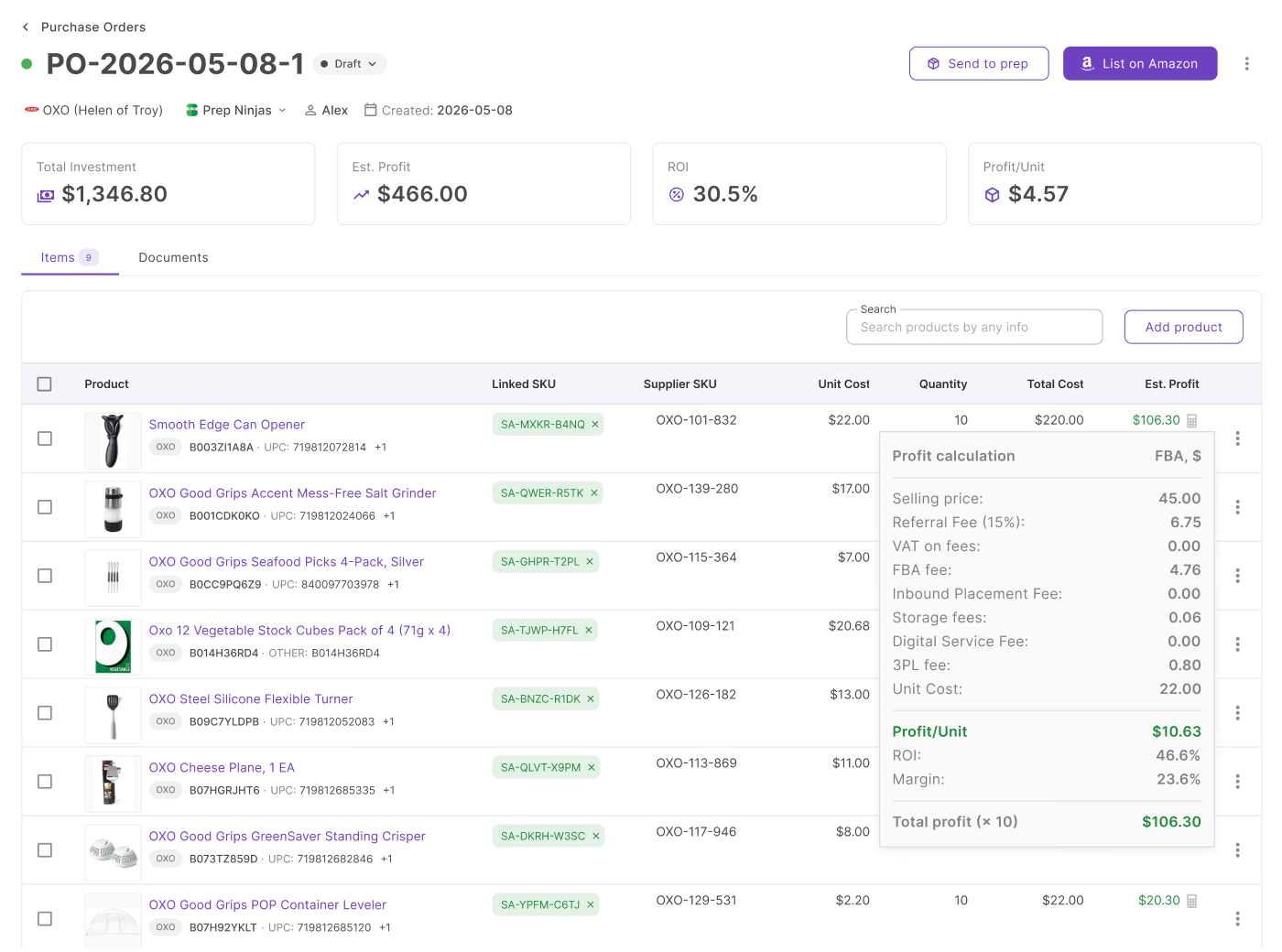


Managing wholesale purchase orders sounds simple – until your Amazon business starts scaling. More suppliers, larger catalogs, multiple prep centers, and constant replenishment quickly turn spreadsheets and email threads into operational chaos. One wrong SKU, outdated cost, or missed routing detail can lead to inventory delays, inaccurate margins, and expensive ordering mistakes.
That’s why Amazon wholesale sellers need more than basic purchase orders – they need a structured procurement workflow.
In this post, we’ll explain how wholesale purchase order management works, why manual systems break at scale, and how Seller Assistant helps Amazon resellers connect sourcing, supplier management, purchasing, and inventory routing into one organized workflow.
Note. Seller Assistant is an end-to-end Amazon workflow management platform that integrates 15+ wholesale-focused solutions into one connected system. It combines sourcing workflow automation, bulk research and intelligence tools, and integrated Chrome extensions – giving you everything you need to streamline finding deals, managing suppliers, and creating purchase orders.

With Seller Assistant, every step of your Amazon wholesale and arbitrage workflow is automated and connected.
What Is Wholesale Purchase Order Management?
Wholesale purchase order management is the process Amazon sellers use to organize, track, and control supplier purchases from sourcing to inventory delivery. It includes managing supplier information, product costs, prep center routing, order statuses, quantities, shipping details, and procurement history across every wholesale order.
How wholesale purchase order management works
In a typical Amazon wholesale workflow, sellers first choose suppliers, analyze supplier catalogs, and validate profitable products. That data then flows into purchase orders, where products, costs, warehouses, and shipping instructions are finalized before inventory is sent to prep centers or Amazon FBA.
Why procurement accuracy matters for Amazon sellers
Doing this correctly is critical because procurement mistakes directly impact margins, inventory flow, and fulfillment speed. Wrong quantities, outdated costs, duplicate replenishment orders, or incorrect routing can quickly create expensive operational problems.
Why purchase order management must be a connected workflow
That’s why wholesale purchase order management cannot rely on disconnected spreadsheets or manual tracking. As operations scale, purchasing needs to become a structured workflow where supplier data, sourcing decisions, product costs, and warehouse routing stay connected across the entire procurement process.
Why Amazon Sellers Outgrow Spreadsheet Purchase Orders
Spreadsheets may work when you place a few supplier orders each month, but they quickly become difficult to manage as your Amazon wholesale business grows. More suppliers, larger catalogs, multiple prep centers, and frequent replenishment create too many moving parts to track manually.
What starts as a simple purchasing system often turns into disconnected files, outdated data, and operational mistakes that directly impact inventory flow and profitability.
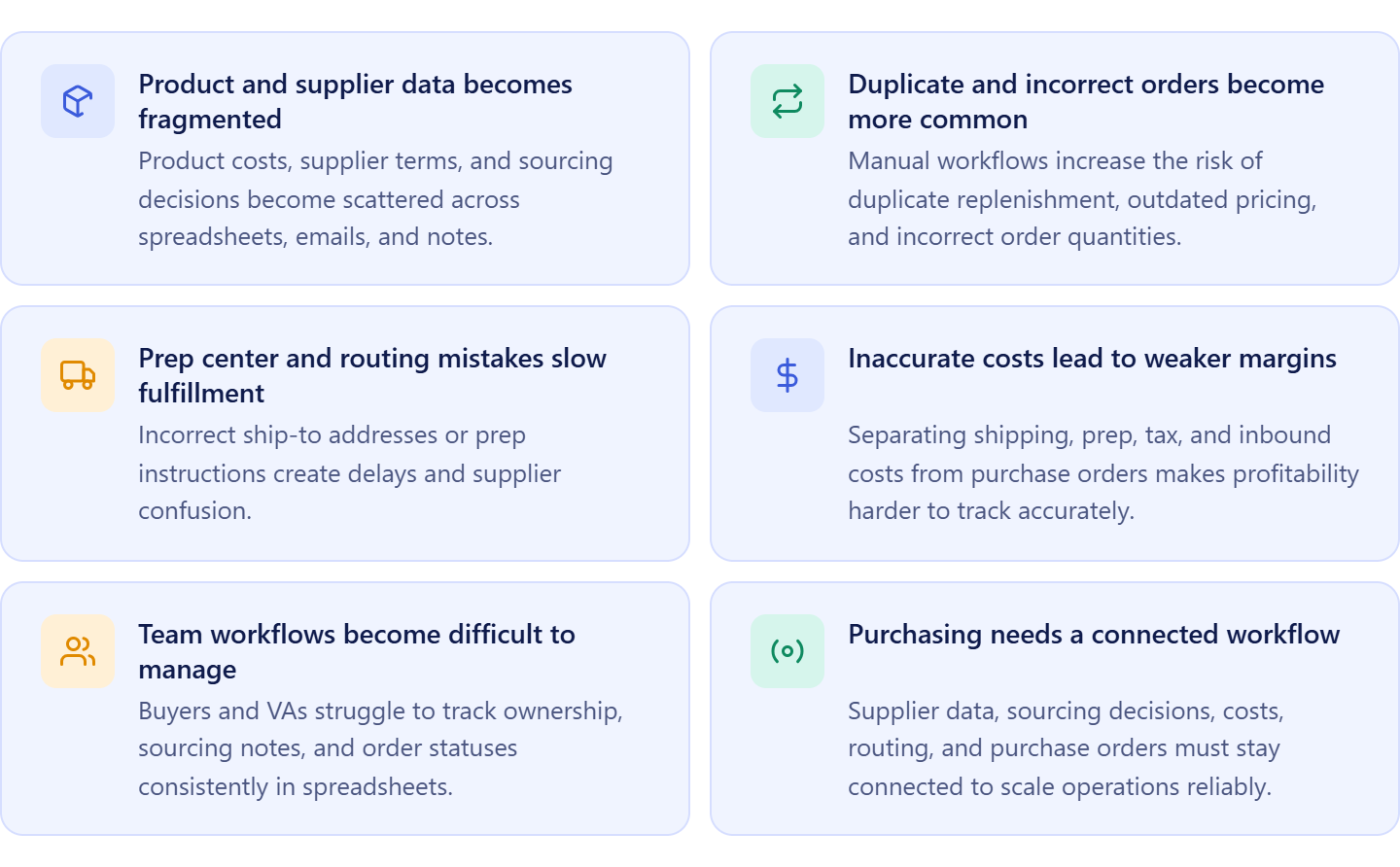
Product and supplier data becomes fragmented
Wholesale purchasing depends on accurate supplier information, product costs, and sourcing decisions. When this data lives across spreadsheets, email threads, and notes, teams waste time rechecking supplier terms, updating costs, and searching for the latest version of product data.
Duplicate and incorrect orders become more common
Manual purchasing workflows increase the risk of ordering the wrong products, duplicating replenishment orders, using outdated pricing, or sending incorrect quantities to suppliers. As order volume grows, these mistakes become harder to catch before inventory is purchased.
Prep center and routing mistakes slow fulfillment
Amazon sellers often work with multiple prep centers, warehouses, and shipping destinations. Without structured routing logic, purchase orders may include outdated ship-to addresses or incorrect prep instructions, creating delays and confusion with suppliers.
Inaccurate costs lead to weaker margins
When shipping, prep, tax, and inbound costs are tracked separately from purchase orders, it becomes difficult to calculate true product profitability. Missing or outdated cost data can turn seemingly profitable purchases into low-margin or unprofitable inventory.
Team workflows become difficult to manage
As businesses scale, multiple buyers, virtual assistants, and sourcing team members often work on the same purchasing process. Spreadsheets make it difficult to track ownership, order status, sourcing notes, and procurement history consistently across the team.
Purchasing needs a connected workflow
As procurement grows more complex, purchase order management needs to function as a structured workflow instead of a collection of disconnected files. Supplier data, sourcing decisions, product costs, warehouse routing, and purchase orders must stay connected so purchasing remains accurate, scalable, and easy to manage.
How Seller Assistant Workflow Supports Purchase Order Management
A typical workflow starts with analyzing supplier catalogs in Price List Analyzer to identify profitable and low-risk products. Approved products and supplier offers are then stored in Product Database, while supplier details, purchasing terms, and routing logic are managed in Suppliers Database and Warehouses Database.
Once products are ready to buy, Purchase Orders Module pulls this data automatically into structured purchase orders with supplier, cost, and ship-to information already filled in.
Benefits of connected purchase order workflows
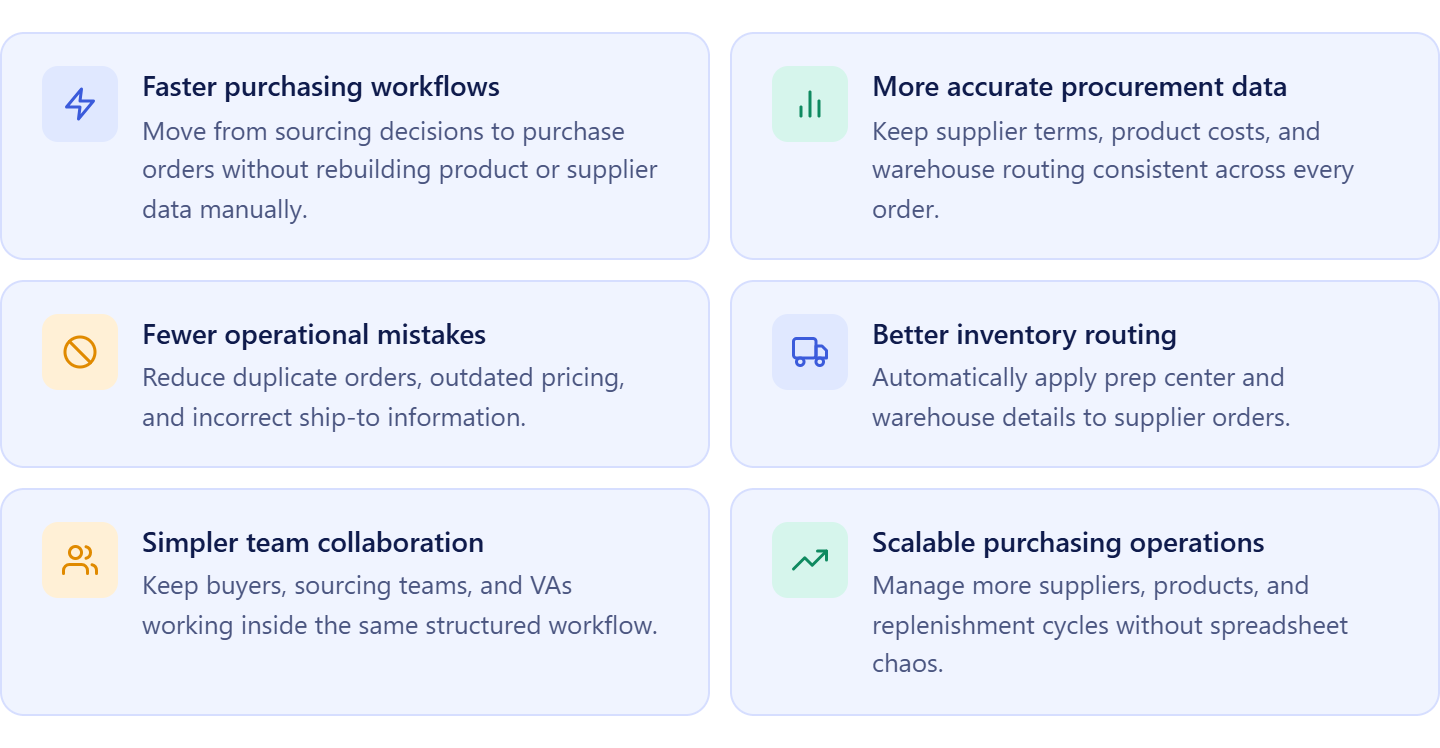
What Seller Assistant tools automate purchase order management
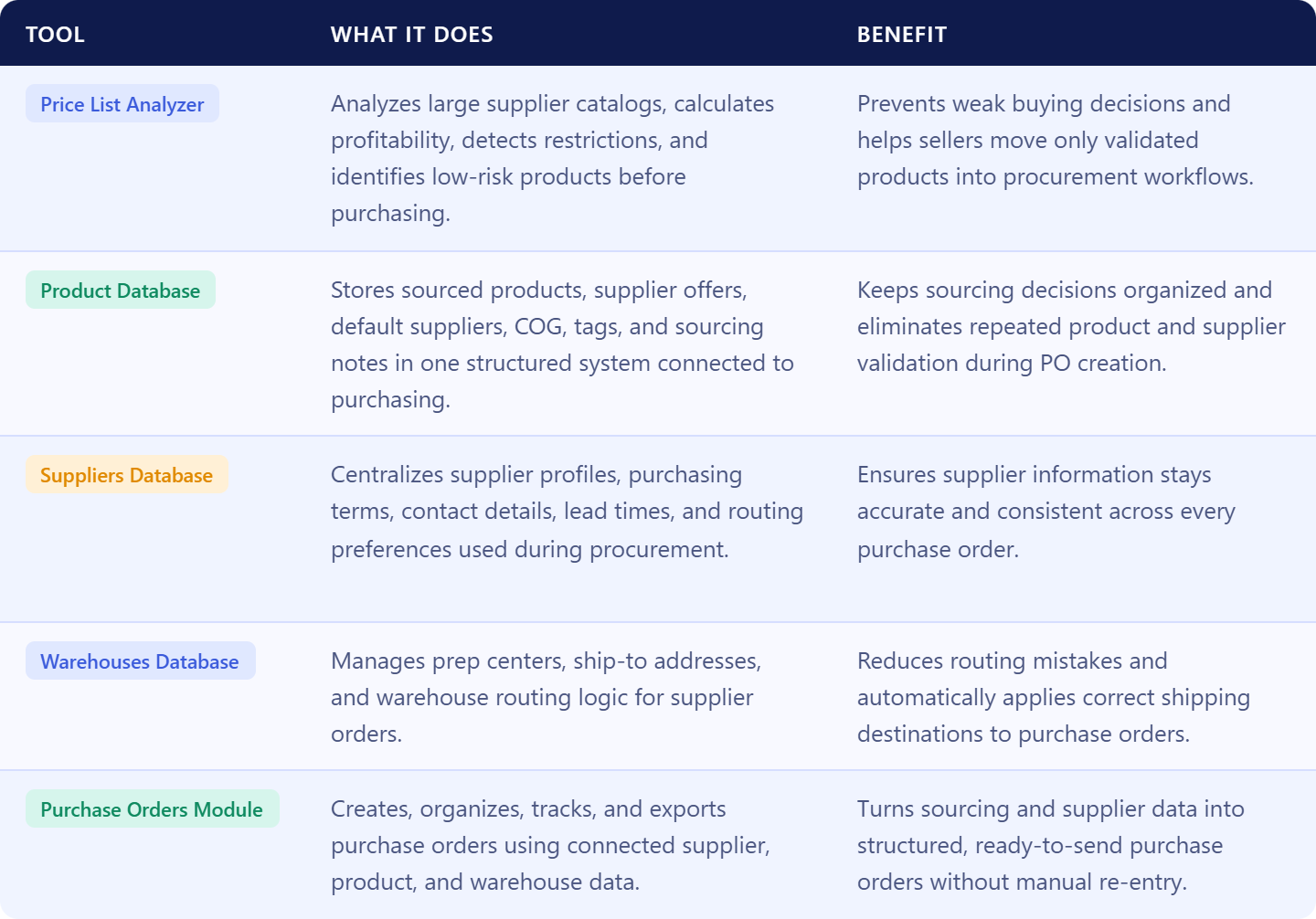
How Seller Assistant Automates Wholesale Purchase Order Management
Managing wholesale purchase orders efficiently starts long before a PO is created. Amazon sellers first need to validate brands, find reliable suppliers, analyze supplier catalogs, organize sourcing data, assign fulfillment routing, and only then move profitable products into procurement.
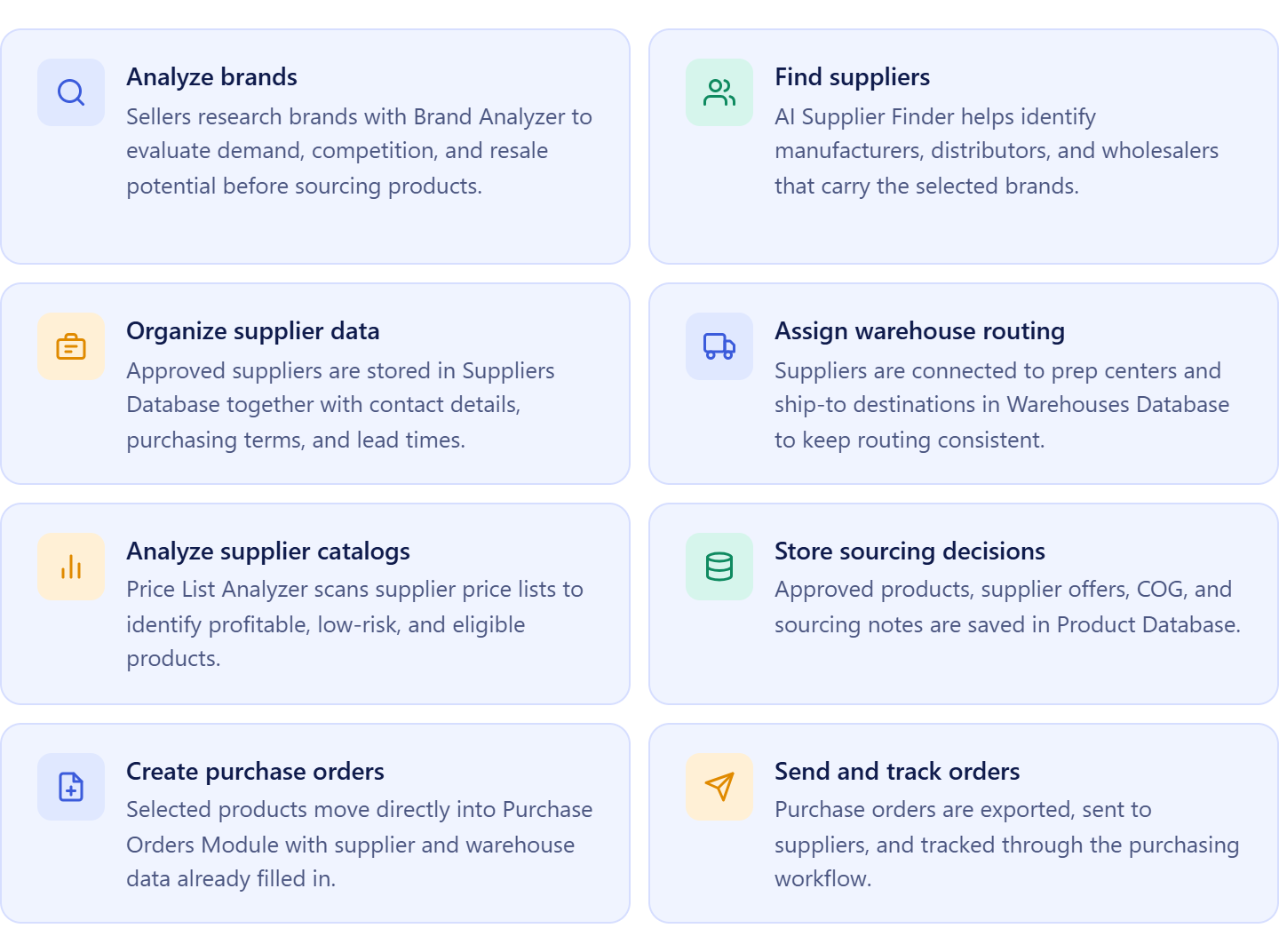
Seller Assistant connects this entire workflow into one structured system. Sellers can start by researching a brand with Brand Analyzer, then use AI Supplier Finder to identify manufacturers, distributors, or wholesalers that carry the products. Once a supplier is approved, their information is stored in Suppliers Database together with purchasing terms and routing details. The supplier is then connected to a prep center or warehouse in Warehouses Database to keep fulfillment routing consistent.
After receiving a supplier catalog, sellers analyze it with Price List Analyzer to identify profitable, low-risk products and filter out restricted, weak, or high-risk ASINs. Approved products and supplier offers are automatically stored in Product Database, where sourcing decisions, COG, and default suppliers stay connected. Finally, selected products move directly into Purchase Orders Module, where supplier, warehouse, and product data automatically populate the purchase order before it is exported and sent to the supplier.
This connected workflow allows Amazon wholesale sellers to move from sourcing to purchasing without rebuilding data manually at every stage.
What Is Suppliers Database?
Suppliers Database is Seller Assistant’s centralized supplier management system designed for Amazon wholesale sellers, online arbitrage sellers, and dropshippers. It keeps all supplier information – contact details, purchasing terms, routing preferences, lead times, and relationship status – organized in one structured workspace connected directly to procurement workflows.
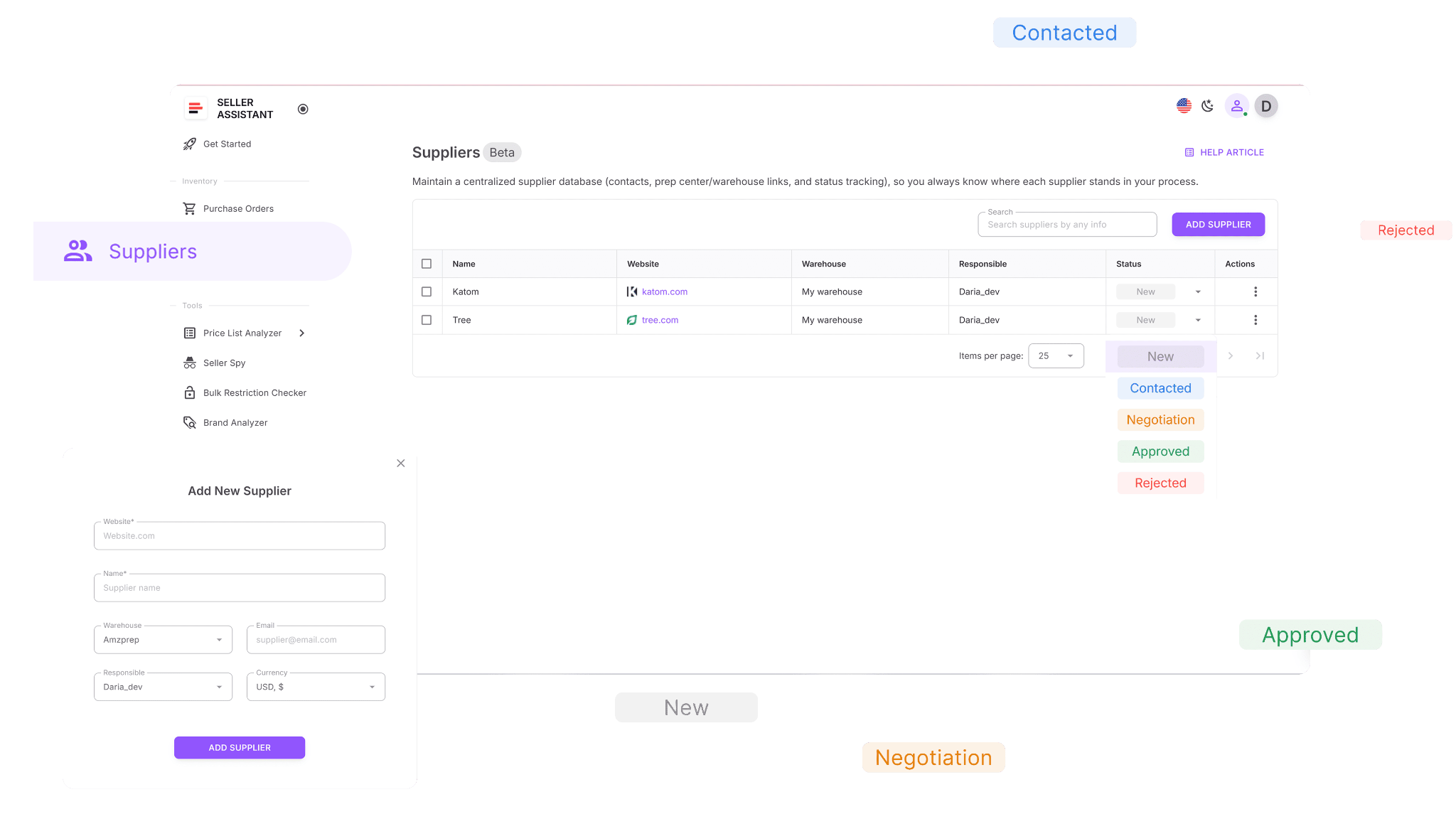
Instead of managing supplier information across spreadsheets, emails, and scattered notes, sellers work with one connected system where supplier records stay accurate, reusable, and easy to access throughout the purchasing process.
What Suppliers Database does
Suppliers Database helps sellers organize supplier relationships and standardize procurement operations by keeping supplier data connected to purchasing workflows.
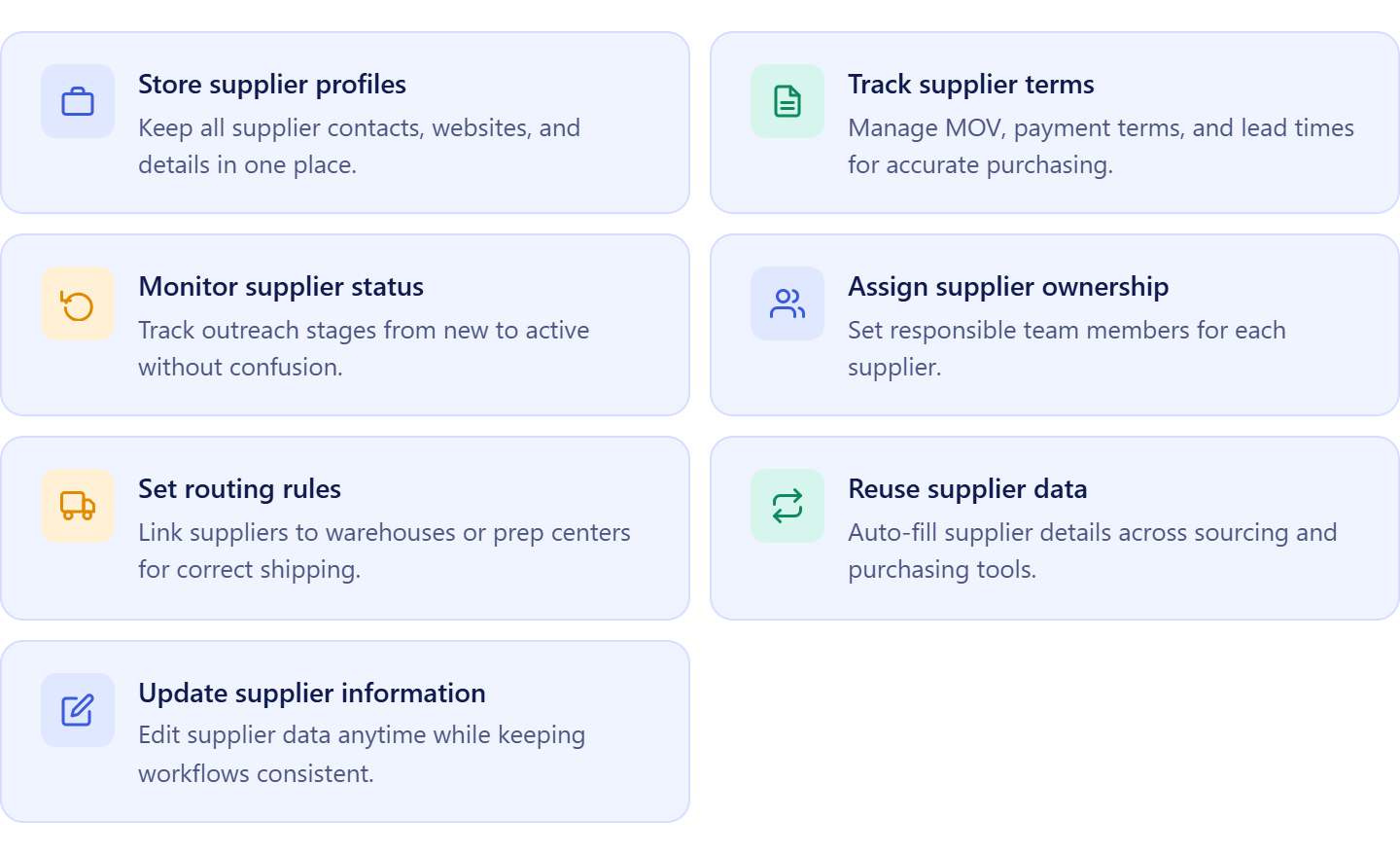
It allows sellers to:
- Store supplier profiles, websites, and contact information in one place;
- Manage purchasing terms such as MOQ, payment terms, lead times, and shipping rules;
- Track supplier relationship stages and outreach progress;
- Assign suppliers to buyers or virtual assistants;
- Connect suppliers to prep centers and warehouse destinations;
- Automatically apply supplier details during purchase order creation;
- Update supplier information without breaking workflow connections.
How Suppliers Database automates PO management
Suppliers Database automates purchase order management by turning supplier records into reusable procurement data. When sellers create a purchase order, supplier information such as contact details, payment terms, lead times, and default warehouse routing is filled automatically instead of being entered manually each time.
This keeps supplier data consistent across all orders, reduces purchasing mistakes, prevents routing errors, and speeds up PO creation. As operations scale, suppliers remain connected to warehouses, products, and purchase orders inside one workflow, making procurement easier to manage and significantly more reliable.
What Is Warehouses Database?
Warehouses Database is Seller Assistant’s centralized warehouse and prep center management system built for Amazon wholesale sellers, online arbitrage sellers, and dropshippers. It stores all ship-to locations, prep centers, and warehouse routing information in one structured workspace connected directly to purchasing workflows.
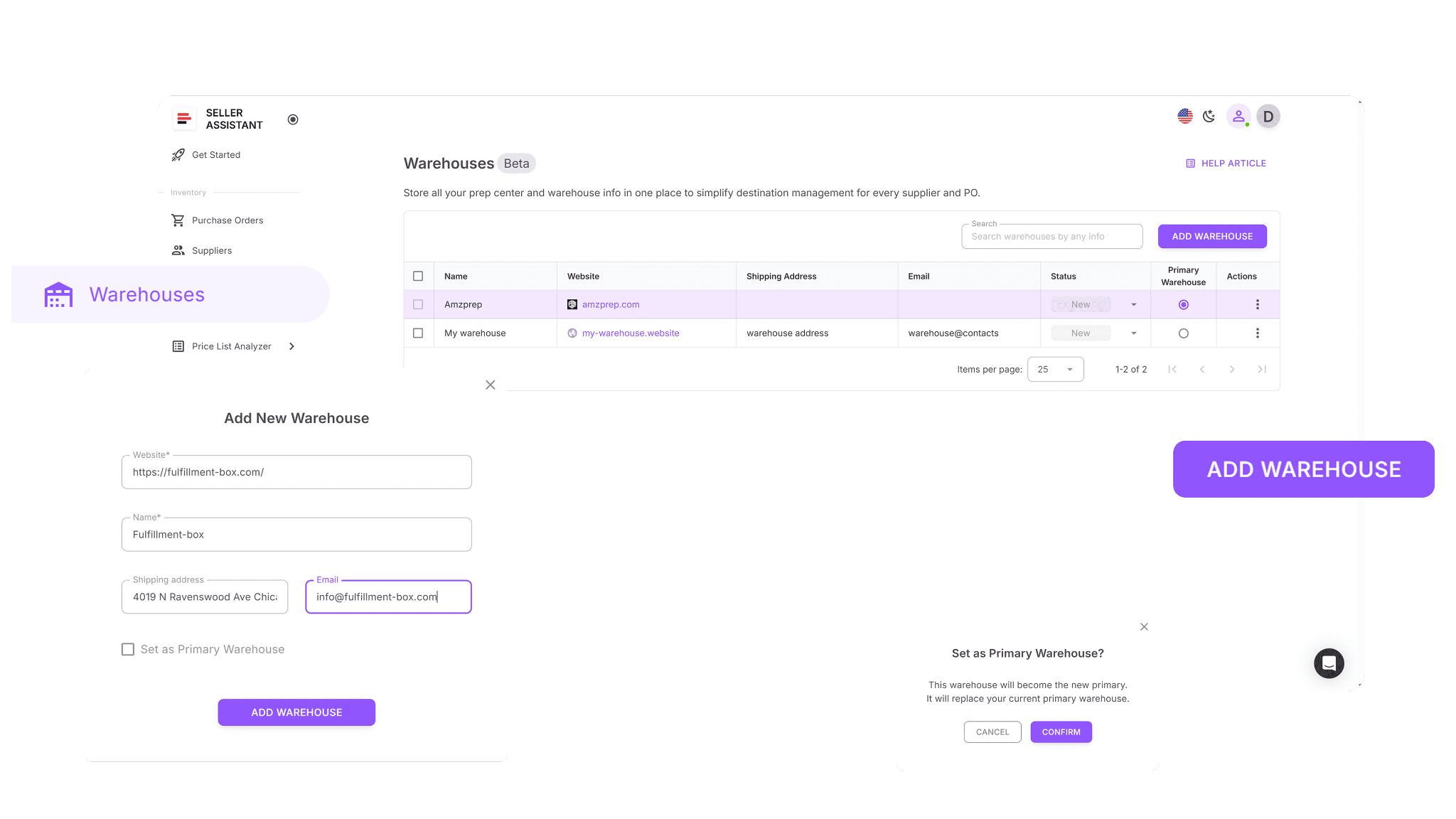
Instead of tracking shipping destinations across spreadsheets, emails, and notes, sellers manage warehouse records in one connected system where routing data stays accurate, reusable, and synchronized across supplier and purchase order workflows.
What Warehouses Database does
Warehouses Database helps sellers organize fulfillment routing and keep shipping destinations consistent across procurement operations.
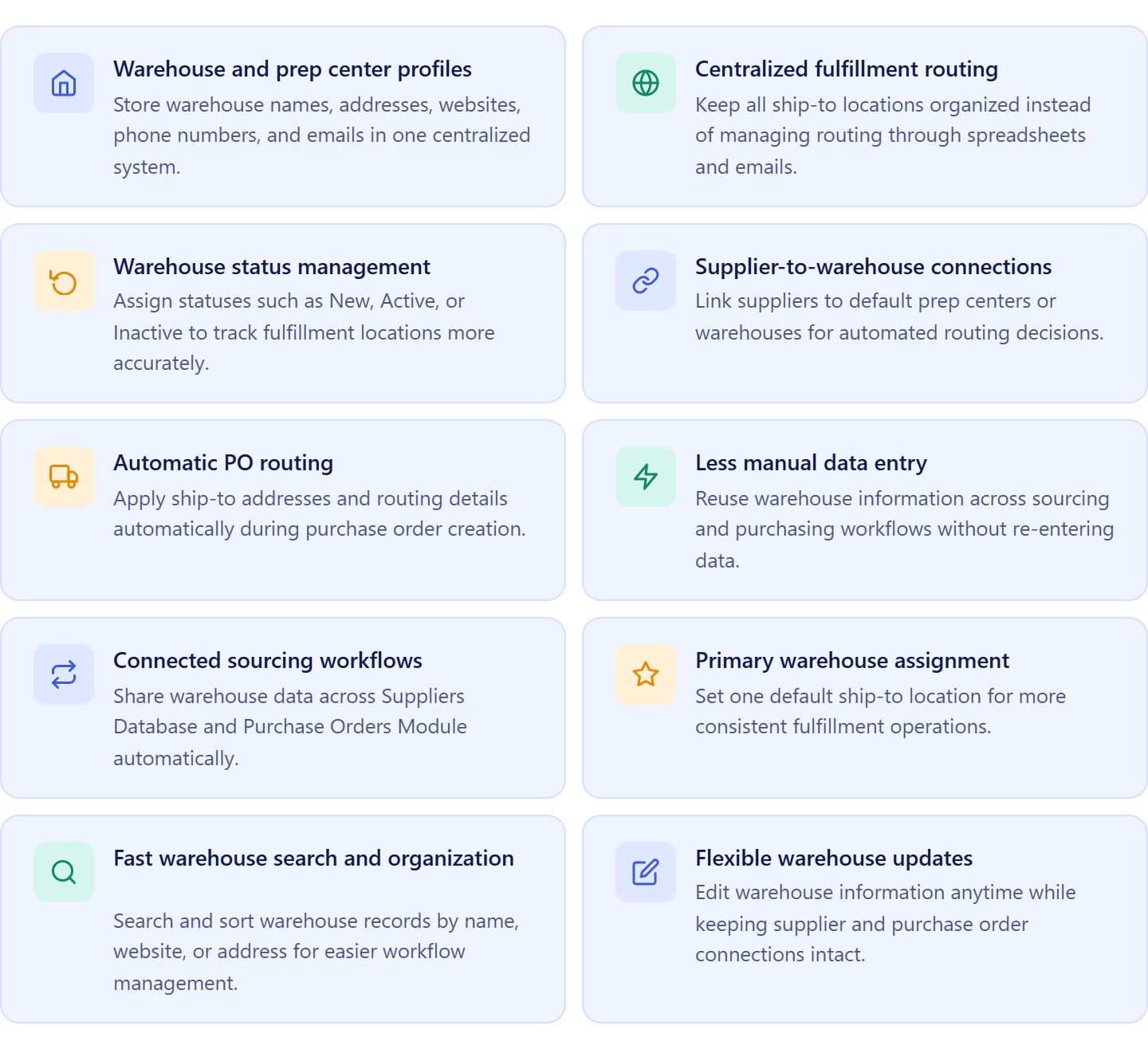
It allows sellers to:
- Create warehouse and prep center profiles with shipping and contact details;
- Manage warehouse statuses and active fulfillment locations;
- Assign default warehouses to suppliers;
- Store and reuse ship-to addresses across purchase orders;
- Set a primary warehouse for default routing;
- Search, organize, and update warehouse records easily;
- Keep routing information connected across sourcing and purchasing workflows.
How Warehouses Database automates PO management
Warehouses Database automates purchase order management by automatically applying warehouse and prep center routing information during PO creation. When sellers create a purchase order, the correct ship-to address and fulfillment destination are filled in using connected warehouse records instead of being entered manually.
This reduces routing mistakes, prevents suppliers from shipping inventory to incorrect locations, and keeps fulfillment workflows consistent across all orders. As operations scale, warehouse routing stays connected to suppliers and purchase orders inside one system, making procurement faster, more accurate, and easier to manage.
What Is Price List Analyzer?
Price List Analyzer is Seller Assistant’s bulk product analysis tool built for Amazon wholesale sellers, online arbitrage sellers, and dropshippers who work with large supplier catalogs. It converts supplier price lists into structured Amazon product data, allowing sellers to evaluate profitability, demand, competition, restrictions, and product risks across hundreds or thousands of products at once.
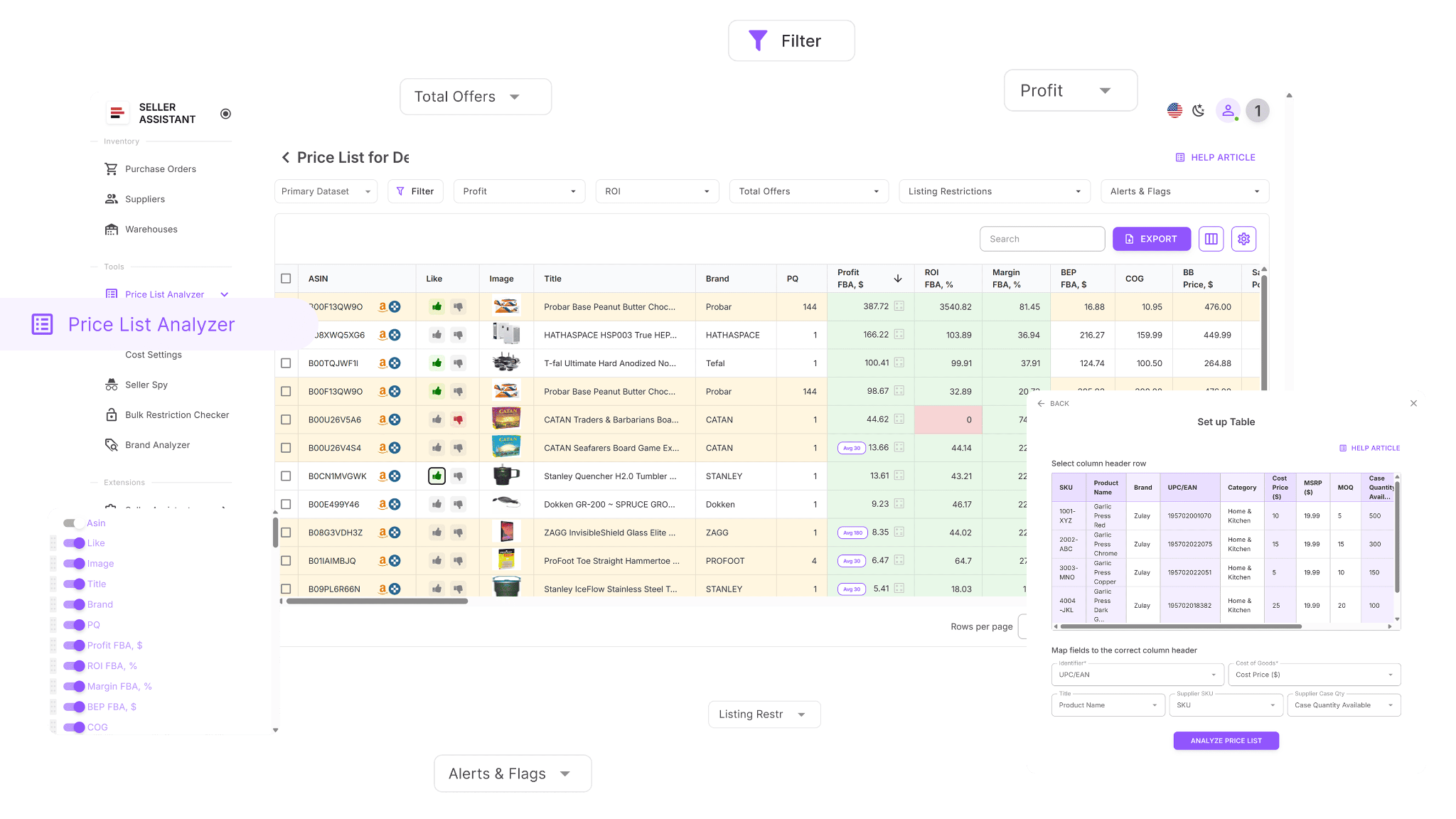
Instead of researching products manually, sellers can upload supplier catalogs directly from Suppliers Database, connect them to the correct supplier automatically, and analyze sourcing opportunities inside one connected workflow.
What Price List Analyzer does
Price List Analyzer helps sellers turn raw supplier catalogs into structured sourcing decisions while keeping supplier and product data connected throughout the procurement workflow.
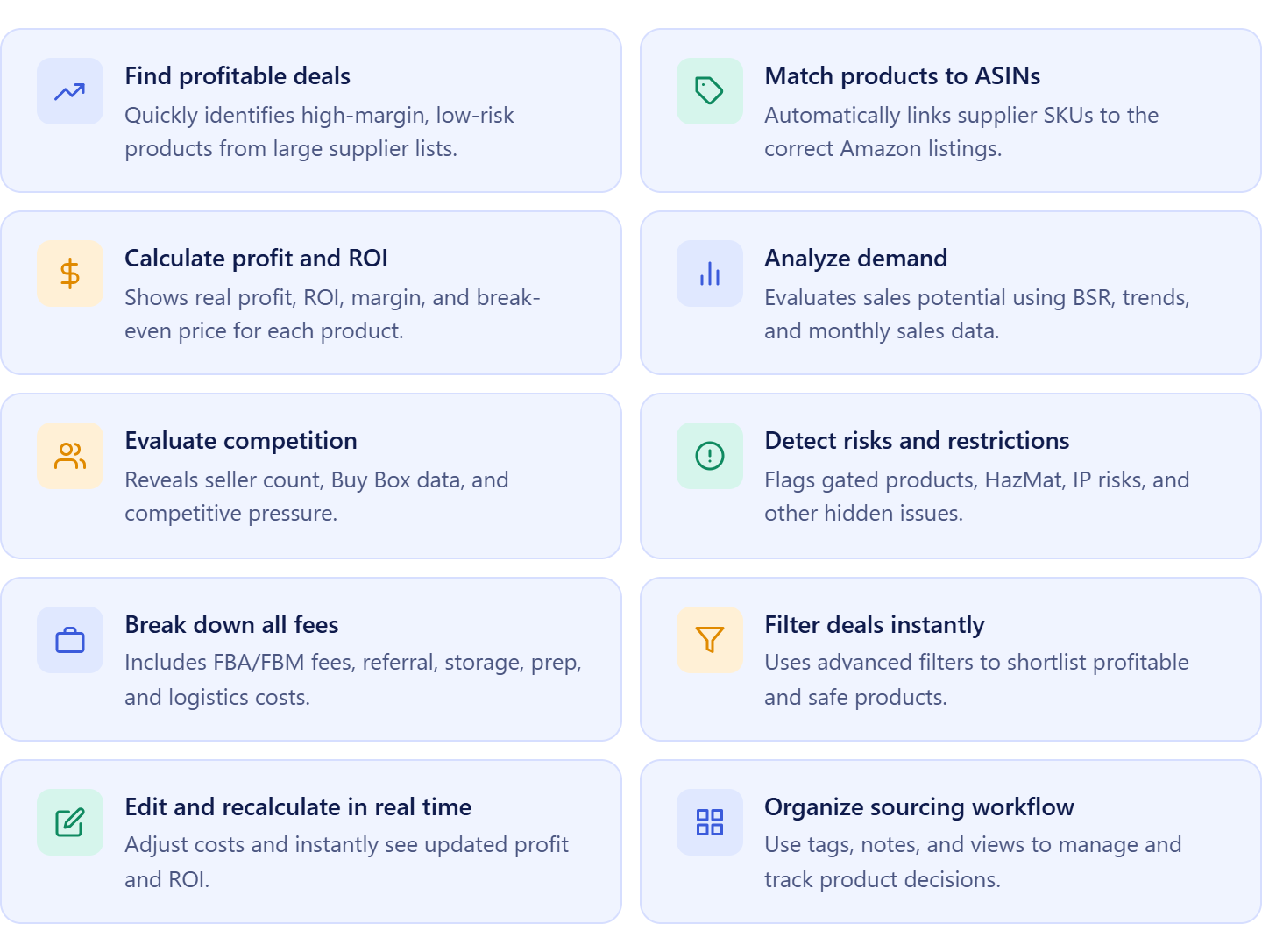
It allows sellers to:
- Analyze large supplier catalogs in bulk;
- Match supplier products to Amazon ASINs automatically;
- Calculate ROI, margin, net profit, and break-even pricing;
- Validate demand using BSR history and sales estimates;
- Review competition, Buy Box conditions, and Amazon presence;
- Detect restrictions, HazMat flags, IP risks, and other sourcing issues;
- Filter profitable and low-risk sourcing opportunities quickly;
- Adjust COG, prep, shipping, and logistics costs dynamically;
- Organize sourcing decisions with notes, tags, and saved views;
- Move approved products directly into Product Database and purchase order workflows.
How Price List Analyzer automates PO management
Price List Analyzer automates purchase order management by validating sourcing decisions before products move into procurement. Instead of manually checking profitability, restrictions, and competition for every ASIN, sellers can analyze entire supplier catalogs in one workflow and identify which products are actually worth purchasing.
Once profitable and low-risk products are approved, supplier offers, COG, and sourcing data can move directly into the Product Database and Purchase Orders Module without being re-entered manually. This helps sellers build purchase orders using verified product data, reduces weak buying decisions, and keeps sourcing and procurement connected inside one workflow.
What Is Product Database?
Product Database is Seller Assistant’s centralized product management system designed for Amazon wholesale sellers, online arbitrage sellers, and dropshippers. It stores sourced products, supplier offers, ASINs, COG, and sourcing decisions in one structured workspace connected directly to purchasing workflows.
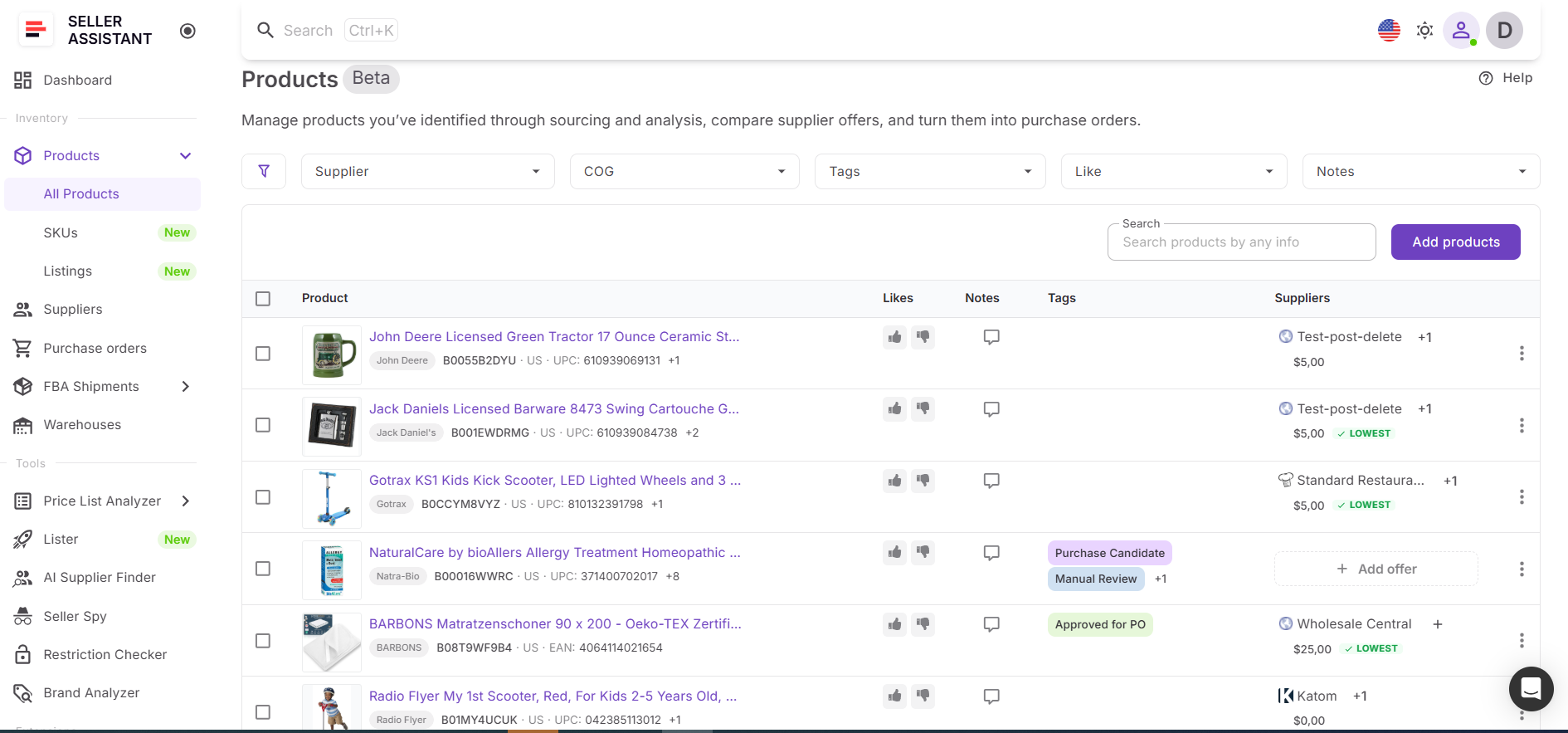
Instead of managing products across spreadsheets and disconnected sourcing tools, sellers work inside one connected system where product data, supplier offers, and sourcing decisions stay organized and reusable throughout procurement operations.
What Product Database does
Product Database helps sellers organize sourcing data and turn validated products into structured purchasing decisions.
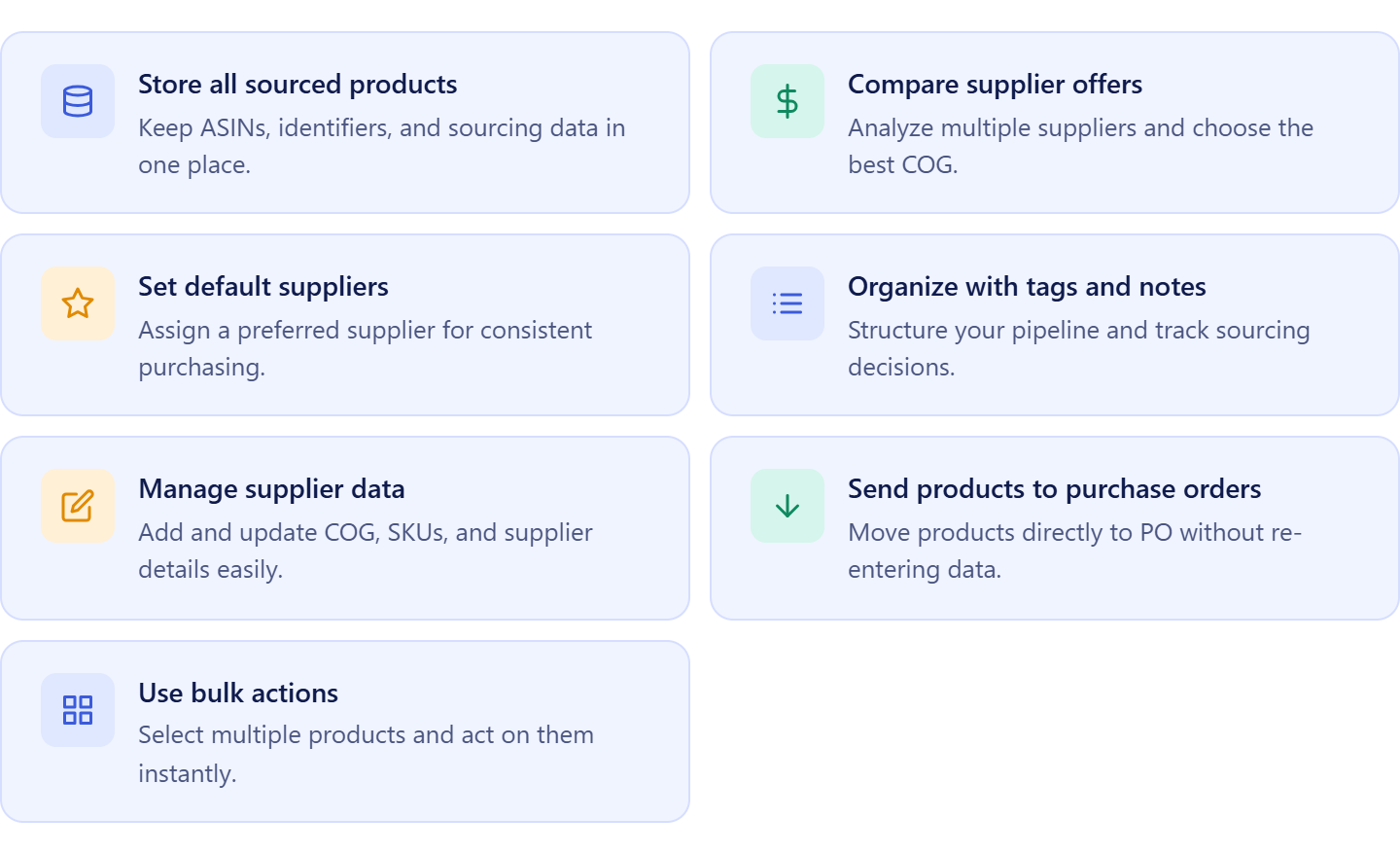
It allows sellers to:
- Store sourced products and ASIN data in one place;
- Compare multiple supplier offers for the same product;
- Manage default suppliers for consistent purchasing;
- Organize sourcing decisions with tags, notes, and likes;
- Add and update supplier offers, COG, and product identifiers;
- Move approved products directly into purchase orders;
- Apply bulk actions across products and sourcing workflows.
How Product Database automates PO management
Product Database automates purchase order management by keeping sourced products, supplier offers, and purchasing decisions connected inside one workflow. Once products are validated and assigned to default suppliers, sellers can move them directly into Purchase Orders Module without manually re-entering ASINs, supplier information, or costs.
This keeps procurement data accurate across every order, reduces duplicate work, prevents supplier and pricing inconsistencies, and speeds up purchase order creation. As operations scale, Product Database acts as a centralized sourcing record that connects product research directly to procurement execution.
What Is Purchase Orders Module?
Purchase Orders Module is Seller Assistant’s centralized procurement management system built for Amazon wholesale sellers, online arbitrage sellers, and dropshippers. It helps sellers create, organize, track, and manage supplier purchase orders inside one connected workflow using synchronized product, supplier, and warehouse data.
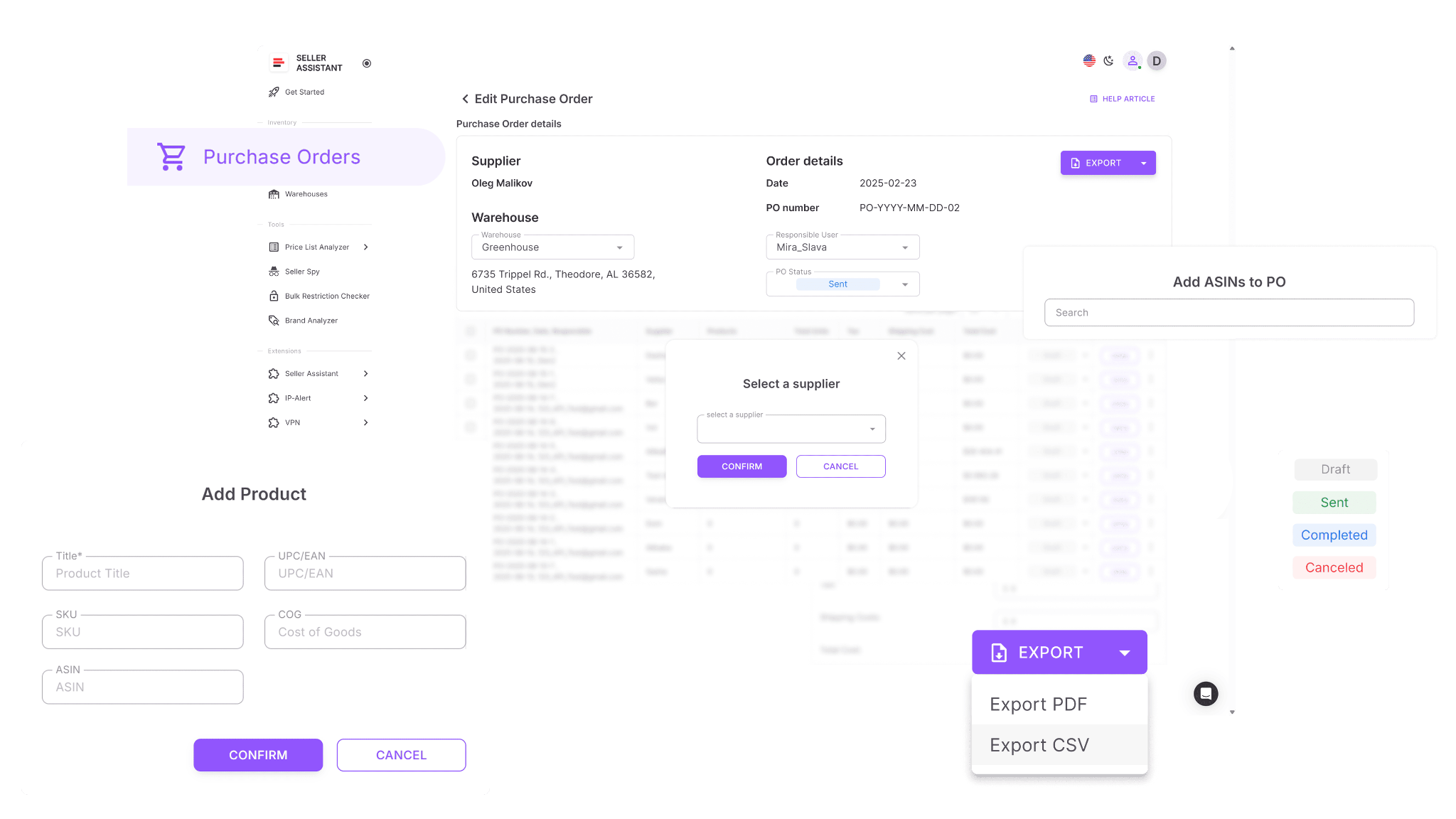
Instead of building purchase orders manually in spreadsheets or disconnected templates, sellers generate structured POs automatically using sourcing, supplier, and routing information already stored inside the workflow.
What Purchase Orders Module does
Purchase Orders Module helps sellers standardize procurement operations and manage supplier purchasing more efficiently.
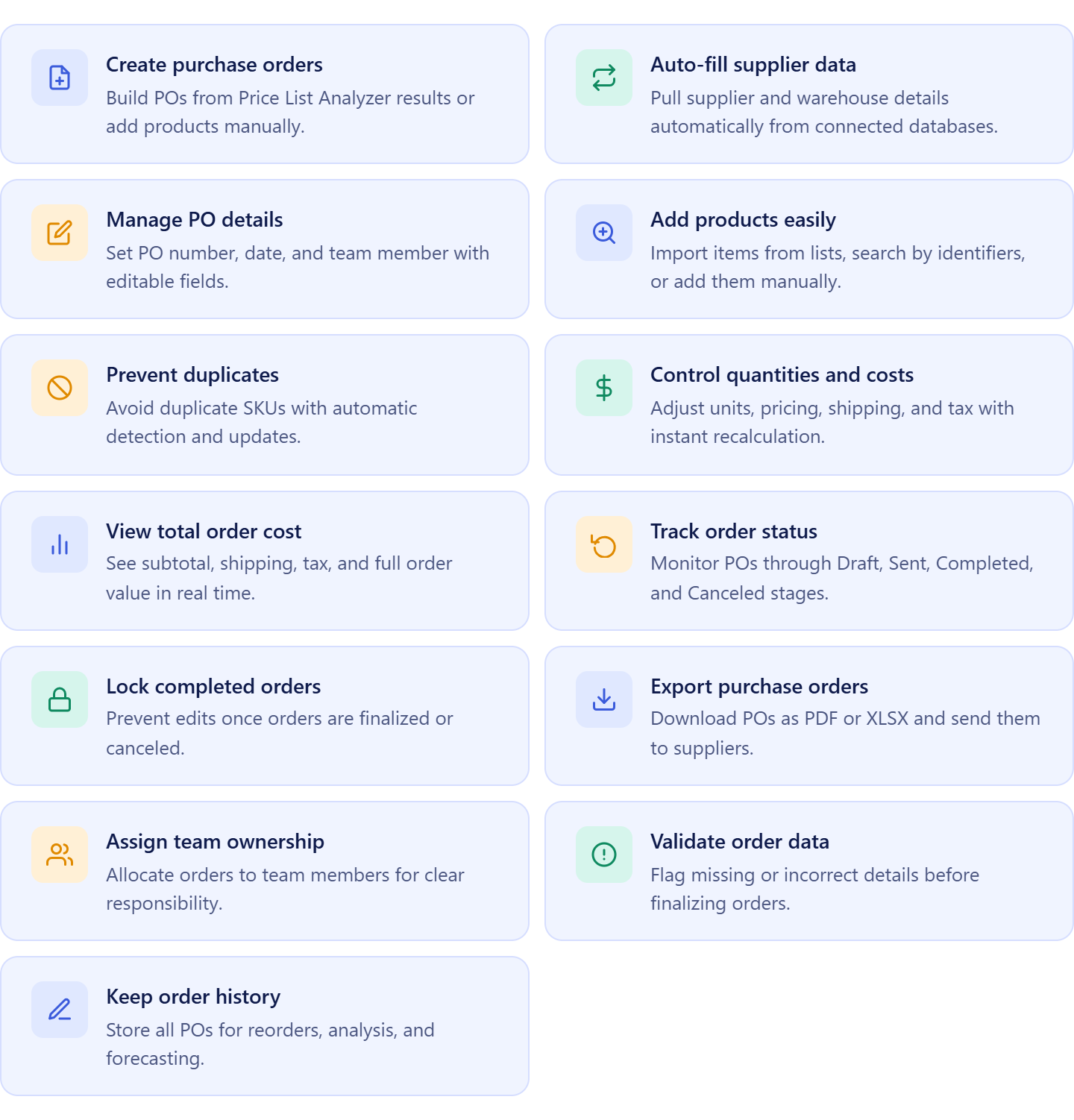
It allows sellers to:
- Create purchase orders from sourced or analyzed products;
- Auto-fill supplier and warehouse routing details;
- Manage PO numbers, ownership, dates, and statuses centrally;
- Add products from Product Database, supplier catalogs, or manual entry;
- Prevent duplicate SKUs inside the same order;
- Adjust quantities, pricing, shipping, taxes, and order costs dynamically;
- Track purchase orders through Draft, Sent, Completed, and Canceled stages;
- Export purchase orders as PDF or XLSX files;
- Assign purchase orders to team members and buyers;
- Detect missing supplier or routing information before finalizing orders;
- Store procurement history for reorders, forecasting, and operational tracking.
How Purchase Orders Module automates PO management
Purchase Orders Module automates PO management by turning connected sourcing, supplier, and warehouse data into ready-to-send supplier orders. Instead of manually rebuilding purchase orders for every procurement cycle, sellers can generate structured POs automatically using validated products, supplier profiles, and assigned fulfillment destinations already stored in the workflow.
This reduces manual entry, prevents duplicate orders and routing mistakes, keeps procurement data consistent across teams, and speeds up purchasing operations significantly. As wholesale businesses scale, Purchase Orders Module helps sellers maintain organized, trackable, and repeatable procurement workflows without relying on spreadsheets or disconnected systems.
Step-by-Step: Create a Wholesale Purchase Order
Creating a wholesale purchase order in Seller Assistant follows a connected workflow where sourcing, supplier management, warehouse routing, and procurement stay synchronized. Instead of rebuilding data manually at every stage, sellers move validated products and supplier information directly into purchasing workflows, reducing errors and speeding up procurement.
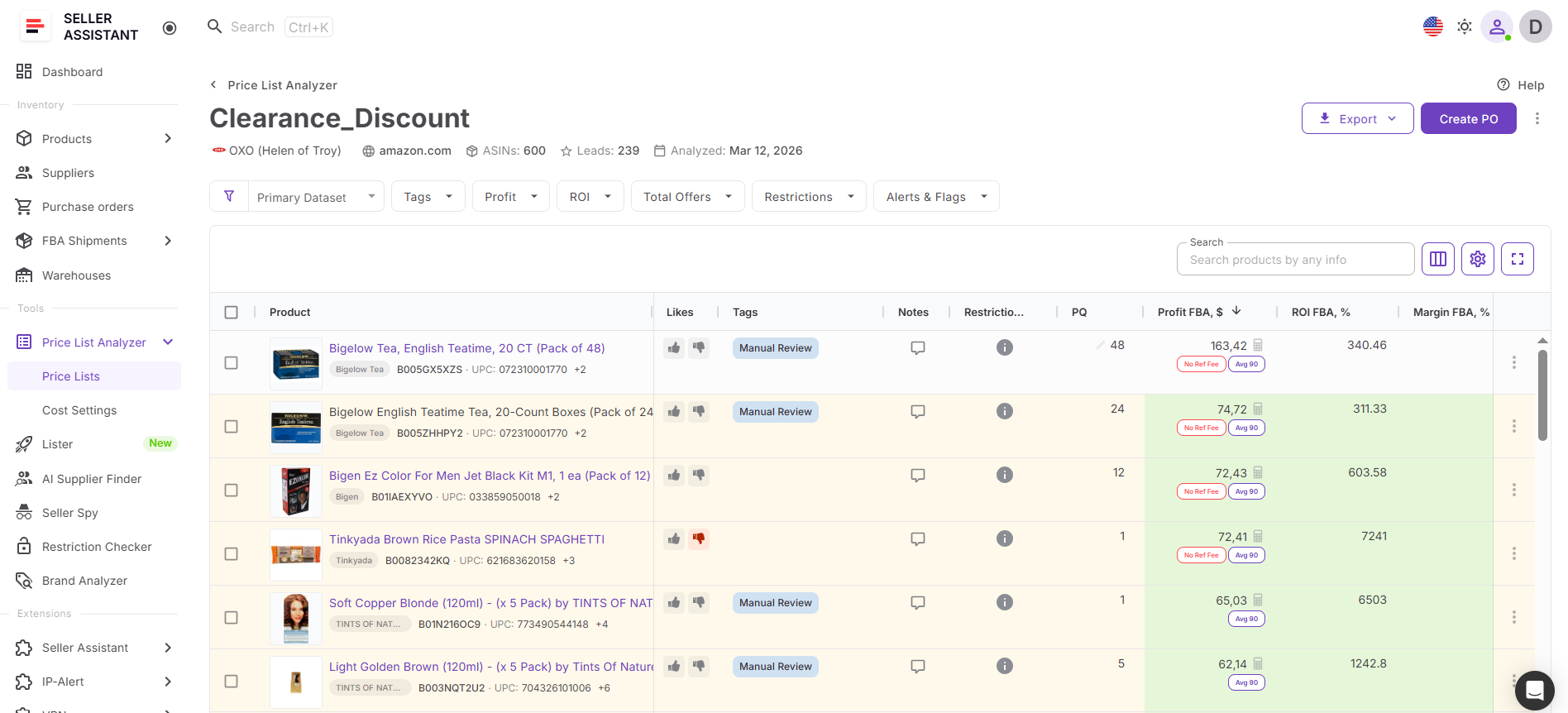
Step 1. Analyze supplier catalogs
Start by uploading supplier price lists into Price List Analyzer. Review profitability, competition, restrictions, and product risks to identify products that are actually worth purchasing.
Step 2. Save approved products
Move profitable and low-risk products into Products (Product Database) together with supplier offers, COG, and sourcing notes. This keeps sourcing decisions organized and reusable during purchasing.
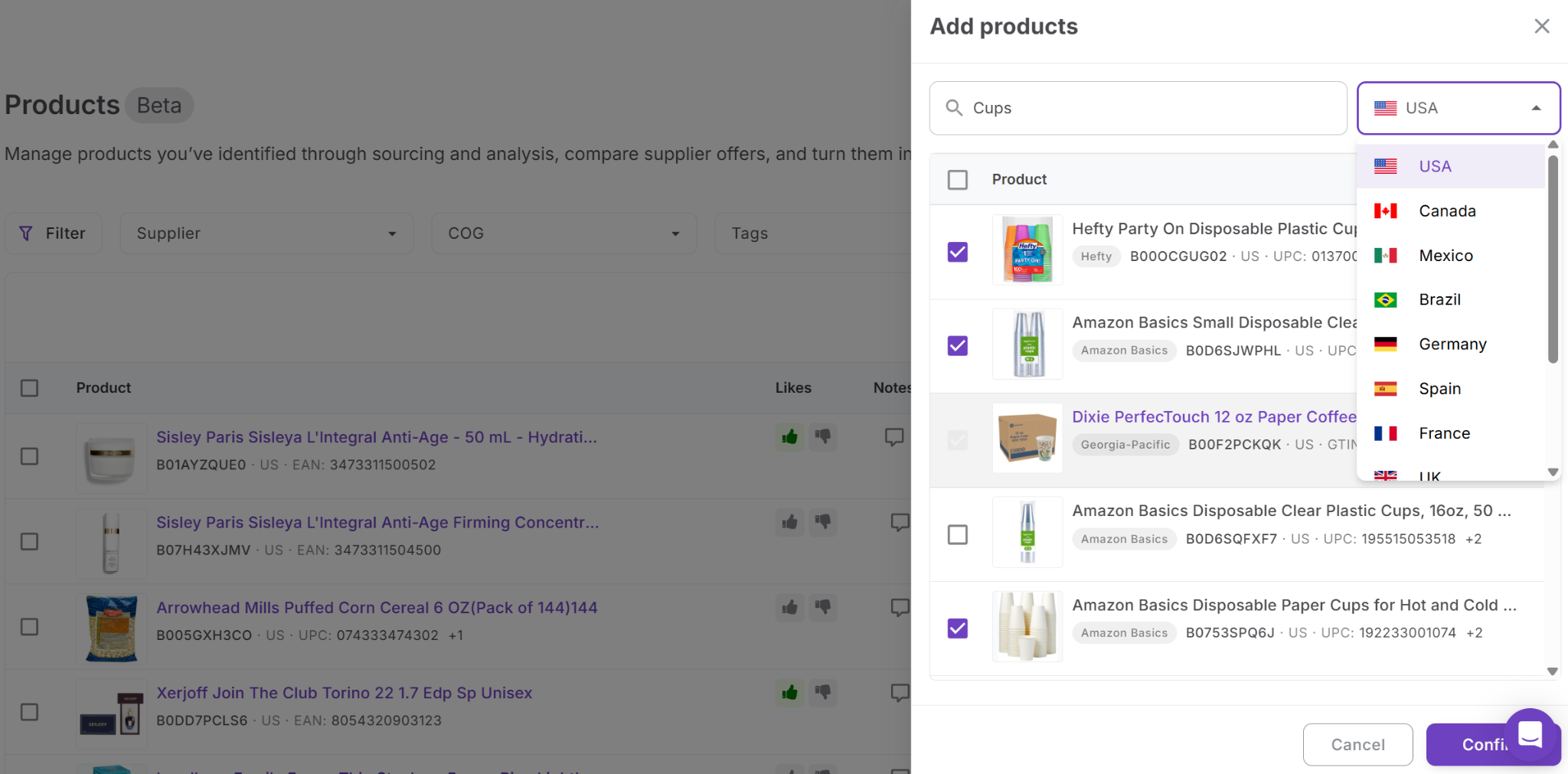
Step 3. Organize supplier information
Store supplier contact details, payment terms, lead times, and procurement notes inside Suppliers Database so purchasing information stays centralized and easy to manage.
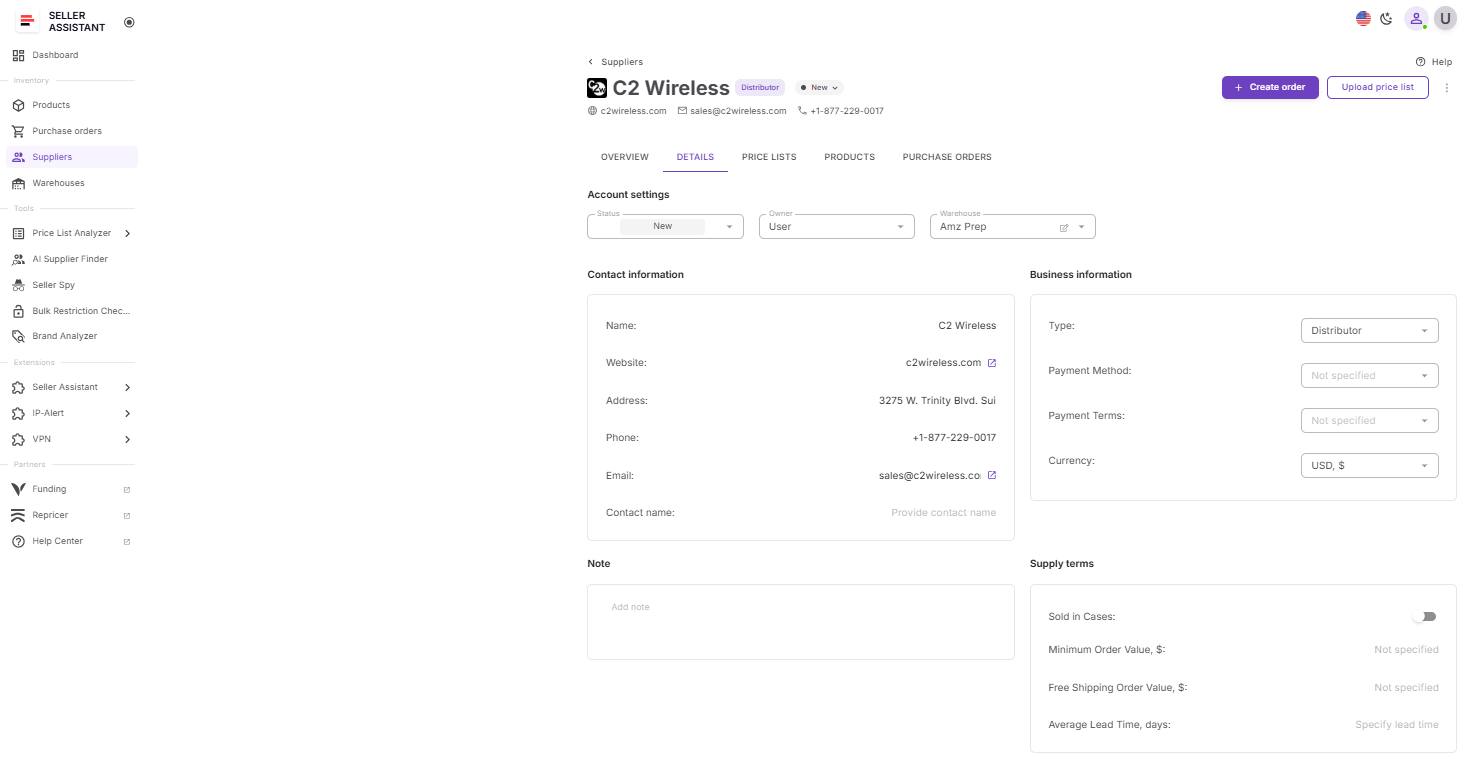
Step 4. Assign warehouse routing
Connect suppliers to prep centers or warehouse destinations in Warehouses Database. This ensures ship-to addresses and routing instructions apply automatically during purchase order creation.
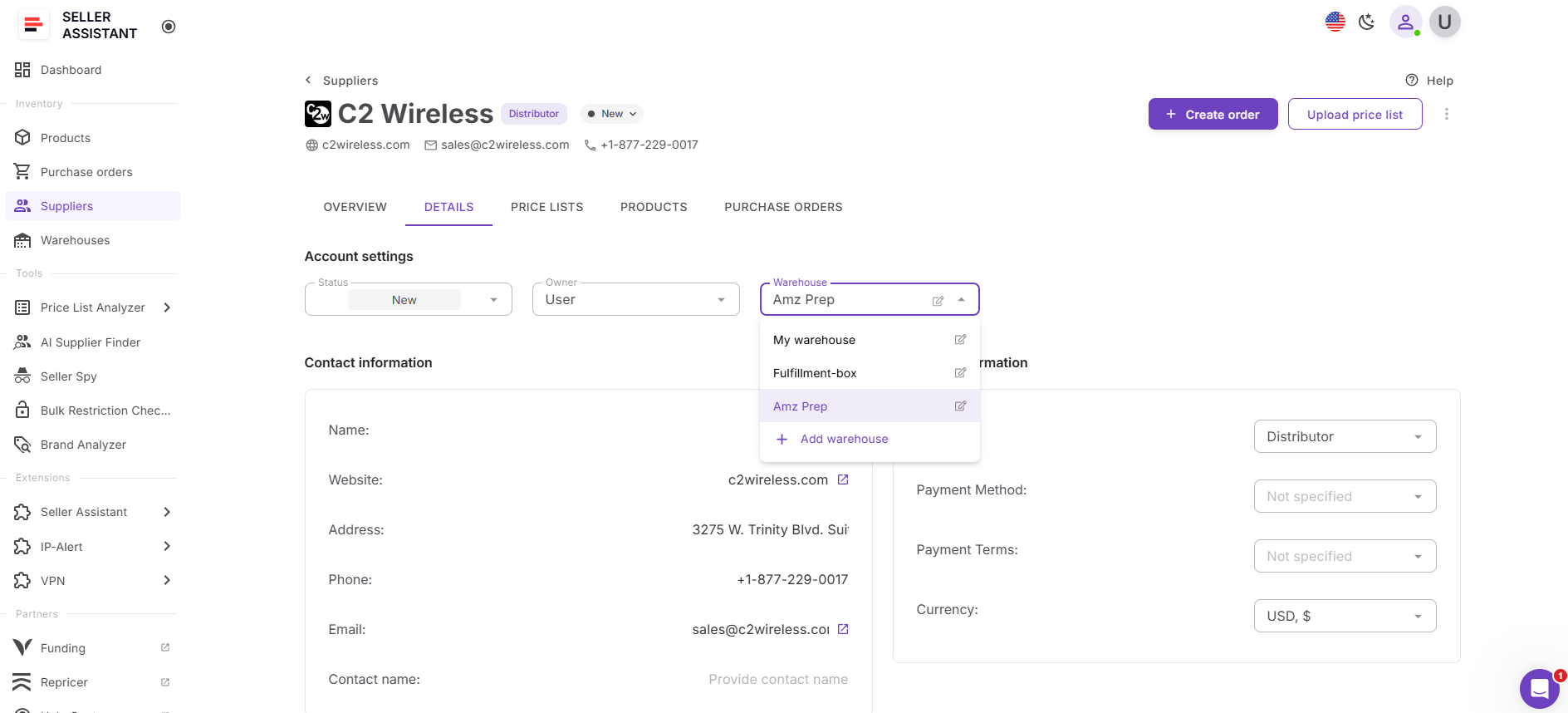
Step 5. Create a purchase order
Open Purchase Orders and generate a new purchase order using connected supplier, product, and warehouse data already stored inside the workflow.
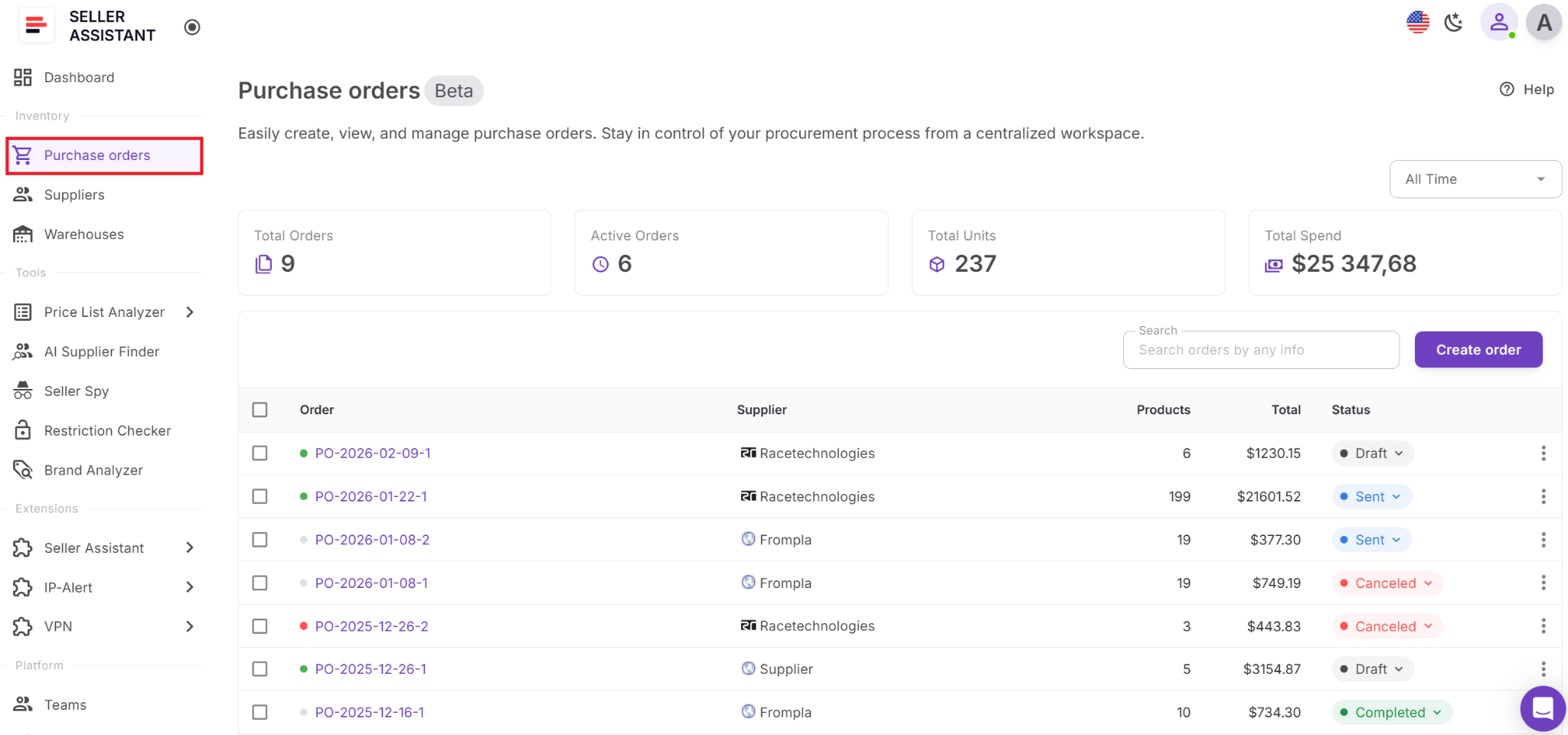
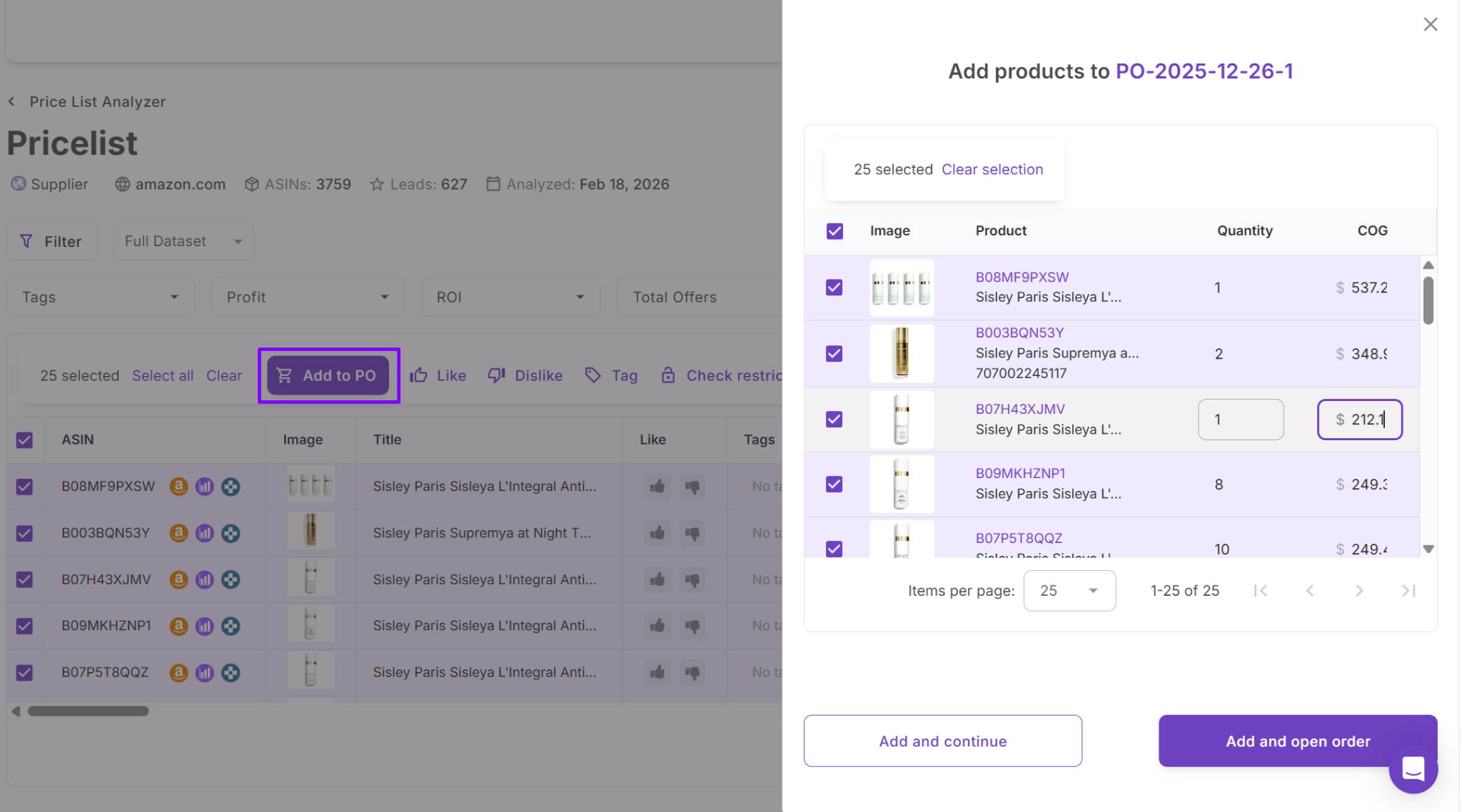
Step 6. Add products to the order
Import products directly from Product Database or sourcing workflows without manually re-entering ASINs, supplier details, or costs.
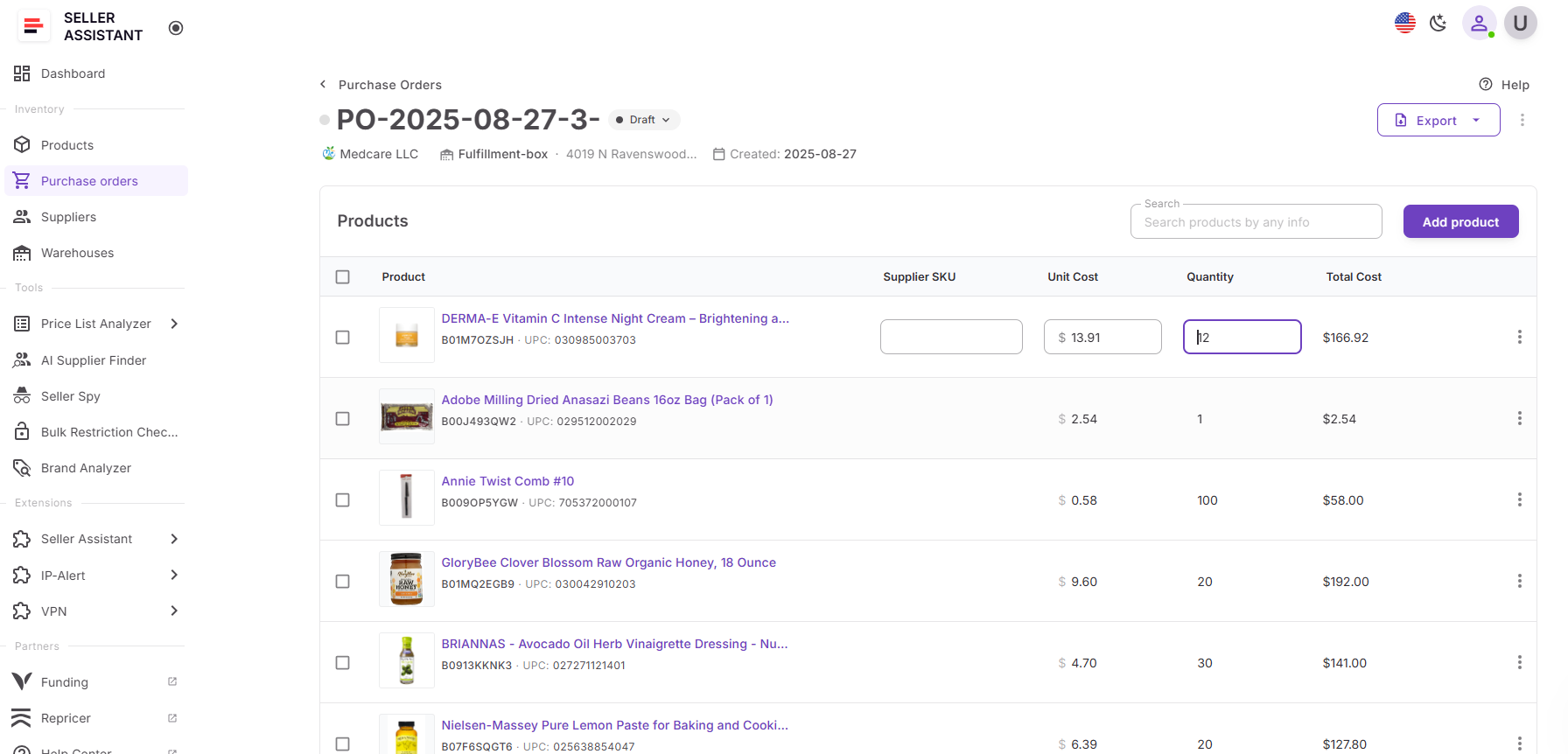
Step 7. Review quantities and costs
Confirm quantities, unit costs, shipping expenses, taxes, and procurement costs while totals recalculate automatically in real time.
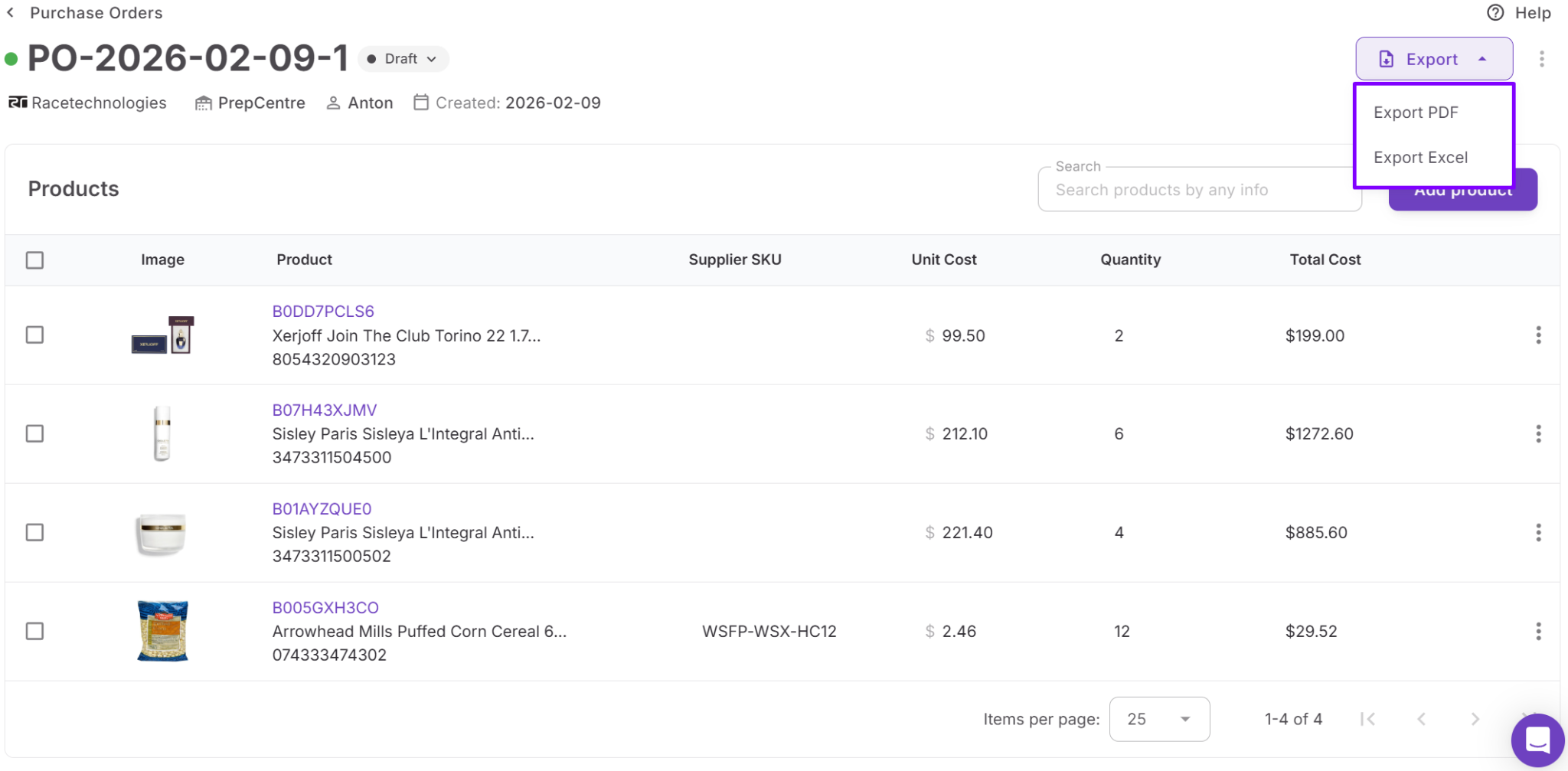
Step 8. Export and send the purchase order
Export the finalized purchase order as a PDF or XLSX file and send it directly to the supplier for fulfillment.
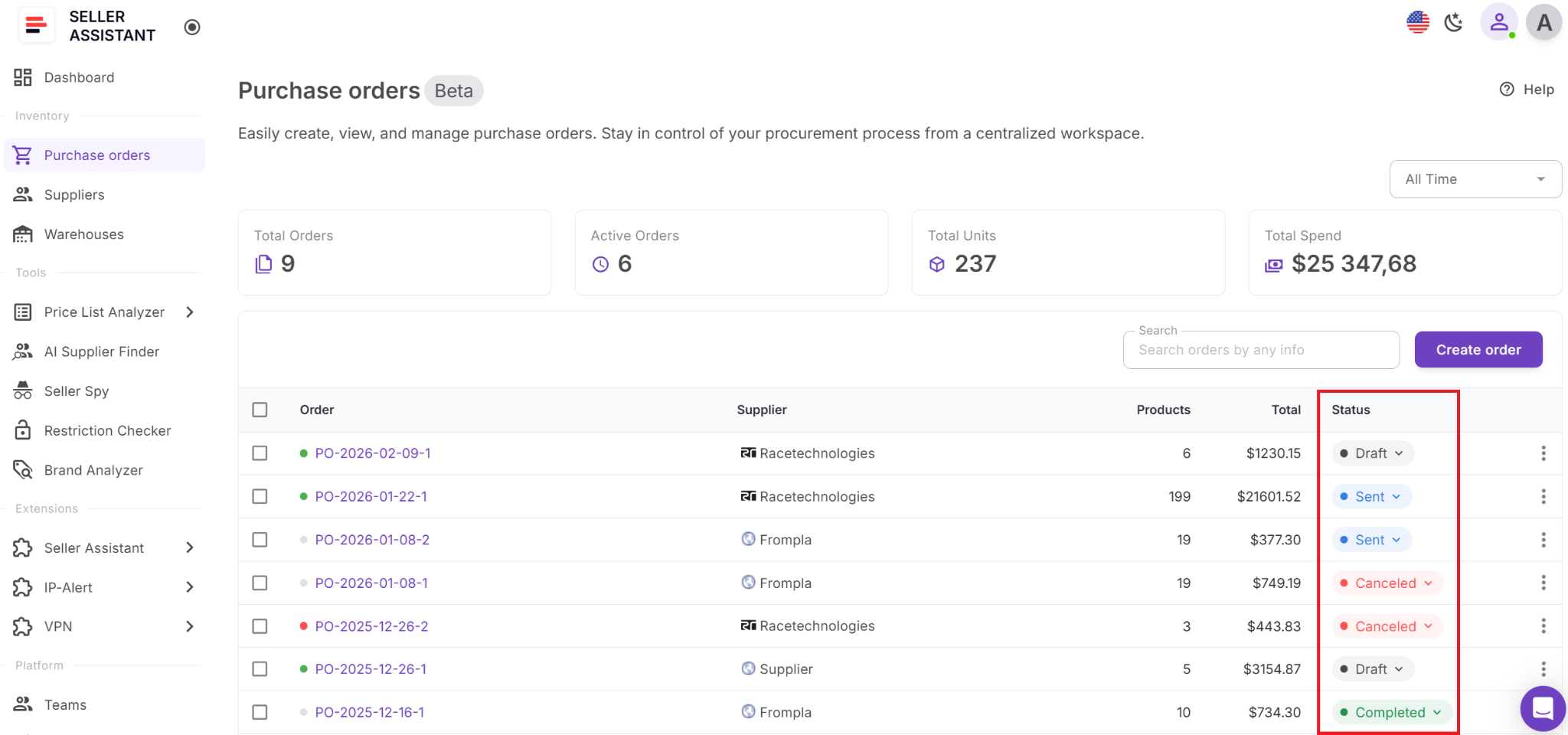
Step 9. Track purchasing progress
Manage orders through procurement stages such as Draft, Sent, Completed, and Canceled while keeping purchasing history organized for future replenishment and forecasting.
FAQ
What is wholesale purchase order management?
Wholesale purchase order management is the process of organizing, tracking, and controlling supplier purchases across sourcing, procurement, and inventory routing workflows. It helps Amazon sellers keep supplier data, product costs, warehouses, and purchasing operations connected and accurate.
Why do Amazon wholesale sellers need purchase order workflows?
As supplier count and order volume grow, spreadsheets and manual tracking create procurement mistakes, duplicate orders, and routing issues. Structured purchase order workflows help sellers scale purchasing operations while keeping sourcing, suppliers, and fulfillment organized.
How does Price List Analyzer help with purchase orders?
Price List Analyzer helps sellers validate supplier catalogs before purchasing inventory by analyzing profitability, restrictions, competition, and product risks in bulk. This ensures only profitable and low-risk products move into purchase order workflows.
How do warehouses and prep centers fit into purchase order management?
Warehouses and prep centers control where supplier shipments are delivered before inventory reaches Amazon FBA. Keeping routing information connected to suppliers and purchase orders reduces shipping mistakes and keeps fulfillment workflows consistent.
How does Seller Assistant automate wholesale purchase orders?
Seller Assistant connects sourcing, supplier management, warehouse routing, and procurement into one workflow where data flows automatically between tools. This reduces manual entry, prevents operational mistakes, and allows Amazon sellers to create structured purchase orders much faster.
Final Thoughts
Managing wholesale purchase orders becomes significantly more difficult as Amazon businesses scale. More suppliers, larger product catalogs, multiple prep centers, and constant replenishment create too many moving parts for spreadsheets and disconnected tools to handle reliably. When sourcing data, supplier terms, routing information, and procurement workflows are separated, mistakes become unavoidable.
Seller Assistant solves this by connecting every stage of wholesale purchasing into one structured workflow. Price List Analyzer helps sellers validate profitable products, Product Database keeps sourcing decisions organized, Suppliers Database centralizes procurement data, Warehouses Database manages routing and fulfillment destinations, and Purchase Orders Module turns all of that information into ready-to-send supplier orders.